Military service
Burial/memorial information
Digital gallery of Second Lieutenant Frederick Carman Pacey
Digital gallery of
Second Lieutenant Frederick Carman Pacey
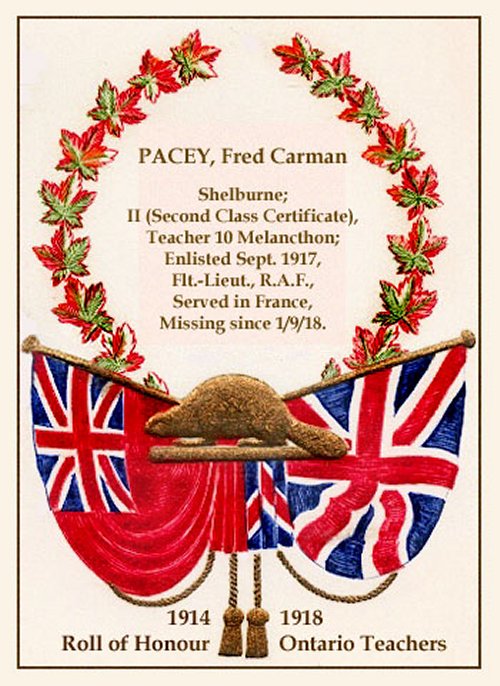
"This Roll of Honour has been prepared as a permanent tribute to those men of the teaching profession in Ontario, who enlisted in connection with the Great War." Source: The Roll of Honour of the Ontario Teachers Who Served in the Great War 1914-1918 (The Ryerson Press: Toronto, 1922). The 1914-1918 Roll of Service for Ontario Teachers contains 851 names. 101 died as a result of their military service. The information on this Honour Roll may differ from other sources as it was compiled by the Department of Education in Toronto, Ontario, from "...varied and numerous sources, that mistakes are inevitable."
Image gallery
-
"This Roll of Honour has been prepared as a permanent tribute to those men of the teaching profession in Ontario, who enlisted in connection with the Great War." Source: The Roll of Honour of the Ontario Teachers Who Served in the Great War 1914-1918 (The Ryerson Press: Toronto, 1922). The 1914-1918 Roll of Service for Ontario Teachers contains 851 names. 101 died as a result of their military service. The information on this Honour Roll may differ from other sources as it was compiled by the Department of Education in Toronto, Ontario, from "...varied and numerous sources, that mistakes are inevitable."
In the Books of Remembrance
Commemorated on:
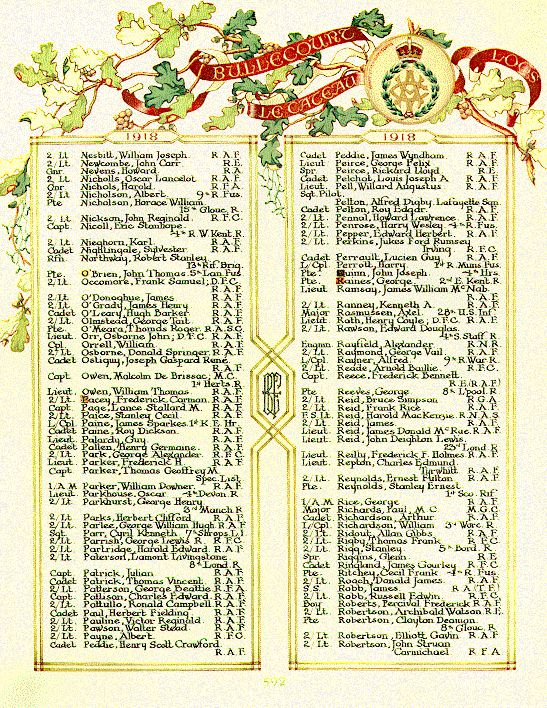
Page 592 of the First World War Book of Remembrance.
Request this page
Download this page
ARRAS MEMORIAL Pas de Calais, France
The ARRAS MEMORIAL is in the Faubourg-d'Amiens Cemetery, which is in the Boulevard du General de Gaulle in the western part of the town of Arras, near the Citadel and approximately 2 kilometres due west of the railway station.
The ARRAS MEMORIAL commemorates over 35,000 casualties of the British, New Zealand and South African Forces who died between Spring 1916 and 7 August 1918, excluding casualties of the Battle of Cambrai in 1917, and who have no known grave.
The design, by Sir Edward Lutyens, consists of a cloister built upon Doric columns and faces west. In the broader part of the site the colonnade returns to form a recessed and open court, terminated by an apse in front of which is the memorial to the Flying Services.
The names of the casualties are carved on stone panels which are fixed to the Flying Services Memorial or to the cloister walls. The British Air Services originated in the use of balloons for purposes of reconnaissance. The balloon gave way to power-driven air machines and in 1911 an Air Battalion of the Royal Engineers was formed. In 1912 the Air Battalion was absorbed into the Royal Flying Corps which consisted of a Naval Wing and a Military Wing and a Central Flying School. These two wings developed during the course of the war, both sections expanding greatly until they combined and the Royal Air Force came into being on the 1 April 1918.
The Flying Services Memorial commemorates over 1,000 men of the Royal Naval Air Service, the Royal Flying Corps and the Royal Air Force, who have no known grave.
For more information, visit Commonwealth War Graves Commission.
The Poppy Design is a trademark of The Royal Canadian Legion (Dominion Command) and is used with permission. Click here to learn more about the poppy.
Did we miss something?
Contribute information to this commemorative page
Do you have photographs, information or a correction relating to this individual’s virtual memorial? Learn more about the CVWM and the information we collect.