
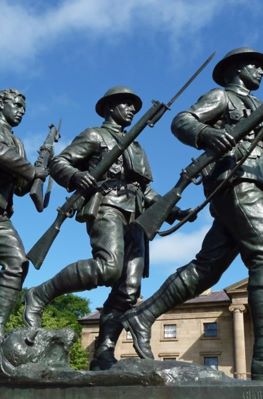
Community cenotaphs across Canada
Age group: 13 - 18
Lesson duration: 90 Minutes
Lesson plans in this series can be used individually or in sequence to create a unit. Optional unit connections have been provided. We recommend using the lessons in the following order:
Aim
Students research a cenotaph from a Canadian province or territory using images and short texts to document features, names, dates, symbols, and materials. They compile notes on a worksheet, share a brief presentation, and compare how different communities commemorate service and sacrifice.
Objectives
Through this activity, students will:
- learn about the history of community cenotaphs in Canada;
- explore the importance of the symbolism and design of a cenotaph to a community;
- compare elements of cenotaphs in communities across the country; and
- understand the importance of Canadian cenotaphs to communities in the past, present and future.
Classroom materials
You will need these supplies, files or resources to complete this lesson:
- PowerPoint slideshow: Community cenotaphs across Canada (19 slides in total)
- Student Worksheet – Describing a community cenotaph
- Computer access for researching
- Optional: Screen, whiteboard or flipchart for class brainstorming
Introduction
Optional: Unit connection
Last time: We explored how national remembrance is expressed at the National War Memorial through design, symbolism and ceremony.
Today: We explore cenotaphs in towns and cities across Canada to see how communities remember their own service members and continue the traditions of remembrance close to home.
What is the history of cenotaphs in Canada?
Hold a discussion with your students exploring the concept of local commemoration. Start by providing background information to your students. Here are some points you may wish to cover:
- Before 1970, the bodies of those who died in Canadian military service outside of Canada were not returned (repatriated) here for burial. Instead, it was decided that they would usually be buried near to where they died.
- This meant that most families and friends had no place to visit loved ones who had died. Canadians needed to find a way to mark the deaths of those they loved in a location nearer to their community.
- Following the First and Second World Wars and the Korean War, communities across Canada — families, schools, churches, employers and local governments — began to build memorials to honour the fallen.
- Memorials were created in churches, schools, cemeteries, parks and town squares across the country. These memorials became the local “resting place” for lost sons, husbands, fathers, brothers, uncles, mothers, wives, daughters, sisters, friends and neighbours.
- There are more than 10,000 registered war memorials and monuments in Canada dedicated to Canadians who died in service outside of Canada. Not all of them are cenotaphs. This is also not a complete count of all memorials, it just represents those recorded in the Memorials in Canada website.
- Explain that today we are going to talk about cenotaphs. A cenotaph is a special type of memorial. It is meant to represent an "empty tomb" to honour people buried elsewhere, usually lost at sea or in distant wars or conflicts.
Activity
Community cenotaphs across Canada introduction
Share the Community cenotaphs PowerPoint with your students. Share the first 5 slides of the PowerPoint and discuss as a group. These slides explore:
- What a cenotaph is
- Cenotaph statues
- Names and dates
- Symbols
- Cenotaphs as public gathering places
Community cenotaphs across Canada group research
Next, explain that they will be assigned to research a cenotaph from one of Canada’s 13 provinces and territories. To document their research and learning, students will use the handout Describing a community cenotaph.
Teacher tip: This activity can be completed individually, in pairs or in small groups. You may wish to review the slides about each cenotaph as a class to help students choose. Each slide has a photo, interesting facts about the cenotaph, and references for finding additional information. Access to computers will be required to complete the activity.
Cenotaphs in the presentation include:
- Japanese Canadian War Memorial (British Columbia)
- Red Deer Cenotaph (Alberta)
- Regina Cenotaph (Saskatchewan)
- Winnipeg Cenotaph (Manitoba)
- Barrie Cenotaph (Ontario)
- Montreal Cenotaph (Quebec)
- Dieppe Cenotaph (New Brunswick)
- Soldiers’ Monument (Prince Edward Island)
- Lest We Forget Cenotaph (Nova Scotia)
- Hodge’s Cove Cenotaph (Newfoundland and Labrador)
- Whitehorse Cenotaph (Yukon)
- Yellowknife Cenotaph (Northwest Territories)
- Iqaluit Veterans Memorial (Nunavut)
For deeper learning
To make the activity more challenging, encourage students to do their own research by assigning a cenotaph without supporting sources.
Students can also choose a different cenotaph to research from the Memorials in Canada website. Your goal is to ensure representation of all Canadian provinces and territories.
Wrap-up
Students should share their findings about the cenotaph they researched with the whole class. If possible, hang pictures of the memorials in the classroom or have students collaborate to create a digital map of Canada with a photo of their memorial over the city or town where it is located.
When presentations are complete, lead a class discussion. You may wish to explore some of the following questions:
- How were the cenotaphs we researched similar and different from one another? (i.e., common design elements, symbols, locations or materials, differences between older and newer cenotaphs, etc.)
- Why are war cenotaphs historically significant?
- What purpose do they serve in a community? (i.e., places to commemorate sacrifices, reflect societal/community values, preserve collective memory of conflicts, etc.)
- Do they have a role as an educational tool for students today and for future generations?
- How do they help communities mark important historical events or create a sense of community or common memory?
- What have we learned about historical decision-making?
- Who made decisions about the creation of local cenotaphs?
- How did communities come up with the funding to build these cenotaphs?
- How and why might the design of a post-First World War cenotaph be different if it was built today?
Extension activities
The Cenotaph Project
The Cenotaph Project invites students to research the personal stories behind names on a local cenotaph. Using a step-by-step guide and archival records, students explore individuals’ lives and service. This deepens understanding of community sacrifice and encourages reflection on meaningful ways to honour them on Remembrance Day.
Tell your cenotaph’s story
Help expand our crowd-sourced Memorials in Canada database. Your class can research a community cenotaph or memorial. Submit a short description about its history and meaning along with photographs and the memorial’s location by emailing education@veterans.gc.ca. This activity is open to schools and youth groups only. Every memorial tells a story—including yours!
(Re) Design your local cenotaph
Challenge students to imagine how their local cenotaph might look if it were designed today. Ask them to create a simple sketch or short written proposal that modernizes the existing memorial or presents an entirely new design to help people connect with remembrance. Encourage consideration of what stories are told, who is represented or missing—including more recent conflicts—and which symbols or materials resonate today. Students should also think about accessibility and inclusivity. The focus is a clear reflection of what is remembered, who is honoured, and how communities keep memories alive.
You may wish to have them read A memorial tells a story at the beginning of the activity as an example of changes that were made to a memorial to make it more inclusive.