
Mountain Memorial Community Park is dedicated to the memory of the citizens of Mountain and Mountain Township who died in the First World War. It was unveiled on November 12, 1925, by the Town of Mountain.
Hill 70 Memorial is located in the park.
Sign in to My VAC Account
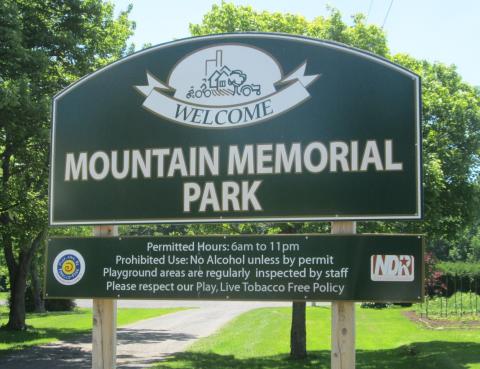
Sign in to My VAC Account[park sign/enseigne du parc]
WELCOME
MOUNTAIN MEMORIAL
PARK
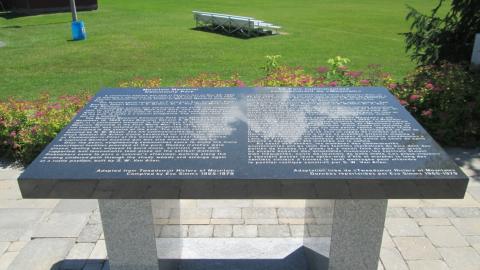
[dedication tablet/plaque commémorative]
Mountain Memorial
Community Park
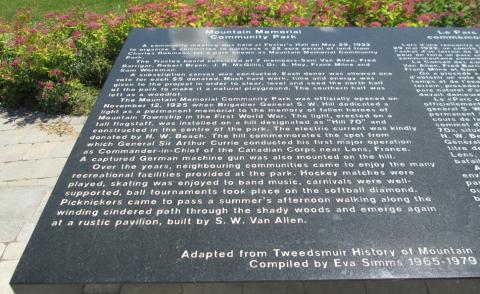
A community meeting was held at Foster’s Hall on May 29, 1922 to organize a committee to purchase a 22 acre parcel of land from Charles Robinson for a park known as Mountain Memorial Community Park.
The Trustee Board consisted of 7 members – Sam Van Allen, Fred Barrigan, Robert Bryan, J.R. McGillis, Dr. A. Hoy, Frank Milne and Sam Workman.
A subscription canvas was conducted. Each donor was allowed one vote for each $5 donated. Much hard work, time and energy was given to the project in order to clear, level and see the north half of the park to make it a natural playground. The southern half was left as a woodlot.
The Mountain Memorial Community Park was officially opened on 12 November 1925 when Brigadier General S.W. Hill dedicated a light as a permanent memorial to the memory of fallen heroes of Mountain Township in the First World War. The light, erected on a tall flagstaff, was installed on a hill designated “Hill 70” and constructed in the centre of the park. The electric current was kindly donated by N.W. Beach. The hill commemorates the spot from which General Sir Arthur Currie conducted his first major operation as Commander-in-Chief of the Canadian Corps near Lens, France. A captured German machine gun was also mounted on the hill.
Over the years, neighbouring communities came to enjoy the many recreational facilities provided at the park. Hockey matches were played, skating was enjoyed to band music, carnivals were well-supported, ball tournaments took place on the soft ball diamond. Picknickers came to pass a summer’s afternoon walking along the winding cindered path through the shady woods and emerge again at a rustic pavilion built by S.W. Van Allen.
-Adapted from Tweedsmuir History of Mountain
Comiled by Eva Simms 1965 – 1979.
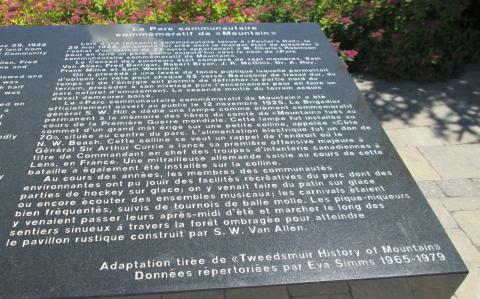
Le parc communautaire
commémoratif de « Mountain »
Lors d’une rencontre communautaire tenue à «Foster’s Hall» le 29 mai 1922, un comité fut crée dont le mandat était de procéder à l’achat d’un terrain de 22 acres appartenant à M. Charles Robinson pour en faire un parc connu aujourd’hui sous le nom de « Parc communautaire commémoratif de Mountain »
Le conseil des curateurs était composé de sept membres, sam Van Allen, Fred Barrigan, Robert Bryan, J.R. McGillis, Dr. A. Hoy, Frank Milne et Sam Workman.
On a procédé à une levée de fonds publique laquelle permettait d’obtenir un vote pour chaque 5$ versé. Beaucoup de travail dur, du temps et de l’énergie ont permis de défricher la partie nord du terrain, procéder à son nivelage puis l’ensemencer pour en faire un parc naturel d’amusement. La seconde moitié du terrain acquis devait demeurer boisé.
Le « Parc communautaire commémoratif de Mountain » a été officiellement ouvert au public le 12 novembre 1925. Le Brigadier général S.W. Hill a dédié une lampe comme élément commémoratif permanent à la mémoire des héros du comté de «Mountain» tués au cours de la Première Guerre mondiale. Cette lampe fut installée au sommet d’un grand mât érigé sur une petite colline appelée «Côte 70» située au centre de parc. L’alimentation électrique fut un don de N.W. Beach. Cette colline se veut un rappel de l’endroit où le Général Sir Arthur Currie a lancé sa première offensive majeure à titre de Commandant en chef des troupes d’infanterie canadiennes à Lens, en France. Une mitrailleuse allemande saisie au cours de cette bataille a également été installée sur la colline.
Au cours des années. Les membres des communautés environnantes ont pu jouir des facilités récréatives du parc dont des parties de hockey sur glace; on y venait faire du patin sur glace ou encore écouter des ensembles musicaux; les carnavals étaient bien fréquentés, suivis de tournois de balle molle. Les pique-niquers y venaient passer leurs après-midi d’été et marcher le long des sentiers sinueux à travers la forêt ombragée pour atteindre le pavillon rustique construit par S.W. Van Allen.
- Adaptation tirée de « Tweedsmuir History of Mountain »
Données répertoriées par Eva Simms 1965-1979
Mountain Memorial Community Park is dedicated to the memory of the citizens of Mountain and Mountain Township who died in the First World War. It was unveiled on November 12, 1925, by the Town of Mountain.
Hill 70 Memorial is located in the park.
[stone at entrance/dalle en pierre à l'entrée du parc]
CORNWALL BRANCH 297
LEGION MEMORIAL PARK
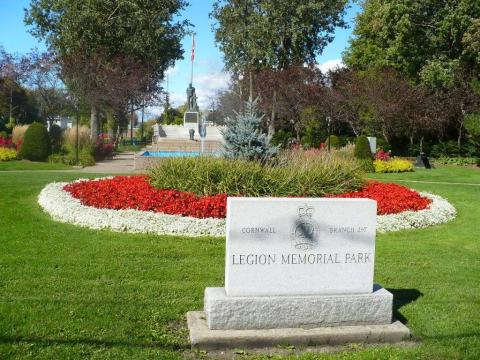
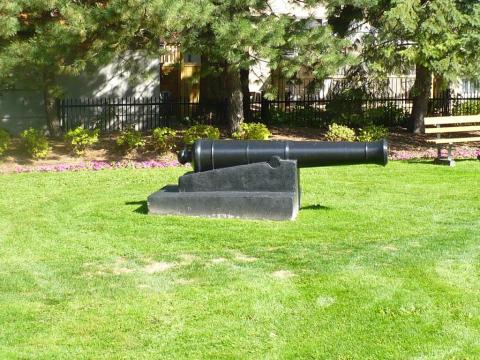
Legion Memorial Park was named in 1923 by the City of Cornwall, dedicated in sacred memory to those who gave their lives in service to their country.
The Cornwall Cenotaph in Legion Memorial Park was erected in 1923. A fountain adorns the grounds in front of the memorial, added as a Centennial project in 1967. There are also a pair of cannons and well landscaped gardens on the park grounds.
Town of Midland
Peace Parks Across Canada
Huronia Park was officially dedicated on
Oct 8, 1992, commemorating Canada's 125th
Anniversary and as part of the Peace Parks
Across Canada Project.
Midland joined with Towns, Villages and Cities
all across Canada in a celebration of Canada's
commitment to peace among all people of the
world and peace with our common home and
environment PLANET EARTH
Officially dedicated by:
E.F.Ted Symons Sheila Carpenter
Mayor Chairwoman, Parks Board
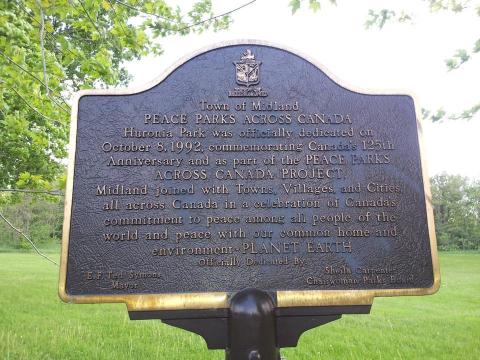
Huronia Park, now Edgehill Park, was designated as Midland's "Peace Park" as part of Canada's 125th Birthday in 1992.
"Peace Parks Across Canada" was conceived and organized by the International Institute for Peace through Tourism (IIPT) in collaboration with "CANADA 125" and the National Capital Commission. As Canada celebrated its 125th Birthday, some 400 cities and towns across Canada dedicated a Park to Peace – with most parks dedicated at Noon local time, October 8th, as the National Peacekeeping Monument was being unveiled in Ottawa. The members of the winning design team included Cornelia H. Oberlander, landscape architect. Supporters included the Federation of Canadian Mayors and Municipalities, Canada Parks and Recreation Association, the Tourism Industry Association of Canada, Heritage Canada, World Wildlife Fund Canada, Friends of the Earth, Canadian Society of Landscape Architects, and local Rotary Clubs all across Canada. Project sponsors included VIA Rail, Greyhound Lines Canada, Ltd., CP Hotels and Resorts, Ramada International Hotels and Resorts, Four Seasons Ltd., Meridien Hotels, Concept 3 Advertising and Programmed Communications, Ltd.
Peace Parks Across Canada" has served as the foundation in launching the "IIPT Global Peace Parks Program" on the 11th hour, of the 11th day, of the 11th month, 2000
At noon on October 9th, 2007 – one day after the precise 15th Anniversary of the original dedications, and as Canada continues to be a beacon of peace, Tolerance, and Understanding in a world of increasing violence and distrust, and a nation that celebrates diversity, a nation-wide re-dedication was co-ordinated.
Each of the original Peace Parks incorporated a ‘Bosco Sacro’ (Peace Grove) of 12 trees as a symbolic link with one another, and with nature - and as a symbol of hope for the future. The 12 trees were also symbolic of Canada’s 10 Provinces and two Territories. As there are now three Territories, a 13th tree was planted as part of the "Re-dedication Ceremony."
WORTHINGTON
PARK
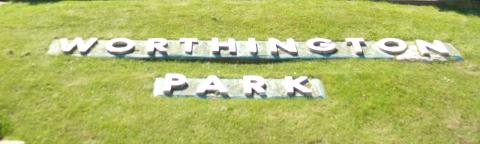
In 1962, the Royal Canadian Armoured Corps School established The Worthington Military Museum. The museum featured displays and equipment relating Major-General Frederic Franklin Worthington's military career and the establishment of the Armoured Corps. A main feature of the museum was Worthington Park, an outdoor display area for armoured vehicles and weapons. When the Base Borden Military Museum was established in 1973, the Worthington Museum was absorbed into this new museum.
FOR HOME
AND COUNTRY
PHELPS MEMORIAL PARK
Est. 1939
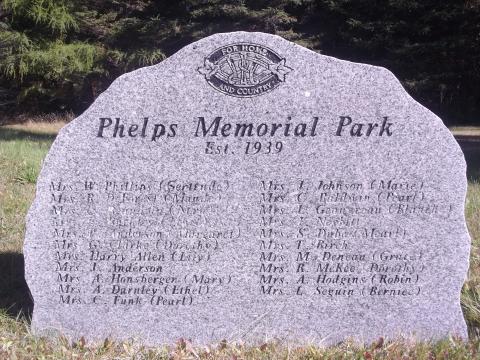
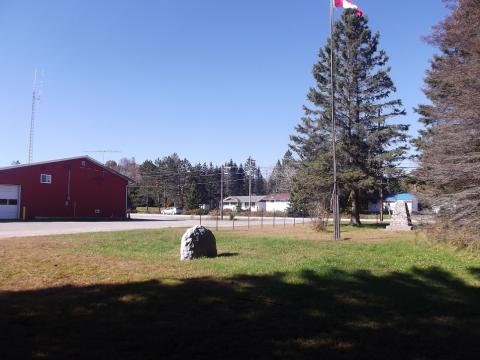
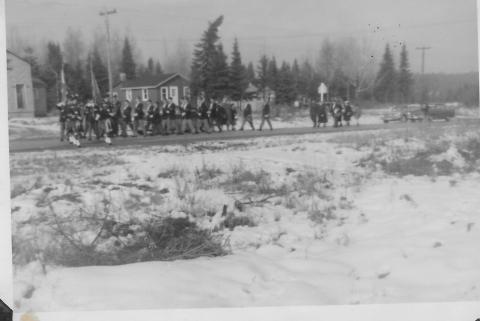
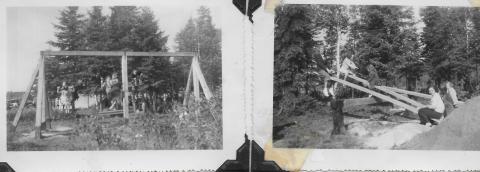
In 1939, the Phelps Women’s Institute was formed. When the men and women of the township returned home in 1946, the Phelps Women’s Institute wanted to honour them. They decided to develop and maintain a community centre and public playground to commemorate the services of these men and women. They obtained a charter from Ontario Department of Municipal Affairs and seven trustees were elected from the branch's institute members. Early in 1947, a 6-acre parcel of land was purchased for $150. It was bordered on two sides by the North River and had a nice swimming hole. The third side had frontage on Highway 63.
Local residents cleaned the land. All labour was donated, and many “bees” were held. In 1947, sufficient land was cleared and levelled for a ball diamond and a back stop and games commenced. A local Athletic Association was organized, and ball games and hockey games were started with outside teams participating.
Picnics and school fairs were organized, and the park became a centre for all township activities. Swings and seesaws were built as a result of a generous donation by Rosamond Deneau who had been crippled by polio and confined to a wheelchair. In spite of that, she managed to raise enough money for this purpose.
In 1950 work on the erection of a hall was started. Before the hall was built all activities were held outside or in tents. Plans for the hall were drawn by a branch member. All labour, except for the man in charge who worked for $0.50 an hour, were given for free.
Around 1959, the Phelps Cenotaph was built to honour the Phelps War Dead and the many, many people who went to war to fight for our freedom and fortunately returned home. At this time, the park was renamed to Phelps Memorial Park to honour all Veterans, especially those who were killed in action.
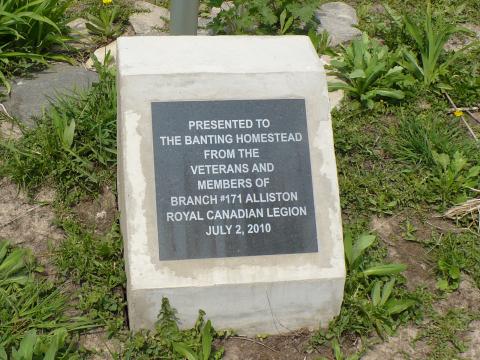
[dedication plaque/plaque commémorative]
PRESENTED TO
THE BANTING HOMESTEAD
FROM THE
VETERANS AND
MEMBERS OF
BRANCH #171 ALLISTON
ROYAL CANADIAN LEGION
JULY 2, 2010
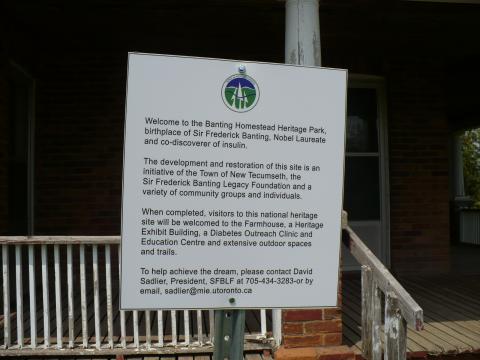
[plaque]
Welcome to the Banting Homestead Heritage Park,
birthplace of Sir Frederick Banting, Nobel Laureate
and co-discoverer of insulin.
The development and restoration of this site is an
initiative of the Town of New Tecumseth, the
Sir Frederick Banting Legacy Foundation and a
variety of community groups and individuals.
When completed, visitors to this national heritage
site will be welcomed to the Farmhouse, a Heritage
Exhibit Building, a Diabetes Outreach Clinic and
Education Centre and extensive outdoor spaces
and trails.
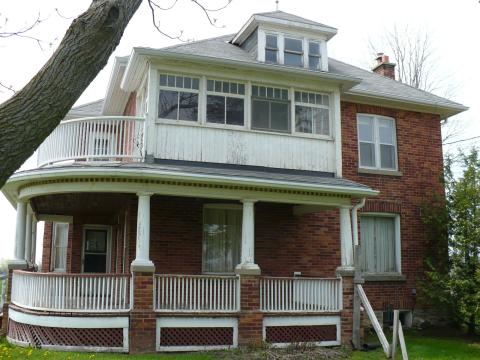
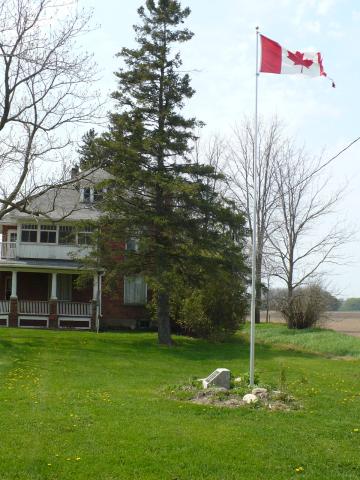
In 1975, a cairn was erected on the Banting property to mark the birthplace of Sir Frederick Grant Banting. In 2008, the Town of New Tecumseth purchased the property and named it the Banting Heritage Park. The farmhouse officially opened to the public at the annual Banting Day/World Diabetes Day celebration held on November 10, 2012. A new Heritage Exhibit building was completed and officially opened on Banting Day, November 9, 2013. The park includes interior exhibits and a Banting Legacy exercise trail.
Banting also had an artistic career and the Banting Legacy Collection of artifacts including wood carvings, sketches, oil paintings and various memorabilia can be viewed in the historic Banting farmhouse.
Frederick Grant Banting was born on November 14, 1891, in Alliston, Ontario. He was the youngest of five children of William Thompson Banting and Margaret Grant. He began his studies at the University of Toronto intending to enter the ministry, but instead switched to medicine and received his M.B. in 1916 accelerated because of the war. After graduating, he joined the Royal Canadian Army Medical Corps and served as a medical officer during the First World War. In August of 1918, he was wounded at the Battle of Cambrai and in September took over treatment of his own forearm wound to avoid its amputation. In 1919, he was awarded the Military Cross for heroism under fire, attending to wounded soldiers even while he himself was wounded.
After the war, he was Resident Surgeon at the Hospital for Sick Children, Toronto. From 1920 until 1921, he taught orthopaedics part-time at the University of Western Ontario, besides his general practice, and from 1921 until 1922 he was a Lecturer in Pharmacology at the University of Toronto. In 1922, he was awarded his M.D. degree, along with a gold medal.
Earlier, Banting had become interested in diabetes and determined to investigate it, Banting discussed it with various people. J.J.R. Macleod, Professor of Physiology at the University of Toronto, gave him facilities for the experimental work. Dr. Charles Best, a medical student at the time, was appointed as Banting’s assistant. Together, they started the work which led to the discovery of insulin.
In 1922, Banting was appointed Senior Demonstrator in Medicine at the University of Toronto and in 1923, he was elected to the Banting and Best Chair of Medical Research. He was appointed Honorary Consulting Physician to the Toronto General Hospital, the Hospital for Sick Children, and the Toronto Western Hospital.
In addition to his medical degree, in 1923, Banting obtained the LL.D. degree (Queens) and the D.Sc. degree (Toronto). The same year, he shared the Nobel Prize in Physiology or Medicine for 1923 with Macleod. He received the Reeve Prize from the University of Toronto (1922). In 1923, the Canadian Parliament granted him a Life Annuity of $7,500. In 1928 Banting gave the Cameron Lecture in Edinburgh. He was appointed member of numerous medical academies and societies in his country and abroad, including the British and American Physiological Societies, and the American Pharmacological Society. He was knighted in 1934.
Banting married Marion Robertson in 1924 and they had one child, William in 19228. In 1932 they divorced and in 1937 Banting married Henrietta Ball.
Banting was head of the University of Toronto's Banting and Best Institute for Medical Research and following the Munich conference in 1938, Banting asked his staff to familiarize themselves with problems in the field of war aviation medicine. Major A. A. James of the Royal Canadian Army Medical Corps, persuaded the very busy Banting that a research program was needed because the aircraft of had exceeded the physical capabilities of the aircrews. Banting realized the ability to fly at high altitudes would give Allied crews a tactical advantage in war, started a fund-raising program, and brought his research team together with James to focus on the most urgent medical problems.
Banting's colleague at the University of Toronto, Wilbur Franks, was researching cancer before the war and heard James explain the fighter pilots were blacking out during high-speed manoeuvres. This research led to making the first anti-gravity suit for pilots.
Sir Frederick Banting died during the Second World War, while serving as a liaison officer between the British and North American medical services. A plane crashed in a snowstorm near a frozen lake in Newfoundland. Two people on board died, Banting and the pilot, Joseph Mackey, suffered serious injuries. Mackey went for help, but Banting died before the pilot returned. Banting was on his way to England for British military support to continue development of the Franks Flying Suit. He was reportedly carrying a copy of the suit on the plane with him.
[arch/arche]
PEACEKEEPERS PARK
Parc des Gardiens de la Paix
[stone/pierre]
CANADA
PEACEKEEPERS
GUARDIENS DE LA PAIX
THIS MONUMENT IS
DEDICATED TO THOSE
WHO SERVED IN
THE NAME OF PEACE
CE MONUMENT EST
DEDIE A CEUX
QUI ONT SERVI
AU NOM DE LA PAIX
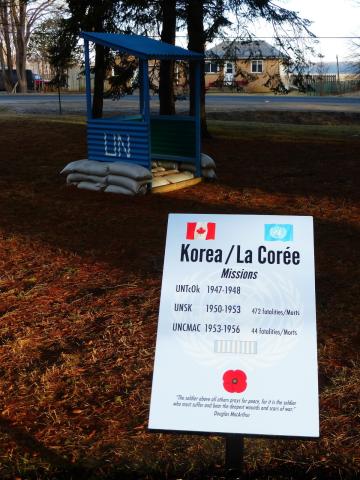
[plaque]
Korea/La Corée
Missions
| UNTcOK | 1947-1948 | |
| UNSK | 1950-1953 | 472 fatalities/Morts |
| UNCMAC | 1953-1956 | 44 fatalities/Morts |
"The soldier above all others prays for peace, for it is the soldier
who must suffer and bear the deepest wounds and scars of war."
Douglas MacArthur
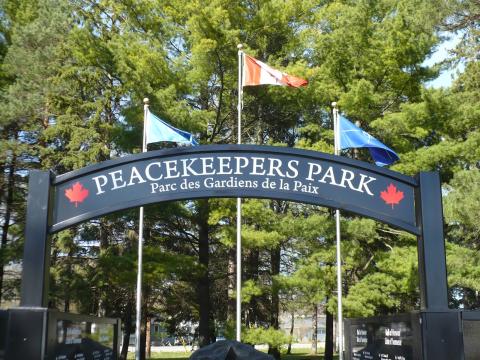
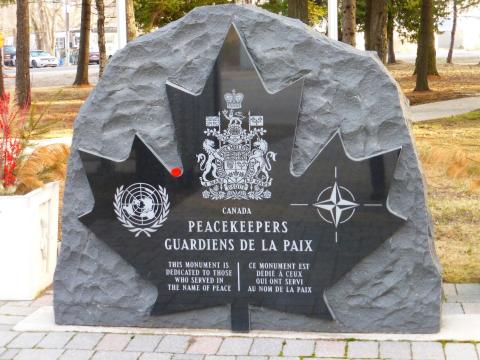
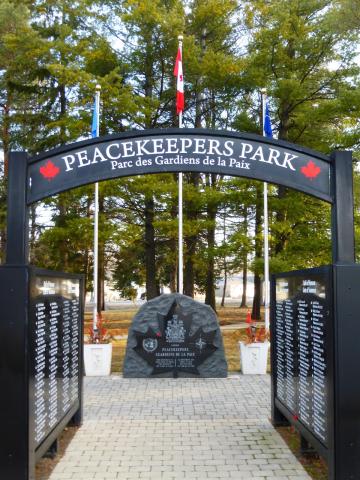
In 2008, this land was leased from the township by the Jerry Tremblay, CD, Central Ontario Chapter, Canadian Association of Veterans in United Nations Peacekeeping. A solid granite commemorative stone was imported from Pakistan and a maple leaf carved into its face in honour of all who served in peace. Peacekeepers Park is dedicated to the 160,000+ Canadians who have served on United Nations sanctioned missions since 1947.
The stone path was installed in 2016 and is lined with 18 mounted pedestals which detail the 59 United Nations missions since 1949. The first eight plaques describe peacekeeping and peacemaking missions, while the last 10 depict aid and observer missions. Also along the path are the Buffalo Nine Memorial and Bringing Their Faces Into The Light—walls mounted with renditions and short biographies of the faces of the fallen.
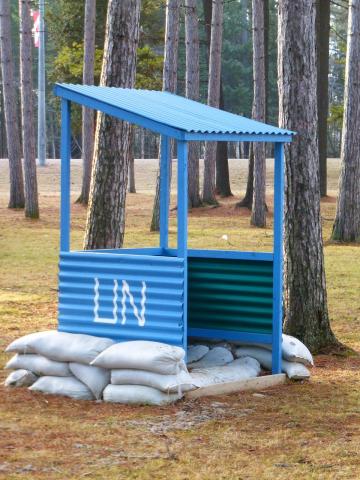
Included in the park are the Wall of Honour, Lynx reconnaissance vehicle (donated in part by Canadian Forces Base Borden), LAV III Monument, Korea missions plaque and a United Nations guard post.
[sign/enseigne]
THE WAGGONERS PARK
This park is dedicated to all who ever served
in the ROYAL CANADIAN ARMY SERVICE CORPS
LE PARC DES WAGGONERS
Ce parc est dédié à tous ceux qui ont servi
dans le corps d'entendance de l'armée
ROYALE CANADIENNE
[slab/dalle]
WAGGONERS PARK
1901 RCASC 2001
THIS PARK IS DEDICATED TO ALL THOSE
WHO HAVE SERVED IN
THE ROYAL CANADIAN ARMY SERVICE CORPS
LE PARC DE WAGGONERS
1901 CRIAC 2001
CE PARC EST DÉDIÉ À TOUS CEUX QUI
ONT SERVI DANS LE CORPS
ROYAL D'INTENDANCE DE L'ARMÉE CANADIANNE
[stele/stèle]
1914-1918
SACRED TO THE MEMORY
OF THOSE MEN OF THE
CORPS WHO GAVE THEIR
LIVES IN THE CAUSE OF
FREEDOM
1939-1945
1950-1953
UNITED NATIONS
[plaque]
ROYAL CANADIAN ARMY SERVICE CORPS
(RCASC)
FORMED ON 1 NOVEMBER 1901, THE RCASC WAS THE COMBATANT
CORPS OF THE CANADIAN ARMY THAT PROVIDED COMBAT SUPPLIES,
TRANSPORTATION, FOOD SERVICE AND CLERICAL SUPPORT IN PEACE,
DURING THE FIRST WORLD WAR, THE SECOND WORLD WAR, THE KOREAN
WAR AND UNITED NATIONS OPERATIONS.
THROUGHOUT ITS HISTORY,
MEMBERS OF THE RCASC PERFORMED WITH DEDICATION, DISTINCTION,
DEVOTION AND PERSONAL PRIDE. THEY WERE A VITAL PART OF EVERY
ARMY OPERATION.SUCCEEDING GENERATIONS SALUTE THEM.
THE RCASC IS A PROUD PREDECESSOR OF THE CANADIAN FORCES
LOGISTICS BRANCH.
"VICTORY IS THE BEAUTIFUL, BRIGHT COLOURED FLOWER.
TRANSPORT IS THE STEM WITHOUT WHICH IT COULD NEVER HAVE
BLOSSOMED."
WINSTON CHURCHILL
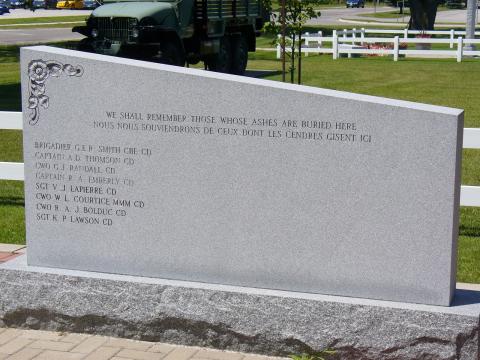
[left slab/dalle gauche]
WE SHALL REMEMBER THOSE WHOSE ASHES ARE BURIED HERE
NOUS NOUS SOUVIENDRONS DE CEUX DONT LES CENDRES GISENT ICI
BRIGADIER G.E.R. SMITH CBE CD
CAPTAIN A.D. THOMSON CD
CWO G.J. RANDALL CD
CAPTAIN R. A. EMBERLY CD
SGT. V.J. LAPIERRE CD
CWO W.L. COURTICE MMM CD
CWO R.A.J. BOLDUC CD
SGT. K.P. LAWSON CD
[right slab/dalle gauche]
WE SHALL REMEMBER THOSE WHOSE ASHES ARE BURIED HERE
NOUS NOUS SOUVIENDRONS DE CEUX DONT LES CENDRES GISENT ICI
S/SGT. R.W. CAMERON CD
CPL G. BAZINET CD
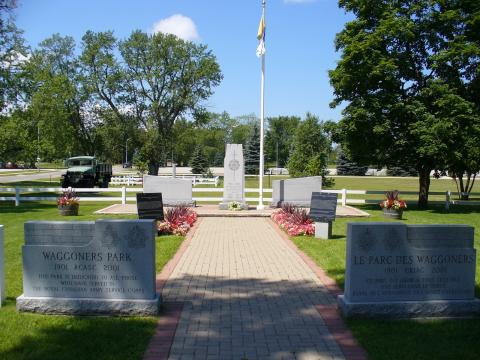
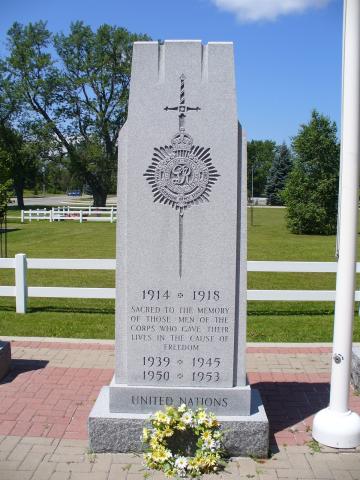
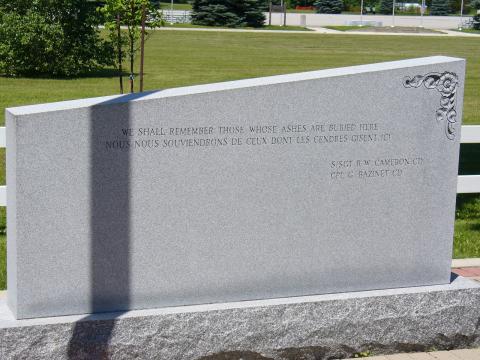
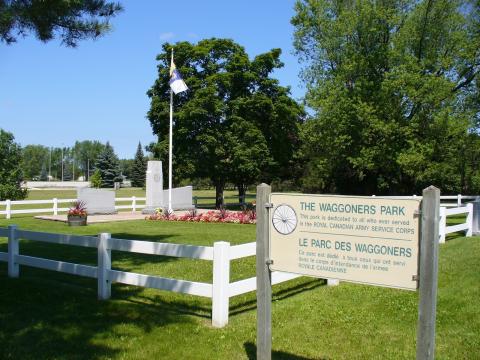
This memorial is dedicated to the men of the Royal Canadian Army Service Corps who fought in the First and Second World Wars and the Korean War. It was erected by the Royal Canadian Army Service Corps.
[plaque]
The Nichola Goddard Park
This park is dedicated to Captain Nichola K.S. Goddard who gave her life
in service to Canada, while trying to improve the quality of life for the people
of Afghanistan.
2 May 1980 - 17 May 2006
In memory of Captain Goddard,
"I do what I do so that you can do what you do."
Captain Goddard was a member of the the 1st Regiment, Royal Canadian Horse
Artillery, stationed at CFB Shilo, Manitoba. She died in Afghanistan while
attached to the 1st Battalion, Princess Patricia's Light Infantry Battle Group.
Nichola posthumously received the Meritous Service Medal on February 19, 2007.
A "Let Them Be Kids" Project
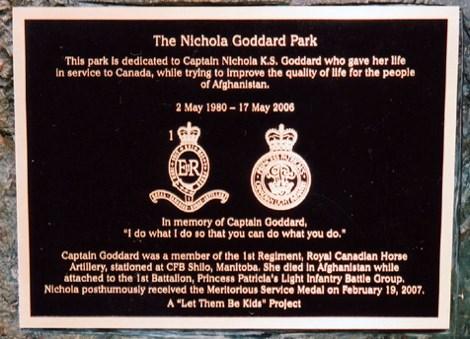
On 15 September 2007 members of the local community and volunteers of the Canadian Forces got together and constructed a park dedicated to the memory of Captain Nichola Goddard. Captain Goddard lived in Sault Ste. Marie at one time and both her grandparents lived there.
Captain Nichola Kathleen Sarah Goddard joined the Canadian Forces under the Regular Officer Training Plan in June 1998 and attended Royal Military College until 2002, when she was a granted a degree in English on the Dean's List. She graduated as a trained artillery officer and was posted to the 1st Regiment Royal Canadian Horse Artillery as a 2nd Lieutenant. Goddard’s early years in the armed forces involved fighting wildfires and avalanche control in British Columbia. She was later promoted to captain.
Captain Goddard was supporting B Company of 2 Princess Patricia's Canadian Light Infantry as part of Task Force ORION in the Panjwai District of Kandahar Province, Afghanistan when she was killed in action on 17 May 2006. Goddard and her team were ambushed by militants as they moved into a mosque in the Paanjwayi district. As the commanding officer, Goddard was standing in the turret of the LAV, with her head and shoulders exposed. Numerous rocket-propelled grenades hit their vehicle. Shrapnel struck Goddard in the back of the head, killing her instantly. She was the first female Canadian soldier to die in a combat role.
Captain Goddard was 26 at the time of her death and was survived by her husband, her father, her mother and her two sisters. She is remembered by her forward observation party as a good officer who considered the advice of her subordinates.
POINT EDWARD
VETERANS
MEMORIAL
PARK
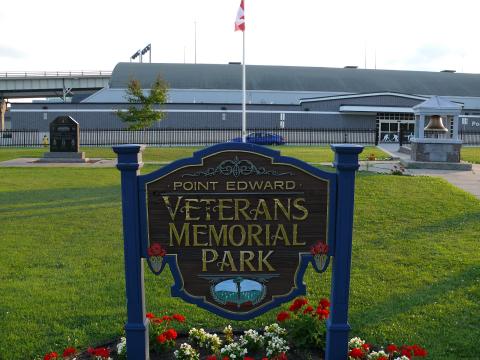
needs further research