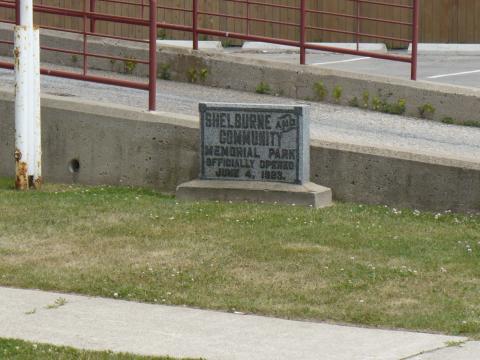
The Shelburne and Community Memorial Park opened on June 4, 1923, in honour of those who served in the First World War.
Shelburne and Community Memorial Park
SHELBURNE
COMMUNITY
MEMORIAL PARK
OFFICIALLY OPENED
JUNE 4, 1923.
My VAC Account
My VAC AccountSHELBURNE
COMMUNITY
MEMORIAL PARK
OFFICIALLY OPENED
JUNE 4, 1923.
The Shelburne and Community Memorial Park opened on June 4, 1923, in honour of those who served in the First World War.
[sign/enseigne]
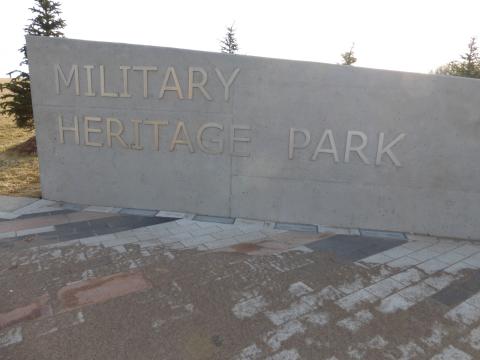
MILITARY
HERITAGE PARK
[plaque]
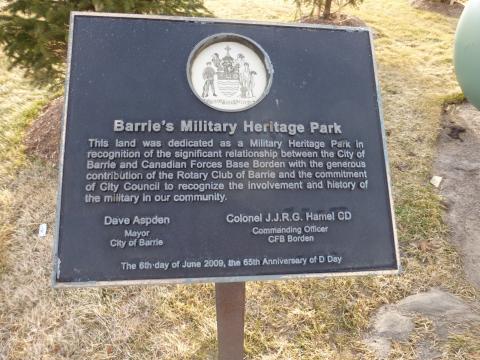
Barrie's Military Heritage Park
This land was dedicated as a Military Heritage Park in
recognition of the significant relationship between the City of
Barrie and Canadian Forces Base Borden with the generous
contribution of the Rotary Club of Barrie and the commitment
of City Council to recognize the involvement and history of
the military in our community.
Dave Aspden
Mayor
City of Barrie
Colonel J.J.R.G. Hamel CD
Commanding Officer
CFB Borden
The 6th day of June 2009, the 65th Anniversary of D Day
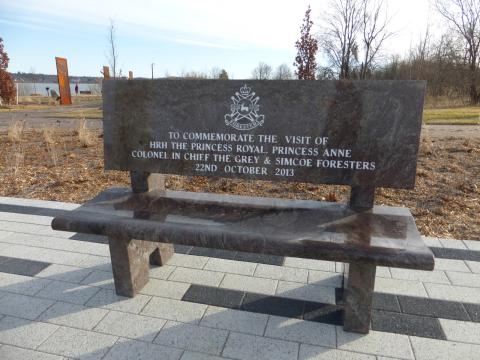
[bench/banc]
GREY SIMCOE
FORESETERS
TO COMMEMORATE THE VISIT OF
HRH THE PRINCESS ROYAL, PRINCESS ANNE
COLONEL AND CHIEF THE GREY & SIMCOE FORESTERS
22ND OCTOBER 2013
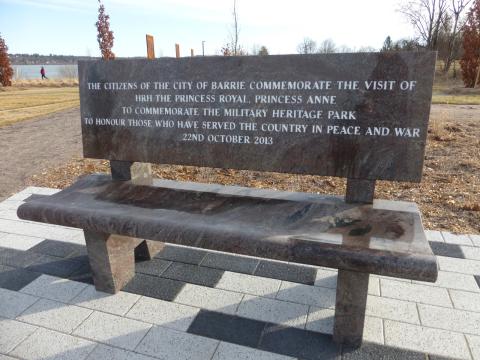
[bench/banc]
THE CITIZENS OF BARRIE COMMEMORATE THE VISIT OF
HRH THE PRINCESS ROYAL, PRINCESS ANNE
TO COMMEMORATE THE MILITARY HERITAGE PARK
TO HONOUR THOSE WHO HAVE SERVED THE COUNTRY IN PEACE AND WAR
22ND OCTOBER 2013
On June 6, 2009, this land was dedicated as a Military Heritage Park in recognition of the significant relationship between the City of Barrie and Canadian Forces Base Borden with the generous contribution of the Rotary Club of Barrie and the commitment of City Council to recognize the involvement and history of the military in our community.
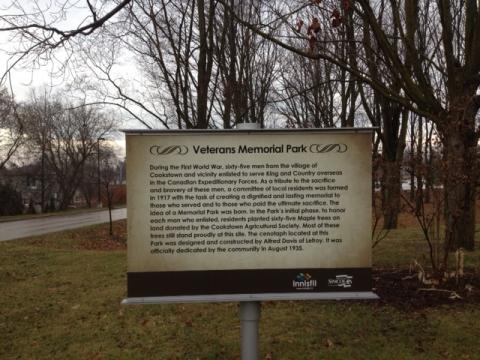
Veterans Memorial Park
During the First World War, sixty-five men from the village of
Cookstown and vicinity enlisted to serve King and Country overseas
in the Canadian Expeditionary Forces. As a tribute to the sacrifice
and bravery of these men, a committee of local residents was formed
in 1917 with the task of creating a dignified and lasting memorial to
those who served and to those who paid the ultimate sacrifice.
The idea of a Memorial Park was born. In the park's initial phase, to hnoour
each man who enlisted, residents planted sixty-five Maple trees on
land donated by the Cookstown Agricultural Society. Most of these
trees still stand proudly at this site. The cenotaph located at this
Park was designed and constructed by Alfred Davis. It was
officially dedicated by the community in August 1935.
The Cookstown Veterans Memorial Park is a tribute to the 65 men from the village of Cookstown and vicinity who enlisted in the First World War. The cenotaph located at this park was officially dedicated by the community in August 1935.
In 2019, a consulting arborist inspected the Maple trees planted in memory of the 65 men. The town has now taken down trees but, sensitive to the memorial function of each maple, plans to replace these memorial trees either with native sugar maples, or locally grown red maples.
[front of first wall/devant du premier mur]
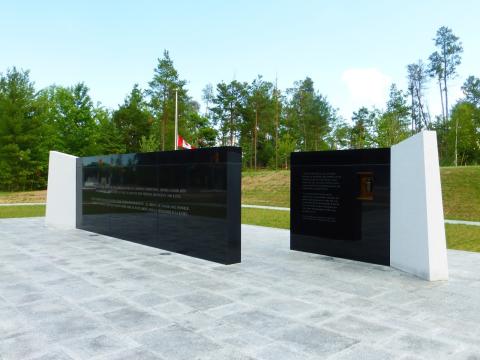
THROUGH THESE GATES THE SONS AND DAUGHTERS OF A GRATEFUL NATION PASS... SERVING CANADA WITH HONOUR, DUTY AND COURAGE, SO THAT ALL MAY LIVE WITH FREEDOM, DEMOCRACY AND JUSTICE.
PAR ICI PASSENT LES FILS ET LES FILLES D'UNE NATION RECONNAISSANTE... ILS SERVENT LE CANADA AVEC HONNEUR, DEVOIR ET COURAGE, POUR QUE CHACUN PUISSENT VIVRE EN TOUTE LIBERTÉ, DANS LA DÉMOCRATIE ET LA JUSTICE.
[back of first wall/dos du premier mur]
LEST WE FORGET
N'OUBLIONS JAMAIS
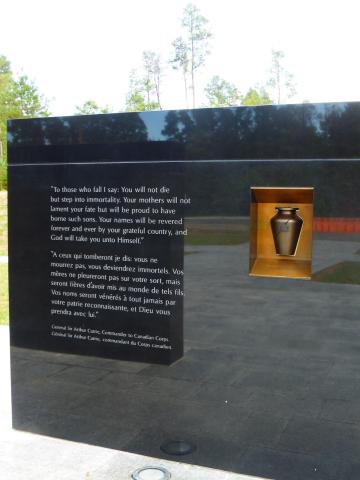
[front of second wall/devant du deuxième mur]
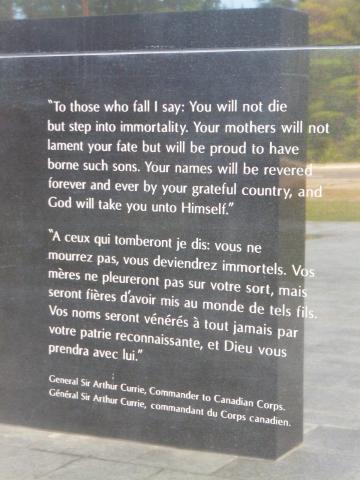
"To those who fall I say: You will not die
but step into immortality. Your mothers will not
lament your fate but will be proud to have
borne such sons. Your names will be revered
forever and ever by your grateful country, and
God will take you unto Himself."
"A ceux qui tombent je dis : vous ne
mourrez pa, vous deviendrez immortels. Vos
mères ne pleureront pas sur votre sort, mais
seront fières d'avoir mis au monde de tels fils.
Vos noms seront vénérés à tout jamais par
votre patrie reconnaissante, et Dieu vous
prendra avec lui."
General Sir Arthur Currie, Commander to Canadian Corps.
Général Sir Arthur Currie, commandant du Corps canadien.
[urn/urne]
This urn holds sacred soil from the April 9th, 1917 battlefields of Vimy Ridge, soil that symbolically
contains the DNA of Canadian soldiers that lived and fought in the fields and trenches of Vimy.
Many were wounded, many died, and many came home. All are remembered.
Cette urne contient le sol sacré des champs de bataille de la crête de Vimy du 9 avril 1917,
symbole de l'ADN de soldats canadiens qui ont vécu et combattu dans les champs et les
tranchées de Vimy. Certains ont été blessés, certains sont morts et d'autres sont revenus au pays.
Nous nous souvenons d'eux.
[statue]
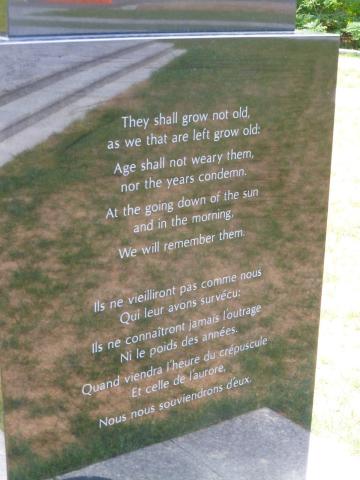
They shall not grow old,
as we that are left grow old:
Age shall not weary them,
nor the years condemn.
At the going down of the sun,
and in the morning,
We will remember them.
Ils ne vieilliront pas comme nous
Qui leur avons survécu:
Ils ne connaîtront jamais l'outrage
Ni le poids des années.
Quand viendra l'heure du crépuscule
Et celle de l'aurore,
Nous nous souviendrons d'eux.
Camp Borden was founded in 1916, training nearly fifty thousand soldiers for service in The Canadian Expeditionary Force. For many of those soldiers, their first action was during the Battle of Arras, and specifically the Battle of Vimy Ridge.
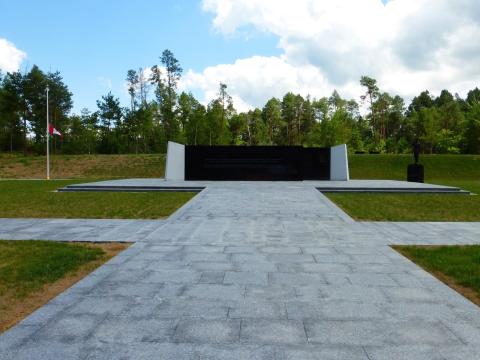
In 2016, Canadian Forces Base (CFB) Borden celebrated its centennial year, and through the enduring partnership of the Base, the City of Barrie and the surrounding communities, the Borden Legacy Park was erected to mark the occasion. The monument was unveiled on June 9 by Prime Minister Trudeau, with Mayor Leturque, Mayor of Arras, contributing to the ceremony. It was designed by Canadian artist and sculptor Marlene Hilton Moore.
The Borden Legacy Project began in 2014, and in June 2015, sacred soil was removed from the Battlefield at Vimy Ridge and patriated to Canada. This soil symbolically holds the DNA of all those fallen and wounded in the 1917 Battle.
The Borden Legacy Park has three distinct pieces that serve to commemorate CFB Borden's past and inspire the future. First, a forty-foot long and seven-foot high white and black granite wall, is a tribute and inspiration to each and every member of the Canadian Armed Forces that passes through the CFB Borden gates. A six-foot wide path separates the two sections of the wall to allow passage between. A berm directly behind the granite walls is meant to represent Vimy Ridge itself. The wall also encases an urn, in which the sacred soil is held. The promise of General Sir Arthur Currie to his troops is etched into the wall that holds the soil.
The second piece of the park is the restored First World War trenches that were used to train infantry soldiers before their departure to the Western Front. Connected to the Legacy Wall via a short wooded trail, these trenches are a reminder of the importance of training, and the conditions of the First World War.
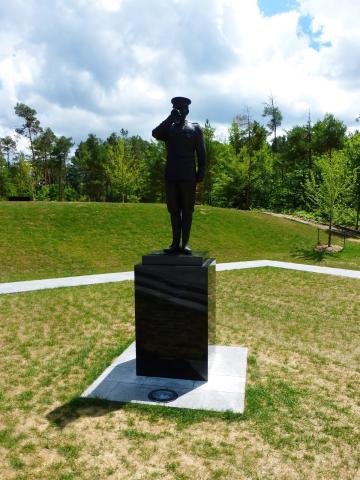
The third piece is a Bronze Bugler stands in the park, calling to his companions, calling visitors to the monument, and calling to the now-empty trenches that once trained soldiers before they left for battle overseas.
To commemorate the 100th Anniversary of the Battle of Vimy Ridge, a second bugler was created and donated to the Vimy Foundation, to stand in the shadow of Walter Allward’s magnificent monument in France.
(needs further research/recherche incomplète)
Riverview Memorial Park has a deep connection with Margaret Baizley and the Women’s Christian Temperance Union, thanks to Baizley’s leadership and efforts in raising funds for the construction of the South African War Monument. Established in 1902, Riverview Memorial Park stands as a testament to the determination of Mrs. Baizley and the Women’s Christian Temperance Union.
The park is a tribute to the valiant servicemen who fought in the South African War, specifically the 2nd Battalion, The Royal Canadian Regiment recruited from New Brunswick. G Company comprised many ex-members of the renowned 62nd Saint John Fusiliers and earned recognition for their bravery during the Battle of Paardeberg in February 1900, which led to the surrender of Pieter Cronje’s forces. Four men from Saint John lost their lives during the South African War, with three of them dying on the day of Cronje’s surrender on February 27, 1900. The local South African War Veterans used to gather at Riverview Memorial Park on Paardeberg Day, reenacting the battle and charging entrenched African forces. Colonel Reginald Fendick revived this ceremony on February 27, 1999, after two decades of absence.
There were several memorials placed in the park, the South African War Monument, a drinking fountain, two smooth-bore cannons and a captured First World War German gun (all three melted down in 1942 for the Second World War effort). Between 1900 and 1925 there were 11 memorial trees planted in memory of South African War soldiers, as well as park organizers and supporters. In 2017, three trees were planted as memorials to other Veterans.
The Royal Canadian Regiment, 2nd Battalion at Canadian Forces Base Gagetown, perpetuates the unit which played a decisive role in the victory at Paardeberg. For decades the New Brunswick Boer War Veterans Association held their annual remembrance ceremony in the park. In 2015, at the 115th anniversary of this battle, the 2nd Battalion, Royal Canadian Regiment held a remembrance ceremony in the Park.
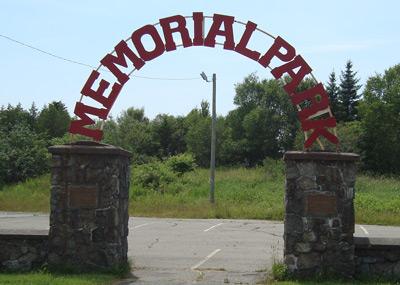
[arch/arche]
MEMORIAL PARK
[left plaque/plaque de gauche]
[right plaque/plaque de droite]
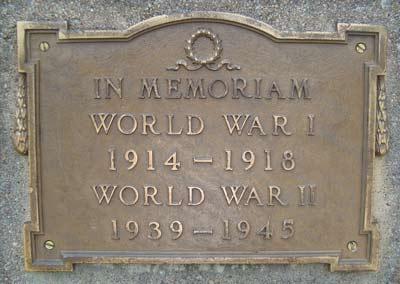
This memorial was erected by William Hebert, Ronald Delaney, local general contractors assisted by Randy Beckwith. Unveiled on September 2, 1947, this memorial was dedicated to the seven local men killed in action in World War II and to those who gave their lives in World War I.
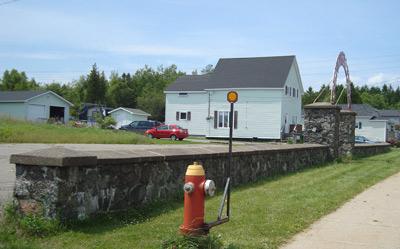
The monument is a 147 foot long grey granite stone and mortar memorial wall divided at the centre by two eight foot stone entry pillars, which are four feet square on either side of a ten foot driveway spanned by an archway. The wall is thirty inches high and thirty inches wide. The arch includes, from one end to the other, the words "MEMORIAL PARK" in red. At the time it was built, it was the second longest memorial wall in New Brunswick.
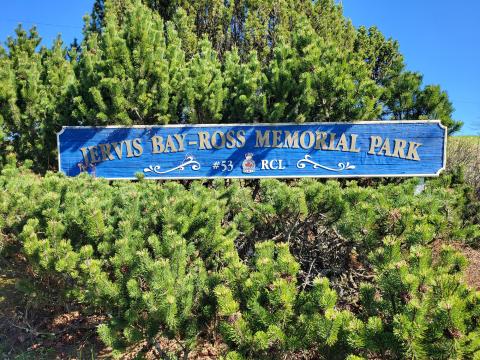
[sign/enseigne]
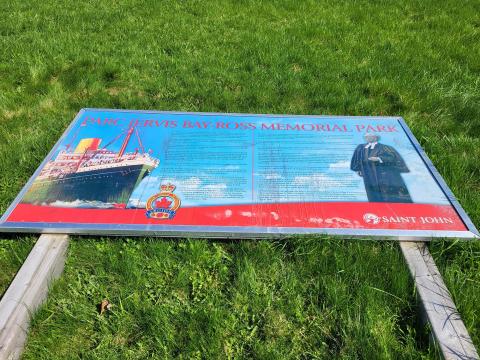
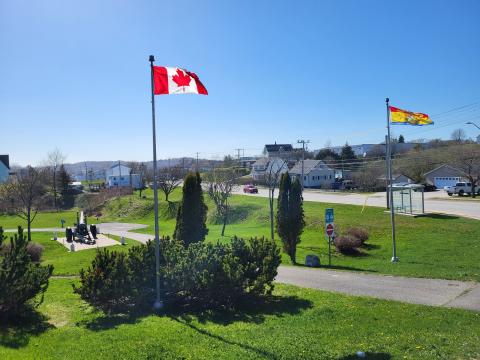
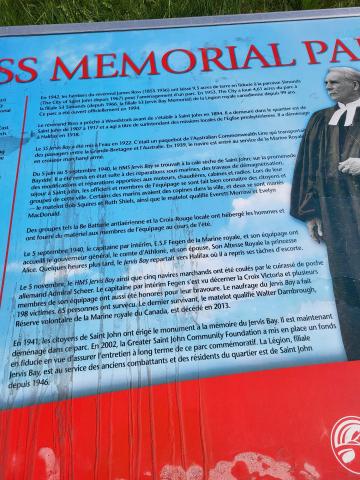
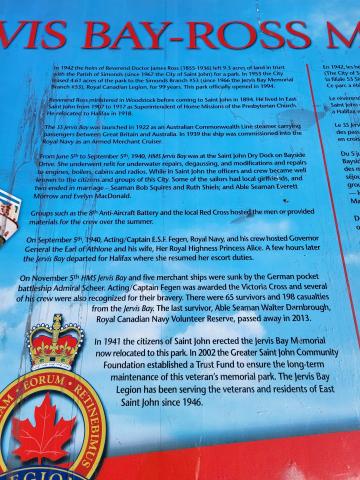
JERVIS BAY - ROSS MEMORIAL PARK
# 53 RCL
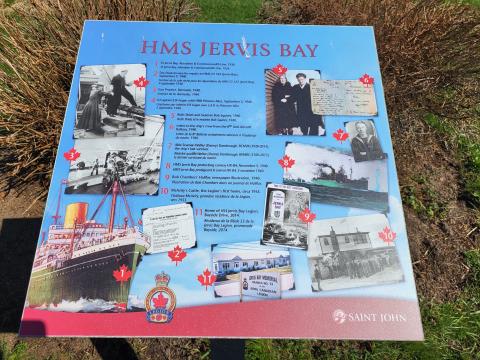
[storyboard/scénarimage]
(needs further research/recherche incomplète)
This memorial park was dedicated on 25 September 1994 after 50 years of effort to convert the land given by the late Reverend James D. Ross into a public space.
Dedicated to peace as part of the Peace Parks Acrss Canada project during Canada's 125th birthday celebrations. Riverview joined some 400 other communities in planting Peace Groves of 12 trees, symbolizing the ten provinces and (at the time) two territories.
Caseley Park was designated as Riverview's "Peace Park" as part of Canada's 125th Birthday in 1992. Near the park entrance stand the 12 trees which comprise the Peace Grove. The park is named after former mayor of Riverview Ralph Caseley. It was officially dedicated on November 11, 1992, as part of the "Peace Parks Across Canada Project" in celebration of Canada's 125th anniversary. Pathways guide visitors past the Cenotaph commemorating the Canadian Merchant Navy.
"Peace Parks Across Canada" was conceived and organized by the International Institute for Peace through Tourism (IIPT) in collaboration with "CANADA 125" and the National Capital Commission. As Canada celebrated its 125th Birthday, some 400 cities and towns across Canada dedicated a Park to Peace – with most parks dedicated at Noon local time, October 8th, as the National Peacekeeping Monument was being unveiled in Ottawa. The members of the winning design team included Cornelia H. Oberlander, landscape architect.
Supporters included the Federation of Canadian Mayors and Municipalities, Canada Parks and Recreation Association, the Tourism Industry Association of Canada, Heritage Canada, World Wildlife Fund Canada, Friends of the Earth, Canadian Society of Landscape Architects, and local Rotary Clubs all across Canada. Project sponsors included VIA Rail, Greyhound Lines Canada, Ltd., CP Hotels and Resorts, Ramada International Hotels and Resorts, Four Seasons Ltd., Meridien Hotels, Concept 3 Advertising and Programmed Communications, Ltd.
At noon on October 9th, 2007 – one day after the precise 15th Anniversary of the original dedications, and as Canada continues to be a beacon of peace, Tolerance, and Understanding in a world of increasing violence and distrust, and a nation that celebrates diversity, a nation-wide re-dedication was co-ordinated.
Each of the original Peace Parks incorporated a ‘Bosco Sacro’ (Peace Grove) of 12 trees as a symbolic link with one another, and with nature - and as a symbol of hope for the future. The 12 trees were also symbolic of Canada’s 10 Provinces and two Territories. As there are now three Territories, a 13th tree was planted as part of the "Re-dedication Ceremony."
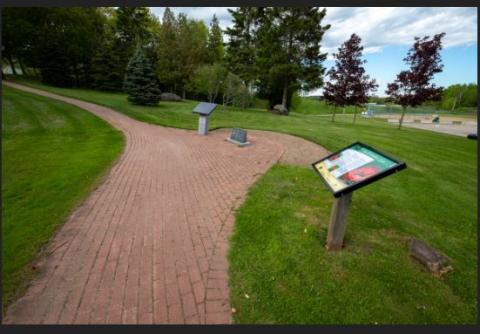
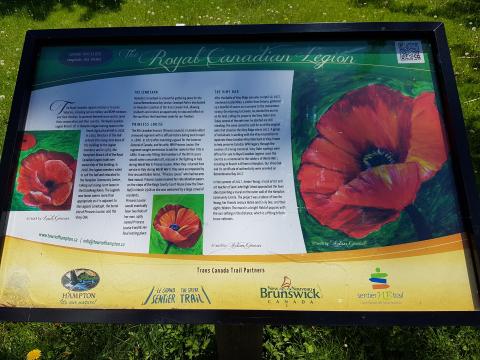
The Royal Canadian Legion's mission is to serve Veterans, including service military and RCMP members and their families, to promote Remembrance and to serve their communities and their country. The Royal Canadian Legion Branch 28 in Hampton began leasing space in the Town's Agricultural Hall in 1928. In 1955, Directors of the Hall entered into a long-term lease of the building to the Legion members and in 1979, the Hampton's Branch 28 of the Royal Canadian Legion took over ownership of the building. In 2016, the Legion members voted to sell the hall and relocated to the Hampton Community Centre, taking out a long-term lease in the Ossekeag Room. The Legion's new home seems more than appropriate as it is adjacent to the Legion's Cenotaph, the burial site of Princess Louise, and the Vimy Oak.
The 8th Canadian Hussars (Princess Louise's) is Canada's oldest armoured regiment with its official history dating back to April 4, 1848. In 1879 after mounting a guard for the Governor General of Canada, and his wife HRH Princess Louise, the regiment sought permission to add her name to their title in 1884. It was only fitting that members of the 8th Hussars would name a wounded colt, rescued in the fighting in Italy during World War II, Princess Louise. When they returned from service in Italy during World War II, they were accompanied by this rescued Italian horse, "Princess Louise" who had become their mascot. Princess Louise received her naturalization papers on the steps of the Kings County Court House (now the Town Hall) in March 1946 as she was welcomed by a large crowd of residents. Princess Louise would eventually have two foals of her own, aptly named Princess Louise II and III. Her final resting place
After the Battle of Vimy Ridge was won on April 12, 1917, Lieutenant Leslie Miller, a soldier from Ontario, gathered up a handful of acorns as a souvenir to the momentous victory. On returning to Canada, he planted the acorns on his land, calling his property the Vimy Oaks Farm. Today several of the oak trees he planted are still standing, the same cannot be said for all of the original oaks that stood on the Vimy Ridge site in 1917. A group of individuals is working with the Vimy Foundation to repatriate these Canadian Vimy Oaks back to Vimy, France to help preserve Canada's WWI legacy through the creation of a living memorial. Vimy Oaks saplings were offered for sale to Royal Canadian Legions cross the country as a memorial to the soldiers of World War I, including to Branch #28 here in Hampton. Our Vimy Oak and its certificate of authenticity were unveiled on Remembrance Day 2017.
In the summer of 2017, Amber Young, a local artist and art teacher at Saint John High School approached the Town about painting a mural on the outer wall of the Hampton Community Centre. The project was a labour of love for Young, her friends Jessica Hickie and Emily Dee, and their eight children. The mural is a bright field of poppies with the sun setting in the distance, which is a fitting tribute to our veterans.
The Cenotaph Trail travels along Main Street at the end of the Dutch Point Park Main Trail. The trail passes by the cenotaph, Princess Louise I Memorial, Poppy Mural, interpretive sign and a Vimy Oak.
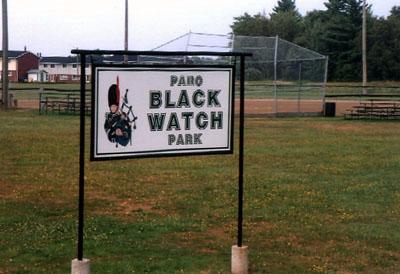
PARC
BLACK WATCH
PARK
This memorial is dedicated to The Black Watch. The park is currently in use.