Parks

City/Municipality
Winnipeg (Transcona)
Memorial Number
46014-023
Type
Address
124 Borden Avenue
in Canada
Yes
GPS Coordinates
49.8855209, -97.0015229
Inscription

VICTOR VALDE
MEMORIAL PARK

Province
!4v1665509922384!6m8!1m7!1sHSYF-vd6eK0fkF8wVTii4A!2m2!1d49.8855208832454!2d-97.00152291561932!3f127.14871019625262!4f-3.223592387348887!5f1.8760109370038944
Body Content

In 1947, Victor Valde Memorial Park was named in honour of Pilot Officer Victor Lewis Valde. He enlisted and served as an air gunner with the Royal Canadian Air Force and was killed in action on 2 November 1944 at 20 years of age. Valde was the only son of Lewis and Emma Valde and attended Transcona Memorial United Church prior to enlistment.

Valde Avenue and Valde Lake are also named in honour of Pilot Officer Valde.

City
Winnipeg (Transcona)
Country
Type Description
Park
Memorial CF Legacy ID
11037
City/Municipality
Winnipeg (Transcona)
Memorial Number
46014-022
Type
Address
534 Regent Ave E
in Canada
Yes
GPS Coordinates
49.8951051, -96.990795
Inscription

MAGAS
MEMORIAL PARK

534 REGENT AVE E

MAGAS
MEMORIAL
PARK

Province
!4v1665507266514!6m8!1m7!1s6D3-nNfuuaqAxuO1Z20P2w!2m2!1d49.89510514464645!2d-96.99079501655595!3f179.18256170344168!4f-5.791448723571662!5f0.7820865974627469
Body Content

Magas Memorial Park was named in honour of the four Magas brothers that served in the Second World War. Flying Officer Fred Magas enlisted in December 1940 and served with the Royal Canadian Air Force. Following training in Canada, Magas served overseas and was tasked with hunting U-boats in the Atlantic. He was honourably discharged in October 1945. For his service, he was awarded the 1939-1945 Star with clasp, Atlantic Star, Defence Medal, Canadian Volunteer Service Medal with clasp, and War Medal 1939-1945. Following the war, Magas worked at the CN Transcona Shops.

Rifleman Harry Magas served overseas as a rifleman with the Royal Regina Rifles. He was killed in action on 6 July 1944 at 21 years of age. Magas Lake in Manitoba was also named in commemoration of Rifleman Harry Magas in 1972.

Corporal John Magas enlisted in 1940 and served with the Lorne Scots of the Canadian Army. He participated in the Normandy landings in 1944 and was discharged from the military in 1945. 

Little is known regarding Tony Magas’ active military service during the Second World War. He enlisted after 1943, served with the Royal Canadian Navy and was discharged in 1945.

City
Winnipeg (Transcona)
Country
Type Description
Park
Memorial CF Legacy ID
11035
City/Municipality
Winnipeg (Transcona)
Memorial Number
46014-021
Type
Address
Rosseau Avenue and Day Street
in Canada
Yes
GPS Coordinates
49.8982866, -97.0027032
Inscription
Province
!4v1665504635338!6m8!1m7!1s68vmIfmkIUIN3U4ihrZAsA!2m2!1d49.8982866433328!2d-97.00270323587085!3f223.47585896527332!4f1.077710407255168!5f3.0064359380201306
Body Content

On 7 March 2016, Billy McCann Memorial Park was named in honour of Flight Sergeant William Alexander McCann. He enlisted in the Second World War in January of 1941. Previous to joining the Air Force, he was a member of the Cameron cadets with whom he gained Dominion honours in marksmanship. Following enlistment, he was trained as an Air Gunner in Canada and was sent overseas in October of 1941. His plane, a Wellington Bomber, was shot down during a bombing raid over Bremen and he was killed in action on June 28, 1942.

It was on these very grounds that Billy spent may of his childhood days while attending Central School. He was regarded as an outstanding individual in collegiate athletic events, a member of the Transcona Rugby Club and a member of the Young People's Association of Knox United Church. He was the son of Mr. Alexander and Mrs. Florence McCann of 181 Oxford Street, Transcona, Manitoba.

City
Winnipeg (Transcona)
Country
Type Description
Park
Memorial CF Legacy ID
11034
City/Municipality
Winnipeg (Transcona)
Memorial Number
46014-012
Type
Address
300 Larche Ave W
in Canada
Yes
GPS Coordinates
49.9074867, -97.0079026
Inscription

THOMAS F. COPELAND
MEMORIAL PARK

Province
!4v1665153865143!6m8!1m7!1sx8Udb-v4yHLo1PblBOWBdw!2m2!1d49.90748665042588!2d-97.00790255021927!3f272.49951329269146!4f-13.211285730245024!5f1.3503318023346984
Body Content

Thomas F. Copeland Memorial Park was named in commemoration of Wireless Air Gunner Thomas F. Copeland in 1998. He enlisted with the Royal Canadian Air Force and trained in Canada through the British Commonwealth Air Training Program. Little is known regarding his active military service during the Second World War. Following the war, he worked as an accountant and municipal official in Transcona. Copeland also served as Mayor of Transcona (1960-1961) and was active with the Royal Canadian Legion Transcona Branch No. 7. He died on 28 January 1998 at 73 years of age.

Copeland Street was named in honour of Thomas Copeland in 1963.

City
Winnipeg (Transcona)
Country
Type Description
Park
Memorial CF Legacy ID
11021
City/Municipality
Winnipeg
Memorial Number
46013-008
Type
Address
55 Anglia Avenue
Location
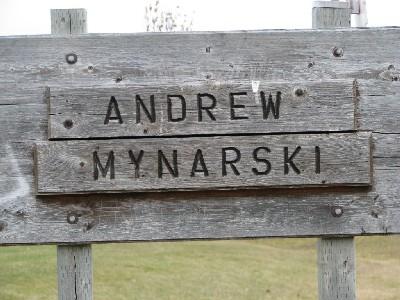
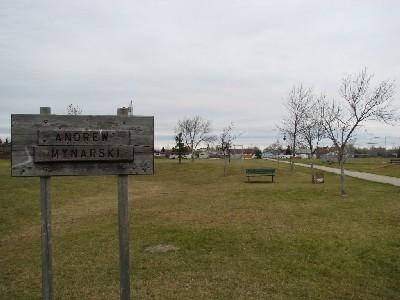
Andrew Mynarski VC Park
in Canada
Yes
GPS Coordinates
49.9607476, -97.1850179
Inscription

[sign/enseigne]

ANDREW
MYNARSKI

Image
Photo Credit
Victor Jarman
Caption
front view
1 of 2 images
Image
Caption
sign
1 of 2 images
Province
!4v1620308560909!6m8!1m7!1s46978bu8gRapXdpJnvIjOQ!2m2!1d49.9607476302854!2d-97.18501785930489!3f181.2451072658985!4f-2.259174477399597!5f2.4520346957507217"
Body Content

This park is named after Andrew Mynarski, V.C. Mynarski was serving with 419 "Moose" Squadron when his plane was shot down. Preparing to jump from the blazing airplane, he saw that the rear gunner, Pat Brophy, was trapped in his gun turret, struggling to break free. Immediately, Mynarski turned from the escape hatch and made his way back through the flames, ignoring his friend's shouts of, "Go back! Save yourself!" After numerous attempts to release Brophy, Mynarski reluctantly make his way back to the hatch. His parachute and clothes ablaze, he offered his friend a final gesture of encouragement: he stood at attention and saluted. He jumped, but succumbed to his burns soon after landing. Miraculously, Brophy survived the crash. The plane hit a tree as it crashed to earth, breaking open the gun turret and throwing him free. He thus lived to tell of Pilot Officer Andrew Mynarski's bravery. Andrew Mynarski was awarded the Victoria Cross posthumously for his effort to save another's life.

City
Winnipeg
Country
Type Description
Park
Memorial CF Legacy ID
7271
City/Municipality
Winnipeg
Memorial Number
46010-049
Type
Address
Selkirk Avenue and Battery Street
in Canada
Yes
GPS Coordinates
49.9215141, -97.1641803
Inscription

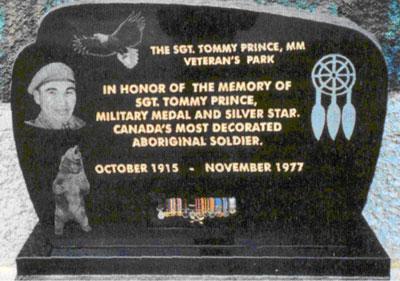
[slab front/devant de la dalle]

THE SGT. TOMMY PRINCE, MM.
VETERAN’S PARK

IN HONOR OF THE MEMORY OF
SGT. TOMMY PRINCE,
MILITARY MEDAL AND SILVER STAR.
CANADA’S MOST DECORATED
ABORIGINAL SOLDIER

OCTOBER 1915 – NOVEMBER 1977

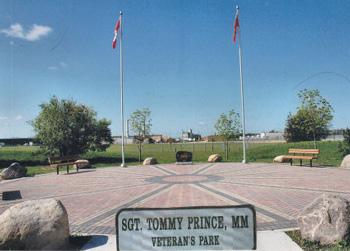
[plaque]

SGT. TOMMY PRINCE, MM
VETERAN'S PARK

Image
Photo Credit
Lynne & Norm Van Tassel
Caption
Stele front
1 of 2 images
Image
Caption
Military plaza and plaque
1 of 2 images
War or Conflict Term
Province
!4v1618419615919!6m8!1m7!1s_OPMjQS9QDHod4UieuwPsQ!2m2!1d49.92151407012112!2d-97.16418029625531!3f209.32394630733683!4f-0.7394393657025375!5f2.299968626952992
Body Content

A Tommy Prince boulder was unveiled on October 6, 2013, replacing the old monument that was vandalized. The 12 boulders placed around the circular plaza symbolize 12 warriors and the 12 trees behind them stand for each of Prince’s medals. The 13th boulder represents Tommy Prince.

Sergeant Tommy Prince was a prominent Anishinaabe activist who served in the Second World War and Korean War. His story is one of the most widely known examples of the wartime contributions of Indigenous soldiers in the mid-20th century and the poor treatment they received upon their return to civilian life in Canada. His accomplishments attracted national media attention during his lifetime and earned him a great many posthumous tributes.

Prince was born in October 1915 in St. Peter's Reserve, Manitoba. He was the great-grandson of respected Ojibwa Chief Peguis, and one of eleven children born to Elizabeth and Henry Prince. In 1920, they moved to Brokenhead Ojibway Nation in Scanterbury, Manitoba. At age five, Prince was forced to leave his community and attend Elkhorn Residential School, where he joined the Cadet Corps. He suffered from post-traumatic stress disorder from the residential school before he joined the military.

In 1940, he volunteered to fight for Canada in the Second World War. He rose from sapper to lance corporal with the Royal Canadian Engineers before volunteering for the 1st Canadian Parachute Battalion in 1942. Soon after, he was assigned to the elite 1st Canadian Special Service Battalion, which was attached to the First Special Service Force (Devil’s Brigade). He reached the rank of sergeant by war’s end, and was one of three Canadians to receive both the Silver Star (United States) and the Military Medal. King George VI presented him with both honours during a ceremony at Buckingham Palace in 1945, shortly before Prince’s discharge from the army. 

He wanted to prove his people were as good as any white man and restore their good name. One way to achieve this was to acquire as many medals as possible and he did so without putting his men at risk. Before any patrols he would ensure they were camouflaged and everything was secured. Often he would patrol alone because there would be less noise. Prince was a natural warrior and he excelled as the military developed the skills he learned on the reserve while living off the land. He loved the Devil's Brigade and was always praising his men, "If it wasn't for my men, I wouldn't be who I am today." He was a caring man who loved to joke around and make people laugh.

He was a prominent leader in the Indigenous rights movement of the 1940s. After the war, he served as spokesperson and vice-president of the Manitoba Indian Association, and appeared on its behalf before a Special Joint Committee of the Senate and House of Commons, tasked with studying the Indian Act. During his testimony in 1947, he advocated for the abolition of the Indian Act and respect for existing treaties, and presented submissions from Indigenous in Manitoba, which called for improved schools, better living conditions, and expanded hunting, trapping, and fishing rights.

In 1950, Prince re-enlisted in the Korean War. He contributed to the defence of Hill 677 in the Battle of Kapyong in 1951, for which the United States awarded the Princess Patricia’s Canadian Light Infantry the Distinguished Unit Citation—the only time a Canadian unit has received this honour. Military service took a heavy toll on his health and, following his honourable discharge from the army, he faced a difficult return to civilian life in Manitoba. Prince endured discrimination, illness, and poverty in the years that followed and died in 1977. He fought many demons after residential school and the horrors of combat, but he never lost his humility, self-worth, sense of humour and pride of being Anishinaabe. 

City
Winnipeg
Country
Type Description
Park, plaza, stele, plaque
Memorial CF Legacy ID
6920
City/Municipality
Winnipeg
Memorial Number
46010-024
Type
Address
340 Amherst Street
in Canada
Yes
GPS Coordinates
49.8842866, -97.2227185
Inscription

KAPYONG PARK

[boulder]
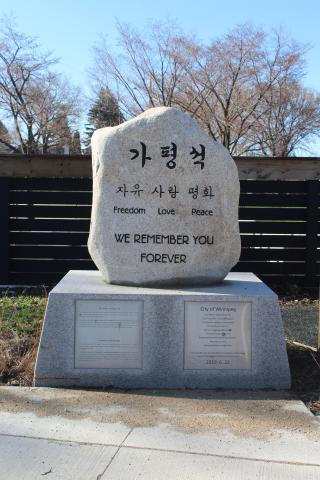
Freedom   Love   Peace

WE REMEMBER YOU
FOREVER

(plaque)
The Battle of Kapyong

On the night of April 23-24, 1951, the 2nd Battalion, Princess Patricia's Canadian light Infantry withstood
heavy attacks in the Kapyong River Valley by forces of the Chinese People's Volunteer Army which were
attempting to push forward to capture Seoul.

Isolated from other unites of the 27th British Commonwealth Brigade and at one point completely surrounded
by the enemy, the Patricia's gave up not one foot of ground, halting the huge eneme offensive and saving the
South Korean capital. For this gallant action the Princess Patricia's 2nd Battalion, which was in the chain of
command of an American Army Corps, was awarded the United States Presidential Unit Citation.

(plaque)
La bataille de Kapyong

La nuit du 23 au 24 avril 1951, dans la vallée de la rivière Kapyong, le deuxième bataillon du Princess
Patricia's Canadian light Infantry résista aux lourdes de l'armée de volontaires de la Chine qui
tentaient de capturer Séoul.

Isolé des autres unités de la 27e Brigade du Commonwealth britannique et à un moment donné complètement
encerclé par l'ennemi, le battaillon ne céda pas un pied de terrain, arrêtant l'énorme offensive et sauvant la
capitale sud-coréenne. Pour cette action courageuse, le deuxième bataillon du Princess Patricia's Canadian
Light Infantry, qui était dans la chaîne de commandement d'un corps d'armée américain, a reçu la United
States Presidential Unit Citation.

City of Winnipeg
City Mayor: Brian Bowman
City Counsellor: Scott Gillingham
The Korean Veterans Assocation
of Canada Inc. Unit 17
Korean Society of Manitoba
Presient: Kyu Yhon Cho
Kapyong Memorial Stone Donated by
Kapyong County
Kapyong Mayor: Sungki Kim

This boulder was quarried from the Kapyong Mountain
region in Korea where the battle took place

2019. 6. 22

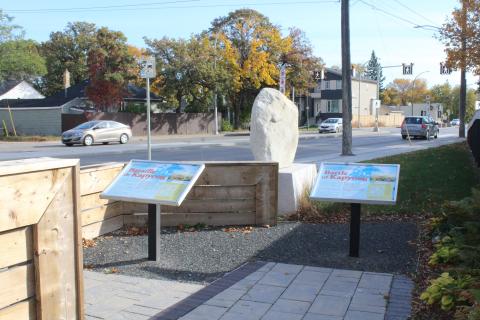
[English interpretive panel/panneau d’interprétation en anglais]

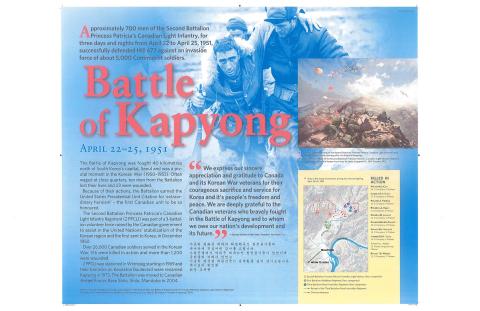
Approximately 700 men of the Second Battalion Princess Patricia’s Canadian Light Infantry, for three days and nights from April 22 to April 25, 1951, successfully defended Hill 677 against an invasion force of about 5,000 Communist soldiers.

Battle of Kapyong
April 22–25, 1951

The Battle of Kapyong was fought 40 kilometres north of South Korea’s capital, Seoul and was a pivotal moment in the Korean War (1950–1953). Often waged at close quarters, ten men from the Battalion lost their lives and 23 were wounded.

Because of their actions, the Battalion earned the United States Presidential Unit Citation for ‘extraordinary heroism’ – the first Canadian unit to be so honoured.

The Second Battalion Princess Patricia’s Canadian Light Infantry Regiment (2 PPCLI) was part of a 3-battalion volunteer force raised by the Canadian government to assist in the United Nations’ stabilization of the Korean region and the first sent to Korea, in December 1950.

Over 26,000 Canadian soldiers served in the Korean War, 516 were killed in action and more than 1,200 were wounded.

2 PPCLI was stationed in Winnipeg starting in 1969 and their barracks on Kenaston Boulevard were renamed Kapyong in 1973. The Battalion was moved to Canadian Armed Forces Base Shilo, Shilo, Manitoba in 2004.

“We express our sincere appreciation and gratitude to Canada and its Korean War veterans for their courageous sacrifice and service for Korea and it's people's freedom and peace. We are deeply grateful to the Canadian veterans who bravely fought in the Battle of Kapyong and to whom we owe our nation's development and its future.” - Korean Society of Manitoba, President, Kyu Hyun Cho

Killed in action
Private M.S. Carr 24, D Company, 12 Platoon
Corporal G.R. Evans 23, B Company, 6 Platoon
Private L.T. Fielding 23, B Company, 6 Platoon
Private C.A. Hayes 21, B Company, 6 Platoon
Private J.M. Lessard 23, D Company, 12 Platoon
Private B.M. MacDonald 20, D Company, 12 Platoon
Private W.J. Marshall 22, D Company, 12 Platoon
Private R.G.H. Tolver 26, B Company, 6 Platoon
Private R.L. Walker 23, Pioneer (engineering) Platoon
Private T.B. Wotton 22, D Company, 11 Platoon

[French interpretive panel/panneau d’interprétation en français]

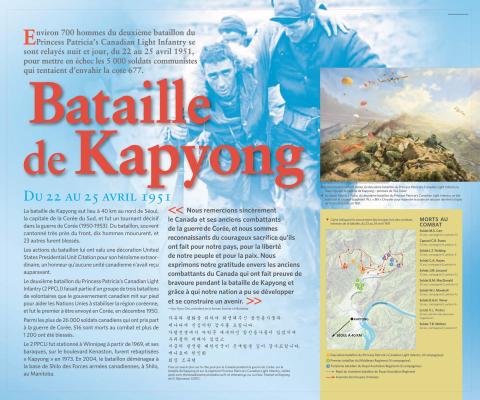
Environ 700 hommes du deuxième bataillon du Princess Patricia’s Canadian Light Infantry se sont relayés nuit et jour, du 22 au 25 avril 1951, pour mettre en échec les 5 000 soldats communistes qui tentaient d’envahir la cote 677.

Bataille de Kapyong
Du 22 au 25 avril 1951

La bataille de Kapyong eut lieu à 40 km au nord de Séoul, la capitale de la Corée du Sud, et fut un tournant décisif dans la guerre de Corée (1950-1953). Du bataillon, souvent cantonné très près du front, dix hommes moururent, et 23 autres furent blessés.

Les actions du bataillon lui ont valu une décoration United States Presidential Unit Citation pour son héroïsme extraordinaire, un honneur qu’aucune unité canadienne n’avait reçu auparavant.

Le deuxième bataillon du Princess Patricia’s Canadian Light Infantry (2 PPCLI) faisait partie d’un groupe de trois bataillons de volontaires que le gouvernement canadien mit sur pied pour aider les Nations Unies à stabiliser la région coréenne, et fut le premier à être envoyé en Corée, en décembre 1950.

Parmi les plus de 26 000 soldats canadiens qui ont pris part à la guerre de Corée, 516 sont morts au combat et plus de 1 200 ont été blessés.

Le 2 PPCLI fut stationné à Winnipeg à partir de 1969, et ses baraques, sur le boulevard Kenaston, furent rebaptisées « Kapyong » en 1973. En 2004, le bataillon déménagea à la base de Shilo des Forces armées canadiennes, à Shilo, au Manitoba.

« Nous remercions sincèrement le Canada et ses anciens combattants de la guerre de Corée, et nous sommes reconnaissants du courageux sacrifice qu’ils ont fait pour notre pays, pour la liberté de notre peuple et pour la paix. Nous exprimons notre gratitude envers les anciens combattants du Canada qui ont fait preuve de bravoure pendant la bataille de Kapyong et grâce à qui notre nation a pu se développer et se construire un avenir. » – Kyu Hyun Cho, président de la Korean Society of Manitoba

Morts au combat
Soldat M.S. Carr, 24 ans, compagnie D, peloton 12
Caporal G.R. Evans, 23 ans, compagnie B, peloton 6
Soldat L.T. Fielding, 23 ans, compagnie B, peloton 6
Soldat C.A. Hayes, 21 ans, compagnie B, peloton 6
Soldat J.M. Lessard, 23 ans, compagnie D, peloton 12
Soldat B.M. MacDonald, 20 ans, compagnie D, peloton 12
Soldat W.J. Marshall, 22 ans, compagnie D, peloton 12
Soldat R.G.H. Tolver, 26 ans, compagnie B, peloton 6
Soldat R.L. Walker, 23 ans, peloton des pionniers (ingénierie)
Soldat T.B. Wotton, 22 ans, compagnie D, peloton 11

Image
Photo Credit
City of Winnipeg
Caption
Interpretive panels
1 of 6 images
Image
Photo Credit
City of Winnipeg
Caption
English interpretive panel inscription
1 of 6 images
Image
Photo Credit
City of Winnipeg
Caption
French interpretive panel inscription
1 of 6 images
Image
Photo Credit
Murray Peterson
Caption
Kapyong Park
1 of 6 images
Image
Photo Credit
Murray Peterson
Caption
Kapyong Park
1 of 6 images
Image
Photo Credit
Murray Peterson
Caption
boulder
1 of 6 images
War or Conflict Term
Province
!4v1649350217839!6m8!1m7!1sB-Z5fdOp6TM6lNepgUjr6A!2m2!1d49.88428655086264!2d-97.22271853232165!3f169.19369486449065!4f-13.516700653831066!5f1.574408531506895
Body Content

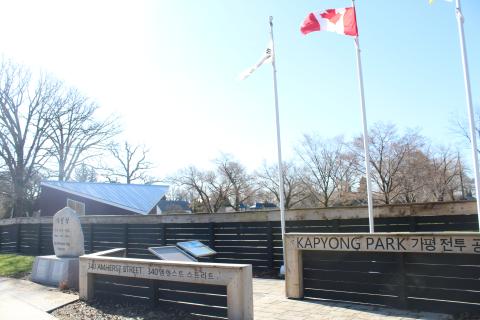
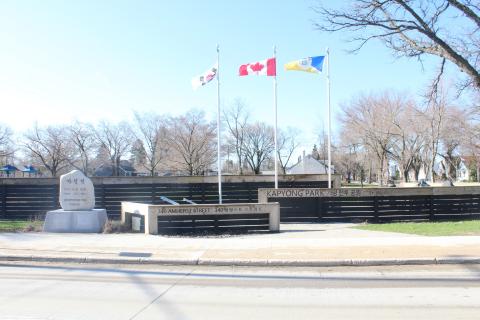
Kapyong Park is a place for reflection on a key battle in Canada’s military history and was officially opened in June, 2019. Ian Legge was the Planning, Property & Development Department’s Landscape Architect behind the project. He wanted to pay tribute to the ten fallen soldiers by featuring ten granite boulders in the park. The boulders sit opposite from 70 white blocks, which also serves as seating for people. 

The chaotic paving stone pattern in the space between the boulders and blocks represent the two sides fighting. Legge designed the park elements to gradually increase in size the further west it goes and is oriented in the direction of Kapyong. The fence starts off really low and then has a raised angle which represents the ascent to the hill towards which the Canadians were fighting from.

The South Korean Government gifted a large granite boulder from the Kapyong region which can be seen at the entrance to Kapyong Park.

City
Winnipeg
Country
Type Description
Park, boulders, interpretive panels
Memorial CF Legacy ID
10854
City/Municipality
Winnipeg
Memorial Number
46010-016
Type
Address
Memorial Boulevard and York Avenue
in Canada
Yes
GPS Coordinates
49.8876067, -97.149184
Inscription

[plaque]

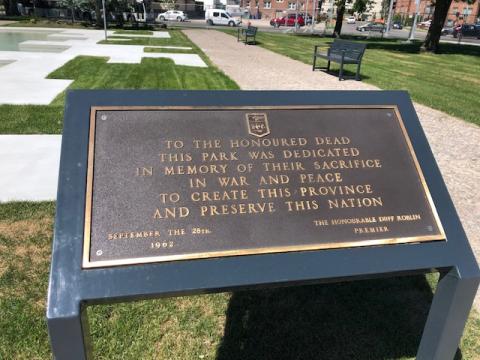
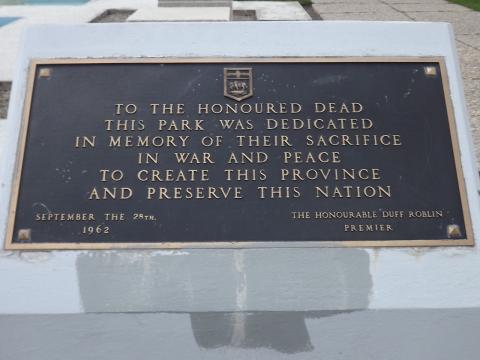
TO THE HONOURED DEAD
THIS PARK WAS DEDICATED
IN MEMORY OF THEIR SACRIFICE
IN WAR AND PEACE
TO CREATE THIS PROVINCE
AND PRESERVE THIS NATION

SEPTEMBER THE 28TH
1962

THE HONOURABLE DUFF ROBLIN
PREMIER

[plaque]

TO THE HONOURED DEAD
THIS PARK WAS DEDICATED
IN MEMORY OF THEIR SACRIFICE
IN WAR AND PEACE
TO CREATE THIS PROVINCE
AND PRESERVE THIS NATION

SEPTEMBER THE 28TH
1962

THE HONOURABLE DUFF ROBLIN
PREMIER

Image
Photo Credit
Manitoba Government
Caption
Memorial Provincial Park
1 of 4 images
Image
Photo Credit
Manitoba Government
Caption
Memorial Provincial Park
1 of 4 images
Image
Photo Credit
Manitoba Government
Caption
plaque
1 of 4 images
Image
Photo Credit
Manitoba Government
Caption
plaque
1 of 4 images
War or Conflict Term
Province
!4v1633453576866!6m8!1m7!1syszbJeDnxgJOIF0qKLrFPA!2m2!1d49.88760667794886!2d-97.14918400938053!3f167.5021248169174!4f3.5807466290682584!5f0.7820865974627469
Body Content

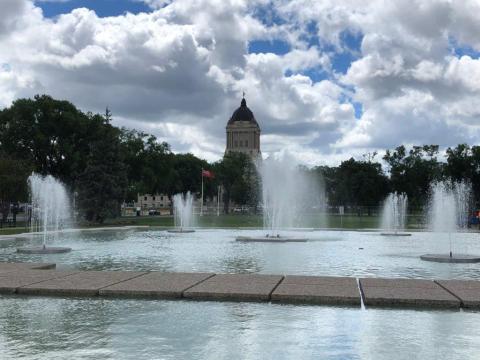
Memorial Provincial Park was originally the site of the University of Manitoba’s Faculty of Science. When the University amalgamated its campus in the Fort Garry location in the 1950s, this site was slated to become the home of the new city hall for Winnipeg. Noting the presence of a First World War cenotaph on the site, a number of Legion branches petitioned for the site to instead become a memorial park. In addition to the First World War cenotaph, the park would recognize the sacrifices made by Canadian Military personnel during the Second World War.

In 1961, the province, which already owned an adjacent parcel of land, acquired the site from the city. Former premier Duff Roblin envisioned Memorial Provincial Park as "a fitting tribute to those who gave their lives for Freedom”. The provincial park, including the City Hydro Fountain, is recognized as a Canadian military memorial. Memorial Park was dedicated on September 28, 1962 by Lieutenant Governor Errick Willis and Premier Duff Roblin.

Military memorials in the park include the Stephenson Monument ‘Intrepid’Women’s Tri-Services Monument and Peacekeepers' Cairn. The Centennial Flame, British Commonwealth Air Training Plan Memorial – Airmen in Training, Cenotaph and flag poles are located outside the park on the Memorial Boulevard center median adjacent to the park.

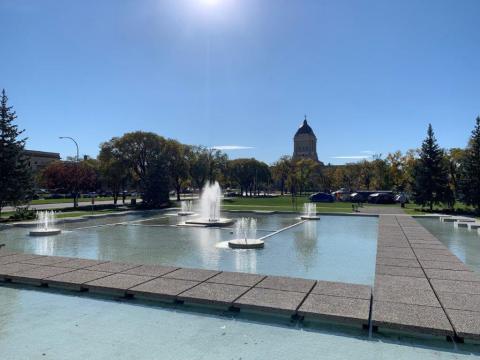
The City Hydro Fountain is a landmark attraction within the park. The original water feature included a central mechanized fountain, which included sweeping waterscapes and light shows that alluded, in colour and movement, to the northern lights. In 2021, the fountain was reopened after being restored through 2019 - 2020 as part of the massive refurbishment project for Manitoba's 150 celebrations in 2020.

City
Winnipeg
Country
Type Description
Park, plaque
Memorial CF Legacy ID
6713
City/Municipality
Winnipeg
Memorial Number
46010-014
Type
Address
Portage Avenue and Home Street
Location
Vimy Ridge Memorial Park
in Canada
Yes
GPS Coordinates
49.886032, -97.1681514
Inscription

[plaque/plaque]

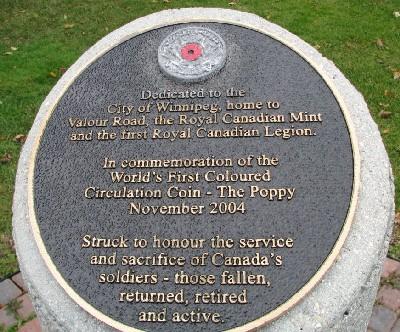
Dedicated to the
City of Winnipeg, home to
Valour Road, the Royal Canadian Mint
and the first Royal Canadian Legion.

In commemoration of the
World's First Coloured
Circulation Coin - The Poppy
November 2004

Struck to honour the service
and sacrifice of Canada's
soldiers - those fallen,
returned, retired
and active.

Image
Photo Credit
Victor Jarman
Caption
plaque
Province
!4v1620221960346!6m8!1m7!1sMJatu0i83XSMgCjC75IE3A!2m2!1d49.88586199972715!2d-97.16808844521348!3f136.34106956164794!4f0.8242671490798585!5f1.744801137306279"
Body Content

This plaque commemorates the world's first coloured circulation coin, The Poppy, November 2004. The coin was made to honour Canadian soldiers.

City
Winnipeg
Country
Type Description
Park
Memorial CF Legacy ID
7264
City/Municipality
Winnipeg
Memorial Number
46010-013
Type
Address
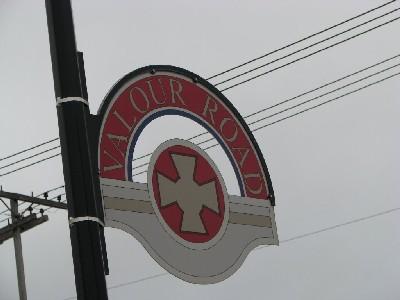
Valour Road and Sargent Avenue
in Canada
Yes
GPS Coordinates
49.8974153, -97.1877828
Inscription

[sign/enseigne]

VALOUR ROAD

Image
Photo Credit
Victor Jarman
Caption
front
1 of 3 images
Image
Caption
front
1 of 3 images
Image
Caption
sign
1 of 3 images
Province
!4v1620221723398!6m8!1m7!1ssq4DQXcCvFVUqgw2EzeBTQ!2m2!1d49.89741527956763!2d-97.18778281973698!3f21.602173001047635!4f2.161233016988973!5f1.5059105464351141"
Body Content

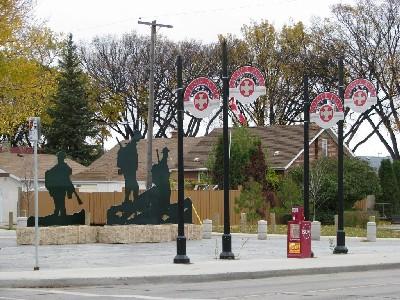
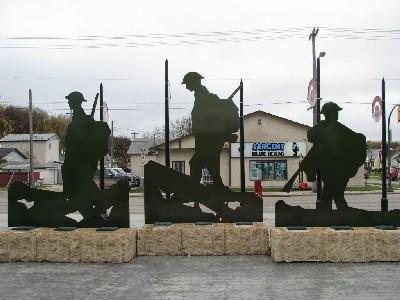
This area was dedicated on 5 November 2004. It honours the contributions of Cpl Leo Clark, Sgt-Major Frederick Hall and Lt. Robert Shankland, each awarded the Victoria Cross. The plaza was designed by landscape architect David Wagner. Pine Street was renamed Valour Road in their honour as well (see memorial # 46010-002)

City
Winnipeg
Country
Type Description
Park
Memorial CF Legacy ID
7731