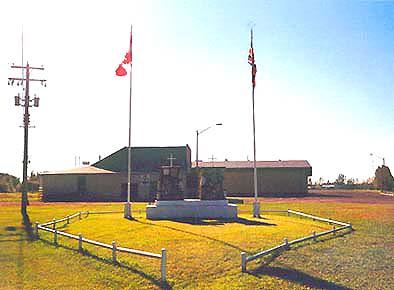
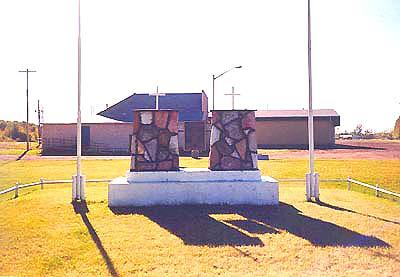
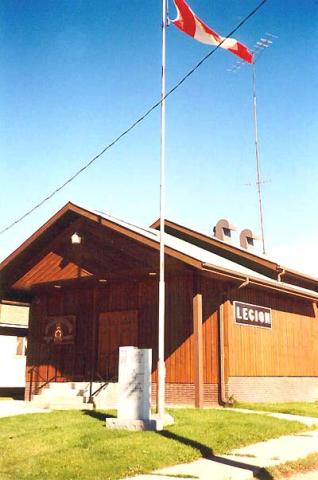
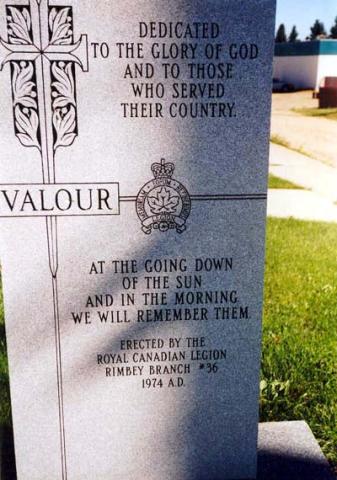
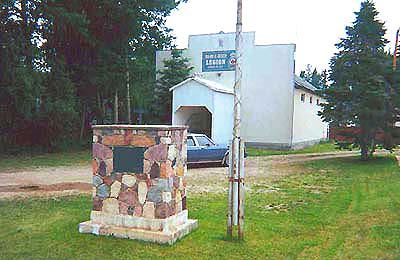
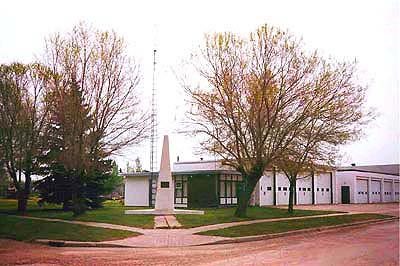
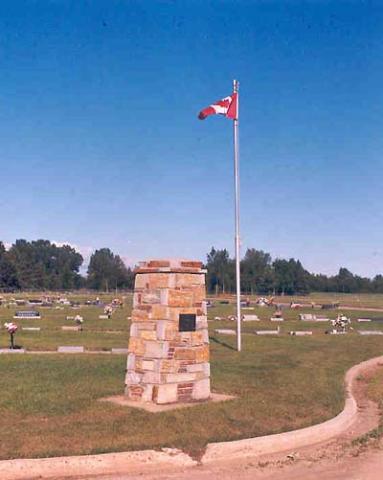
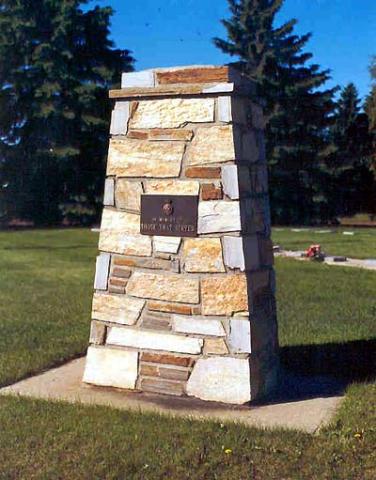
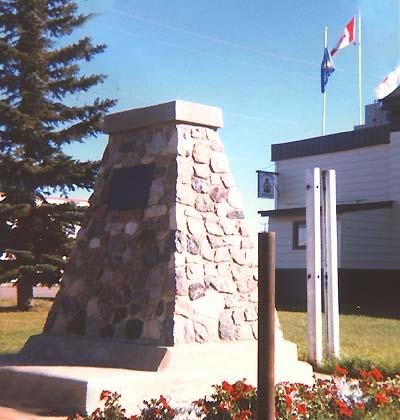
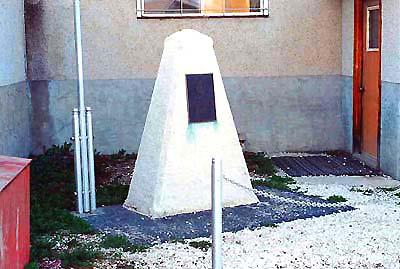
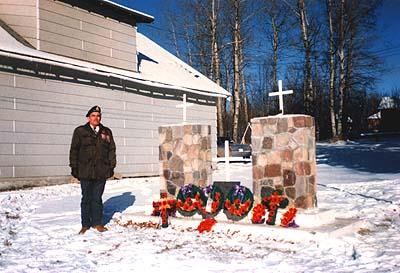
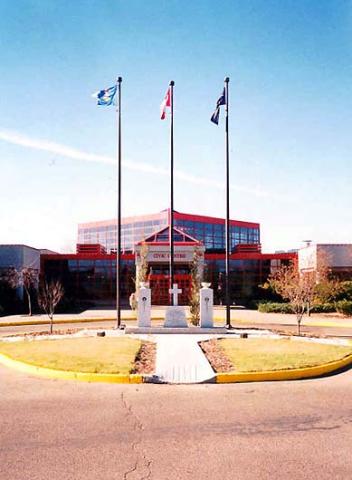
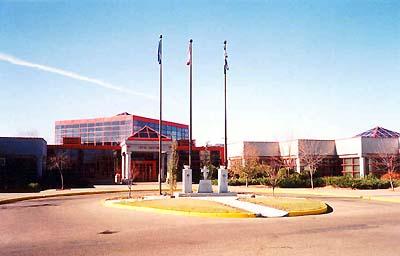
Erected by the Royal Canadian Legion, this memorial is dedicated to fallen soldiers.
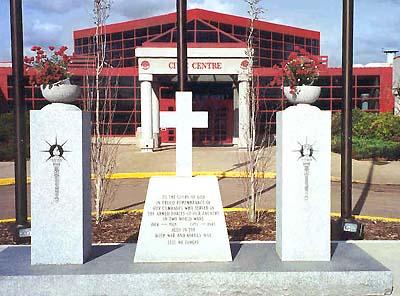
Royal Canadian Legion Branch No. 176 Memorial Pillars
[front/devant]
MORINVILLE BRANCH
My VAC Account
My VAC Account[front/devant]
MORINVILLE BRANCH
Erected by the Royal Canadian Legion, this memorial is dedicated to fallen soldiers.
[front/devant]
DEDICATED TO THE GLORY OF GOD AND IN MEMORY OF THE MEN AND WOMEN WHO SERVED OUR COUNTRY
1899 BOER WAR 1902
1914 WORLD WAR I 1918
1939 WORLD WAR II 1945
1950 KOREA 1953
"LEST WE FORGET"
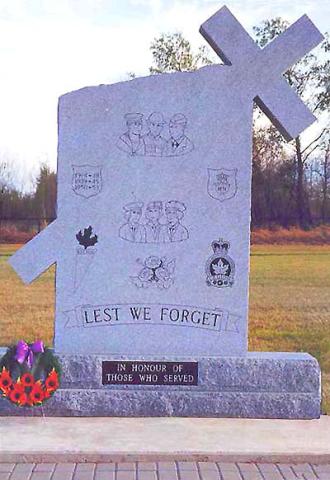
This memorial to the veterans of the South African War, the First and Second World Wars and the Korean War was erected by Royal Canadian Legion Branch No. 256.
[front/devant]
OUR GLORIOUS DEAD
1914 - 1918
ALBERT GOODMAN
CHARLES MALONEY
DOMILL KENNEDY
JOHN KENNEDY
HARRY MALONEY
OUR GLORIOUS DEAD
1939 - 1945
JOHN ARTYNUIK
MOSE BOUCHARD
PHILLIP HARNOIS
EMILE HEBERT
FRANK HOGAN
RAYMOND LIDDY
RYAN MCDONNELL
JOSEPH NOLAL
CHARLES TOUPIN
JOHN TURNBULL
[right side/côté droit]
needs further research/recherche incomplète
[left side/côté gauche]
KOREA
1950 - 53
The St. Albert Cenotaph has been updated and relocated multiple times since its creation. The original cenotaph was erected sometime after the end of the Second World War, most likely coinciding with the founding of the Royal Canadian Legion St. Albert Branch in 1957. It was a cement cross approximately four feet high, located on the front lawn of the St. Albert Community Hall. In the mid-1960s, a new cenotaph was constructed on the corner of Sir Winston Churchill Avenue and Green Grove Drive.
Due to noise from passing traffic, especially during each November’s moment of silence, the legion decided to relocate the cenotaph to its present location on St. Anne Street. This site was consecrated in the summer of 1987, with representatives present from the federal, provincial, and municipal governments, as well as dignitaries from the Royal Canadian Legion.
Of the approximately 625 local residents, 61 of them took up the call to arms. The town lent 10 per cent of its population to a fight half a world away. Locally there were 10 killed in action, only five of which had their names inscribed on the cenotaph. For nearly a decade, the names of Privates Moise Beausoleil, Wilfred Chevigny, Hector Duroche, Daniel Flynn, and William Laurence were missing.
In 2012, the Musée Heritage Museum began preparation for an exhibit that it would host two years later to commemorate the 100th anniversary of the beginning of the Great War. Their research determined that the names of five men from St. Albert were missing from the cenotaph. How these men were missed when the cenotaph was first built is still a mystery. Individual names of fallen soldiers were not added to the St. Albert Cenotaph until 2009, nearly a century after the end of the war.
On September 11, 2016, a public ceremony was held at the cenotaph recognizing the names of all 10 fallen heroes.
VETERANS' PARK
Veterans' Park was officially opened on September 22, 2011. The park was created around the Cenotaph and features eight interpretive panels with stories of those who served in the wars and Canadian peacekeeping missions.
ROYAL
CANADIAN
LEGION
R.L. ZENGEL V.C. BRANCH No. 8
"PRIDE IN OUR PAST, FAITH IN OUR FUTURE"
Raphael Louis Zengel was born on 11 November 1894 in Faribault, United States. While he was still very young, he and his mother moved from the United States to a homestead in Saskatchewan. Zengel enlisted in the Canadian Expeditionary Force in December 1914. He served overseas with the 5th Infantry Battalion, Canadian Expeditionary Force, taking part in several raids on German trenches. For his role in one of these raids, near Passchendaele in Belgium in 1917, Zengel received the Military Medal.
On 9 August 1918, Sergeant Zengel was leading his platoon forward during the second day of the massive Allied offensive against the German lines around Amiens, in France. When he noticed a gap on the flank of his platoon and an enemy machine gun firing on the advancing Canadians at close range, he quickly decided to deal with the machine gun position himself. Rushing 200 metres ahead of his platoon, Zengel charged the German emplacement, killing two of the machine gun’s crew and compelling the rest to flee. Later that day, when the progress of the 5th Battalion was blocked by heavy machine gun fire, he demonstrated great tactical skill in directing the fire of his platoon to eliminate the enemy resistance. Sergeant Zengel’s courage, leadership and disregard for his own safety inspired his men, and were important factors in enabling the advance to continue. For his conduct on this day, he was awarded the Victoria Cross. Zengel died in Vancouver, British Columbia on 27 February 1977.
After the war, Zengel lived in Calgary and joined the Calgary Fire Department in 1919 and served until 1927. He spent most of the rest of his life in Rocky Mountain House where the local Royal Canadian Legion Branch No. 8 was named in his honour. He donated his Victoria Cross to the Legion where it is kept in a safety box and a replica along with the rest of his medals are on display. His headstone can be found at Pine Grove Cemetery, Rocky Mountain House, Canada.
From 1941 to 1944, 35 pilots and instructors with the Royal Air Force were killed in Central Alberta. They were not killed in battles raging over war-torn countries in Europe or Asia; they died in Penhold and Bowden, while training for those dangerous assignments.
In 1941, the British Royal Air Force established the No. 36 Service Flying Training School in Penhold, just south of Red Deer. At its peak, up to 1,400 people trained in Penhold, with another 800 in training at Bowden. During day and night training fl ights, a variety of accidents occurred, claiming the lives of 35 airmen – students and instructors from Canada, Britain, Australia and New Zealand. The names of all 35 individuals are listed on the grey granite monument in the Penhold Field of Honour. However, only 22 of these men are buried in Red Deer Cemetery, and the remaining 13 are interred in Innisfail. The Penhold Field of Honour is maintained with funding from the Commonwealth War Graves Commission.
In the grounds of the Royal Canadian Legion there are three memorials. In September 1996 a plaque was erected in memory of the members of the Canadian Army who were killed during the First and Second World Wars, Korean War and Kuwait. A howitzer gun and plaque were installed in October 2001 to commemorate the Korea War Veterans. A large anchor and bronze plaque commemorates the men and women who served in the Royal Canadian Navy and the Merchant Navy during the First and Second World Wars, Korean War and Persian Gulf.
This anchor and plaque commemorate the men and women who served in the Royal Canadian Navy Merchant Marine. They also commemorate those who served in the First and Second World Wars, Korean War, Persian Gulf, and who participated in NATO and United Nations missions.
(needs further research/recherche incomplète)
The Willow Crescent Playground was renamed the Mynarksi Memorial Park in September 2004. Dedicated to the memory of Pilot Officer Andrew Charles Mynarksi, VC, a Second World War gunner who lost his life trying to rescue his crewmate in a burning Lancaster.
The following is an excerpt from the National Defence - Directorate of History and Heritage - Victoria Cross Biography
Victoria Cross - Second World War, 1939-1945 - Andrew Charles Mynarski
Andrew Charles Mynarski was born in Winnipeg, Manitoba on 14 October 1916. He joined the Royal Canadian Air Force (RCAF) in 1941. On the night of 12 to 13 June 1944, Pilot Officer Mynarski was the mid-upper gunner in an Avro Lancaster bomber of 419 Squadron, RCAF during an attack on the railway yards at Cambrai, in France. When the aircraft was attacked by a German night fighter, both port engines failed, and fire broke out between the mid-upper and rear gun turrets, as well as in the port wing fuel tanks. Soon the flames grew to such an extent that the pilot ordered the aircraft abandoned. As Mynarski left his turret and proceeded toward the escape hatch, he saw that the rear gunner, Flying Officer G.P. Brophy, was unable to get out of his turret, which could not be moved due to the failure of both the hydraulic and manual systems. At once Mynarski made his way aft through the fire in an attempt to free Brophy. With his parachute and the clothing below his waist now on fire, Mynarski strained to move the turret and release Brophy, but to no avail. At this point, Brophy indicated clearly that there was no more to be done, and that Mynarski should save himself. Reluctantly, Mynarski went back through the flames to the escape hatch and jumped, his parachute and clothing all on fire. After landing, he was eventually found by the French, but died due to the severity of his burns. For his courageous and selfless attempt to save his crewmate, Pilot Officer Mynarski was awarded the Victoria Cross posthumously. Miraculously, Flying Officer Brophy survived the crash of the stricken and abandoned Lancaster, and, courtesy of the French Resistance, was back in England in September.
[Honour Roll/tableau d’honneur]
HONOUR ROLL
Of members of Red Deer Lodge
No.12 A.F.&A.M. who volunteered for
service in the great war
[left column/colonne de gauche]
Wilfred Patterson
R.W. Alcock
G.W.G. Moore
G.R. Broughton
H.E. White
B.P. Alford
R.W. Harrison
J. Nurcombe
R. Parsons
R.W. Faulks
H.B. George
H.H. Kingzell
S.S. Sands
H. Wallace
[centre column/colonne du centre]
FOR
KING
AND
COUNTRY
[right column/colonne de droite]
W.H. Hadley
H.H. Drake
J.W. Hagey
H.J. Snell
E.H. Adair
J.G. McGregor
W.H.F. Harris
E.W. Bjorkeland
J.I. Mann
T.H. Edis
E.G.B. Greenwood
T.H. Reade
W.W. Webb
This Honour Roll lists the members of Red Deer Lodge No. 12 who volunteered for service for the First World War.
EX COELIS
MOUNTAINS
1ST CANADIAN PARACHUTE BATTALION
1942-1945
IN THE FIRST HOUR OF D-DAY, 6 JUNE 1944, THE BATTALION
PARACHUTED INTO NORMANDY FRANCE WITH THE[wording is not clear in the photo/le texte n’est pas clair sur la photo]
TO REMEMBER IS TO STRIVE FOR PEACE AMONGST ALL NATIONS.
On September 8, 2000, a ceremony was held to honour the men of the 1st Canadian Parachute Battalion. It was held near Siffleur Falls, about 365 km southwest of Edmonton and about 4 kilometres from the mountain named Ex Coelis, Latin for "out of the clouds". They jumped "out of the clouds" and this was the battalion's motto. A memorial was unveiled at this ceremony to mark the group's heroic wartime service. The massive four peaks of the Ex Coelis mountain represent the major campaigns the battalion fought in the Second World War: Normandy, Ardennes, Rhine and Elbe. The memorial, a sister to the Le Mesnil monument in size and shape, serves three purposes: to identify the mountain and the battalion, pay tribute to the men who rest in foreign lands and those who died after the war, and affirm that while battalion members were operationally part of the British 6th Airborne Division, their role as soldiers was as Canadians. The battalion, the forerunner of postwar Canadian airborne formations, suffered more than 540 casualties. The men of the group won 18 honours and awards and 19 Mentioned in Dispatches. The project was spearheaded by the late Norm Toseland, a former Lieutenant in the battalion. Walt Romanow, a battalion veteran, brought the project to completion. Source: The Western Sentinel story from The Edmonton Sun