Canadian Armed Forces

Goodman came home from his service with a souvenir he would only uncover 25 years later. He served in France and Belgium and was wounded in the Netherlands during the fighting in the Scheldt Estuary. His regiment was positioned near a Dutch farmhouse when they were attacked by the Germans and ended up covered in shrapnel. Goodman spent two weeks in a field hospital near Antwerp. Twenty-five years later, a British doctor would discover a piece of shrapnel, the size of a thumbnail, still lodged in his chest. His son now has this piece of shrapnel as a reminder of his father’s service.
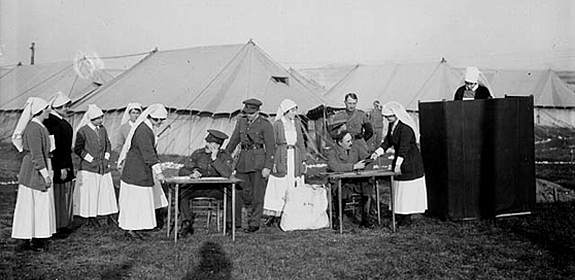

Pearson was reassigned to the South Saskatchewan Regiment in September 1944, arriving with a small group of reinforcements to bring the regiment up to strength after suffering numerous battle casualties. During the Second World War, Pearson served in Canada, Belgium, Holland, Germany and the United Kingdom.

Young Tommy Prince

Thomas George "Tommy" Prince was one of 11 children born to Henry and Arabella Prince of the Brokenhead Band at Scanterbury, Manitoba. He was a descendant of Peguis, the Saulteaux Chief who led his band of 200 Ojibwa from the Sault Ste. Marie region to the Red River in the 1790s, and of Chief William Prince, who headed the Ojibwa-Manitoba team of Nile Voyageurs.

Why were you sent to Egypt? What did you know about the mission?

I was sent to Egypt as a peacekeeper to be part of the Canadian Contingent United Emergency Forces in the Middle East for Operation DANACA. I was there from May to November 1978. My main role was to maintain the camp facilities, as well as some remote forward posts in the Sinai Peninsula.

Growing up in rural Newfoundland, Two-Spirit Indigenous Veteran Sharp Dopler had a curious mind and a gift for learning.

Dopler was born into a military family of Irish and Aniuyunwiya/Meskwakie/Ashkwakie descent, and despite passing as white, they experienced frequent acts of racial discrimination.

Although they were given unconditional acceptance and love by their family, Dopler’s self-esteem suffered. They said they never “really felt seen or good at anything.”

Deploying to the ice storm

I was with the 2nd Field Artillery Regiment in Montréal and I had just rejoined the army. I was a Lieutenant at the time. It was the first time the Reserves had been mobilized since the Second World War. I heard on the radio that reservists had to report to their units! I remember in those first few days we saw total darkness, then exploding blue transformers. It was surreal! I served three weeks during the operation.

Background

For most of Canada’s history, the military officially barred members of the 2SLGBTQI+ community from serving in uniform. This legacy of discrimination meant most of their stories were deeply buried. Recent research has brought more of these inspiring and heartbreaking stories to light.