Needs further research
Rivercrest Cenotaph
[front/devant]
LEST WE FORGET
[back/arrière]
(needs further research/recherche incomplète)
My VAC Account
My VAC Account[front/devant]
LEST WE FORGET
[back/arrière]
(needs further research/recherche incomplète)
Needs further research
[front/devant]
CANADA
1914 ROLL OF HONOUR 1919
OUR VOLUNTEERS FOR KING AND COUNTRY
A. ALLEN, F.B. BALDOCK, J.W. BALDOCK, O.F. BALDOCK, F.A. MCRAE, G. MASTERS, P.J. NYE, A. VANDAL, S. TAYLOR, W.J. SLATER, W. STEPHENS, F.W. GRIFFIN, G. HOLLAND, F. PRYME, F. BARTLETT, J. EMES, W. EMES, R. PREST, J.B. HOLMES, J. TOSHACK, S. WARD, J. PATERSON
KILLED IN ACTION
ERECTED BY PUBLIC SUBSCRIPTIONS OF THE RESIDENTS OF WEST ST. PAUL
This plaque was erected by the residents of West St. Paul in memory of the local men who died during the First World War.
[front/devant]
FOR KING AND COUNTRY
ROLL OF HONOUR
1939 - 1945
(needs further research/recherche incomplète)
MUNICIPALITY OF WEST ST. PAUL
PRESENTED BY THE WAR WORKERS CLUB
This memorial was presented by the War Workers' Club to the municipality of West St. Paul and is dedicated to the local war dead of the Second World War.
IN MEMORY OF
THE BOYS
OF EAST ST. PAUL
WHO GAVE THEIR LIVES
IN THE GREAT WAR
1914 - 1918
"LEST WE FORGET"
IN MEMORY OF
THE BOYS
OF EAST ST. PAUL
WHO GAVE THEIR LIVES
IN THE SECOND WORLD WAR
1939 - 1945
"LEST WE FORGET"
The East St. Paul Cenotaph was unveiled on May 28, 1921, by Major General Ketchen in memory of the soldiers of the municipality of East St. Paul who fell in the great war. It was dedicated on September 13, 1925, by Rev. R. W. Ridgeway of St. Thomas’ Anglican Church and Rev. J. W. McAlpine of Birds Hill United Church. A crowd of approximately 100 people including families of the fallen, East St. Paul Reeve W.J. Dawson and a number of other dignitaries attended.
The cenotaph is of Garson granite and was constructed and designed by Mr. A C Cox of Beausejour. It has curved pediments at the top and a carved wreath on the front.
A plaque on the cenotaph identifies the East St. Paul residents who lost their lives in the Great War. There are seventeen names on the plaque, but an eighteenth name was missed - Private Walter Chudleigh. Plaques were later dedicated to the war dead of the local area from the Second World War and the Korean War.
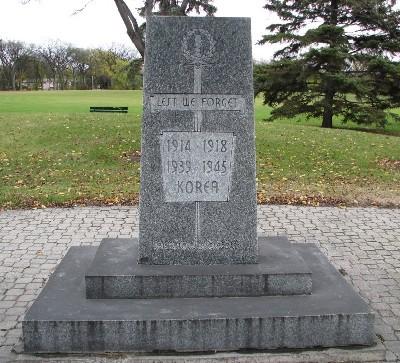
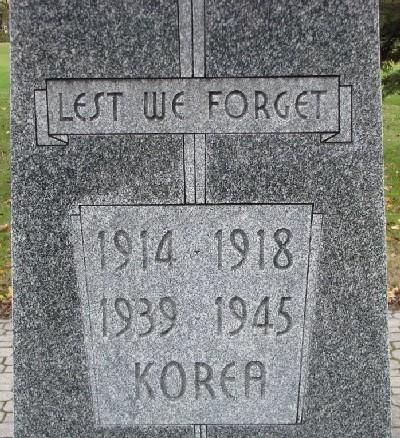
[front/devant]
LEST WE FORGET
1914 - 1918
1939 - 1945
KOREA
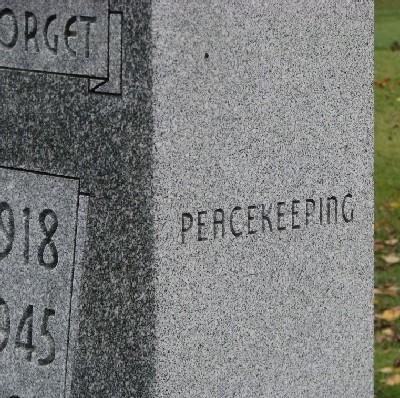
[side/côté]
PEACEKEEPING
This memorial is dedicated to the veterans of the First World War, Second World War, Korea and to Peacekeeping.
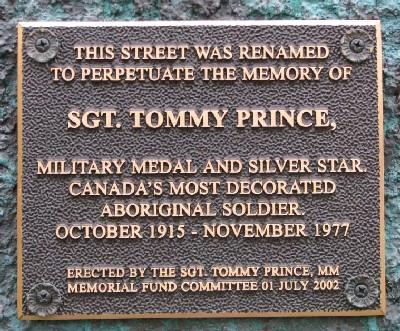
[plaque]
THIS STREET WAS RENAMED
TO PERPETUATE THE MEMORY OF
SGT. TOMMY PRINCE,
MILITARY MEDAL AND SILVER STAR
CANADA'S MOST DECORATED
ABORIGINAL SOLDIER
OCTOBER 1915 - NOVEMBER 1977
ERECTED BY THE SGT. TOMMY PRINCE, MM
MEMORIAL FUND COMMITTEE 01 JUNE 2002
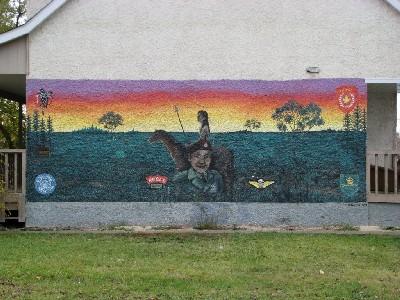
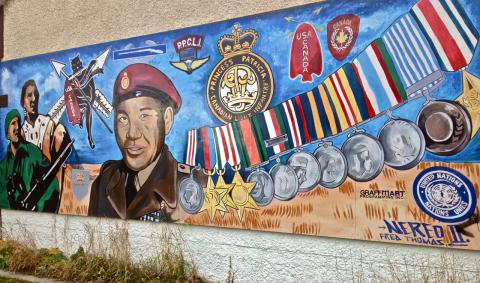
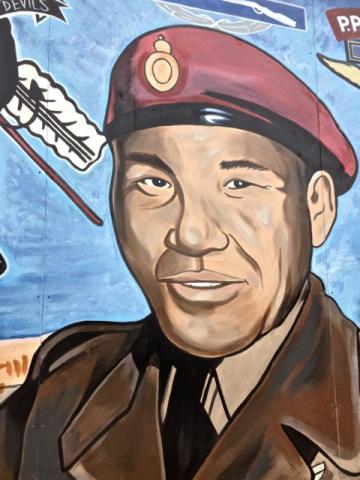
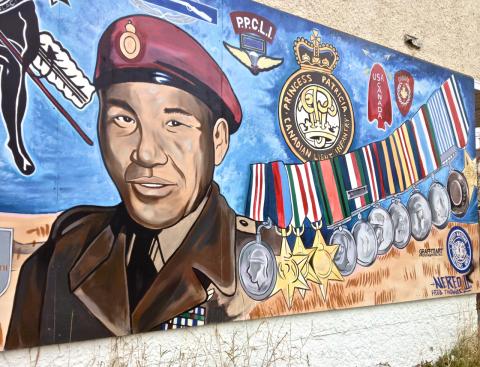
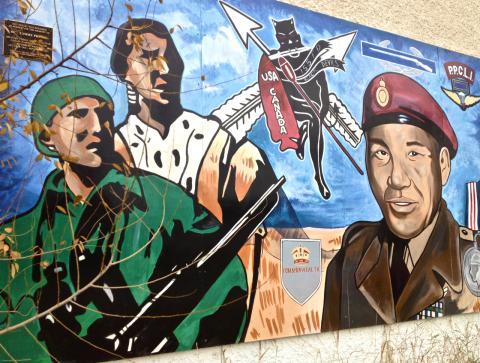
The Sergeant Tommy Prince Mural was unveiled on 17 September 2011. Fred Thomas designed the mural and his co-worker at the time, Nereo Eugenio, painted the mural with the help of some youth at Graffiti Art Programming. From left to right, the images in the mural include:
1. Prince as one with the land. He is dressed in uniform, but still a warrior as represented in the image behind him;
2. Devil holding First Special Service Force (Devil’s Brigade) shoulder patch;
3. United States Combat Infantry Badge which Prince received with the First Special Service Force (Devil’s Brigade).
4. Prince wearing a backwards beret as a Princess Patricia Canadian Light Infantry (PPCLI) soldier in the Korean War. The PPCLI Cap Badge on his beret would either be the 1933 or 1948 version he wore in Korea;
5. Jump Wings - the basic style worn for basic Para Qualified personnel. Prince was Jump Qualified from the Second World War;
6. PPCLI Cap Badge, the 1965 pattern which is current from 1956 to today;
7. First Special Service Force shoulder patch worn by the combined Canadian/United States troops;
8. 25th Canadian Infantry Brigade badge worn by troops in Korea;
9. Medals that Prince was entitled to.
Donald Mackey, chair of the Tommy Prince Military Medal Memorial Fund Committee, first met Prince in 1953 when they were both stationed in Winnipeg. An existing mural of Prince, who lived in the North End, was the target of repeated vandalism over the years and to help sustain the memory of Prince, Donald began fund raising for the new mural. Donald founded the Tommy Prince Royal Army Cadet Corps, located at 200 Isabel Street, for inner city youth in October 1999. He was also instrumental in the Tommy Prince Veteran's Park being established in 2007.
Sergeant Tommy Prince was a prominent Anishinaabe activist who served in the Second World War and Korean War. His story is one of the most widely known examples of the wartime contributions of Indigenous soldiers in the mid-20th century and the poor treatment they received upon their return to civilian life in Canada. His accomplishments attracted national media attention during his lifetime and earned him a great many posthumous tributes.
Prince was born in October 1915 in St. Peter's Reserve, Manitoba. He was the great-grandson of respected Ojibwa Chief Peguis, and one of eleven children born to Elizabeth and Henry Prince. In 1920, they moved to Brokenhead Ojibway Nation in Scanterbury, Manitoba. At age five, Prince was forced to leave his community and attend Elkhorn Residential School, where he joined the Cadet Corps. He suffered from post-traumatic stress disorder from the residential school before he joined the military.
In 1940, he volunteered to fight for Canada in the Second World War. He rose from sapper to lance corporal with the Royal Canadian Engineers before volunteering for the 1st Canadian Parachute Battalion in 1942. Soon after, he was assigned to the elite 1st Canadian Special Service Battalion, which was attached to the First Special Service Force (Devil’s Brigade). He reached the rank of sergeant by war’s end, and was one of three Canadians to receive both the Silver Star (United States) and the Military Medal. King George VI presented him with both honours during a ceremony at Buckingham Palace in 1945, shortly before Prince’s discharge from the army.
He wanted to prove his people were as good as any white man and restore their good name. One way to achieve this was to acquire as many medals as possible and he did so without putting his men at risk. Before any patrols he would ensure they were camouflaged and everything was secured. Often he would patrol alone because there would be less noise. Prince was a natural warrior and he excelled as the military developed the skills he learned on the reserve while living off the land. He loved the Devil's Brigade and was always praising his men, "If it wasn't for my men, I wouldn't be who I am today." He was a caring man who loved to joke around and make people laugh.
He was a prominent leader in the Indigenous rights movement of the 1940s. After the war, he served as spokesperson and vice-president of the Manitoba Indian Association, and appeared on its behalf before a Special Joint Committee of the Senate and House of Commons, tasked with studying the Indian Act. During his testimony in 1947, he advocated for the abolition of the Indian Act and respect for existing treaties, and presented submissions from Indigenous in Manitoba, which called for improved schools, better living conditions, and expanded hunting, trapping, and fishing rights.
In 1950, Prince re-enlisted in the Korean War. He contributed to the defence of Hill 677 in the Battle of Kapyong in 1951, for which the United States awarded the Princess Patricia’s Canadian Light Infantry the Distinguished Unit Citation—the only time a Canadian unit has received this honour. Military service took a heavy toll on his health and, following his honourable discharge from the army, he faced a difficult return to civilian life in Manitoba. Prince endured discrimination, illness, and poverty in the years that followed and died in 1977. He fought many demons after residential school and the horrors of combat, but he never lost his humility, self-worth, sense of humour and pride of being Anishinaabe.

Roll of Honour
The members of the Low Society of Manatoba served in
the Great War
These gave their lives (killed in action or who died of wounds)
| Archibald Joseph Anderson |
| Andrew Stuart Baird |
| Richard de Berghs Molyneux Bird |
| David Scott Borthwick |
| Russell Heath Boulton |
| John William Brown |
| Ralph Russell James Brown |
| John Scott Cameron |
| Harold Reid Campbell |
| Harward Eastman Chaffey |
| William Joseph Chalk |
| John Romeyn Dennistoun |
| Albert Ethelbert Aylward Evans |
| A. Francis |
| Charles Franklin Galbraith DFC |
| Hubert De’Arze Gill |
| William Forbes Guild MiD |
| Clendon Charles Heath |
| Francis Martin Hetherington |
| Robert Edward Higginbotham |
| Oscar Harrold Hollis |
| Ronald Hoskins |
| Edmund Lally Howell |
| Hugo Anthony Launcelot Ceadda Jackson |
| Charles Inglis Jameson |
| George Willis Jameson |
| Alexander G. Kemp |
| Hart Leech |
| Charles Herman Macneil |
| Christian Marie Jules Martel |
| William Lee Mawhinney |
| Ernest D’Harcourt McMeans |
| Clarence Harvey Miller |
| John Munro |
| Harold Arthur Newman |
| Glen Norton |
| Lamont Livingstone Paterson |
| Mowbray MacDonell Perdue |
| Aylwin Murray Pratt |
| James Sanford Price |
| Frederick Leopold Pusch DSO |
| John Edward Reynolds |
| James Ernest Robertson |
| Henry Awtry Robinson |
| George Huntington Ross |
| Fred Irwin Simpson |
| Thomas Edward Smith |
| Melbourne Robert Carter Smith |
| Robert Edmund Struthers |
| John Sutherland DSO |
| Edward Payson Thompson |
| Robert McDonnell Thomson |
| Charles Philip Uhrich |
| Charles Dorsett Ward |
| George Stephen Whittaker |
| Alman Clare Williams |
| Otto Russell Williams |
...
Roll of Honour
The members of the Law Society of Manatoba served in
the Second World War
These gave their lives
These also served
| John Edwin Bissett |
| Joseph Goodwin Butcher |
| Allan Lloyd Dyker |
| Ross Pringle Fahrni |
| Allan Munro Livingston |
| James Archibald MacKelvie |
| Sam Berry Sheps |
| Walter Edward Shields |
| Morris Marvin Soronow |
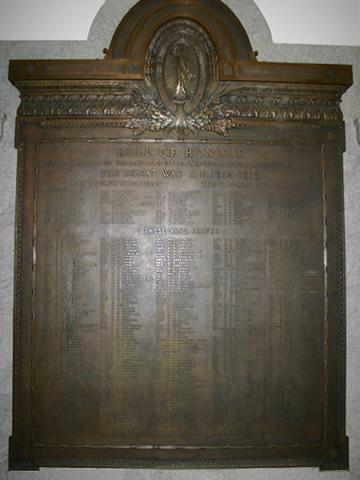
A tablet in honour of members of the Law Society of Manitoba who served during First World War was unveiled by the Governor General Sir Julian H. G. Byng of Vimy at a ceremony on 15 October 1923. In addition to listing all who served, it identifies those who were killed in action or who died of wounds. Weighing 1,025 pounds and having a surface area of 55 square feet, the tablet was designed by C.W. Chivers and was manufactured by the Architecural Bronze and Iron Works of Toronto. Lady Justice is depicted wearing a blindfold, carrying a sword in one hand and a balance, in the other.
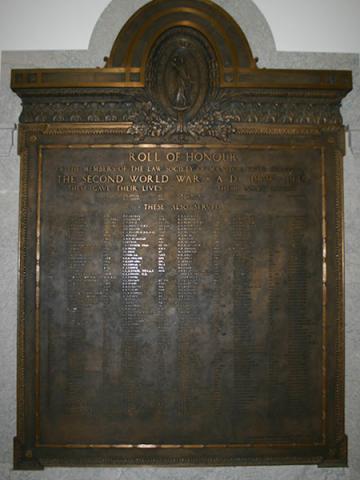
A similar tablet for the Second World War members of the Law Society was added after that war.
Both are located in the Broadway Avenue entrance of the Law Courts Building.
| Name |
| Harry Blackburn Adderley |
| Alwyn Clarence Brewer |
| Charles Bryan |
| Robert Thomas Campbell |
| Harold Cormick |
| Charlie Ronald Dier |
| James Frederick “Fred” Forster |
| Samuel Grills |
| John Ralph Hammond |
| Samuel Hanson |
| George William Hepworth |
| [Strathclair, Medical College] |
| Albert James Higgs |
| James Gordon Hill |
| Nelson Jarvis |
| William Arthur Johnson MM |
| George King |
| James Reid Locke |
| Ian Cameron Mallough |
| Heber Havelock Moshier |
| Colin Stewart Murray |
| Frank Samuel Occomore DCF |
| Daniel Fleming Pack |
| William Ross Pringle |
| Kelby Roseboro |
| Joseph Lawrence Smith |
| Cecil Beacham Spencer |
| William Slater Turner |
| Ernest Clifford Walters |
| John William Whittaker |
| Robert Wray |
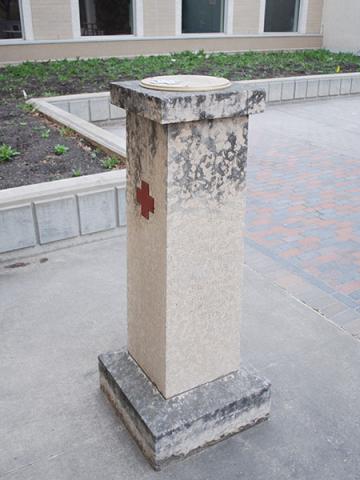
The 11th Canadian Field Ambulance (CFA) was formed by men of the Manitoba Agricultural College, along with those mobilized from other Western Canada universities. The Tyndall-stone pillar stands about four feet tall and features the engraved names of fallen battalion comrades of the First World War who died during their time in the unit or subsequently elsewhere as part of the Great War. The north, east, and south faces bear the faded names, with the western facade adorned only by the Red Cross emblem. The eastern face also features the emblem of the Canadian Army Medical Corps, and the memorial was initially capped with a bronze sundial. It was designed by CFA serviceman Christopher Thomas “Chris” Best (1889-1969). The formal unveiling took place on 16 October 1927 along the Avenue of Elms (Chancellor Matheson Road), on the grounds in front of the Administration Building, and across from the Manitoba Agricultural College War Memorial. It was later relocated to a raised plaza between the University Centre and the Faculty of Nursing Building / Helen Glass Centre for Nursing.
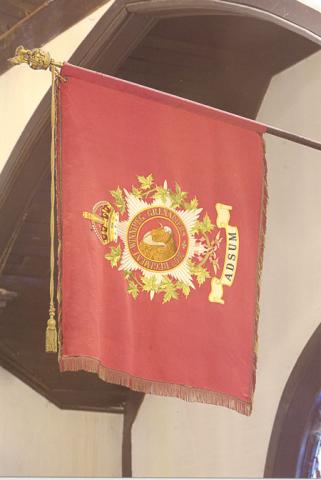
[regimental color flag/drapeau des couleurs du régiment]
100th REGIMENT WINNIPEG GRENADIERS
ADSUM
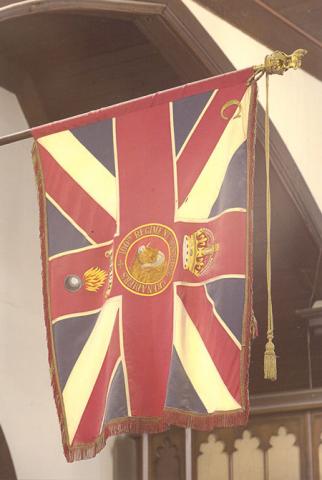
[Queen's colors flag/drapeau des couleurs de la Reine]
100th REGIMENT WINNIPEG GRENADIERS
ADSUM
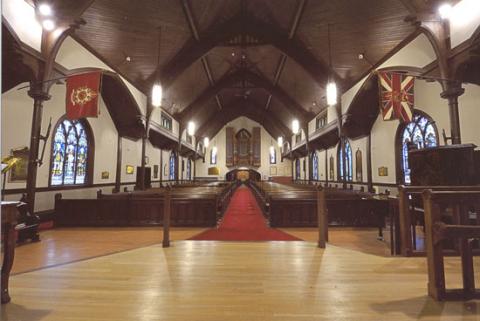
The 100 Regiment Winnipeg Grenadiers regimental colour flag and the queen colours flag hang inside the church among many other memorials of this regiment.
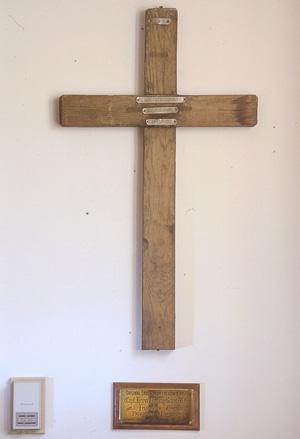
[Cross inscription/ inscription de la Croix]
(need further research/recherche incomplète)
[plaque/plaque]
ORIGINAL CROSS FROM THE GRAVE OF
CAPT HERVÉ MURRAY GRANT M.C.
FROM LISSENHOCK - CEMETARY.
PASSCHENBALE, FLANDERS
(need further research/recherche incomplète)
The Parish of St Luke erected this memorial. It was unveiled in St Luke in around 1919 and is dedicated to Capt Hervé Murray Grant M.C. killed in action during the Great War. This Cross is the original cross from his grave from Lijssenthoek cemetery, Passchendaele, Flanders.