Other

City/Municipality
Winnipeg
Memorial Number
46011-001
Type
Address
444 River Avenue
Location
St. Augustine United Church
in Canada
Yes
GPS Coordinates
49.8793793, -97.145678
Inscription

TO THE GLORY OF GOD AND
IN SACRED MEMORY OF
THOSE OF THIS CHURCH WHO
LAID DOWN THEIR LIVES IN
THE WORLD WAR

  • GEORGE ADAMS
  • ROBERT F. AITKEN
  • EARL ALLWARD
  • JOHN R. BAIRD
  • A. STUART BAIRD
  • S. PERCY BENSON
  • PETER W. BISSETT
  • DOUGLAS U. CAMERON
  • GEORGE W. CASLAKE
  • CECIL FARR
  • WILLIAM J. FERGUSON
  • LEONARD FOSTER
  • ALLAN W. FRASER
  • JOHN C. GRANT
  • JACK GRANT
  • AUGUSTINE HAGUE
  • W. J. D. HARRISON
  • ARCHIE HUNTER
  • J. G. HUNTER
  • V. R. KEELING
  • MAXWELL KRUSPE
  • JACK LUMSDEN
  • TOM LUMSDEN
  • HERB MAYBANK
  • JOSEPH MORTON
  • Wm. G. McCAULLY
  • JAMES McCLELLAN
  • DONALD MacDONALD
  • ALEX McFEAT
  • ROY McKELLAR
  • EDGAR A. McLENNAN
  • THOMAS PATTERSON
  • JAMES E. ROBERTSON
  • ROBERT W. SHIRLEY
  • GORDON SIMPSON
  • WILLIAM ROWE SMITH
  • ALFRED STEELE
  • A. McB SUTHERLAND
  • ROBERT SUTHERLAND
  • ROBERT B. YOUNG

THEY FOUGHT THIS GOOD FIGHT
NOT COUNTING THEIR LIVES DEAR
UNTO THEMSELVES THAT HONOUR
AND LIBERTY MIGHT BE PRESERVED.

Image
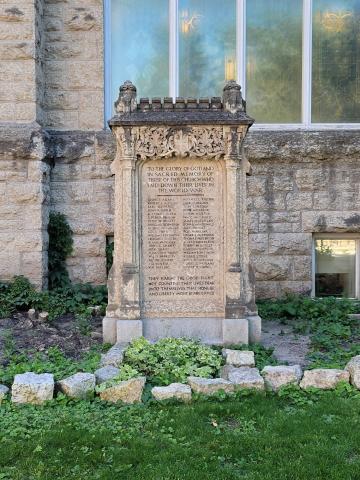
Photo Credit
Augustine Centre and Augustine United Church
Caption
front
1 of 2 images
Image
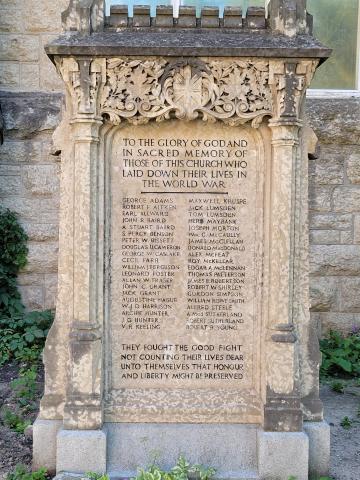
Photo Credit
Augustine Centre and Augustine United Church
Caption
inscription
1 of 2 images
War or Conflict Term
Province
!4v1620239688407!6m8!1m7!1sHDwj2JzaylpecDYXo14VVA!2m2!1d49.87938334726914!2d-97.14568752571525!3f139.7375092706146!4f-1.2836816631724304!5f3.325193203789971"
Body Content

This memorial is dedicated to the members of St. Augustine United Church who died in the First and Second World Wars. It was erected by St. Augustine United Church and designed by Arthur Alexander Stoughton.

City
Winnipeg
Country
Type Description
Stele - Tyndall stone
Memorial CF Legacy ID
5270
City/Municipality
Winnipeg
Memorial Number
46010-084
Type
Address
90 Sinclair Street
in Canada
Yes
GPS Coordinates
49.9177915, -97.1619738
Inscription

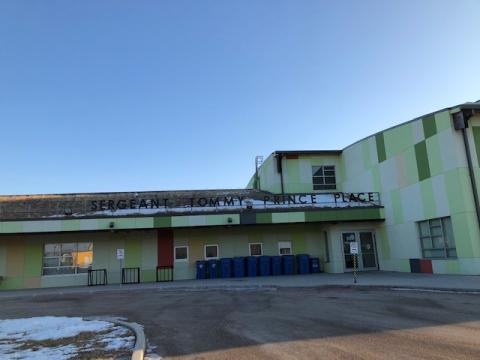
SERGEANT TOMMY PRINCE PLACE

Image
Photo Credit
City of Winnipeg
Caption
Sergeant Tommy Prince Place
War or Conflict Term
Province
!4v1613764314588!6m8!1m7!1sRHkXE6HRaTHZmXVwvfDUNw!2m2!1d49.91779151825786!2d-97.16197379429111!3f49.27453072510782!4f-0.778153807925932!5f1.9587109090973311
Body Content

North Centennial Recreation and Leisure Facility in Point Douglas was renamed Sergeant Tommy Prince Place in March 2017. Veterans, members of the Canadian Armed Forces and other dignitaries took part in a ceremony to honour Thomas George "Tommy" Prince.

Sergeant Tommy Prince was a prominent Anishinaabe activist who served in the Second World War and Korean War. His story is one of the most widely known examples of the wartime contributions of Indigenous soldiers in the mid-20th century and the poor treatment they received upon their return to civilian life in Canada. His accomplishments attracted national media attention during his lifetime and earned him a great many posthumous tributes.

Prince was born in October 1915 in St. Peter's Reserve, Manitoba. He was the great-grandson of respected Ojibwa Chief Peguis, and one of eleven children born to Elizabeth and Henry Prince. In 1920, they moved to Brokenhead Ojibway Nation in Scanterbury, Manitoba. At age five, Prince was forced to leave his community and attend Elkhorn Residential School, where he joined the Cadet Corps. He suffered from post-traumatic stress disorder from the residential school before he joined the military.

In 1940, he volunteered to fight for Canada in the Second World War. He rose from sapper to lance corporal with the Royal Canadian Engineers before volunteering for the 1st Canadian Parachute Battalion in 1942. Soon after, he was assigned to the elite 1st Canadian Special Service Battalion, which was attached to the First Special Service Force (Devil’s Brigade). He reached the rank of sergeant by war’s end, and was one of three Canadians to receive both the Silver Star (United States) and the Military Medal. King George VI presented him with both honours during a ceremony at Buckingham Palace in 1945, shortly before Prince’s discharge from the army. 

He wanted to prove his people were as good as any white man and restore their good name. One way to achieve this was to acquire as many medals as possible and he did so without putting his men at risk. Before any patrols he would ensure they were camouflaged and everything was secured. Often he would patrol alone because there would be less noise. Prince was a natural warrior and he excelled as the military developed the skills he learned on the reserve while living off the land. He loved the Devil's Brigade and was always praising his men, "If it wasn't for my men, I wouldn't be who I am today." He was a caring man who loved to joke around and make people laugh.

He was a prominent leader in the Indigenous rights movement of the 1940s. After the war, he served as spokesperson and vice-president of the Manitoba Indian Association, and appeared on its behalf before a Special Joint Committee of the Senate and House of Commons, tasked with studying the Indian Act. During his testimony in 1947, he advocated for the abolition of the Indian Act and respect for existing treaties, and presented submissions from Indigenous in Manitoba, which called for improved schools, better living conditions, and expanded hunting, trapping, and fishing rights.

In 1950, Prince re-enlisted in the Korean War. He contributed to the defence of Hill 677 in the Battle of Kapyong in 1951, for which the United States awarded the Princess Patricia’s Canadian Light Infantry the Distinguished Unit Citation—the only time a Canadian unit has received this honour. Military service took a heavy toll on his health and, following his honourable discharge from the army, he faced a difficult return to civilian life in Manitoba. Prince endured discrimination, illness, and poverty in the years that followed and died in 1977. He fought many demons after residential school and the horrors of combat, but he never lost his humility, self-worth, sense of humour and pride of being Anishinaabe. 

City
Winnipeg
Country
Type Description
Building
Memorial CF Legacy ID
9855
City/Municipality
Winnipeg
Memorial Number
46010-083
Type
Address
117 Regent Avenue East
Location
Royal Canadian Legion Branch 7
in Canada
Yes
GPS Coordinates
49.8950622, -97.0017583
Inscription

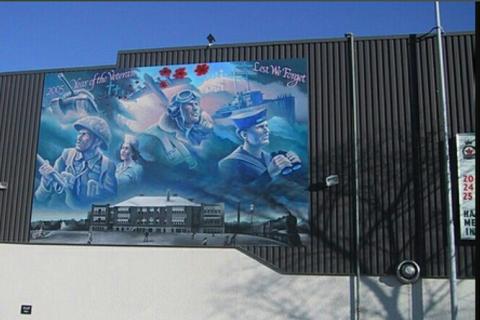
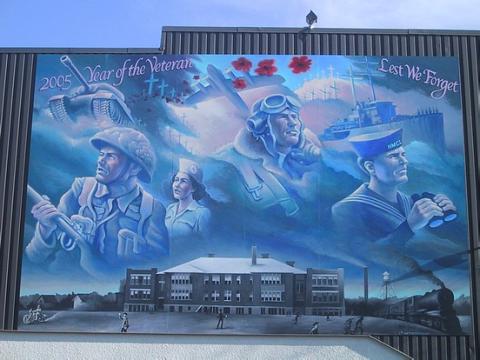
2006 year of the veteran

Image
Photo Credit
Victoria Edwards
Caption
117 Regent mural
1 of 2 images
Image
Caption
117 Regent mural
1 of 2 images
Province
!4v1605195143807!6m8!1m7!1s5MAkr0e52YOVdbh_-87dJA!2m2!1d49.89506218347529!2d-97.00175826878849!3f58.95559374636566!4f17.303252781425186!5f0.7820865974627469
Body Content

The 2006 year of the veteran mural was painted by Charlie Johnson. It considers children from Central School, who graduated and served as soldier, sailor, pilot or nurse. The mural depicts the HMCS Trancona and a Sherman tank.

City
Winnipeg
Country
Type Description
Mural
Memorial CF Legacy ID
9747
City/Municipality
Winnipeg
Memorial Number
46010-082
Type
Address
626 Sargent Avenue
in Canada
Yes
GPS Coordinates
49.8963917, -97.1606104
Inscription

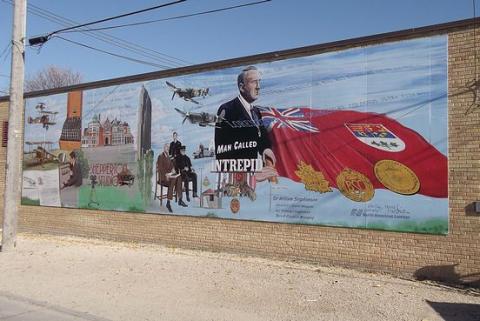
A man called intrepid, William Stephenson

Image
Photo Credit
Victoria Edwards
Caption
Mural
Province
!4v1620238394925!6m8!1m7!1scL4x1Yb8B0huYM4B4BZpSw!2m2!1d49.89639166047873!2d-97.16061040869518!3f93.387843309104!4f2.1875743693743317!5f0.7820865974627469"
Body Content

The mural by Dave Carty features WWI ace William Stephenson with 3 of the 5 Sopwith camels he flew - B7302, C8296 & D6476. He was in charge of intelligence in the western hemisphere, working out of the 36th floor of Rockefeller Centre.

City
Winnipeg
Country
Type Description
Mural
Memorial CF Legacy ID
9746
City/Municipality
Winnipeg
Memorial Number
46010-080
Type
Address
1 Navy Way
in Canada
Yes
GPS Coordinates
49.88591, -97.13761
Inscription

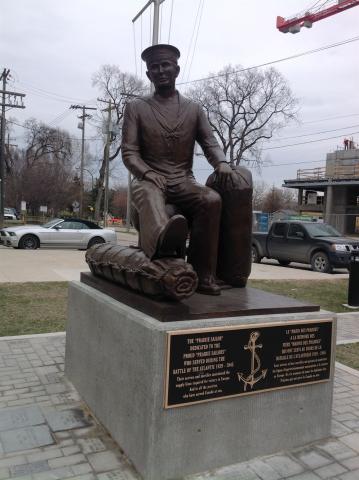
                   THE PRAIRIE SAILOR

  DEDICATED TO THE PROUD "PRAIRIE SAILORS"

                WHO SERVED DURING THE

          BATTLE OF THE ATLANTIC 1939 - 1945

 Their service and sacrifice maintained the supply lines

              required for victory in Europe.

And to all from the prairies who have served Canada at sea.

Image
Photo Credit
Christopher Edwin Thain
Caption
Prairie Sailor statue, Winnipeg
Province
!4v1620237769341!6m8!1m7!1sQ5Zz3WsQArTzF_Vi3Y72yQ!2m2!1d49.88594307302837!2d-97.137794620906!3f100.54275752488853!4f-4.402352125799013!5f3.112761922422178"
Body Content

The "Prairie Sailor" statue is dedcated to the exception number of prairie men who fought in the Battle of the Atlantic during WWII and all from the prairies who have served Canada at Sea. With over 300 officers and 8,000 other ranks having been recruited and initially trained onboard HMCS CHIPPAWA (making it the third largest naval wartime recuitment center only exceeded by those on either coast) it was deemed appropriate to erect a statue on the site of the present day CHIPPAWA.

The statue was created by Helen Granger Young, a noted Manitoba sculptress who is the widow of a wartime "prairie sailor."

The statue depicts a sailor in WWII uniform sitting on a bollard with his kit bag at his side.

The statue was a project of the Naval Museum of Manitoba and was funded by The Friends of the Naval Museum Inc.

The statue was dedicated on Battle of the Atlantic Sunday, May 4, 2014.

City
Winnipeg
Country
Type Description
Statue
Memorial CF Legacy ID
9321
City/Municipality
Winnipeg
Memorial Number
46010-079
Type
Address
580 Victor Street R3G 3A5
in Canada
Yes
GPS Coordinates
49.89598, -97.16322
Image
Photo Credit
Jim Busby
Caption
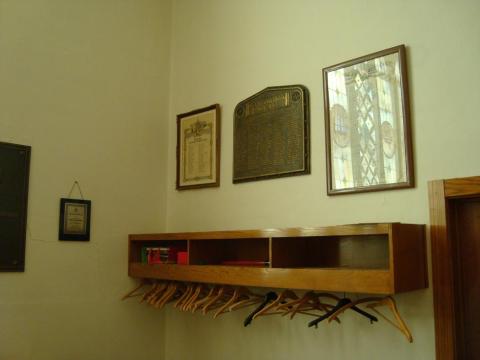
First Lutheran Church Honour Rolls
1 of 4 images
Image
Caption
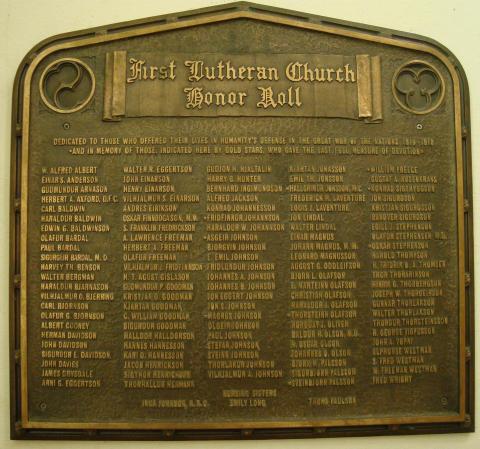
First Lutheran Church WW1 Honour Roll
1 of 4 images
Image
Caption
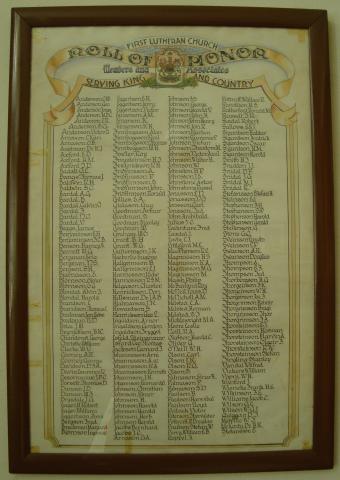
First Lutheran Church WW2 Honour Roll
1 of 4 images
Image
Caption
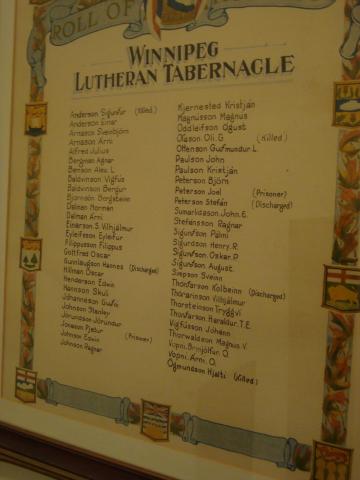
Winnipeg Lutheran Tabernacle WW1 Honour Roll
1 of 4 images
Province
!4v1620237628586!6m8!1m7!1sNYG2V6e1mMTZ0lEeuJEmHg!2m2!1d49.89589333021095!2d-97.16285870401546!3f300.58541491382465!4f23.109352770300973!5f0.7820865974627469"
Body Content

Honour Rolls to First Lutheran Church members who served in both world wars, located in the nathex of First Lutheran Church, Winnipeg

City
Winnipeg
Country
Type Description
Plaque
Memorial CF Legacy ID
9320
City/Municipality
Winnipeg
Memorial Number
46010-078
Type
Address
580 Victor Street R3G 3A5
Location
First Lutheran Church
in Canada
Yes
GPS Coordinates
49.89598, -97.16322
Inscription

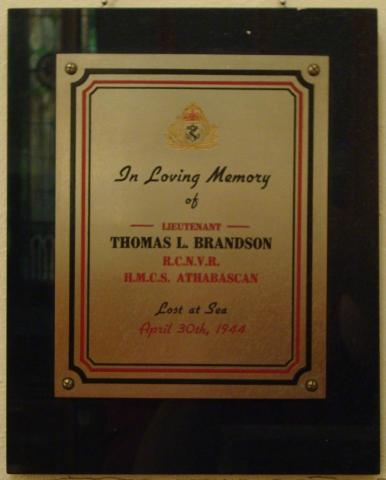
In loving memory of Lieutenant Thomas L Brandson, RCNVR, HMCS Athabascan Lost at Sea April 30, 1944

Image
Photo Credit
Jim Busby
Caption
TL Brandson memorial plaque
Province
!4v1620236840647!6m8!1m7!1sNYG2V6e1mMTZ0lEeuJEmHg!2m2!1d49.89589333021095!2d-97.16285870401546!3f306.5357856704495!4f26.439043020658247!5f0.7820865974627469"
Body Content

Memorial plaque to Lt Thomas L Brandson in the narthex of First Lutheran Church, Winnipeg

City
Winnipeg
Country
Type Description
Plaque
Memorial CF Legacy ID
9319
City/Municipality
Winnipeg
Memorial Number
46010-077
Type
Address
Bonnycastle Park, 260 Assiniboine Avenue in the Centre of Winnipeg
Location
Bonnycastle Dog Park
in Canada
Yes
GPS Coordinates
49.88648, -97.13416
Image
Photo Credit
Victoria Edwards
Province
!4v1620236549222!6m8!1m7!1sCAoSLEFGMVFpcFBOUmJzT2V5V21iTkNqZEFNRHlCbEQ0WTU3cDdSWVZITTJQbWF0!2m2!1d49.8864441!2d-97.1342239!3f46.57558451398425!4f-14.42044309790569!5f1.7216887195700386"
Body Content

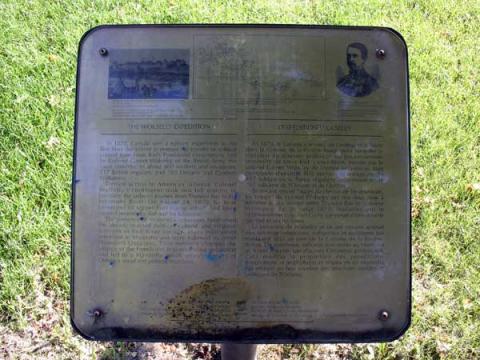
Wolseley Expedition Plaque (2009)

The memorial commemorates the 1870 Wolseley Expedition. Led by Colonel Garnet Wolseley of the British Army, the force consisted of about 800 workers and voyageurs, 417 British regulars, and 783 Ontario and Quebec militiamen. Denied access to American railways, Colonel Wolseley’s contingent took two full months to complete the arduous journey from Thunder Bay to the Winnipeg River. On 24 August 1870, he took command of Upper Fort Garry, which had been vacated recently by Louis Riel and his followers. The presence of Wolseley’s volunteers heightened the already strained political, cultural, and religious tensions in Red River society. Many militiamen remained in Manitoba and were followed by other Protestant Ontarians. Their numbers changed the balance of the French and English-speaking population and led to a Manitoba which reflected many of Ontario’s social and political structures.

City
Winnipeg
Country
Type Description
Plaque
Memorial CF Legacy ID
8755
City/Municipality
Winnipeg
Memorial Number
46010-076
Type
Address
661 Banning Street, Winnipeg, MB
in Canada
Yes
GPS Coordinates
49.8942288, -97.1718914
Inscription

[sign/panneau]

George Wolfe School

Image
Province
!4v1620236335668!6m8!1m7!1sxhyshXlXc5U9BSgaBQ93Lw!2m2!1d49.89422877883086!2d-97.17189142042587!3f133.89940920932776!4f-3.7008828032378602!5f0.7820865974627469"
Body Content

General Wolfe School, a junior high school for grades 7, 8, and 9, is named in honour of Major General James Peter Wolfe.

Major General James Peter Wolfe (January 1727 – September 1759) is known chiefly for his victory at the Battle of Quebec in 1759. The son of a distinguished general, Wolfe was destined for a military career, entering his father’s 1st Marine Regiment at the age of thirteen. He served during the War of the Austrian Succession (1740 – 1748) as well as in Flanders and in Scotland in 1746. The advancement of his career was halted by the Peace Treaty of 1748 and he spent much of the next eight years in garrison duty in the Scottish Highlands. Already a major at the age of eighteen, he was a lieutenant-colonel by the age of twenty-three.

The outbreak of the Seven Years’ War in 1756 offered Wolfe fresh opportunities for advancement. His part in the raid on Rochefort in 1757 led to his appointment as second-in-command of an expedition to capture the Fortress of Louisbourg. Following the success of the Siege of Louisbourg he was made commander of a force which sailed up the Saint Lawrence River to capture Quebec City. After a lengthy siege, Wolfe captured the city. Wolfe was killed at the height of the battle due to injuries from three musket balls.

City
Winnipeg
Country
Type Description
Building; school
Memorial CF Legacy ID
9134
City/Municipality
Winnipeg
Memorial Number
46010-075
Type
Address
195 Collegiate Street
Location
St. James the Assiniboine Anglican Church
in Canada
Yes
GPS Coordinates
49.87798, -97.2177255
Inscription

HE IS RISEN   HE IS NOT HERE   DID NOT OUR HEART BURN WITHIN US
WHILE HE TALKED WITH US BY THE WAY

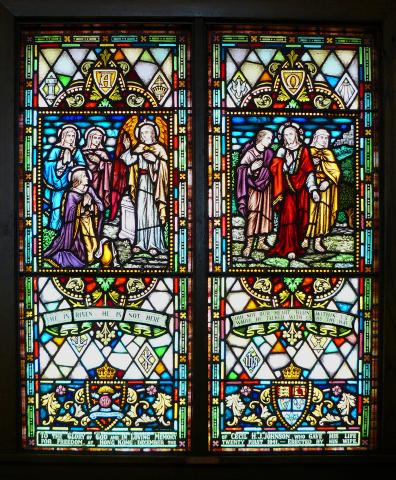
TO THE GLORY OF GOD AND IN LOVING MEMORY OF CECIL H.J. JOHNSON, WHO GAVE HIS LIFE

FOR FREEDOM, AT HONG KONG, DECEMBER THE TWENTY FIRST 1941. — ERECTED BY HIS WIFE.

Image
Caption
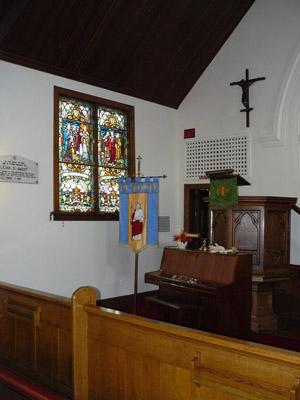
surroundings
1 of 2 images
Image
Photo Credit
Elizabeth Bonnett
Caption
stained glass window
1 of 2 images
Province
!4v1663076833545!6m8!1m7!1sNBoJS2U8wSfLk-kK-BdVVQ!2m2!1d49.87797996762688!2d-97.21772554465687!3f80.41890562594227!4f7.685144165614076!5f0.60830928560228
Body Content

This memorial, in memory of Cecil H.J. Johnson who had died at Hong Kong in December 1941, was donated by his widow.

Cecil Henry Johnson was a medical non-combatant with the Winnipeg Grenadiers in Hong Kong. After being captured by the Japanese army, the soldiers were walked to the internment camp and a soldier in front of Private Johnson tripped and fell. Johnson stopped to tend to him and their captors shot and killed both men. After the Second World War ended, the members of his battalion melted down their combat medals to create an award commemorating Private Johnson’s actions for his family.

The two window panels represent the last stage in the story of Jesus's life. Depicted on the left panel: The Women Come to the Tomb, when they found it empty. The window's bottom panel has the Coat of Arms of the Winnipeg Grenadiers, Private Johnson’s regiment. Depicted on the right panel: The Emmaus Road, one of the early resurrection appearances of Jesus after the crucifixion. The window's bottom panel has the Shield from the Coat of Arms of Canada, with green maple leaves, which were changed to red in 1957. The two window panels were the first to be installed after the Memorial Altar Window.


City
Winnipeg
Country
Type Description
Stained glass window
Memorial CF Legacy ID
8128