Other

City/Municipality
Toronto
Memorial Number
35091-044
Type
Address
620 Spadina Avenue
Location
St Vladimir’s Institute
in Canada
Yes
GPS Coordinates
43.662017, -79.40198
Inscription

[front/devant]

Recalling Canada's First National Internment Operations 1914-1920

A la mémoire des premières opérations d’internement nationale du Canada 1914-1920

Image
Photo Credit
Victoria Edwards
Caption
Plaque
Province
!4v1623087110203!6m8!1m7!1slvflUITKrDwC1Lpm0n8hsQ!2m2!1d43.66214981289934!2d-79.40183250006639!3f247.65304890021355!4f5.389222740971718!5f1.9875499230817564"
Body Content

This memorial recalls a historic injustice Canadians should pause to remember, as we recall the First World War and the valour of all those Canadian men, and some women, who served. It is a tribute to mark the memory of the thousands of "enemy aliens" who had their civil rights stripped, and were subsequently imprisoned during Canada's first national internment operations of 1914-1920, following the implementation of the War Measures Act. 2014 marks the 100th anniversary of the War Measures Act - adopted on August 22, 1914 during the First World War. It was used to imprison Ukrainian-Canadians, and other ethnic groups, including German, Hungarian, Serbian, Croatian, and Armenian communities, into one of Canada's 24 internment camps.

Dr. Lubomyr Luciuk, a professor at the Royal Military College of Canada and former chair of the Ukrainian Canadian Civil Liberties Association (UCCLA), had taken it upon himself to lead the way and organize the memorial. In the CTO ("One Hundred") project, 100 aluminum plaques were simultaneously unveiled at 100 different locations across the country at 11:00am local time on August 22, 2014. The first plaque was unveiled in Amherst, Nova Scotia, followed by a wave of plaque unveilings moved west, from province to province, culminating in Nanaimo, British Columbia. The plaques, which cost $1,000 to make, were funded by the generosity of the Endowment Council of the Canadian First World War Interment Recognition Fund.

Each plaque features a photo of internment prisoners confined behind a wire fence at the Castle Mountain Internment Camp in Banff, Alberta. The Castle Camp, which was built in 1915 at the base of Castle Mountain, was a Canadian internment camp which held immigrant prisoners of Ukrainian, Austrian, Hungarian, and German descent.

City
Toronto
Country
Type Description
Plaque, aluminum
Photo Credit
Victoria Edwards
Memorial CF Legacy ID
9087
City/Municipality
Toronto
Memorial Number
35091-043
Type
Address
142 Front Street West
Location
At the North-west corner of University Avenue and Front Street West
in Canada
Yes
GPS Coordinates
43.6451898, -79.3835265
Inscription

[Plaque/Plaque ]

THE BISHOP'S PALACE 1818

On this site stood the "Bishop's palace", residence of
Bishop John Strachan (1778-1867), built in 1817-18
while he was the incumbent of St. James Church. Born in
Scotland, he came to Upper Canada in 1799 where he
achieved prominence as an educator and churchman and
was consecrated first Anglican Bishop of Toronto in 1839.
He served as a member of the province's Legislative
Council 1820-41 and of the Executive Council 1815-36.
During the Rebellion of 1837, the Loyalist forces that
defeated William Lyon Mackenzie near Montgomery's
Tavern assembled on the grounds of the Palace.

Erected by the Ontario Archaeological and Historic Sites Board.

Image
Photo Credit
www.ontarioplaques.com
Caption
Plaque
Province
!4v1623087415841!6m8!1m7!1sW3tJQwoGHtj0qwygBObtkg!2m2!1d43.64507888217042!2d-79.38349393005979!3f303.8106886886688!4f-0.08272967184458935!5f3.325193203789971"
Body Content

This plaque commemorates the residence of Bishop John Strachan (1778-1867). The Bishop's Palace is the site where assembled the Loyalist forces that defeated William Lyon Mackenzie during the Rebellion of 1837. See the plaque inscription for more details.

City
Toronto
Country
Type Description
Provincial plaque
Photo Credit
www.ontarioplaques.com
Memorial CF Legacy ID
8349
City/Municipality
Toronto
Memorial Number
35091-042
Type
Address
Canada Boulevard and Princes' Boulevard
Location
Beanfield Centre
in Canada
Yes
GPS Coordinates
43.6346439, -79.4096694
Inscription

[Plaque/Plaque ]

THE WARRIORS` DAY PARADE

At the end of the First World War (1914-1918) activities
took place across Canada to commemorate the country's
wartime efforts and to honour the over 60,000 Canadians
lost. One of the most significant and lasting events was a
veterans parade held at the Canadian National Exhibition
in 1919 Edward, Prince of Wales, opened the Exhibition and
conducted a military review of the thousands of veterans
who attended. In 1921, the annual parade became the high-
light of the Exhibition's new Warrior's Day (later Warriors'
Day). The Warriors' Day Parade has marched through the
Princes' Gates since 1927, honouring the veterans and the
over 100,000 who perished in the Boer War, the Great War,
the Second World War, the Korean War, and in peacekeeping
missions around the world.

Ontario Heritage Foundation, an agency of the Government of Ontario.

Image
Photo Credit
(www.ontarioplaques.com)
Caption
Plaque
Province
!4v1623088035482!6m8!1m7!1sXIkUzESKTmFyJAqWvqygyQ!2m2!1d43.63464389481694!2d-79.40966943581138!3f181.08526459363202!4f-2.6734094071707943!5f3.325193203789971"
Body Content

This plaque is dedicated to the veterans and the over 100,000 who perished in the Boer War, the Great War, the Second World War, the Korean War, and in peacekeeping missions around the world. See the plaque inscription for more details.

City
Toronto
Country
Type Description
Provincial plaque
Photo Credit
(www.ontarioplaques.com)
Memorial CF Legacy ID
8348
City/Municipality
Toronto
Memorial Number
35091-041
Type
Address
1 Queen's Park Circle
Location
Queen's Park
in Canada
Yes
GPS Coordinates
43.6613719, -79.3916394
Image
Photo Credit
Rob Gilmour
Caption
front
Province
!4v1605625433638!6m8!1m7!1sCAoSLEFGMVFpcE0tSmJZRUVvaFotRUJKa2F3VHdpdzh2QkVvaGthWHpNenF4WW9t!2m2!1d43.66137187161896!2d-79.39163938164711!3f340.0499242402475!4f-2.663132765219686!5f0.829215453713976
Body Content

The Ontario Veterans' Memorial commemorates the sacrifices of Canada's veterans who served in war and peace and was unveiled on September 17, 2006, by the province, veterans, and the military. It was fitting that this significant memorial was unveiled on the front lawn of Queen's Park to coincide with the anniversary date of the first parliament in Ontario.

Following one of the largest military parades in Toronto's history, the memorial was unveiled by numerous veterans and dignitaries including the Honourable James K. Bartleman, Lieutenant-Governor of Ontario, Premier Dalton McGuinty and the Honourable Michael A. Brown, Speaker of the Legislative Assembly. "This memorial wall will be a lasting tribute to the sacrifice, courage and dedication of our Veterans," said Major-General Richard Rohmer, Co-Chair of the Veterans' Memorial Advisory Committee, which is responsible for the overall planning of the project. "We are pleased that the military, our veterans, the province, and the Crown will jointly dedicate this new monument to those who have given so much."

Allan Harding MacKay and landscape architectural firm Phillips Farevaag Smallenberg designed the granite wall, etched with scenes and inscriptions of Canada’s military involvement in conflicts since 1867. It is approximately 100 feet long and eight feet six inches tall. The memorial is also inscribed with text written by poet Jane Urquhart. Major-General Richard Rohmer (Ret.), co-chair of the committee, said one of the great Canadian historians, Dr. Jack Granatstein, helped with the scenes. Other features include a stone-paved gathering area, seating area, paths and a gently sloping lawn.

In 2020, the Ontario Afghanistan Memorial was added to this location.

City
Toronto
Country
Type Description
Granite wall
Photo Credit
Rob Gilmour
Memorial CF Legacy ID
8067
City/Municipality
Toronto
Memorial Number
35091-037
Type
Address
76 Adelaide Street West
Location
Bell Canada
in Canada
Yes
GPS Coordinates
43.649815, -79.3812805
Image
Caption
First World War Tablet
War or Conflict Term
Province
!4v1690291368994!6m8!1m7!1sz_WPpAwbhhfecTP6Tv11Jw!2m2!1d43.64981499667141!2d-79.38128054094659!3f151.9419244211562!4f18.677484644088253!5f0.4000000000000002
Body Content

This tablet was dedicated by Toronto employees of the Bell Telephone Company of Canada in honour of their comrades who gave their lives in the First World War.

City
Toronto
Country
Type Description
Tablet
Photo Credit
Bell Canada
Memorial CF Legacy ID
11903
City/Municipality
Toronto
Memorial Number
35091-033
Type
Address
111 Wellesley Street West
Location
Legislative Assembly of Ontario
in Canada
Yes
GPS Coordinates
43.6622781, -79.3915272
Inscription

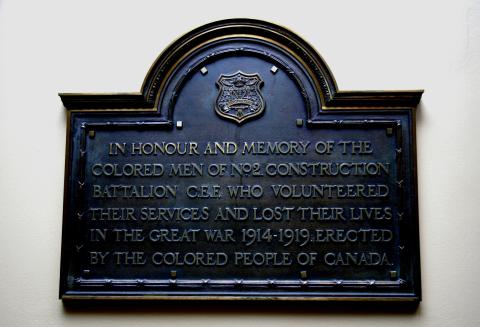
No. 2
CONSTRUCTION

IN HONOUR AND MEMORY OF THE
COLORED MEN OF NO.2 CONSTRUCTION
BATTALION C.E.F. WHO VOLUNTEERED
THEIR SERVICES AND LOST THEIR LIVES
IN THE GREAT WAR 1914-1919. ERECTED
BY THE COLORED PEOPLE OF CANADA.

Image
Photo Credit
Legislative Assembly of Ontario
Caption
plaque
War or Conflict Term
Province
!4v1659113077629!6m8!1m7!1sCAoSLEFGMVFpcE1mdXBCQkFaYVVVVHJWYTVCWGNGMTVnb0tQQlVCd0NDdlp0R1Jh!2m2!1d43.66227809999999!2d-79.3915272!3f287.8830730855961!4f9.465952360212611!5f0.8534297900256235
Body Content

The first recognition of No. 2 Construction Battalion was the dedication of a plaque. It was unveiled in the main hallway of the Ontario Legislative Assembly at Queen’s Park on 5 July 1920 on the 4th anniversary of the unit’s founding. The project was spearheaded by Toronto minister, Reverend Harry Logan, and his wife who were the parents of a No. 2 soldier, Private Harry Logan Jr. Private Logan who died of pulmonary tuberculosis two years later.

After considerable lobbying by Blacks and white supporters, Canada fielded one Black battalion during the First World War — but they had to fight with shovels, not rifles. No. 2 Construction Battalion was authorized on July 5, 1916, in Pictou, Nova Scotia, and was composed of Black men from across Canada, United States and British West Indies. Its officers were white, with the exception of the unit’s chaplain, Honorary Captain The Reverend William Andrew White. 
City
Toronto
Country
Type Description
Plaque
Photo Credit
Legislative Assembly of Ontario
Memorial CF Legacy ID
10936
City/Municipality
Toronto
Memorial Number
35091-031
Type
Address
76 Adelaide Street West
Location
Bell Canada
in Canada
Yes
GPS Coordinates
43.649815, -79.3812805
Inscription

(Needs further information/recherche incomplète)

Image
Caption
Second World War Tablet
War or Conflict Term
Province
!4v1690291368994!6m8!1m7!1sz_WPpAwbhhfecTP6Tv11Jw!2m2!1d43.64981499667141!2d-79.38128054094659!3f151.9419244211562!4f18.677484644088253!5f0.4000000000000002
Body Content

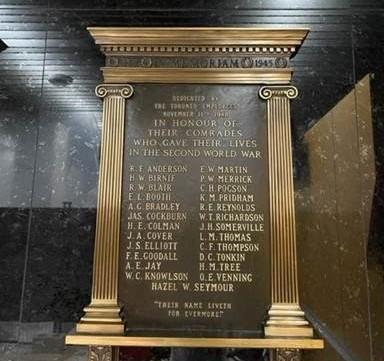
This tablet was dedicated by Toronto employees of the Bell Telephone Company of Canada in honour of their comrades who gave their lives in the Second World War.

City
Toronto
Country
Type Description
Tablet
Photo Credit
Bell Canada
Memorial CF Legacy ID
4540
City/Municipality
Toronto
Memorial Number
35091-029
Type
in Canada
Yes
GPS Coordinates
0, 0
Inscription

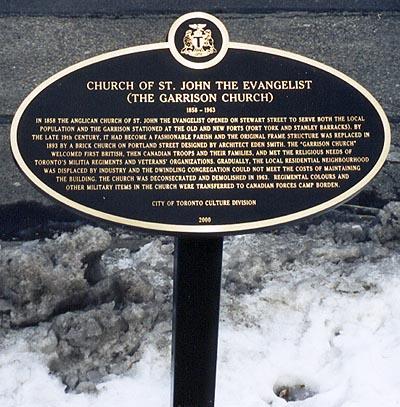
CHURCH OF ST. JOHN THE EVANGELIST
(THE GARRISON CHURCH)
1853-1963
In 1858 the Anglican Church of St. John the Evangelist opened on Stewart Street to serve both the local
population and the garrison stationed at the old and new forts (Fort York and Stanley Barracks). By
the late 19th century, it had become a fashionable parish and the original frame structure was replaced in
1893 by a brick church on Portland Street designed by architect Eden Smith. The Garrison Church
welcomed first British, then Canadian troops and their families, and met the religious needs of
Toronto’s militia regiments and veterans’ organizations. Gradually, the local residential neighbourhood
was displaced by industry and the dwindling congregation could not meet the costs of maintaining
the building. The church was deconsecrated and demolished in 1963. Regimental colours and
other military items in the church were transferred to Canadian Forces Camp Borden.

City of Toronto Culture Division

2000

Image
Photo Credit
D.Julsusson
Caption
Plaque
Province
Body Content

This plaque is dedicated to the Church of St. John The Evangelist (The Garrison Church). It was erected by the City of Toronto, Culture Division.

City
Toronto
Country
Type Description
Plaque
Photo Credit
D.Julsusson
Memorial CF Legacy ID
4640
City/Municipality
Toronto
Memorial Number
35091-028
Type
Address
110 Wellesley Sreett W
Location
Queen's Park
in Canada
Yes
GPS Coordinates
43.6658325, -79.3930588
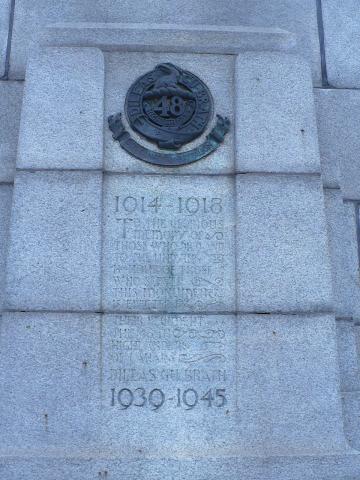
Inscription

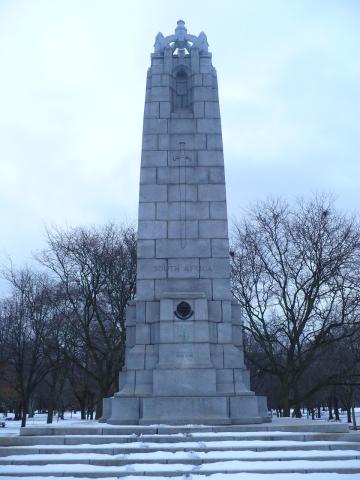
[front/devant]

SOUTH AFRICA

1914 - 1918
TO THE GLORIOUS
MEMORY OF
THOSE WHO DIED AND
TO THE UNDYING
HONOUR OF THOSE
WHO SERVED
THIS MONUMENT
IS ERECTED BY
THEIR REGIMENT
THE 48TH
HIGHLANDERS
OF CANADA
DILEAS GULBRATH
1939 - 1945

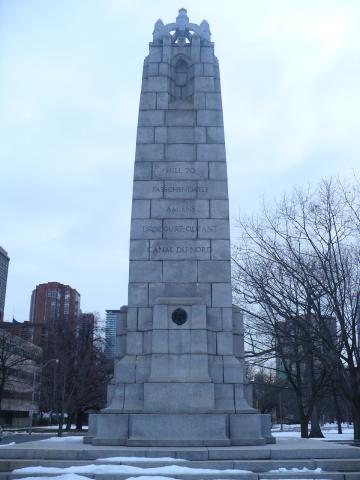
[right side/côté droit]

HILL 70
PASSCHENDAELE
AMIENS
DROCOURT-QUEANT
CANAL DU NORD

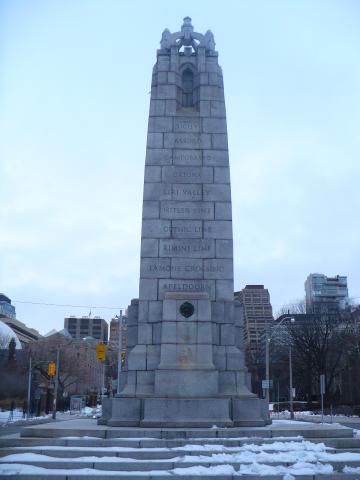
[back/arrière]

LANDING IN
SICILY
ASSORO
CAMPOBASSO
ORTONA
LIRI VALLEY
HITLER LINE
GOTHIC LINE
RIMINI LINE
LAMONE CROSSING
APELDOORN

[left side/côté gauche]

YPRES
FESTUBERT
MOUNT SORREL
SOMME
VIMY

Image
Caption
48th Highlanders Regimental Memorial
1 of 5 images
Image
Caption
right side
1 of 5 images
Image
Caption
back
1 of 5 images
Image
Caption
left side
1 of 5 images
Image
Caption
front inscription
1 of 5 images
War or Conflict Term
Province
!4v1623152103163!6m8!1m7!1sCAoSLEFGMVFpcE1tUjRHem13SHlYanNEbHZ6bzhWSnZFNkx5bDE5ZFNWTGg3Tkst!2m2!1d43.6658325!2d-79.3930588!3f237.17788283696729!4f19.355697555487183!5f0.7820865974627469"
Body Content

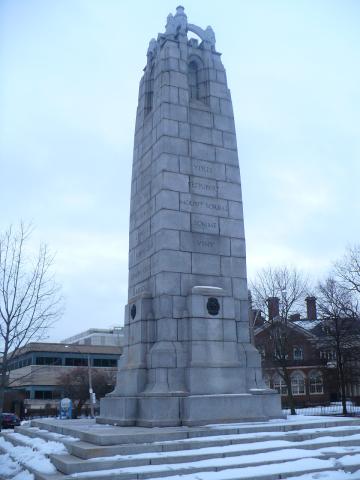
The 48th Highlanders Regimental Memorial was erected in 1923, in memory of the officers and men of the 48th Highlanders who gave their lives in the First World War. The memorial was paid for by members, ex-members and friends of the Regiment. The memorial was unveiled by His Excellency, Lord Byng, Governor-General of Canada at the Armistice-Remembrance Parade of the Regiment in November 1923.

Designed by Captain (then Brigadier) E.W. Haldenby, CBE, MC, VD, the pillar is set on an elevated base of six steps with the regimental crest on each side. The pillar is surmounted by the Christian Cross of Sacrifice carved on each side. A sheathed sword is carved on the front of the memorial. The crest on the front bears the words "15th Canadian Battalion", on the right side - "134 Overseas", and on the left side - "92 Canada Overseas". Carved in the stone are the names of the battles from the First World War in which the regiment took its full part and in which 61 officers and 1,406 non-commissioned officers gave their lives. 

A further 10 Battle Honours were added after the Second War to honour the 351 dead from that conflict. Alvan Sherlock Mathers was the architect. In 1962, the entire structure was lifted and moved to the east to allow for construction of the new University subway line that would run immediately below the site. When the subway was completed, the memorial was moved back to its original location. Time, elements, the 1960 relocation process and the presence of the subway below the structure gradually took their toll on the structure. In 2014, Brigadier General (ret) Greg Young proposed a project for the much needed restoration of the memorial. The work commenced in 2015 and was completed by November 11 the following year. The Regiment’s newest Battle Honour – Afghanistan – was added to the memorial. 

City
Toronto
Country
Type Description
Pillar - granite and bronze
Photo Credit
Tim Laye, Ontario War Memorials
Memorial CF Legacy ID
5775
City/Municipality
Toronto
Memorial Number
35091-027
Type
Address
University Avenue and Dundas Street W
in Canada
Yes
GPS Coordinates
43.6546182, -79.3883755
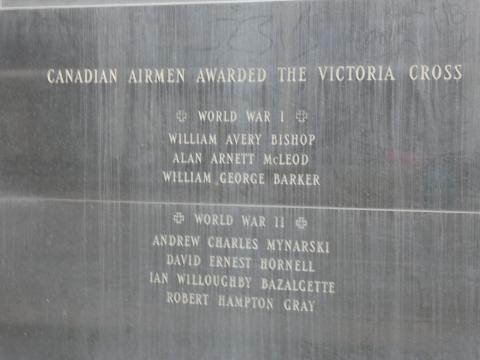
Inscription

[front/devant]
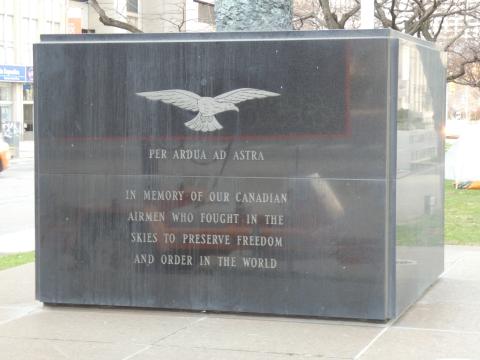
PER ARDUA AD ASTRA

IN MEMORY OF OUR CANADIAN
AIRMEN WHO FOUGHT IN THE
SKIES TO PERSERVE FREEDOM
AND ORDER IN THIS WORLD

[right side/côté droit]
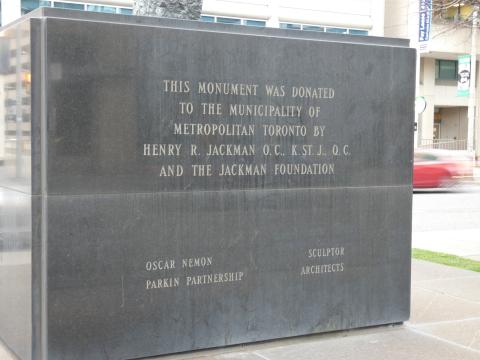
THIS MONUMENT WAS DONATED
TO THE MUNICIPALITY OF
METROPOLITAN TORONTO BY
HENRY R. JACKMAN O.C., K.ST.J., Q.C.
AND THE JACKMAN FOUNDATION

OSCAR NEMON SCULPTOR
PARKIN PARTNERSHIP ARCHITECTS

[back/arrière]
THIS MONUMENT WAS DEDICATED BY
HER MAJESTY QUEEN ELIZABETH II
SEPTEMBER 29, 1984

[left side/côté gauche]
CANADIAN AIRMEN AWARDED THE VICTORIA CROSS

WORLD WAR I
WILLIAM AVERY BISHOP
ALAN ARNETT MC LEOD
WILLIAM GEORGE BARKER

WORLD WAR II
ANDREW CHARLES MYNARSKI
DAVID ERNEST HORNELL
IAN WILLOUGHBY BAZALGETTE
ROBERT HAMPTON GRAY

Image
Caption
back inscription
1 of 5 images
Image
Caption
left side inscription
1 of 5 images
Image
Caption
right side inscription
1 of 5 images
Image
Caption
front inscription
1 of 5 images
Image
Caption
Airmen Memorial
1 of 5 images
War or Conflict Term
Province
!4v1702392128893!6m8!1m7!1sj0GiS4tl3DirVSAXNYKSNg!2m2!1d43.65461820235158!2d-79.38837551811795!3f100.8143600028661!4f13.575360087825729!5f0.7820865974627469
Body Content

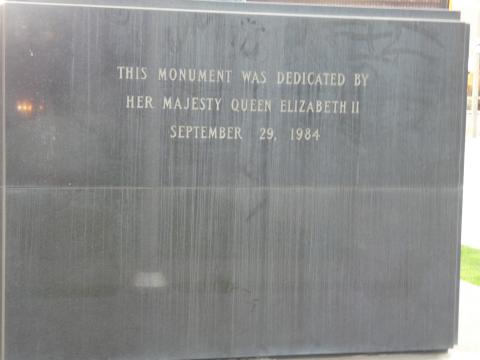
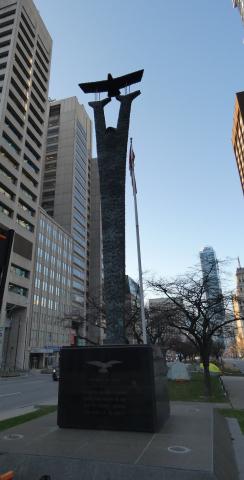
This monument was donated to the Municipality of Metropolitan Toronto by Henry R. Jackman O.C., K.St. J., Q.C. and the Jackman Foundation. It was dedicated by Queen Elizabeth in 1984. The bronze and marble monument was designed by Oscar Nemon.

The Airmen Monument was designed by sculptor Oscar Nemon. Oscar was born in Osijek, Croatia, which formed part of former Yugoslavia for most of his lifetime. At the start of the Second World War, he was a newly settled refugee sculptor in England trying to make his way in an unknown language and country. Most of Oscar's family died in the Holocaust, a total of twenty-two murdered relatives.

City
Toronto
Country
Type Description
Statue - bronze and marble
Photo Credit
Tim Laye, Ontario War Memorials
Memorial CF Legacy ID
5784