
Other

City/Municipality
Quinte West
Memorial Number
35090-034
Type
Address
327 Dundas Street East
Location
Bain Park
in Canada
Yes
GPS Coordinates
44.1038864, -77.5483982
Inscription

[plaque]


Canada Company    La Compagnie Canada

In recognition and memory of the efforts of approximately
40,000 Canadian Armed Forces personnel who served and
the 162 Canadians who died in the cause of bringing peace
and freedom to the people of Afghanistan.

2001    2004

En mémoire et en reconnaissance des efforts des quelque
40 000 membres des Forces armées canadiennes qui ont
servi en Afghanistan et des 162 Canadiens qui sont morts
pour la cause de la paix et de la liberté du peuple afghan.

Image
Caption
front and right side
1 of 4 images
Image
Caption
surroundings
1 of 4 images
Image
Caption
plaque
1 of 4 images
Image
Caption
LAV III armoured vehicle
1 of 4 images
War or Conflict Term
Province
!4v1624383830866!6m8!1m7!1sCAoSLEFGMVFpcE0yTEU2Z3pGLWJhSXVmTU5rZV9STnVFc2xHczVNM2VrMlJadjht!2m2!1d44.10388639232254!2d-77.5483981595274!3f38.1114193477769!4f-1.787968630068761!5f0.7820865974627469"
Body Content

An official groundbreaking ceremony was held August 4, 2016 at the site for the Quinte West LAV III Monument. The project was spearheaded by the Honorary Colonels Group at 8 Wing/CFB Trenton. The monument was constructed from demilitarized LAVs used during the mission in Afghanistan and spare parts from manufacturer General Dynamics Land Systems Canada in London.

Dozens of Canadian soldiers were either killed or wounded in Afghanistan while riding in a LAV III armoured vehicle. The LAV III took quite a beating, but it’s important to know it saved a lot of lives as well. The armoured vehicle was moved to its concrete pad on September 23, 2016, next to the Afghanistan Repatriation Memorial where the names of 158 Canadian soldiers killed during the mission in Afghanistan are carved in granite.

Quinte West is extremely proud of its military heritage, being the home of Canada’s largest military air force base, 8 Wing/CFB Trenton. Honorary Colonels Group at 8 Wing began discussing the project in late 2015. They raised money to complete the project, the city helped, Wayne Scaletta transported the LAV to the site and Cooney Excavating was hired to construct the base for the monument.

The LAV III Monument program was launched in November 2014 with a prototype sponsored by the Federal Government and built by General Dynamics Land Systems Canada. Subject to government approval, it’s estimated up to 250 LAV III Monuments will be made available through the application process to communities across the country.

The LAV III Monuments are built from demilitarized LAV IIIs by Militex Coating Inc. and Fanshawe College students in London, Ontario.

City
Quinte West
Country
Type Description
Artillery - LAV III
Photo Credit
Tim Laye, Ontario War Memorials
Memorial CF Legacy ID
9431
City/Municipality
Toronto
Memorial Number
35090-033
Type
Address
100 Queen Street West
Location
Nathan Phillips Square Sculpture Court
in Canada
Yes
GPS Coordinates
43.653445, -79.38491
Inscription

needs further research/recherche incomplète

Image
Caption
inscription
1 of 5 images
Image
Caption
right side
1 of 5 images
Image
Caption
right side and back
1 of 5 images
Image
Caption
back
1 of 5 images
Image
Caption
Peace Through Valour
1 of 5 images
War or Conflict Term
Province
!4v1702495958330!6m8!1m7!1sApCPiCa0Bc75pdBMcfqRLg!2m2!1d43.65360929096799!2d-79.38527147883438!3f101.34718522315295!4f-9.853812164249021!5f1.8563750664701493
Body Content

On Jul 21, 2016 Deputy Mayor Denzil Minnan-Wong (Ward 34 Don Valley East) received, on behalf of the Mayor and City Council, a new public art sculpture donated by the Italian-Canadian community through the Peace Through Valour committee of Villa Charities.

The large bronze sculpture, called Peace Through Valour, presents a 3D printed bronze topographical map of the town of Ortona, where Canadian soldiers fought the fiercest battle in the Italian Campaign, and achieved one of the greatest victories of the Second World War. At each of the four corners of the map, a slightly less than life-size bronze statue of a Canadian soldier stands vigil.

This monument commemorates the more than 93,000 Canadian soldiers who took part in the Italian campaign of the Second World War. Several veterans of that campaign were at the dedication ceremony Jul 21, 2016 today and helped unveil the sculpture. The work was created by internationally known Canadian artist Ken Lum.

This work conveys the accomplishments of our Canadian veterans while also creatively illustrating the immense destruction of war.

Former senator Consiglio Di Nino led the Peace Through Valour committee. The sculpture is part of the City of Toronto's permanent Public Art and Monuments Collection

City
Toronto
Country
Type Description
Sculpture
Photo Credit
Veterans Affairs Canada
Memorial CF Legacy ID
9379
City/Municipality
Toronto
Memorial Number
35090-032
Type
Address
Hart House Circle
Location
Soldiers' Tower, St. George Campus, University of Toronto
in Canada
Yes
GPS Coordinates
43.6633139, -79.3951215
Inscription

[plaque]

In memory of Wren Mary Sweeny and all who served in the Women’s Royal Canadian Naval Service 1942-1945

[interpretive panel]

Window 1:  A Wren -- Women’s Royal Canadian Naval Service.

            She is shown raising the Royal Canadian Navy ensign.

           Gift of the Wren Association of Toronto.

Image
Photo Credit
University of Toronto
Caption
Three stained glass windows commemorating women’s service in the Second World War.
1 of 2 images
Image
Photo Credit
K. Parks, courtesy of Alumni Relations, University Advancement, University of Toronto
Caption
stained glass window
1 of 2 images
Province
!4v1623341229208!6m8!1m7!1sgY03BeBFiJzhEkcownX6Hg!2m2!1d43.66331719276263!2d-79.39512235018397!3f6.836040260935523!4f30.024991952116437!5f0.4000000000000002
Body Content

The Women’s Royal Canadian Naval Service Window is the first window in the Soldiers' Tower Staircase of Honour. It depicts a member of the Women’s Royal Canadian Naval Service raising the Royal Canadian Navy ensign.

The Staircase of Honour features a series of eight stained glass windows honouring the Canadian Armed Forces in action during wartime. The windows were officially dedicated on May 26, 2005, by the Honourable James K. Bartleman, Lieutenant Governor of Ontario.

The three stained glass windows along the first flight of stairs, on the north wall, commemorate women’s service in the Second World War: Women’s Royal Canadian Naval Service (WRCNS), commonly known as Wrens, Canadian Women's Army Corps, and the Royal Canadian Air Force (Women's Division).

Turning and mounting the next flight, one passes three larger windows on the south wall honouring all those who served in the Armed Forces during both World Wars: Air Force, Navy, and Vimy Ridge. Ascending the third and final flight of stairs, two small windows are on the north wall: Canadian Merchant Navy and the Auxiliary Services of The Royal Canadian Legion, Canadian Red Cross, Knights of Columbus, Salvation Army and the Young Men’s Christian Association.

All eight windows in the Staircase of Honour were designed and installed by the Goodman Zissoff Stained Glass Studio of Kelowna, British Columbia — formerly the Russell C. Goodman Stained Glass Studios of Parry Sound, Ontario, which created the Memorial Window in the Memorial Room of the Tower.

City
Toronto
Country
Type Description
Stained Glass Window
Memorial CF Legacy ID
9233
City/Municipality
Toronto
Memorial Number
35090-030
Type
Address
2 Eireann Quay
Location
Billy Bishop Toronto City Airport
in Canada
Yes
GPS Coordinates
43.6341967, -79.3973139
Inscription

AÉROPORT de TORONTO BILLY BISHOP TORONTO CITY AIRPORT

L'AÉROPORT BILLY BISHOP AIRPORT

[front/devant]

Billy Bishop Toronto City Airport

History of airport: Billy Bishop Toronto City Airport (IATA: YTZ), commonly known as the Toronto Island Airport, is a small airport located on the Toronto Islands in Toronto. It is named after Air Marshall Billy Bishop. Originally conceived in the 1930's, the paved runways and the terminal building opened in 1939. During World War II, the island airport became a military training base. From 1940 until 1943, the Norwegian Government in-exile used the island airport as a training facility for the Royal Norwegian Air Force (RNAF). Barracks were built nearby on the mainland at the foot of Bathurst Street. The nearby "Little Norway Park" is named in remembrance of the Norwegian community around the airport. For the duration of the war, the airport was used by the Royal Canadian Air Force for training pilots and as a waypoint for transporting planes. After the war, the airport returned to civilian use.

Image
Photo Credit
PortsToronto
Caption
Billy Bishop Toronto City Airport
1 of 2 images
Image
Photo Credit
Veterans Affairs Canada
Caption
Billy Bishop Toronto City Airport sign at ferry terminal
1 of 2 images
War or Conflict Term
Province
!4v1702496227206!6m8!1m7!1s38WlCjpitY12qit0EsuVNA!2m2!1d43.63419665117578!2d-79.39731386841065!3f184.5280306349763!4f-1.2951409127368976!5f0.7820865974627469
Body Content

This airport is named in honour of Air Marshal William Avery “Billy” Bishop, VC, CB, DSO & Bar, MC, DFC, ED. The airport was opened in 1939, and renamed Billy Bishop Toronto City Airport on November 10, 2009. It is managed by Toronto Port Authority.

William Avery Bishop was born in Owen Sound, Ontario on 8 February 1894. During the outbreak of the Great War, he was a cadet at the Royal Military College, in Kingston. He enrolled in the 9th Mississauga Horse, Canadian Expedition Force, on 30 September 1914, and he later transferred to the Royal Flying Corps. Bishop, who already had the Distinguished Service Order and Military Cross, became the first Canadian Airman to be awarded the Victoria Cross for his single-handed early morning attack on an enemy airfield near Cambrai, France. On 2 June 1917, he found seven aircraft on the ground; he attacked and destroyed three, and was later credited with the destruction of the remaining four aircraft. Bishop continued air operations until August 1917 and returned to the front in June 1918. He emerged as the British Empire’s second highest scoring ace, with 72 official victories.

In the Second World War, Bishop was an Air Marshal in the Royal Canadian Air Force and assisted in recruiting. He later died in Palm Beach, United States, on 11 September 1956.

City
Toronto
Country
Type Description
Airport
Memorial CF Legacy ID
8942
City/Municipality
Toronto
Memorial Number
35090-027
Type
Address
675 Ontario St
Location
Rose Avenue Public School
in Canada
Yes
GPS Coordinates
43.670295901939, -79.372692453356
Inscription

(needs further research/recherche incomplète)

Image
Photo Credit
Victoria Edwards
Caption
Rose Avenue Public School stained glass
1 of 5 images
Image
Caption
Rose Avenue stained glass
1 of 5 images
Image
Caption
Rose Avenue Public School mural featuring photos of memorial stained glass
1 of 5 images
Image
Caption
Rose Avenue Public School mural featuring photos of memorial stained glass
1 of 5 images
Image
1 of 5 images
War or Conflict Term
Province
!4v1623342489114!6m8!1m7!1sZFHhTZR-hxpFlduiVJ03og!2m2!1d43.66994063541748!2d-79.37312916545112!3f89.14510702686992!4f8.081922452876725!5f0.7820865974627469"
Body Content

This memorial was erected by alumni and unveiled in 1944. The stained glass window is dedicated to alumni who served, and in some cases died during the First and Second World Wars.

City
Toronto
Country
Type Description
Stained glass window
Photo Credit
Victoria Edwards
Memorial CF Legacy ID
8312
City/Municipality
Toronto (Scarborough)
Memorial Number
35090-026
Type
Address
37 Crow Trail
Location
Tom Longboat Junior Public School
in Canada
Yes
GPS Coordinates
43.8101623, -79.2324079
Inscription

Tom Longboat
Junior Public School

Image
Caption
Tom Longboat Junior Public School
1 of 2 images
Image
Caption
inscription
1 of 2 images
War or Conflict Term
Province
!4v1623076312815!6m8!1m7!1sMyhJFB0NdEdxxgwG9fFk9A!2m2!1d43.81016199957329!2d-79.23240766578427!3f78.43935307454859!4f3.980504660017999!5f1.3542169332215286
Body Content

Thomas Charles Cogwagee Longboat was the son of George Longboat and Elizabeth Skye. Born on July 4, 1886, he was of the Onondaga Nation from Six Nations Territory.

In 1905, as a teenager he won the five-mile Victoria Day race at Caledonia, Ontario. Longboat won the 1906 Hamilton's Around the Bay road race, the oldest road race in North America event, by more than three minutes. In 1907, he won the Boston Marathon with a time nearly five minutes faster than the previous best. He represented Canada in the 1908 Olympics. His status as a racing celebrity was solidified in 1909, when he won the world professional marathon championships at Madison Square Garden in New York City.

At the age of 29, he set aside his athletic career to enlist. As a dispatch carrier with the 107th Pioneer Battalion in France, Longboat ran messages and orders between units. He also kept in competitive form by racing in inter-battalion sporting contests, many of which he won.

The famous runner was wounded twice during his time of service. Once he was mistakenly declared dead in the battlefields of Belgium, after being buried in rubble as a result of heavy shelling. He survived the war and returned to Canada in 1919. He served as a member of the Veterans Guard in the Second World War while stationed at a military camp near Brantford, Ontario.

Tom Longboat died in 1949 at the age of 62. He is a member of the Canadian Sports Hall of Fame and the Indian Hall of Fame.
City
Toronto (Scarborough)
Country
Type Description
Building - school
Photo Credit
Bob Braley
Memorial CF Legacy ID
6870
City/Municipality
Toronto
Memorial Number
35090-025
Type
Address
19 Trinity Square
Location
Church of the Holy Trinity
in Canada
Yes
GPS Coordinates
43.6544181, -79.3816604
Inscription

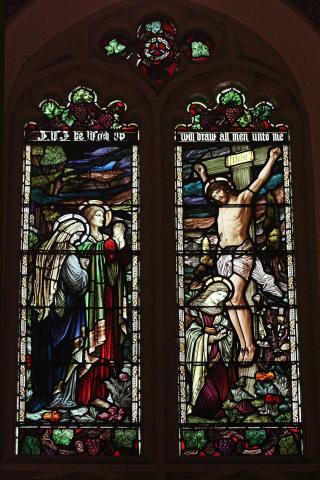
If I be lifted up I will draw all men unto me
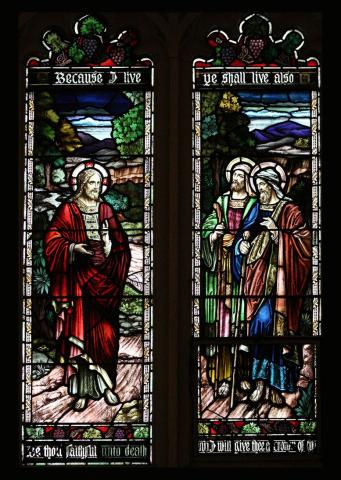
Because I live ye shall live also
Be thou faithful unto death and I will give thee a crown of life

Image
Photo Credit
Shirley Ann Brown, Victoria Edwards
Caption
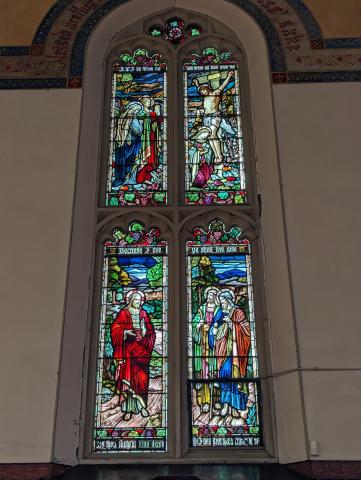
Two upper panes
1 of 3 images
Image
Photo Credit
Shirley Ann Brown, Victoria Edwards
Caption
Two lower panes
1 of 3 images
Image
Photo Credit
Church of the Holy Trinity
Caption
Church of the Holy Trinity First World War Window
1 of 3 images
War or Conflict Term
Province
!4v1623342921205!6m8!1m7!1sZMyiBqxZecXcXNK_EhjkUQ!2m2!1d43.65443734964939!2d-79.38167289520943!3f9.695840605544138!4f8.19664429456401!5f0.7820865974627469
Body Content

On 5 November 1922 a set of stained-glass windows were unveiled on the north side of Church of the Holy Trinity. The window was dedicated to the 32 parishioners of the congregation who had lost their lives in the First World War. The ceremony and unveiling were conducted by Bishop William Day Reeve and Canon W. L. Baynes-Reed, who drew apart two large Union Jacks to reveal the newly installed memorial window pieces.

Designed and constructed in the Tiffany style by the Robert McCausland Co. Ltd., the two top panes of the window depict the crucifixion with the Virgin Mary, John, and Mary Madeline and the lower panes depict the meeting of Jesus with his disciples on the way to Emmaus. The window was erected by members of the congregation.

City
Toronto
Country
Type Description
Stained glass window
Memorial CF Legacy ID
8287
City/Municipality
Toronto
Memorial Number
35090-024
Type
Address
Lakeshore Boulevard East
in Canada
Yes
GPS Coordinates
43.630908, -79.4235052
Inscription

[plaque]

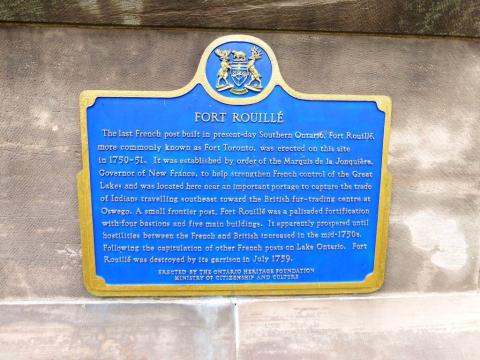
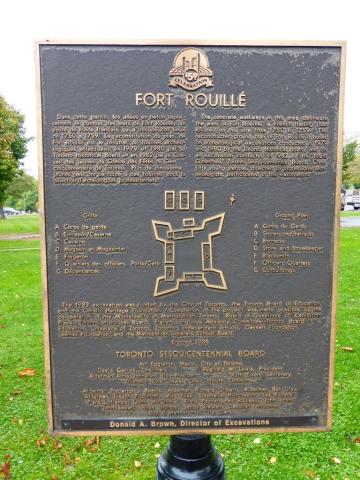
FORT ROUILLÉ
The last French post built in present-day southern Ontario, Fort Rouillé,
more commonly known as Fort Toronto, was erected on this site
in 1750-51. It was established by order of the Marquis de La Jonquière,
Governor of New France, to help strengthen French control of the Great
Lakes and was located here near an important portage to capture the trade
of Indians travelling southeast toward the British fur-trading centre at
Oswego. A small frontier post, Fort Rouillé was a palisaded fortification
with four bastions and five main buildings. It apparently prospered until
hostilities between the French and British increased in the mid-1750s.
Following the capitulation of other French posts on Lake Ontario, Fort
Rouillé was destroyed by its garrison in July 1759.

ERECTED BY THE ONTARIO HERITAGE FOUNDATION
MINISTRY OF CITIZENSHIP AND CULTURE

[plaque]

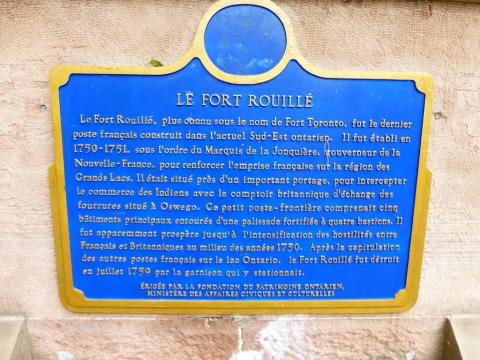
LE FORT ROUILLÉ

Le Fort Rouillé, plus connu sous le nom de Fort Toronto, fut le dernier poste français construit dans l'actuel Sud de l'Ontario. Il fut établi en 1750-1751, sous l'ordre du Marquis de La Jonquière, gouverneur de la Nouvelle-France, pour renforcer l'emprise française sur la région des Grands Lacs. Il était situé près d'un important portage, pour intercepter le commerce des Indiens avec le comptoir britannique d'échange des fourrures situé à Oswego. Ce petit poste-frontière comprenait cinq bâtiments principaux entourés d'une palissade fortifiée à quatre bastions. Il fut apparemment prospère jusqu'à l'intensification des hostilités entre Français et Britanniques au milieu des années 1750. Après la capitulation des autres postes français sur le lac Ontario, le Fort Rouillé fut détruit en juillet 1759 par la garnison qui y stationnait.

[plaque]

needs further research/recherche incomplète

Image
Caption
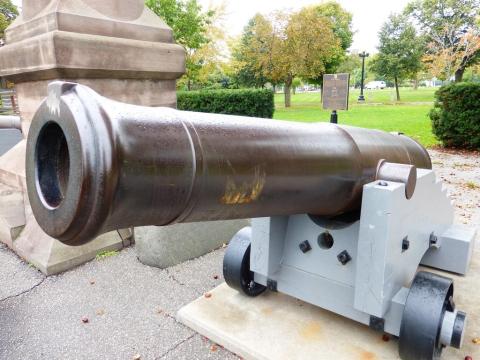
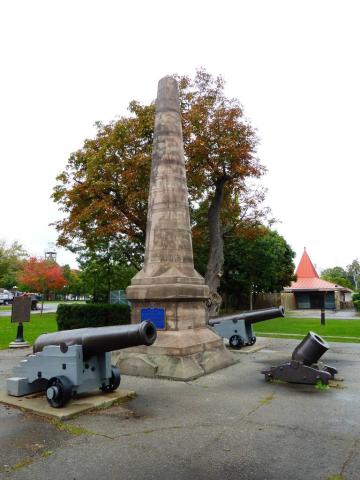
cannon
1 of 5 images
Image
Caption
Fort Rouillé plaque (English)
1 of 5 images
Image
Caption
Fort Rouillé plaque (French)
1 of 5 images
Image
Caption
Fort Rouillé 1986 plaque
1 of 5 images
Image
Caption
Fort Rouillé Memorial
1 of 5 images
Province
!4v1713362399610!6m8!1m7!1sDEOohOSNXOiKPM_-Kprjkw!2m2!1d43.63090798891528!2d-79.42350522340091!3f168.0712266514827!4f-5.590464889355445!5f0.7820865974627469
Body Content

A tall stone pillar carrying two Ontario historical plaque, one in English and the other in French, surrounded by cannons, mark the location of Fort Rouillé, a French fort destroyed in 1759.

City
Toronto
Country
Type Description
Pillar, cannons, plaque
Photo Credit
Tim Laye, Ontario War Memorials
Memorial CF Legacy ID
4532
City/Municipality
Toronto
Memorial Number
35090-023
Type
Address
Lakeshore Boulevard West
Location
On the grounds of the museum, Stanley Barracks
in Canada
Yes
GPS Coordinates
43.632939, -79.4128422
Inscription

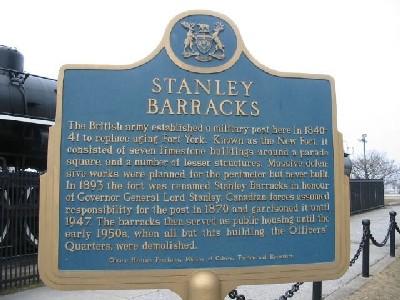
STANLEY
BARRACKS

The British army established a military post here in 1840-
41 to replace aging Fort York. Known as the New Fort, it
consisted of seven limestone buildings around a parade square, and a number of lesser structures. Massive defen-
sive works were planned for the perimeter but never built.
In 1893 the fort was renamed Stanley Barracks in honour
of Governor Lord Stanley. Canadian forces assumed
responsibility for the post in 1870 and garrisoned it until
1947. The barracks then served as public housing until the
early 1950s, when all but this building, the Officers’
Quarters, were demolished.

Ontario Heritage Foundation, Ministry of Cutlure, Tourism and Recreation

L’armée britannique établit un poste militaire ici en 1840-1841 pour remplacer le fort York. Le poste comporte sept bâtiments en Pierre à chaux érigés autour d’une cour de parade et plusieurs autres structures. Les fortifications prévues ne sont jamais construites. En 1893, le fort est rebaptisé Stanley Barracks en honneur du gouvernement general Lord Stanley. Les forces canadiennes en assument la responsibilité en 1870 et y restent publics avant sa demolition au début des années 1950. Il n’en reste plus que les quartiers des officiers.

Image
Photo Credit
(www.ontarioplaques.com)
Caption
front
War or Conflict Term
Province
!4v1623344403784!6m8!1m7!1s95ItMgK3UVAhG11n7c5WPg!2m2!1d43.63293903368493!2d-79.41284224323253!3f280.28682534755626!4f-5.077309745200239!5f2.904322225125058"
Body Content

This plaque was erected in 1963. The title of the Plaque is Stanley Barracks.

City
Toronto
Country
Type Description
Provincial Military Plaque
Photo Credit
(www.ontarioplaques.com)
Memorial CF Legacy ID
4533
City/Municipality
Toronto
Memorial Number
35090-021
Type
Address
Lakeshore Boulevard West
in Canada
Yes
GPS Coordinates
43.630944280903, -79.418264259714
Inscription

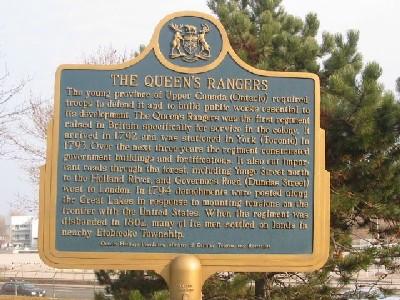
THE QUEEN’S RANGERS

The young province of Upper Canada (Ontario) required
troops to defend it and to build public works essential to
its development. The Queen’s Rangers was the first regiment
raised in Britain specifically for service in the colony. It
arrived in 1792 and was stationed in York (Toronto) in
1793. Over the next three years the regiment constructed
government buildings and fortifications. It also cut impor-
tant roads through the forest, including Yonge Street north
to the Holland River, and Governor’s Road (Dundas Street)
west to London. In 1794 detachments were posted along
the Great Lakes in response to mounting tensions on the
frontier with the United States. When the regiment was
disbanded in 1802, many of its men settled on lands in
nearby Etobicoke Township.

Ontario Heritage Foundation, Ministry of Culture, Tourism and Recreation

LES QUEEN’S RANGERS

La jeune province du Haute-Canada (l’Ontario) avait besoin de troupes pour se defender et entreprendre les travaux publics essentials à son dévelopement. Les Queen’s Rangers constituent le premier regiment recruté en Angleterre spécifiquement pour servir dans la colonie. Il arrive en 1792 et est envoyé en garnison à York (Toronto) en 1793. Le regiment construit des bâtiments gouvernementaux et des fortifications. Ils déblaient des routes à travers la forêt, dont la rue Yonge vers le nord jusqu’à la rivière Holland, et le chemain Governor’s (rue Dundas) vers l’ouest. En 1794, des détachements sont expédiés le long des Grands Lacs où les tensions s’intensifient avec les Américains. Lorsque le regiment est disperse en 1802, nombre de ses homes s’installent sur des terres du canton avoisinant d’Etobicoke.

Image
Photo Credit
(www.ontarioplaques.com)
Caption
front
Province
Body Content

The title of this plaque is Queen's Rangers. It was erected in 1979.

City
Toronto
Country
Type Description
Provincial Military Plaque
Photo Credit
(www.ontarioplaques.com)
Memorial CF Legacy ID
4535