Other

City/Municipality
Cornwall
Memorial Number
35083-040
Type
Address
Glengarry County Road 2 & Stonehouse Point Road
Location
On the corner of Glengarry County Road 2 & Stonehouse Point Road
in Canada
Yes
GPS Coordinates
45.0395747, -74.6194083
Inscription

[front/devant]

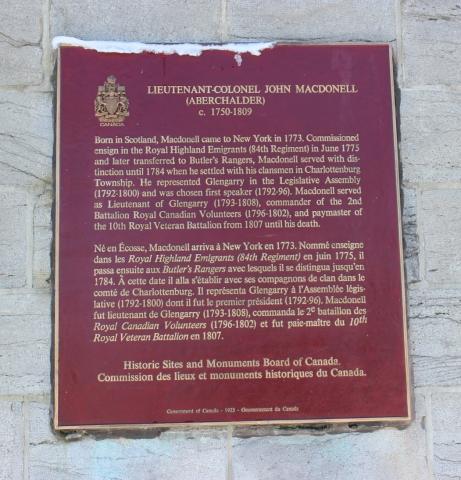
LIEUTENANT-COLONEL JOHN MACDONELL
(Aberchalder)
c. 1750 – 1809

Born in Scotland, Macdonell came to New York in 1773. Commissioned ensign in the Royal Highland Emigrants (84th Regiment) in June 1775 and later transferred to Butler’s Rangers, Macdonell served with distinction until 1784 when he settled with his clansmen in Charlottenburg Township. He represented Glengarry in the Legislative Assembly (1792 – 1800) and was chosen first speaker (1792 – 1796). Macdonell served as Lieutenant of Glengarry (1793 – 1808), commander of the 2nd Battalion Royal Canadian Volunteers (1796 – 1802), and paymaster of the 10th Royal Veteran Battalion from 1807 until his death.

Né en Écosse, Macdonell arriva à New York en 1773. Nommé enseigne dans les Royal Highland Emigrants (84th Regiment) en juin 1775, il passa ensuite aux Butler’s Rangers avec lesquels il se distingua jusqu’en 1784. À cette date il alla s’établir avec ses compagnons de clan dans le comté de Chalottenburg. Il représenta Glengarry à l’Assemblée législative (1792 – 1800) dont il fut le premier président (1792 – 1796). Macdonell fut lieutenant de Glengarry (1793 – 1808), commanda le 2e bataillon des Royal Canadian Volunteers (1796 – 1802) et fut paie-maître du 10th Royal Veteran Battalion en 1807.

Historic Sites and Monuments Board of Canada/Commission des lieux et monuments historiques du Canada Government of Canada – 1923 – Gouvernement du Canada

Image
Caption
front
1 of 2 images
Image
Caption
plaque
1 of 2 images
Province
!4v1624297714968!6m8!1m7!1sPccEHt2zqt5-r3p_ODv5KA!2m2!1d45.03957472651824!2d-74.61940830960637!3f144.47118214290754!4f-5.475114470046947!5f2.8767866485056115"
Body Content

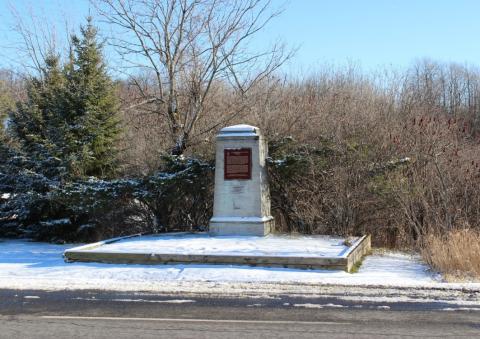
This metal plaque on a stone cairn is dedicated to Lt.-Col John Macdonell, “Spanish John”. It was unveiled in 1923 by the Historic Sites and Monuments Board of Canada. He is the father of Captain Miles Macdonell.

City
Cornwall
Country
Type Description
Plaque, stone cairn
Photo Credit
Richard Turcotte
Memorial CF Legacy ID
8939
City/Municipality
Lunenberg
Memorial Number
35083-037
Type
Address
4725 County Road 12
Location
Memorial Hill Cemetery
in Canada
Yes
GPS Coordinates
45.0606217, -74.9602962
Inscription

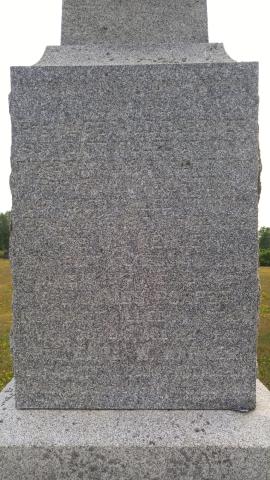
IN MEMORY OF OUR FALLEN
HEROES

PTE. WM GERALD GARDINER
50TH BATT. KILLED AT VIMY
RIDGE. FEB. 26, 1916 AGE 27 YRS.

PTE. FRANK BURTON
24TH BATT. KILLED AT VIMY
RIDGE, MAY 5, 1917 AGE 22YRS

PTE. WM WERLEY
75TH BATT. KILLED IN ACTION
JUNE 8, 1917 AGE 26 YRS.

PTE. JAMES POAPST
156TH BATT. KILLED IN ACTION
OCT. 30, 1917 AGE 22 YRS

PTE. EARL W. WARNER
154TH BATT. KILLED AT BATTLE OF
AMIENS. AUG. 10, 1918 AGE 20 YRS.

1914 - 1918


Image
Photo Credit
Louise Bellec
Caption
Lunenberg Cenotaph
1 of 3 images
Image
Photo Credit
Louise Bellec
Caption
inscription
1 of 3 images
Image
Photo Credit
Louise Bellec
Caption
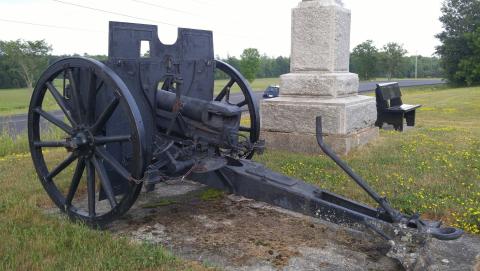
artillery
1 of 3 images
War or Conflict Term
Province
!4v1635770770619!6m8!1m7!1sPu6I_8LOZRkVVTsNnofSIw!2m2!1d45.06062660567282!2d-74.96028811651509!3f239.85288327014086!4f5.219771800807436!5f2.729218147401085"
Body Content

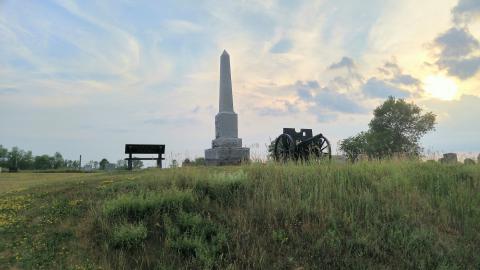
This memorial is dedicated to the First World War casualties from Lunenberg.

City
Lunenberg
Country
Type Description
Obelisk, artillery
Photo Credit
Nelson Mercier; Hélène Garand
Memorial CF Legacy ID
7022
City/Municipality
Morrisburg
Memorial Number
35083-036
Type
Address
8 5th Street West
Location
South Dundas Justice building
in Canada
Yes
GPS Coordinates
44.8989823, -75.1854701
Inscription

[front/devant]
IN MEMORY
OF THE MEN
OF MORRISBURG
AND VICINITY
WHO SERVED
IN THE
GREAT WAR
1914-18

[right side/côté droit]
GNR. DONALD BRADFIELD
C.O., G.M.S., C.H. GILLESPIE
SIGNR. GARNET E. LEWIS
SERGT. GERALD MEIKLE
CORP. ORLIN MERKLEY
N. SISTER F. MUNROE
SIGNR. DONALD PRUNER
LANCE CORP. E.R. STEEN
LIEUT. IVAN TINKESS
LIEUT. HUME WINGARD

[left side/côté gauche]
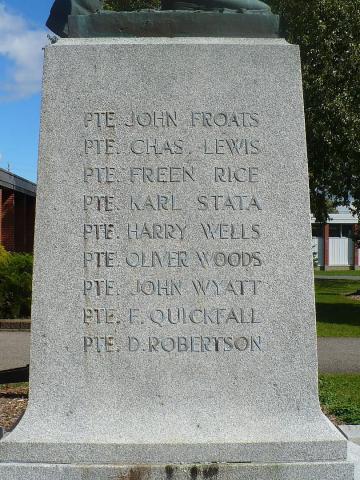
PTE. JOHN FROATS
PTE. CHAS. LEWIS
PTE. FREEN RICE
PTE. KARL STATA
PTE. HARRY WELLS
PTE. OLIVER WOODS
PTE. JOHN WYATT
PTE. F. QUICKFALL
PTE. D. ROBERTSON

[back/arrière]
THEIR BODIES
ARE BURIED IN PEACE,
BUT THEIR NAME
LIVETH FOREVERMORE

Image
Photo Credit
Richard Turcotte
Caption
surroundings
1 of 6 images
Image
Photo Credit
Tim Laye, Ontario War Memorials
Caption
Soldier’s Monument
1 of 6 images
Image
Photo Credit
Tim Laye, Ontario War Memorials
Caption
front inscription
1 of 6 images
Image
Photo Credit
Tim Laye, Ontario War Memorials
Caption
right side inscription
1 of 6 images
Image
Photo Credit
Tim Laye, Ontario War Memorials
Caption
left side inscription
1 of 6 images
Image
Photo Credit
Tim Laye, Ontario War Memorials
Caption
back inscription
1 of 6 images
War or Conflict Term
Province
!4v1629812779380!6m8!1m7!1s118jWVG80aMsW-1Lu3Nuvg!2m2!1d44.89898018312749!2d-75.18544853861363!3f310.055043714566!4f4.1961164599192955!5f2.974757134134734
Body Content

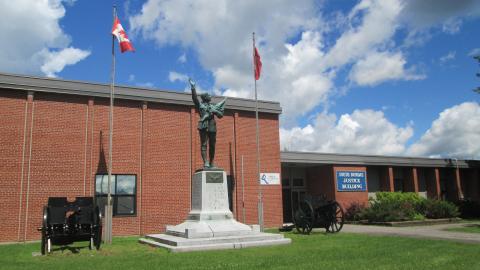
The Morrisburg Soldiers' Monument Association was formed shortly after the First World War. This association pledged to erect a memorial to those who gave their lives in the war. The officers appointed were: Honorary President, Mr. Geo. W. Cook; Honorary Vice-President, Mr. I. Hilliard, K.C., M.P.P.; Chairman, Mr. W. K. Farlinger, Reeve; Mr. Leo Laurin, Editor of the Morrisburg Leader; Secretary, Miss Grace D. Merkley; Treasurer, Mr. Fred R. Chalmers, Town Clerk; Chairmen of Committees: Messrs. John Gormley; R.F. Lyle; Rev. Hugh Cameron; George L. Brown, C.E.; John H. Meikle; B.B. Tucker, C.E.; Arthur Flynn; and Fred Meikle.

This group successfully erected a beautiful monument costing $10,000 and executed by sculptor George William Hill, R.C.A. of Montreal. Standing nineteen feet high, its base is constructed of granite and is twelve feet square and nine feet high. A ten feet high bronze figure of an Infantry man, who having laid off his equipment of war, is in the act of acclaiming peace. His right arm is raised while he shouts the glad tidings, and with his left hand he presses the victorious flag to his heart. A wreath of laurel leaves, held against the flag, is a symbol of achievement. On the Die is placed the Dove of Peace, descending on the globe.

Over 5,000 people attended the unveiling of the war memorial on September 9, 1923. It was located on the municipal square, south-east corner of Main Street and Highway 31. A row of stately Lombardy poplars, planted by John H. Meikle, made a colourful background for the bronze figure. 

The memorial was relocated in April 1958 to the front of Morrisburg's Civic Building on 5th Street. When the soldier was moved from its original site by Luther Wells of Ingleside, workers found something unexpected. Placed in the foundation was a large glass bottle. J.H. Meikle, whose son Gerald was lost in the Great War in August of 1918, had arranged the contents. Four coins current at the time; the honour roll of those who had made the supreme sacrifice and those who had served overseas and honours won; a list of subscriptions to the monument fund including $2,000 from the Women’s Institute; and printed materials from various publications. When the monument was finally placed outside the Civic Centre, the bottle and its contents were again interred at the base of the cenotaph.

George William Hill was born in Shipton, Eastern Townships, in 1861. He learned to carve marble in his father’s company, after he graduated from college. Between 1889 and 1894, he left Quebec to study sculpting at the École nationale des beaux-arts and Académie Julian in Paris. When he returned to Montreal, he opened a studio and worked with architect Robert Findlay and brothers Edward and William S. Maxwell. Known for his public monuments and war memorials, he is now considered one of the most important Canadian sculptors of the early twentieth century.

Hill designed several monuments commemorating Canadians lost in the South African War, including the Strathcona and South African Soldiers' Memorial in Quebec and Boer War Soldiers Monument in Ontario. At the end of the First World War, Hill was awarded several contracts by towns and cities wishing to pay homage to citizens who had died on the battlefields. Between 1920 and 1930 he designed these monuments: Westmount CenotaphMagog CenotaphArgenteuil CenotaphRichmond CenotaphSherbrooke War Memorial in Quebec; Pictou County War Memorial in Nova Scotia; Soldier's MonumentThe Soldier and Nurses’ Memorial in Ontario; and the Soldier's Monument in Prince Edward Island.

City
Morrisburg
Country
Type Description
Shaft - granite, statue - bronze
Memorial CF Legacy ID
5553
City/Municipality
Cornwall
Memorial Number
35083-034
Type
Address
240 Water Street West
Location
In front of Royal Canadian Air Force Association 424 Wing Cornwall District
in Canada
Yes
GPS Coordinates
45.0135218, -74.7326761
Inscription

[plaque on pedestal/plaque sur piédestal ]

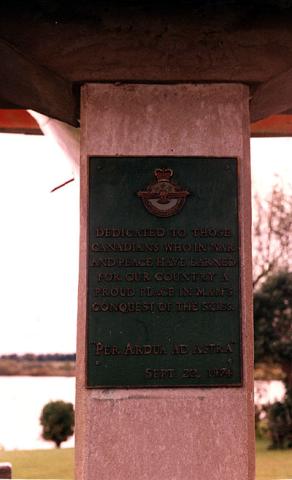
DEDICATED TO THOSE
CANADIANS WHO IN WAR
AND PEACE HAVE EARNED
FOR OUR COUNTRY A
PROUD PLACE IN MAN’S
CONQUEST OF THE SKIES.


"PER ARDUA AD ASTRA"
SEPT. 22, 1974

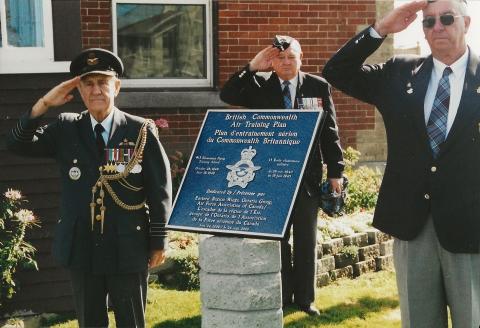
[plaque]

British Commonwealth
Air Training Plan
Plan d’entraînement aérien
du Commonwealth Britannique

13 Elementary Flying
Training School 
13 École elementaire
militaire
   
October 28, 1940            
June 19, 1945 
du 28 oct. 1940
au 19 juin 1945


Dedicated by/Présentée par
Eastern Region Wings, Ontario Group,
Air Force Association of Canada/
L’escadre de la region de l’Est,
groupe de l’Ontario, de l’Association
de la Force aérienne du Canada
Sept. 24, 2000/ le 24 sept. 2000

Image
Photo Credit
Terry MacDonald
Caption
airplane
1 of 3 images
Image
Photo Credit
Terry MacDonald
Caption
plaque
1 of 3 images
Image
Photo Credit
RCAF Association/Association de l’Aviation royale canadienne
Caption
2000 Battle of Britain Ceremony at 424 Wing
1 of 3 images
Province
!4v1624297255542!6m8!1m7!1siE3x-OuHFGX8wrX_xYE8nw!2m2!1d45.01352176845961!2d-74.73267608365018!3f171.83205178461895!4f1.2085955774265358!5f3.325193203789971"
Body Content

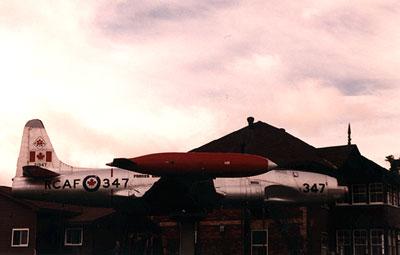
The Wing 424 T33 aircraft was moved from CFB Mountain View to Cornwall in 1974.  The pylon, made of solid reinforced concrete with a large footing, was constructed on site by a local contractor. An active member of the 424 Wing, Frank (Doc) Roberts, a former RCAF rigger, volunteered to design and fit the cradle on top of the pylon and supervised the actual mounting of the air craft.

The T33 was erected on September 27, 1974 and the brass memorial plaque was donated by John Leroux, an associate member at the time.

In 2000, the BCATP Memorial was dedicated during the Battle of Britain Ceremony at 424 Wing. An identical plaque was presented to the village of St. Eustache where there was a training location during the 1940s.

City
Cornwall
Country
Type Description
Airplane CT 33 Silver Star #21347 with plaque
Memorial CF Legacy ID
5044
City/Municipality
Morrisburg
Memorial Number
35083-032
Type
Address
13740 County Road 2
Location
Battle of Crysler's Farm National Historic Site of Canada
in Canada
Yes
GPS Coordinates
44.9461021, -75.0735554
Inscription

[plaque]

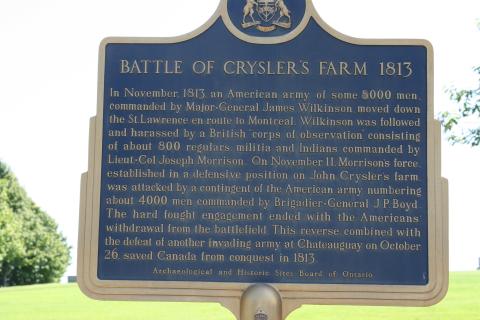
BATTLE OF CRYSLER’S FARM 1813

In November 1813, an American army of some 8000 men,
commanded by Major-General James Wilkinson, moved down
the St. Lawrence en route to Montreal. Wilkinson was followed
and harassed by a British corps of observation consisting
of about 800 regulars, militia and Indians commanded by
Lieut.-Col Joseph Morrison. On November 11, Morrison’s force,
established in a defensive position on John Crysler’s farm,
was attacked by a contingent of the American army numbering
about 4000 men commanded by Brigadier-General J.P. Boyd.
The hard fought engagement ended with the Americans’
withdrawal from the battlefield. This reverse, combined with
the defeat of another invading army at Chateauguay on October
26, saved Canada from conquest in 1813.

Archaeological and Historic Sites Board of Ontario

(located outside the Battlefield Memorial Building)

Image
Photo Credit
Cpl Sean Hunter (National Defence/Défense nationale)
Caption
surroundings
1 of 2 images
Image
Photo Credit
St. Lawrence Parks Commission
Caption
plaque
1 of 2 images
Province
!4v1632840239959!6m8!1m7!1sCAoSLEFGMVFpcE9Bcm5DOUxtclppS2NjWDF5ZGI2TTZrWVVpYkQ1ckIyS1JJMU5o!2m2!1d44.9461021!2d-75.0735554!3f207.17117787563865!4f-5.558032593995989!5f0.7820865974627469
Body Content

The Battle of Crysler's Farm 1813 Plaque was erected by the Archaeological and Historic Sites Board of Ontario in 1963.

City
Morrisburg
Country
Type Description
Plaque
Memorial CF Legacy ID
4599
City/Municipality
Van Camp
Memorial Number
35083-031
Type
Address
11035 Levere Road
Location
Van Camp Cemetery
in Canada
Yes
GPS Coordinates
45.0442812, -75.4482547
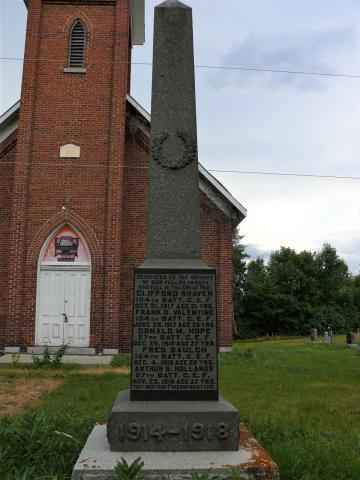
Inscription

[front/devant]
DEDICATED TO THE MEMORY
OF OUR FALLEN HEROES
WHO FELL IN THE GREAT WAR.

CLIFFORD SHAVER
154TH BATT. C.E.F.
OCT. 31, 1917 AGE 21 YRS.

FRANK D. VALENTINE
154TH BATT. C.E.F.
JUNE 26, 1917 AGE 26 YRS.

DONALD M. HOPE
27TH BATT. C.E.F.
DEC. 29, 1918 AGE 27 YRS.

FRED BAULCH
154TH BATT. C.E.F.
DEC. 4, 1918 AGE 20 YRS.

ARTHUR S. HOLLANDS
87TH BATT. C.E.F.
NOV. 23, 1916 AGE 22 YRS.

THEY DIED THAT FREEDOM MIGHT LIVE.

1914-1918

[left side/côté gauche]

needs further research/recherche incomplète

Image
Photo Credit
Derek Pullen
Caption
Van Camp Cenotaph
War or Conflict Term
Province
!4v1732901144158!6m8!1m7!1s0AbWCZ-VEXYWKos_R1NZPg!2m2!1d45.04428115545829!2d-75.4482547243637!3f333.7790961058029!4f-0.4831491824194387!5f0.4000000000000002
Body Content

The Van Camp Cenotpah was erected in honour of those who died in the First World War. It is located on private property, formerly United Church property, and those who wish to visit the monument are asked to remain on the public roadway and not trespass.

City
Van Camp
Country
Type Description
Obelisk
Memorial CF Legacy ID
5468
City/Municipality
Mountain
Memorial Number
35083-030
Type
Address
10480 Clark Road
Location
Mountain Memorial Community Park
in Canada
Yes
GPS Coordinates
45.0321657, -75.499079
Inscription

[slab/dalle]

(front/devant)

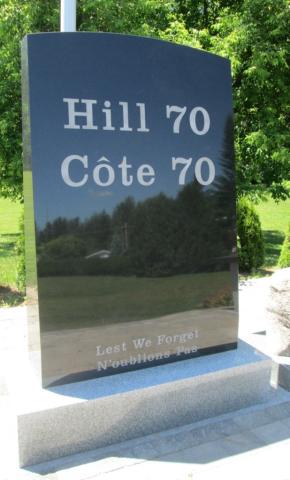
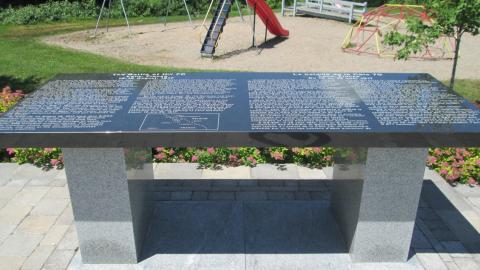
Hill 70
Côte 79
Lest we forget
N'oublions pas

(back/arrière)

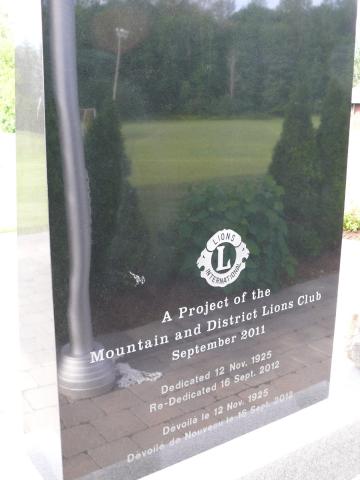
A Project of the
Mountain and District Lions Club
September 2011

Dedicated 12 Nov. 1925
Re-dedicated 16 Sept. 2012

Dévoilé le 12 Nov. 1925
Dévoilé de Nouveau le 16 Sept. 2012

[left flank stone/pierre du flanc gauche]

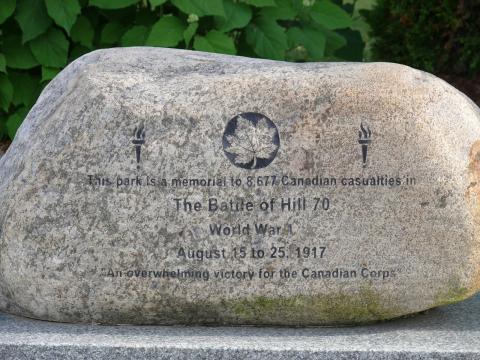
This park is a memorial to 8,677 Canadian casualties in
The Battle of Hill 70
World War 1
August 15 to 25, 1917
An overwhelming victory for the Canadian Corps

[right flank stone/pierre du flanc droit]

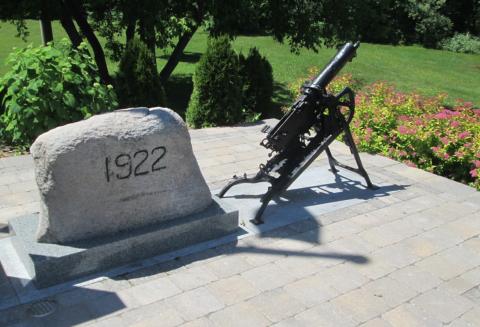
1922

[tablet/tablette]

The Battle of Hill 70
Lens, France
15 – 18 August, 1917

The Battle of Hill 70 has been called the forgotten battle of the First World War of 1914 – 1918. Unlike famous battles in which Canadian soldiers took part, such as Vimy Ridge and Passchendaele, no monument has ever been erected to remember what happened there. Only in the community of Mountain, Ontario is there a memorial expressly dedicated to this important Canadian victory.

In the summer of 1917, Canadian General Sir Arthur Currie was promoted and made the General Officer Commanding of the Canadian Corps of the Canadian Expeditionary Force. For the first time, and for the remainder of the war, all four divisions of the Canadian Corps would be under Canadian command.

On July 7, 1917, the British High Command ordered General Currie and the Canadian Corps to capture the French city of Lens from its German occupiers. Seeing that the city was heavily fortified and easily defended, General Currie proposed that the Canadians instead storm Hill 70, the higher ground north of Lens.

Beginning on Aug. 1, 1917, the Canadian artillery bombarded the German trenches and defences on and in the vicinity of Hill 70. The artillery, for the first time in history aided through real-time observation by radio-equipped aircraft of the Royal Flying Corps, targeted the German defensive positions and gun batteries for two weeks.

At 4:25 A.M. on August 15, 1917 more than 5,000 Canadian infantrymen of the 1st and 2nd Division went over the top and went forward from their trenches preceded by a rolling barrage of shells fired by over 200 Canadian artillery pieces. The rapidity of the Canadian attack took the German defenders by surprise and most of the Canadian objectives were quickly captured.

Despite heavy enemy artillery fire including with newly-invented mustard gas shell, the Canadians consolidated their gains and awaited the German counterattacks. Over the next four days and nights, the Germans would launch attack after attack to try to push the Canadians off Hill 70. None succeeded, as the Canadians tenaciously defended the hill, despite the sweltering summer heat wave, the clouds of poison gas, the ceaseless artillery shelling, and the murderous machine gun fire sweeping the battlefield. Ammunition and water ran low, and fighting often was hand-to-hand, Casualties were heavy on both sides. But the Canadians never relented.

By the end of August 18, the Germans had been completely defeated. No fewer than twenty-one counterattacks had been fought off.

This victory cemented the reputation of the Canadian soldiers as being elite “shock troops” who were among the best Allied troops to fight in the war. The cost was high. The Canadian Corps suffered 5843 casualties during the Battle of Hill 70 including 1505 killed, 4297 wounded and 41 taken prisoner. In all, the Corps suffered 8677 casualties during the fighting of Lens between August 15 and 25, 1917.

(battle map of Hill 70 area)

La bataille de la Côte 70
Lens, France
Du 15 au 18 août 1917

La bataille de la Côte 70 a été souvent désignée lade la Première Guerre mondiale 1914-1918. Contrairement célèbres batailles où les soldats canadiens ont pris part, comme la crête de Vimy et à Passchendaele, aucun monument a été érigée pour commémorer les événements entourant cette bataille. Il n’existe qu’un seul monument spécifiquement désigné pour rappeler cette importante victoire canadienne; il est situé dans la communauté de «Mountain» en Ontario.

À l’été 1917, le Général canadien Sir Arthur Currie, a été promu le grade du Commandant général  du Corps canadien de la Force expéditionnaire canadienne. Pour le première fois, et cela jusqu’à la fin de la guerre, les quatre divisions du Corps canadien demeureront sous le commandement canadien.

Le 7 juillet 1917, le Haut Commandement britannique a donné ordre au Commandant Currie et du Corps d’infanterie canadien de reprendre la ville française de Lens occupée par le Allemands. Ayant observé que la ville était bien fortifié assurant une défense facile, le Général Currie a préféré envahir la Côte 70, le point le plus élevé situé au nord de la ville de Lens.

Le 1er août 1917, l’artillerie canadienne a amorcé le bombardement des tranchées et des systèmes de défense de la Côte 70 elle-même et de son environnement immédiat. L’artillerie, pour la première fois de l’histoire soutenue simultanément par l’aviation britannique en contact radio avec les forces canadiennes, a ciblé les positions de défense allemande et leurs batteries pendantes deux semaines.

À 04 :25h, le 15 août 1917, plus de 5000 soldats d’infanterie des Premières et Deuxième Divisons se sont lancés à l’assaut de la Côte 70, un mouvement précédé par un barrage soutenu d’obus provenant de plus de 200 pièces de l’artillerie canadienne. La rapidité de l’attaque canadienne a pris les soldats allemands par surprise et la plupart des objectifs des canadiens ont été atteints.

En dépit du feu intense de l’artillerie ennemie incluant les nouveaux obus contenant le «gaz moutarde», les Canadiens ont consolidé leurs gains sans toutefois ignorer les futures contre-attaques inévitables des forces allemandes. Au cours des quatre jours suivants, jour et nuit, les Allemands ont multiplié leurs attaques afin de déloger les canadiens de la Côte 70 avec ténacité en dépit d’une chaleur d’été étouffante, des nuages de gaz empoisonné, des bombardements d’artillerie sans arrêt et du balayage meurtrier du champ de bataille aux armes automatique. Les munitions et l’eau ont atteint un bas niveau et souvent les combats finissaient en corps à corps. Des deux côtés, les pertes étaient lourdes, mais les Canadiens n’ont jamais cédé.

À la fin de la journée du 18 août, les soldats allemands sont défaits. Les Canadiens avaient résisté à pas moins de vingt et une contre-attaque.

Cette victoire a consolidé la réputation des soldats canadiens comme étant l’élite des «troupes de choc» et les meilleurs soldats parmi les troupes alliés. Le coût était élevé. Durant la bataille de la Côte 70, les pertes se sont élevées à 5843 soldats dont 1505 morts, 4297 blessés et 41 d’entre eux fait prisonniers. Au cours de la bataille à Lens, qui a durée du 15 au 25 août 1917, le Corps canadien a perdu 8677 hommes.

(carte de bataille de la région de la Colline 70)

Image
Photo Credit
Tim Laye, Ontario War Memorials
Caption
Battle of Hill 70 Memorial
1 of 6 images
Image
Photo Credit
Tim Laye, Ontario War Memorials
Caption
front inscription
1 of 6 images
Image
Photo Credit
Tim Laye, Ontario War Memorials
Caption
original dedication stone et German artillery
1 of 6 images
Image
Photo Credit
Richard Turcotte
Caption
Battle of Hill 70 tablet
1 of 6 images
Image
Caption
left flank stone
1 of 6 images
Image
Photo Credit
Tim Laye, Ontario War Memorials
Caption
back inscription
1 of 6 images
War or Conflict Term
Province
!4v1711371062195!6m8!1m7!1sCAoSLEFGMVFpcE1oMHpoc2xOWFpyeDZQVkRURzFqM3RBTnF3YXE4dW1uT2M3bzJp!2m2!1d45.0321657!2d-75.4990799!3f253.96917315430855!4f-0.5152672011896442!5f0.4000000000000002
Body Content

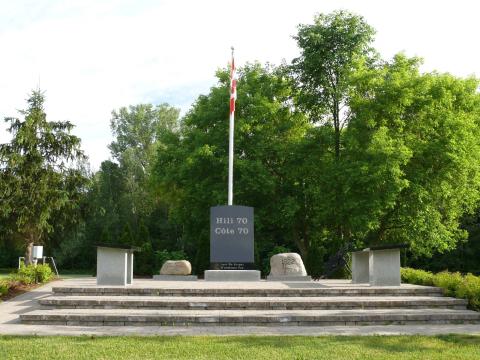
The Hill 70 Memorial was unveiled by the Town of Mountain in 1922 and is dedicated to the First World War Battle of Hill 70 near Lens, France. It was rededicated on September 16, 2012.

The memorial was restored by the Mountain and District Lions Club. There is now an interlocking brick platform resting on top of the original hill, a base for the flagpole, an access ramp and lighting for the main monument. Eastern Ontario Cemetery Memorials created two black granite storyboards with text in English and French. The larger of the two describes the battle itself and the second focuses on the founding of the Mountain Memorial Community Park.

Stones from the original site sit to the left and right of the main large black granite slab. The captured German machine gun, which was the centerpiece of the original memorial, is also to the left of the main column.

City
Mountain
Country
Type Description
Slab, stones, artillery
Memorial CF Legacy ID
5385
City/Municipality
Ormond
Memorial Number
35083-029
Type
Address
12663 Ormond Road
Location
Ormond Protestant Cemetery
in Canada
Yes
GPS Coordinates
45.1626386, -75.362483
Inscription

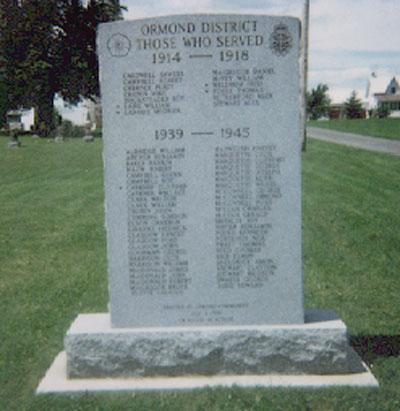
ORMOND DISTRICT
THOSE WHO SERVED

1914 - 1918  
CALDWELL SAMUEL
CARKNER PERCY
CAMPBELL ROBERT
CRONIN MIKE
DOCKSTEADER ROY
LANG WILLIAM
LANOUE MEDRICK
MACGREGOR DANIEL
MCVEY WILLIAM
MELDRUM FRED
POOLE THOMAS
RUTHERFORD ALEX
STEWART ALEX
   
1939 - 1945  
ALDERIDGE WILLIAM
ARCHER BENJAMIN
AYOTTE LAURIAN
BAKER RANKIN
BILOW ROBERT
CAMPBELL GLENN
CAMPBELL ROY
CARKNER CLIFFORD
CARKNER WALLACE
CLARK WELDON
CLARK WILLIAM
CRONIN JOHN
CUMMING GORDON
ELSON CAMERON
GIBBONS FREDRICK
GLASGOW ERNEST
GLASGOW FORD
GLASGOW JOHN
GOODMAN GEORGE
HARRISON CECIL
HARRISON WILLIAM
MACDONALD JAMES
MACDONALD JOHN
MACDONALD ROBERT
MACGREGOR BRUCE
ALDERIDGE WILLIAM
ARCHER BENJAMIN
AYOTTE LAURIAN
BAKER RANKIN
BILOW ROBERT
CAMPBELL GLENN
CAMPBELL ROY
CARKNER CLIFFORD
CARKNER WALLACE
CLARK WELDON
CLARK WILLIAM
CRONIN JOHN
CUMMING GORDON
ELSON CAMERON
GIBBONS FREDRICK
GLASGOW ERNEST
GLASGOW FORD
GLASGOW JOHN
GOODMAN GEORGE
HARRISON CECIL
HARRISON WILLIAM
MACDONALD JAMES
MACDONALD JOHN
MACDONALD ROBERT
MACGREGOR BRUCE


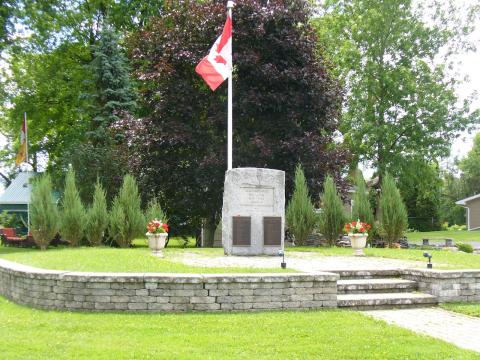
Image
Caption
front
1 of 2 images
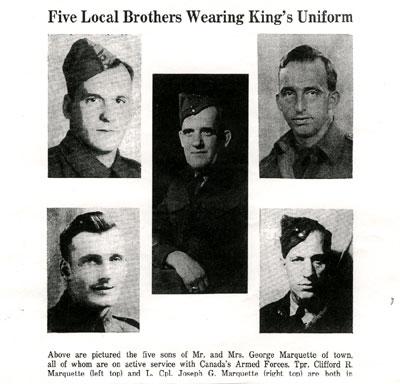
Image
Caption
five local Marquette brothers wearing King's Uniform
1 of 2 images
War or Conflict Term
Province
!4v1630683946246!6m8!1m7!1skPOeOOiy-w7mfscKMz3Ntg!2m2!1d45.16263856713316!2d-75.36248295439468!3f342.7283553171962!4f-3.85262431719795!5f3.325193203789971"
Body Content

The Ormond Community War Memorial was dedicated July 1, 1990, in memory of the War Veterans from the First and Second World Wars. It was moved from its original location at the Ormond Baptist Church when the church was demolished.

City
Ormond
Country
Type Description
Stele
Photo Credit
George Marquette
Memorial CF Legacy ID
5364
City/Municipality
Morewood
Memorial Number
35083-028
Type
Address
Main and Mill Streets
in Canada
Yes
GPS Coordinates
45.1774752, -75.2853547
Inscription

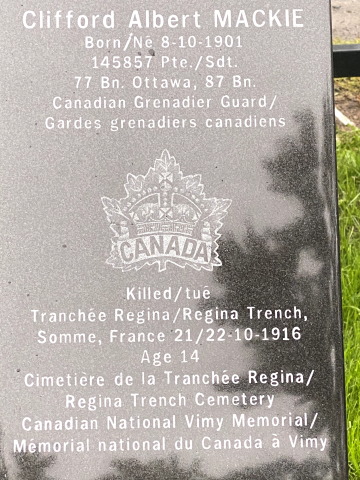
Clifford Albert MACKIE
Born/Né 8-10-1901
145857 Pte./Sdt.
77 Bn. Ottawa, 87 Bn.
Canadian Grenadier Guard/
Gardes grenadiers canadiens

Killed/tué
Tranchée Regina/Regina Trench,
Somme, France 21/22-10-1916
Age 14
Cimetière de la Tranchée Regina/
Regina Trench Cemetery
Canadian National Vimy Memorial/
Mémorial national du Canada à Vimy

Image
Photo Credit
Morewood Cenotaph Committee
Caption
inscription
1 of 2 images
Image
Photo Credit
Bill Smirle
Caption
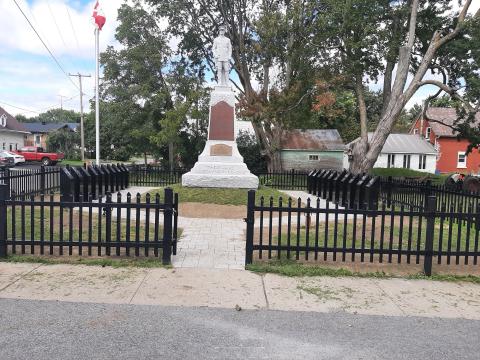
surroundings
1 of 2 images
War or Conflict Term
Province
!4v1629744946685!6m8!1m7!1suWXeIVZT5ttpEnnhBxXUwQ!2m2!1d45.17748049696227!2d-75.28535711421901!3f330.8470338471845!4f5.815212643639711!5f1.7590664711975967
Body Content

The Morewood Cenotaph Committee honored their fallen on the 100th anniversary of the original unveiling of the cenotaph - July 6, 2021, by installing 21 mini-monuments - ten along each side - one for each of those who had given their lives, and one by itself at the back representing all who returned.  Unable to locate a photograph of Clifford, the general list cap badge which was a standard badge worn by soldiers of the Canadian Expeditionary Force during the First World War, is etched into his memorial.

Clifford stood 5 foot 7 inches, had brown hair, blue eyes and a faint scar on the first finger of his left hand. He was a farm laborer before the war and sailed from Halifax on 19 June 1916 aboard the RMS Missanabie which arrived in France 10 September 1916. An attack north of Courcelette on the 21/22 of October 1916 resulted in his death. 

The 20 pillars representing individual soldiers are in alphabetic order. The 21st pillar sits in the shadow of the cenotaph and between the two rows.

City
Morewood
Country
Type Description
Pillar
Memorial CF Legacy ID
10804
City/Municipality
Williamstown
Memorial Number
35083-027
Type
Address
19678 William Street
in Canada
Yes
GPS Coordinates
45.1458817, -74.5811393
Inscription

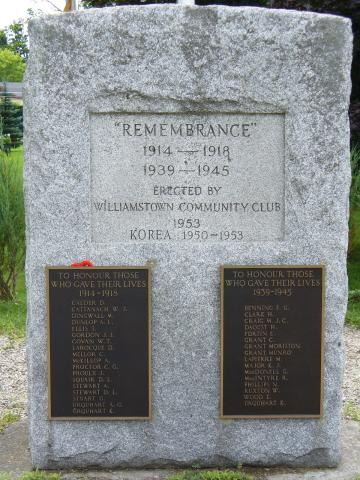
"REMEMBRANCE"

1914-1918

1939-1945

ERECTED BY
WILLIAMSTOWN COMMUNITY CLUB

1953
KOREA 1950-1953

TO HONOUR THOSE WHO GAVE THEIR LIVES
1914-1918

CALDER, D.
CATTANACH, W. J.
DINGWALL, M.
DUNLOP, A. L.
ELLIS, T.
GORDON, J. J.
GOVAN, W. T.
LAROCQUE, D.
MELLOR, C.
MCKILLOP, A.
PROCTOR, C. G.
PROULX, J.
SQAIR, D. L.
STEWART, A.
STEWART, D. L.
STUART, G.
URQUHART, A. G.
URQUHART, K.

TO HONOUR THOSE WHO GAVE THEIR LIVES
1919-1945

BENNING, F.G.
CLARK, H.
CRAIG, M. J. C.
DAOUST, H.
FORTIN, H.
GRANT, C.
GRANT, M.
GRANT, MUNRO
LAPIERRE, M.
MAJOR, K. J.
MACDONELL, G.
MACINTYRE, R.
PHILLIPS, N.
RUXTON, W.
WOOD, E.
URQUHART, K.

Image
Caption
surroundings
1 of 3 images
Image
Caption
Williamstown Cenotaph
1 of 3 images
Image
Caption
inscription
1 of 3 images
Province
!4v1622718620324!6m8!1m7!1s0jbM_nQj_sM7d2rpJw6KyQ!2m2!1d45.14588712435401!2d-74.58114721530512!3f152.32919867371572!4f1.3612408963901572!5f1.7921639606754676"
Body Content

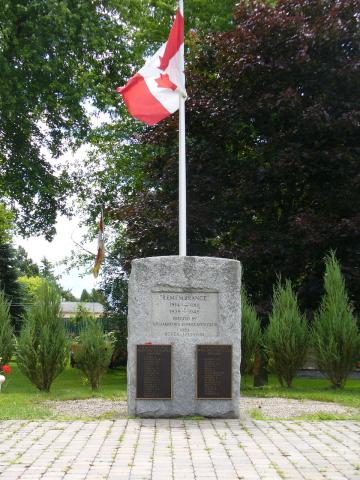
On a hot November 1953 day, Major J. A. McNeil, of the Stormont, Dundas and Glengarry Highlanders, was master of ceremonies for the unveiling of the Williamstown Cenotaph. Major McNeil was a native son of Williamstown who served his country with distinction. He called on a lady who sent five sons to war (four returned) and a padre recently returned from active service to unveil the impressive monument. It was erected by the Williamstown Community Club.

The observance began with a parade from the high school to the square led by four veterans carrying the colours of Williamstown and Claude Nunney, V.C., Lancaster and branches of the Canadian Legion. The members of both branches in their blue berets and wearing their medals, under command of Legionnaire John McLaren of Lancaster, followed. The high school cadets and the Stormont, Dundas & Glengarry pipe band walked behind the Legion members. The cadets, both boys and girls, Legionnaires and Stormont, Dundas & Glengarry Highlanders officers snapped to the salute as a new Union Jack was broken out from the staff, over the square for the first time, by war veteran, Parade Marshall Rene Rozon.

A choir from Williamstown Public School sang "Canada Proudly We Hail Thee". As the staff flag moved slowly to half-mast, Major McNeill called for two minutes of silence. It was broken by the Last Post and Reveille from the bugle of Percy Smith, bandmaster Royal Canadian Air Cadet Squadron 325 Kiwanis of Cornwall. Pipe Major Bert Sutherland piped a lament. A wreath for the Silver Cross Mothers of Canada was laid at the foot of the cenotaph by Mrs. Helen Daoust of Williamstown; by Dennis Lynch of Lancaster for the Legion; and by Capt. D. J. Coshman, another Williamstown native, for the Highlanders. Following the wreath-laying the school children sang the hymn "Now Thank We All Our God".

City
Williamstown
Country
Type Description
Slab - grey granite
Photo Credit
Tim Laye, Ontario War Memorials
Memorial CF Legacy ID
5478