Parks

City/Municipality
Edmonton
Memorial Number
48011-090
Type
Address
4415 McCrae Avenue
Location
Village of Griesbach
in Canada
Yes
GPS Coordinates
53.6119334, -113.5131618
Inscription

needs further research/recherche incomplète

Image
Photo Credit
Castle Downs Recreation Society
Caption
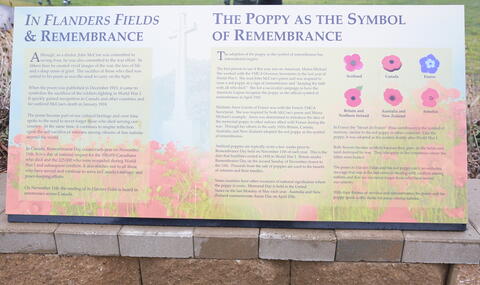
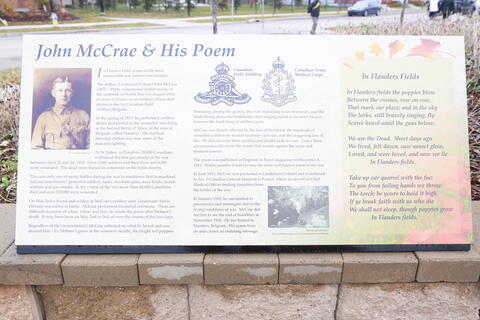
John McCrae storyboard
1 of 4 images
Image
Photo Credit
Castle Downs Recreation Society
Caption
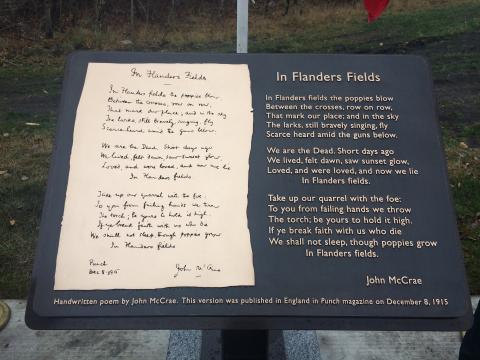
In Flanders Field, remembrance and poppy storyboard
1 of 4 images
Image
Photo Credit
Village of Griesbach
Caption
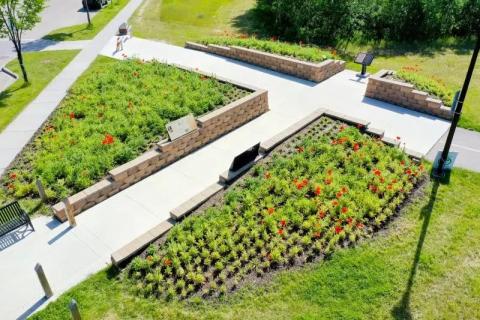
Bronze plaque with handwritten poem by John McCrae.
1 of 4 images
Image
Photo Credit
Village of Griesbach
Caption
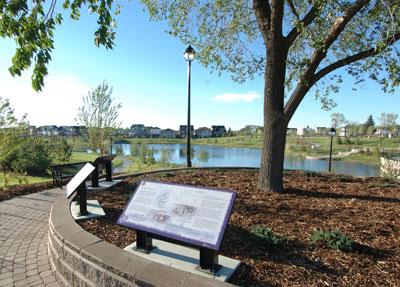
Flanders Field Park
1 of 4 images
Province
!4v1696332210277!6m8!1m7!1sfy92_3mCKtwottFqyJ0QRw!2m2!1d53.61193341529249!2d-113.5131618142225!3f174.56826106657775!4f7.903663542582365!5f0.7820865974627469"
Body Content

Flanders Field Park was dedicated to Lieutenant-Colonel John McCrae’s famous war poem, In Flanders Fields by the Canada Lands Company on June 23, 2004, as part of their redevelopment of Edmonton’s former Canadian Forces Base (Griesbach Barracks).

On November 1, 2015, the park was officially dedicated to commemorate the 100th anniversary of the famous war poem, In Flanders Fields. The park features unique walkways and walls made of brick which mimic the trenches in the First World War, poppy beds, a bronze plaque with the poem in the author’s original handwriting, a storyboard with the story of McCrae and how he came to write the poem and another storyboard with the story of how the poem itself became tied to remembrance and the poppy became the symbol of remembrance.

Castle Downs Recreation Society were the driving force behind the storyboard. In November 2014, they began working with Canada Lands Company and local military reserve units – the 15th Field Ambulance reserve unit and the 20th Field Artillery Regiment – to help bring the project to life.

Lieutenant-Colonel John McCrae was born in Guelph, Ontario in 1872, he served with an artillery battery in the South African War and had a successful civilian medical career. When the First World War broke out in 1914, the patriotic 41-year-old enlisted again and would be appointed as a medical officer with the First Brigade of the Canadian Field Artillery.

During the Second Battle of Ypres in the spring of 1915, McCrae was tending to the wounded in a part of Belgium traditionally called Flanders. On May 2, a close friend was killed in action and this painful loss inspired McCrae to write In Flanders Fields the next day. It would be published in Britain’s Punch magazine and quickly became one of the best-known poems of the war, helping make the poppy an international symbol of remembrance. Sadly, Lieutenant-Colonel McCrae would not survive the conflict, dying of illness in January 1918.

City
Edmonton
Country
Type Description
Park, garden, plaque, storyboard
Memorial CF Legacy ID
12028
City/Municipality
Edmonton
Memorial Number
48011-063
Type
Address
903 Valour Way NW
Location
Village of Griesbach
in Canada
Yes
GPS Coordinates
53.6063705, -113.4926128
Inscription

(needs further research/recherche incomplète)

War or Conflict Term
Province
!4v1697820343783!6m8!1m7!1sl3Z6n6EyQ2q-JMbwxLXzUA!2m2!1d53.60637047272377!2d-113.4926128107261!3f126.65230038946322!4f-9.234526475327087!5f0.7820865974627469
Body Content

The original Maple Leaf Park, now known as Maple Grove Park, was dedicated to returning soldiers by the Canada Lands Company on August 15, 2007, as part of their redevelopment of Edmonton’s former Canadian Forces Base (Griesbach Barracks). The park is a strand of maple trees which pay tribute to the returning soldiers.

In 2017, the name Maple Leaf Park was moved to its current location at 2603 Sir Arthur Currie Way SW.

City
Edmonton
Country
Type Description
Park
Memorial CF Legacy ID
8228
City/Municipality
Edmonton
Memorial Number
48011-053
Type
Address
2534 Pegasus Boulevard NW
Location
Village of Griesbach
in Canada
Yes
GPS Coordinates
53.6022151, -113.5043713
Inscription

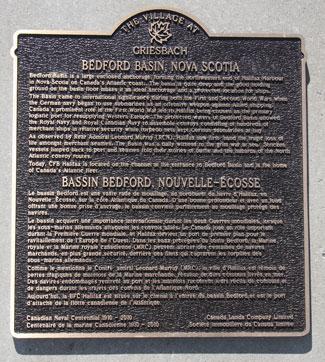
[plaque]

THE VILLAGE AT
GRIESBACH
BEDFORD BASIN, NOVA SCOTIA

Bedford Basin is a large enclosed anchorage, forming the northwestern end of Halifax Harbour
in Nova Scotia on Canada's Atlantic coast. The basin is quite deep and the good holding
ground on the basin floor makes it an ideal anchorage and a protected location for ships.
The Basin came to international significance during both the First and Second World Wars when
the German navy began to use submarines as an offensive weapon against Allied shipping
Canada's prominent role in the First World War led to Halifax being chosen as the primary
logistic port for resupplying Western Europe. The protected waters of Bedford Basin allowed
the Royal Navy and Royal Canadian Navy to assemble convoys consisting of hundreds of
merchant ships in relative security while torpedo nets kept German submarines at bay
As observed By Rear Admiral Leonard Murray (RCN), Halifax saw first hand the tragic loss of life amongst merchant seamen. The Basin was a daily witness to the grim war at sea. Stricken
vessels limped back to port and seamen fold their stories of battle and the hazards of the North
Atlantic convoy routes.
Today, CFB Halifax is located on the channel at the entrance to Bedford Basin and is the home
of Canada's Atlantic fleet.

BASSIN BEDFORD, NOUVELLE-ÉCOSSE

Le bassin Bedford est une vaste rade de mouillage, au nord ouest du havre d`Halifax, en
Nouvelle-Écosse, sur la côte Atlantique du Canada. D`une bonne profondeur et avec un fond
offrant une bonne prise d`ancrage, le bassin convient parfaitement au mouillage protégé des
navires.

Le bassin acquiert une importance internationale durant les deux Guerres mondiales, lorsque
les sous-marins allemands attaquent les convois alliés. Le Canada joue un rôle important
durant la Première Guerre mondiale, et Halifax devient un port de premier plan pour le
ravitaillement de l`Europe de l`Ouest. Dans les eaux protégées du basin Bedford, al Marine
royale et la Marine royale canadienne (MRC) peuvent abriter des centaines de navires
marchands, en plus grande sécurité, derrière des filets qui capturent les torpilles des
sous-marins allemands.

Comme le mentionne le Contre amiral Leonard Murray (MRC), la ville d`Halifax est témoin de
pertes tragiques de matelots de la Marine marchande, résultat de durs combats livrés en mer
Des navires endommagés rentrent au port et les matelots racontent leurs récits de combats et
de dangers durant les trajets des convois de l`Atlantique Nord.
Aujourd`hui, la BFC Halifax est située sur le chenal à l`entrée du bassin Bedford et est le port
d`attache de la flotte canadienne de l`Atlantique.

Canadian Naval Centennial 1910 - 2010
Centenaire de la marine Canadienne 1910-2010
Canada Lands Company Limited
Société immobilière du Canada limitée

Image
Photo Credit
Don Stewart
Caption
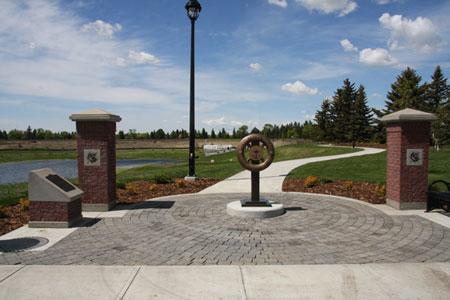
Lake and surroundings
1 of 3 images
Image
Caption
plaque
1 of 3 images
Image
Caption
plaque and surroundings
1 of 3 images
War or Conflict Term
Province
!4v1615389824857!6m8!1m7!1sUravHqhX039Ka8-NKMXWSQ!2m2!1d53.60226008241018!2d-113.5043604982822!3f287.63895378002405!4f-4.186336639633041!5f1.8382826790640267"
Body Content

Bedford Basin was dedicated in memory of the original Bedford Basin situated in Halifax, Nova Scotia by the Canada Lands Company on January 16, 2008, as part of their redevelopment of Edmonton’s former Canadian Forces Base (Griesbach Barracks).

Bedford Basin is a large enclosed area for ships to anchor that forms the north-western end of Halifax Harbour in Nova Scotia on Canada's Atlantic coast. The basin had international significance during both the First and Second World Wars when the German navy used submarines as an offensive weapon against Allied shipping. Canada's prominent role in the First World War led to Halifax being chosen as the primary logistic port for resupplying Western Europe. The protected waters of the Bedford Basin allowed the Royal Navy and Royal Canadian Navy to assemble convoys of hundreds of merchant ships in relative security while torpedo nets kept German submarines at bay.

City
Edmonton
Country
Type Description
Park, pond, plaque
Memorial CF Legacy ID
8218
City/Municipality
Edmonton
Memorial Number
48011-044
Type
Address
2109 Topham Street NW
Location
Village of Griesbach
in Canada
Yes
GPS Coordinates
53.6009924, -113.5015891
Inscription

(needs further research/recherche incomplète)

War or Conflict Term
Province
!4v1695840688343!6m8!1m7!1sQ2P5bCfbB3W5Y3eLmeo5xA!2m2!1d53.60099238942679!2d-113.5015890856761!3f88.56659376086351!4f4.213491161251156!5f0.7820865974627469
Body Content

Sanctuary Wood Park was dedicated by the Canada Lands Company on January 18, 2006, as part of their redevelopment of Edmonton’s former Canadian Forces Base (Griesbach Barracks). The park was named for the original Sanctuary Wood, where a Commonwealth War Graves Commission Cemetery contains the First World War graves of 1,990 Commonwealth soldiers, of whom 1,353 are unidentified.

In the early months of the First World War, as the first Battle of Ypres in Belgium raged, British troops found shelter in a pine forest they called Sanctuary Wood. It lay within the Ypres salient, a bulge in the front line where British and Canadian forces halted the German advance and held the last remaining portion of unoccupied Belgium. On 1 June 1916, the Princess Patricia’s Canadian Light Infantry relieved Edmonton’s 49th Battalion in the trenches of Sanctuary Wood. The day after the Patricia’s arrived at Sanctuary Wood, the Germans launched a massive offensive, and captured the strategically high ground of Mount Sorrel, Hill 61, and Hill 62. The Patricia’s were left exposed and lost almost half their initial strength, but they held their position. Of the units ordered to reinforce the exposed Patricia’s, only the 49th Battalion, commanded by Lieutenant-Colonel William Griesbach, arrived in time. Together they held the line. The broader Battle of Mount Sorrel ended on 13 June when the Canadians retook the lost heights, which remained in Allied hands until 1918.

City
Edmonton
Country
Type Description
Park
Memorial CF Legacy ID
8209
City/Municipality
Edmonton
Memorial Number
48011-016
Type
Address
At the North-East edge of Bedford Basin Lake.
Location
Village of Griesbach, Navy Memorial Plaza
in Canada
Yes
GPS Coordinates
53.602424, -113.5053898
Inscription

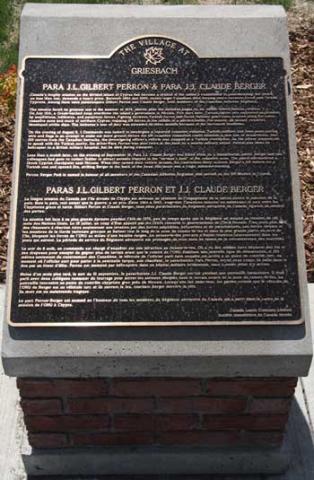
THE VILLAGE AT GRIIESBACH

PARA J.L. GILBERT PERRON & PARA J.J. CLAUDE BERGER

Canada's lengthy mission on the divided island of Cyprus has become a symbol of the nation's commitment to peacekeeping. But peace, no less than war, demands a heavy price. Between 1964 and 1993, twenty-eight Canadians died keeping peace between Greek and Turkish Cypriots. Among them were paratroopers Gilbert Perron and Claude Berger, both members of the Canadian Airborne Regiment.

The mission faced its greatest test in the summer of 1974, shortly after the Airborne began its six month United Nations rotation. On July 15th, a Greek-backed coup overthrew the island's government in Nicosia. Five days later, Turkish fighter jets supported an invasion by amphibious, heliborne, and paratroop forces. Fighting between Turkish forces and Greek National guardsmen erupted along the entire ceasefire zone and much of northern Cyprus, trapping UN forces in the middle of a pitched battle. Fortunately, an uneasy ceasefire developed within days. The Airborne's tour of duty was extended by three months because of the increased hostilities.

On the evening of August 6, 1 Commando was tasked to investigate a reported ceasefire violation. Turkish soldiers had been seen moving wire and flags in an attempt to stake out more ground before the UN ceasefire committee could establish a new line o demarcation. Just 100 meters form the Canadian barracks, the investigating officer's vehicle was stopped at a Turkish checkpoint. As the officer stepped out to speak with the Turkish sentry, his driver-Para Perron was shot twice in the back by a nearby military sniper. Perron was flown by helicopter to a British military hospital, but he died during transport.

Less than month later, on the evening of September 10, Para J.J. Claude Berger was killed while on a humanitarian patrol. Berger and two colleagues had gone to collect fodder to attract animals trapped in the "no-man's land" of the ceasefire zone. The patrol encountered a Greek Cypriot checkpoint near Nicosia. When Thy turned their vehicle around, the Guardsmen likely mistook Berger's UN vehicle for a Turkish one and opened fire, striking Berger in the back of the head. His death was a tragic misunderstanding.

Perron Berger Park is named in honour of all members of the Canadian Airborne Regiment who served on the UN Mission in Cyprus.

PARAS J.L. GILBERT PERRON ET J.J. CLAUDE BERGER

La longue mission du Canada sur l'île divisée de Chypre est devenue un symbole de l`engagement de la nation envers le maintien de la paix. Mais al paix, tout autant que la guerre, a un prix. Entre 1964 à 1993, vingt-huit Canadiens meurent en maintenant la paix entre les Chypriotes grecs et turcs. Gilbert Perron et Claude Berger, tous deux parachutistes du Régiment aéroporté du Canada, figurent au nombre des pertes.

La mission fait face à sa plus grande épreuve pendant l`été de 1974, peu de temps après que le Régiment ait entamé sa rotation de six mois des Nations Unies. Le 15 juillet, un coup d`État appuyé par les Grecs renverse le gouvernement de l`ile à Nicosie. Cinq jours plus tard, des chasseurs à réaction turcs soutiennent une invasion par des forces amphibies, héliportées et de parachutistes. Les forces turques et les membres de la Grade nationale grecque se battent tout le long de la zone de cessez-le-feu et dans la plus grande partie du nord de l`île, bloquant les forces de l`ONU au milieu d`un bataille rangée. Un cessez-le-feu précaire s`établit toutefois heureusement dans les jours qui suivent. La période de service du Régiment aéroporté est prolongée de trois mois en raison de la recrudescence des hostilités.

Le soir du 6 août, un commando est chargé d`enquêter sur une infraction au cessez-le0-feu. On a vu des soldats turcs déplacer des fils et des drapeaux pour essayer de gagner plus de terrain avant que le comité de l'ONU établisse une nouvelle ligne de démarcation. A 100
mètre seulement du casernement des Canadiens, le véhicule de l`officier parti faire enquête est arrêté à un poste de contrôle turc. Au moment où l`officier sort pour parler à la sentinelle turque, son chauffeur, le parachutiste para perron, reçoit deux coups de balle dans le dos par un tireur d`élite. perron est emmené par hélicoptère dans un hôpital militaire britannique, mais il meurt avant d`y arriver.

Moins d`un mois plus tard, le soir du 10 septembre, le parachutiste J.J. Claude Berger est tué pendant une patrouille humanitaire. Il était parti avec deux collègues ramasser du fourrage pour attirer les animaux bloqués dans le terrain neutre de la zone de cessez-le-feu. La patrouille rencontre un poste de contrôle chypriote grec près de Nicosie. Lorsqu'elle fait demi-tour, les gardes croient que le véhicule de l`ONU de Berger est un véhicule turc et ils ouvrent le feu, touchant Berger derrière la tête. Sa mort est un malentendu tragique.

Le parc Perron-Berger est nommé en l`honneur de tous les membres du Régiment aéroporté du Canada qui a servi dans le cadre de la mission de l`ONU à chypre.

Canada Lands Company Limited
Société immobilière du Canada limitée

Image
Photo Credit
Don Stewart
Caption
Perron-Berger Park plaque
Province
!4v1696333775813!6m8!1m7!1sCAoSLEFGMVFpcE12Yl9YdVZWaVlBTlVQcUdUTGpHVzFJOHVJcFZYWElkYmhWcUVC!2m2!1d53.60242397546747!2d-113.5053898028692!3f358.1179467939055!4f7.064196607932018!5f0.7820865974627469"
Body Content

Perron-Berger Park was dedicated by the Canada Lands Company on June 6, 2010, as part of their redevelopment of Edmonton’s former Canadian Forces Base (Griesbach Barracks).

The park is named in memory of paratroopers Gilbert Perron and Claude Berger, members of the Canadian Airborne Regiment who were killed while serving with the United Nations mission in Cyprus. The park is also named in honour of all members of the Canadian Airborne Regiment who served on the United Nations Mission in Cyprus.

City
Edmonton
Country
Type Description
Park, plaque
Memorial CF Legacy ID
8173
City/Municipality
Edmonton
Memorial Number
48010-019
Type
Location
Canadian Forces Base Edmonton
in Canada
Yes
GPS Coordinates
0, 0
Inscription

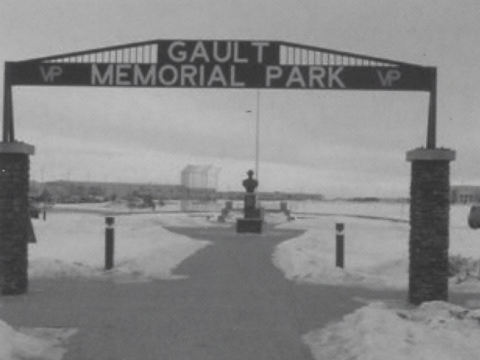
GAULT
MEMORIAL PARK

Image
Photo Credit
Princess Patricia’s Canadian Light Infantry
Caption
Gault Memorial Park
War or Conflict Term
Province
Body Content

Lady Patricia Mountbatten formally opened the Gault Memorial Park during a formal ribbon-cutting ceremony on 20 June 2003.

Canada’s quick response to the First World War was partly due to the actions of Hamilton Gault, a wealthy and distinguished Montreal businessman and Captain of the Royal Highlanders of Canada. As a Veteran of the South African War, Gault remained personally involved with the Canadian political responsibility to Britain as part of the Empire. In early August 1914, Hamilton ventured by train to Ottawa with a proposal. He would personally raise and equip a mounted unit of Canadians for the Imperial service. The proposal was set in front of Colonel Sam Hughes, the Canadian Minister of Militia and Defence. Colonel Hughes was attracted to the offer, but thought that an Infantry unit, as opposed to cavalry, would be more useful to Britain.

Lieutenant Colonel Farquhar approached the Duke of Connaught for permission to name the Regiment after his daughter, Her Royal Highness, Princess Patricia of Connaught. Princess Patricia had already become a much-admired figure in Canada because of her appreciation of the country’s vast wilderness and people. The request was made to the Princess, who was delighted. On 6 August 1914 the Canadian Government provisionally accepted Hamilton Gault’s offer.

Authority for the Regiment was granted on 10 August 1914, through a charter embodied in a report of the Committee of the Privy Council of Canada, to raise and equip an infantry battalion. As detailed in the charter, Hamilton Gault would contribute $100,000 to finance and equip the regiment, with the remainder of expenditures being covered by the Department of Militia and Defense.

Hamilton Gault would serve in the Regiment during the First World War, first as the second in command and at wars end as the commanding officer bringing the battalion home to Ottawa. 

He was seriously wounded in the Battle of Frezenberg (1915) and lost a leg at Sanctuary Wood (1916). He was the first Canadian in the war to be awarded the Distinguished Service Order for gallantry in the field. Lieutenant-Colonel Gault brought the regiment home as its commanding officer in March 1919. During the Second World War, he commanded a Canadian Army reinforcement holding unit, was promoted to Colonel in 1940 and to Brigadier-General in 1942. Ill health forced Hamilton to retire, and he returned to Canada in 1944. Gault founded the Princess Patricia’s Canadian Light Infantry Association in 1947 and served as its first national president. He served as the Regiment’s Honorary Lieutenant-Colonel from 1920 to 1948 and then as Honorary Colonel of the Regiment until his death in 1958.

City
Edmonton
Country
Type Description
Park
Memorial CF Legacy ID
11257
City/Municipality
Lougheed
Memorial Number
48009-021
Type
Address
Beside 4911 McLeod St, Lougheed, AB
in Canada
Yes
GPS Coordinates
52.74364, -111.54512
Inscription

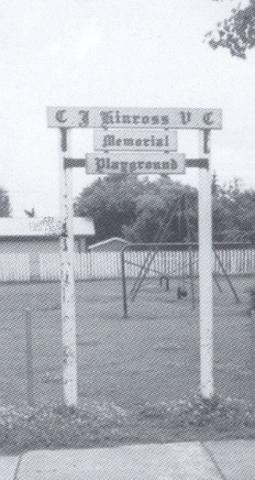
[sign/enseigne]

C.J. Kinross V C
Memorial
Playground

Image
Caption
front
Province
!4v1615302238776!6m8!1m7!1sF_cMT2qhj09m8Ut-XWJ-jA!2m2!1d52.74381763123625!2d-111.5453604981986!3f147.00219471376897!4f-5.411409268694598!5f3.1621984355932486"
Body Content

This park is dedicated to Pte. Cecil John Kinross V.C.

City
Lougheed
Country
Type Description
Park
Memorial CF Legacy ID
7372
City/Municipality
Calgary
Memorial Number
48008-022
Type
Address
Dallaire Aveneu SW, Forand Street SW, Mclean Avenue SW, and Joseph Marquis Crescent SW
in Canada
Yes
GPS Coordinates
51.0026813, -114.1220051
Inscription

[obelisk at entrance/obélisque à l`entrée ]
BUFFALO PARK

[plaque]
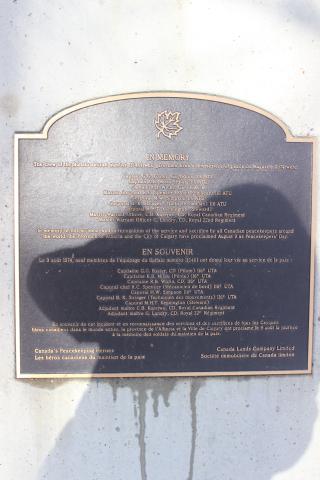
IN MEMORY
The crew of the Buffalo aircraft number 115461 who gave their lives in the service of peace on August 9, 1974 were:
Captain G.G. Foster, CD (Pilot) 116 ATU
Captain K.B. Mirau (Pilot) 116 ATU
Captain R.B. Wicks, CD, 116 ATU
Master Coporal R.C. Spencer (Flight Engineer) 116 ATU
Corporal M.W. Simpson 116 ATU
Corporal B.K. Stringer (Traffice technician) 116 ATU
Corporal M.H.T. Kennington (Steward)
Master Warrant Officer, C.B. Korejwo, CD, Royal Canadian Regiment
Master Warrant Officer G.Landry, CD, Royal 22nd Regiment

In memory of this incident, and in recognition of the service and sacrifice by all Canadian peacekeepers around
the world, the Province of Alberta and the City of Calgary have proclaimed August 9 as Peacekeepers' Day.

EN SOUVENIR
le 9 août 1974, neuf membres de l'équipage du Buffalo numéro 115461 ont donné leur vie au service de la paix :
Capitaine G.G. Foster, CD (Pilote) 116e UTA
Capitaine K.B. Mirau (Pilote) 116e UTA
Capitaine R.B. Wicks, CD, 116e UTA
Caporal chef R.C. Spencer (Mécanicien de bord) 116e UTA
Caporal M.W. Simpson 116e UTA
Caporal B.K. Stringer (Technicien des mouvements) 116e UTA
Caporal M.H.T. Kennington (Steward)
Adjudant maître, C.B. Korejwo, CD, Royal Canadian Regiment
Adjudant maître G.Landry, CD, Royal 22e Régiment

En souvenir de cet incident et en reconnaissance des services et des sacrifice de tous les Casques
bleus canadiens dans le monde entier, la province de l'Alberta et la Ville de Calgary ont proclamé le 9 août la journée
à la mémoire des soldats du maintien de la paix.

Canada's Peacekeeping Heroes
Les héros canadiens du maintien de la paix

Canada Lands Company Limited
Société immobilière du Canada limitée

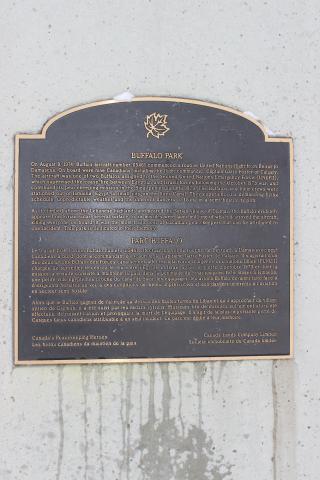
[plaque]
BUFFALO PARK

On August 9, 1974, Buffalo aircraft number 115461 commenced a routine United Nations flight from Beirut to
Damascus. On board were nine Canadians, including the flight commander, Captain Garry Foster of Calgary.
The aircraft was one of two Buffalos assigned to the Second United Nations Emergency Force (UNEFII),
which supervised the cease-fire between Egyptian and Israeli forces following the October 1973 war, and
continued its peacekeeping mission in the Sinai peninsula until 1979. The Buffalos and their crews were
stationed out of Ismailia, Egypt, a small city on the Suez Canal. They experienced a demanding flying
schedule, unpredictable weather and the inherent dangers of flying in a semi-hostile region.

As it climbed above the Lebanese highlands and neared the Syrian village of Diemas, the Buffalo evidently
appeared on Syrian radar. Several surface-to-air missiles were launched, one of which destroyed the aircraft,
killing everyone on board. It was the most tragic loss of Canadian peacekeepers that can be attributed to
one incident. This park is dedicated in their memory.

PARC BUFFALO

Le 9 août 1974, l'avion Buffalo numéro 115461 effectuait un vol de routine de Beyrouth à Damas avec neuf
Canadiens à bord, dont le commandant d'escadrille, le Capitaine Garry Foster de Calgary. Il s'agissait d'un
des deux avions Buffalo des Forces canadiennes affectés à la Force d'urgence des Nations Unies (FUNUII)
chargée de surveiller le cessez-le-feu entre l'Égypte et Israël après la guerre d'octobre 1973 et dont la
mission a ensuite consisté à maintenir la paix dans la péninsule du Sinaï jusqu'en 1979. Basés à Ismaïlia,
une petite égyptienne proche du canal de Suez, les équipages des avions Buffalo devaient faire face à
d'exigeants horaires de voi, à des conditions de météo imprévisibles et aux dangers inhérents à l'aviation
en secteur semi-hostile.

Alors que le Buffalo gagnait de l'altitude au dessus des hautes terres du Liban et qu'il approchait du village
syrien de Diemas, il a été suivi par les radar syriens. Plusieurs tir de missiles sol-air ont on alors été
effectués, détruisant l'avion et provoquant la mort de l'équipage. Il s'agit de la plus importante perte de
Casques bleus canadiens attribuable à un seul incident. Ce parc est dédié à leur mémoire.

Canada's Peacekeeping Heroes
Les héros canadiens du maintien de la paix

Canada Lands Company Limited
Société immobilière du Canada limitée

[plaque]

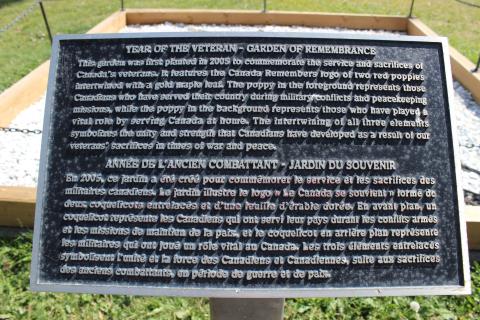
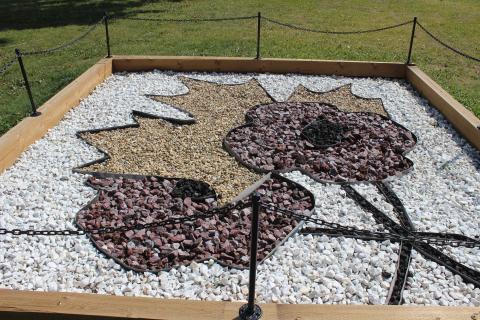
YEAR OF THE VETERAN - GARDEN OF REMEMBRANCE

This garden was first planted in 2005 to commemorate the service and sacrifices of
Canada's veterans. It features the Canada Remembers logo of two red poppies
intertwined with a gold maple leaf. The poppy in the foreground represents those
Canadians who have served their country during military conflicts and peacekeeping
missions, while the poppy in the background represents those who have played a
vital role by service in Canada at home. The intertwining of all three elements
symbolizes the unity and strength that Canadians have developed as a result of our
veterans' sacrifices in times of war and peace.

ANNÉE DES L'ANCEIN COMBATTANT - JARDIN DU SOUVENIR

En 2005, ce jardin a été créé pour commémorer le service et les sacrifices des
militaires canadines. Le jardin ilustre le logo Le Canada se souvient formé de
deux coquelicots entrelacés et d'une feuille d'érable dorée. En avant plane, un
coquelicot représente les Canadiens qui ont servi leur pays durant les conflits armés
et les missions de maintien de la paix, et le coquelicot en arrière plan représente
les militaires qui ont joué un rôle vital au Canada. Les trois éléments entrelacés
symbolisent l'unité et la force des Canadiens et Canadiennes, suite aux sacrifices
des anciens combattants en période de guerre et de paix.

Image
Photo Credit
Peacekeeper Park Committee
Caption
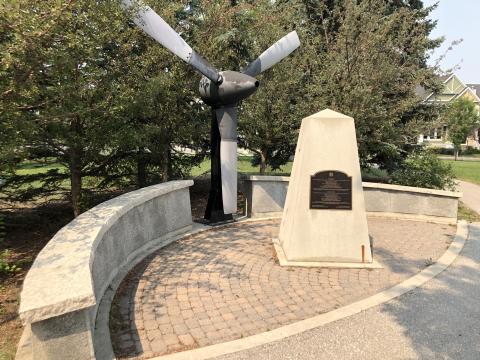
Buffalo Park cairn and propeller.
1 of 6 images
Image
Caption
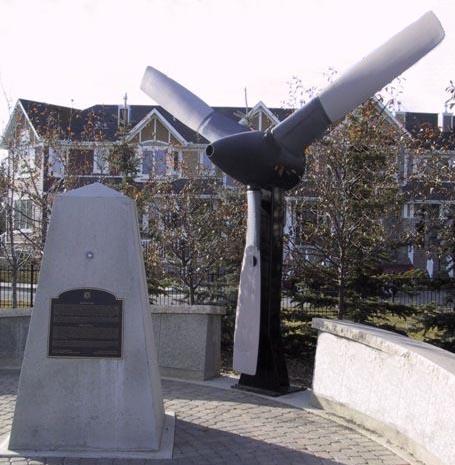
Obelisk and propeller
1 of 6 images
Image
Photo Credit
Linda Wright
Caption
Buffalo Park plaque
1 of 6 images
Image
Photo Credit
Linda Wright
Caption
In Memory Plaque
1 of 6 images
Image
Photo Credit
Peacekeeper Park Committee
Caption
Garden of Remembrance plaque
1 of 6 images
Image
Photo Credit
Peacekeeper Park Committee
Caption
Garden of Remembrance
1 of 6 images
War or Conflict Term
Province
!4v1615296807089!6m8!1m7!1sq3qPKuZXOw360I0uJA4zVQ!2m2!1d51.0026769407086!2d-114.1220029584016!3f14.97510548164671!4f-6.8756145808474685!5f1.7932939330358062
Body Content

Buffalo Park is named in honour of the nine Canadian Forces members killed in a Buffalo aircraft over Syria in 1974. This 1.3 acre park consists of a Buffalo propeller as an integral part of the monument, an obelisk, commemorative plaques, a garden of remembrance and a play area. It was completed in 2005 and opened in 2006. The Canadian Association of Veterans in United Nations Peacekeeping, Calgary chapter, provided guidance and input for the park design. The Garden of Remembrance was created in 2005, commissioned by Veterans Affairs Canada.

In late 1973, Canadian Forces took part in the Second United Nations Emergency Force, to supervise the ceasefire between Egyptian and Israeli forces. Included in Canada's commitment to the mission were two Canadian Forces Buffalo aircrafts and crew. The unit was stationed in Ismailia, Egypt, a small city next to the Suez Canal.

The single highest loss of Canadian lives since Canada began to participate in international peace missions involved their presence in Syria. Nine Canadian Armed Forces members with the United Nations peace mission in Egypt were killed on August 9, 1974, when their Buffalo aircraft 115461 was shot down in a Syrian missile attack while making a routine supply run to the mission in the Golan Heights. For this reason, August 9 has been declared National Peacekeepers' Day in Canada.

City
Calgary
Country
Type Description
Park, obelisk, propeller, plaques, garden
Memorial CF Legacy ID
8182
City/Municipality
Calgary
Memorial Number
48008-021
Type
Address
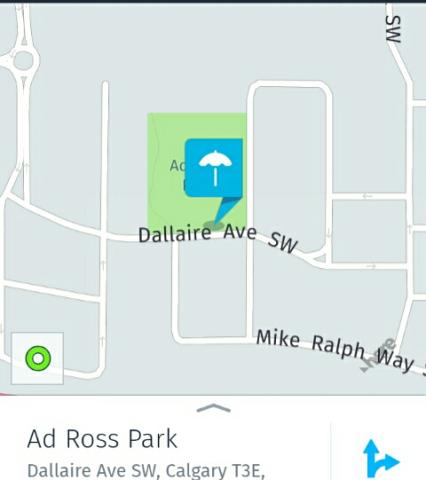
2816 Dallaire Ave SW, Calgary, AB
Location
A.D. Ross Park
in Canada
Yes
GPS Coordinates
51.003928870926, -114.12447182924
Image
1 of 2 images
Image
1 of 2 images
Province
!4v1615296547555!6m8!1m7!1sMZkRw2TcHNAFZYRNE1PV3A!2m2!1d51.00295329731868!2d-114.124702499193!3f8.220338660825508!4f-1.1416766976692685!5f1.3823114222521701"
Body Content

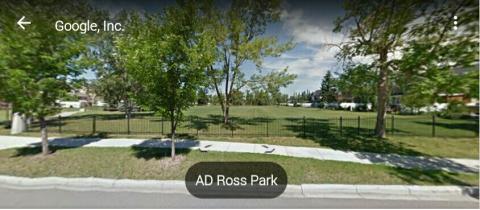
A.D. Ross Park is named in honour of the first commander of Canadian Forces Base Calgary. The following is an excerpt from: Garrison Green - Community - Greenspace A.D. Ross Park - The 3.3 acre (1.34 ha) A.D. Ross Park provides an open play space and several large preserved trees. The local pathway running through the park connects to the Calgary Regional Pathway System.

City
Calgary
Country
Type Description
Park
Memorial CF Legacy ID
8043
City/Municipality
Calgary
Memorial Number
48008-008
Type
Address
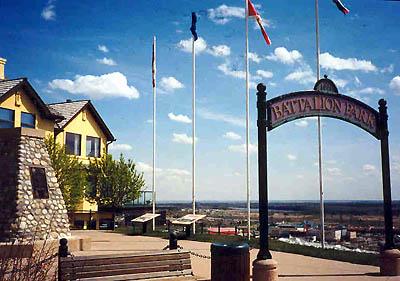
2972 Signal Hill Dr, Calgary,
Location
Battalion Park
in Canada
Yes
GPS Coordinates
51.02156, -114.1738
Inscription

[front/devant]

1991

BATTALION PARK

Image
Caption
arch (front and surroundings)
1 of 4 images
Image
Caption
park
1 of 4 images
Image
Caption
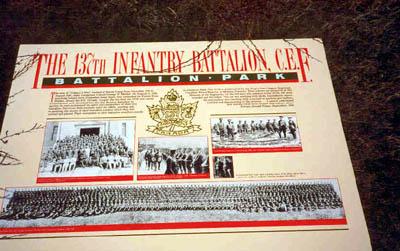
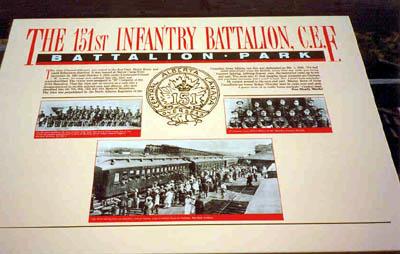
plaque
1 of 4 images
Image
Caption
plaque
1 of 4 images
Province
!4v1615294863610!6m8!1m7!1sCJ_ULIXS9ND2i8VEPgZBRA!2m2!1d51.02165388476582!2d-114.1740185887227!3f134.560497046131!4f1.4909586969285158!5f3.325193203789971"
Body Content

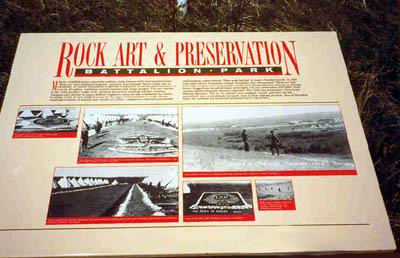
Erected in 1991, this arch forms the entrance to Battalion Park.

City
Calgary
Country
Type Description
park - metal and wooden arch
Memorial CF Legacy ID
1940