"Mount Borsato" - This mountain was named in 1961 in honour of Pte. Leno Borsato from Michel, BC. Pte. Borsato was killed in action on 9 December 1944 while serving with the Seaforth Highlanders.
Mount Borsato
no inscription/aucune inscription
Sign in to My VAC Account
Sign in to My VAC Accountno inscription/aucune inscription
"Mount Borsato" - This mountain was named in 1961 in honour of Pte. Leno Borsato from Michel, BC. Pte. Borsato was killed in action on 9 December 1944 while serving with the Seaforth Highlanders.
(further research needed/recherche incomplete)
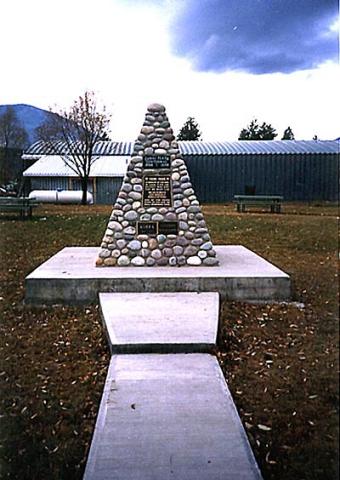
CANAL FLATS
CENTENNIAL
1858 1958
1939-1945
IN MEMORY OF THE MEN
OF CANAL FLATS AND
DISTRICT WHO DIED
THAT WE MIGHT LIVE
MELVIN ROBERTS
JACK ARBUCKLE
DONALD PATTENAL
AND AT THE GOING
DOWN OF THE SUN, WE
SHALL REMEMBER THEM.
This memorial to local veterans was erected by the community of Canal Flats.
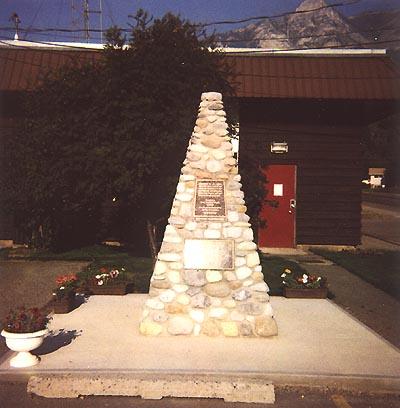
[upper plaque/plaque du haut]
DEDICATED TO ALL THOSE WHO LOST THEIR LIVES IN THE WARS AND CONFLICTS OF THE 20TH CENTURY AND ESPECIALLY THOSE WHO FOUGHT AND DIED THAT OTHERS COULD BE FREE
BRANCH 279 ROYAL CANADIAN LEGION ELKFORD
AND THE MAYOR AND COUNCIL OF ELKFORD IN THE YEAR 2000
CANADIAN PEACEKEEPERS
[lower plaque/plaque du bas]
DEDICATED TO THE MEN AND WOMEN WHO PAID THE SUPREME SACRIFICE
WARS
1914 - 1918
1939 - 1945
1950 - 1953
AT THE GOING DOWN OF THE SUN AND IN THE MORNING WE WILL REMEMBER THEM
LEST WE FORGET
Dedicated to the memory of the war dead of the First and Second World Wars and the Korean War and to Canadian peacekeepers, this cairn was erected by the municipality of Elkford and Royal Canadian Legion Branch No. 279 in 2000.
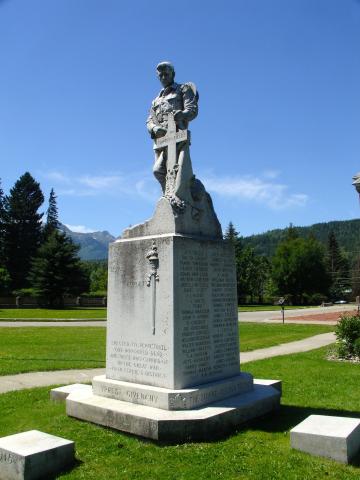
[front/devant]
(cross/croix)
IN
FLANDERS FIELDS
LEST
WE
FORGET
ERECTED • TO • PERPETUATE •
• OUR • HONOURED • DEAD •
• AND • THOSE • WHO • CARRIED ON •
• IN • THE • GREAT • WAR • FROM •
• FERNIE • & • DISTRICT •
YPRES • • GIVENCHY
[right side/côté droit]
OUR • DEAD
THE • SOMME • REGINA • TRENCH
[back/arrière]
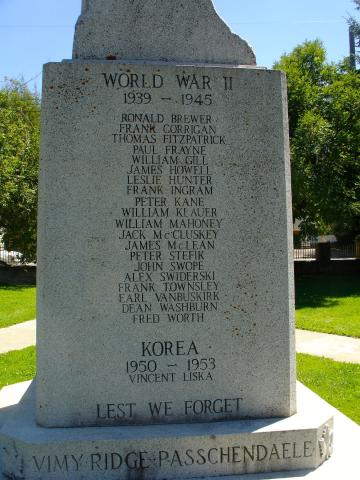
WORLD WAR II
1939 — 1945
RONALD BREWER
FRANK CORRIGAN
THOMAS FITZPATRICK
PAUL FRAYNE
WILIAM GILL
LESLIE HUNTER
FRANK INGRAM
PETER KANE
WILLIAM KLAUER
WILLIAM MAHONEY
JACK McCLUSKEY
JAMES McLEAN
PETER STEFIK
JOHN SWOPE
ALEX SWIDERSKI
FRANK TOWNSLEY
EARL VANBUSKIRK
DEAN WASHBURN
FRED WORTH
KOREA
1950 — 1953
VINCENT LISKA
LEST WE FORGET
VIMY RIDGE • PASSCHENDAELE
[left side/côté gauche]
OUR • DEAD
AMIENS • • MONS
[front stone]
1915
[right stone]
1916
[back stone]
1917
[left stone]
1918
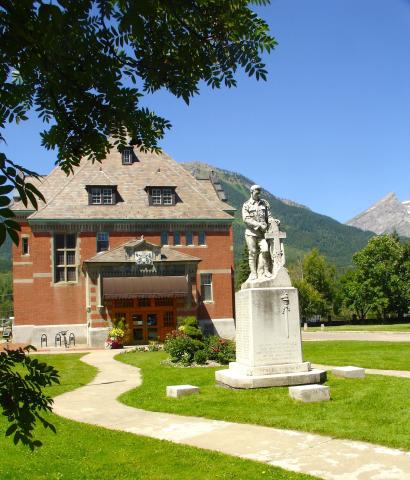
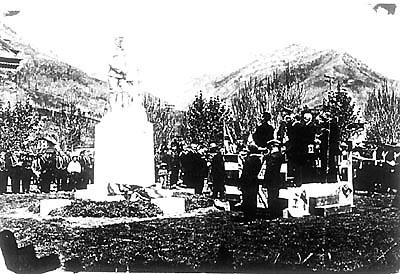
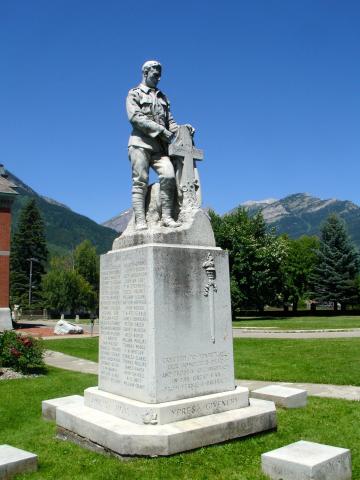
The Fernie Cenotaph was unveiled by Dr. Douglas Corsan on 24 May 1923. He lost two sons in the First World War. His oldest son Tom was among the first to leave Fernie for overseas. Tom was severely wounded twice and in each case went back to the fighting lines once recovered from his injuries. The cenotaph was dedicated to the memory of the local war dead and Veterans of the First World War. Names were later added of those who died in the Second World War and Korean War.
Hahn's design represents the sorrows caused by war. The soldier atop the cenotaph looks down in sadness at the ground below him, as if he might find there, his fallen comrades, if not for the tragedy of war.
The statue depicts a young, grieving Canadian soldier in First World War army uniform. With uncovered head, he is standing at a battlefield grave – a simple cross with poppies and a broken chain at the base and the flag draped behind it – the final resting place of a comrade killed in action. His left hand rests on the cross, while his right hand holds a reversed rifle. His helmet is slung over his shoulder.
Emanuel Hahn moved to Toronto at the age of seven with his family of artists and musicians from Germany, in 1888. He studied commercial design and model-making at Toronto Technical School and Ontario College of Art and Industrial Design. At 25 years old Hahn began a nearly lifelong contract with Thomson Monument Company of Toronto. Two years later, he also started work as a studio assistant to sculptor Walter Seymour Allward. Part of his duties included assisting on Allward’s significant works such as the South African War Memorial in Toronto.
In 1912 Hahn began an association with the Thomson Monument Company of Toronto. It was there, along with several assistants, he made the many war memorials that are found across Canada: Fernie, British Columbia; Killarney and Russell, Manitoba; Alvinston, Bolton, Cornwall, Hanover, Lindsay, Malvern, Milton, Petrolia and Port Dalhousie, Ontario; Gaspe, Quebec; Moncton, New Brunswick; Springhill and Westville Nova Scotia; Summerside, Prince Edward Island.
Hahn is probably most famous as the designer of the Bluenose on the back of the Canadian dime and the Caribou on the back of the Canadian quarter. He was a victim of anti-German sentiment in the years following the Great War, when his design for the Winnipeg Cenotaph was rejected in 1925.

This is one of four existing railway bridges on the old Kettle Valley Railway, now Trans Canada Trail, that were converted from railway bridges to pedestrian/biking friendly crossings for the trail. The crossings were completed by the Canadian Military Engineers, assisted by the Royal Engineers on two of the crossings from 2002 to 2004.
The bridges were named Canadian Railway Troops Crossing after the First World War Canadian Railway Troops who were part of the Canadian Engineers.
The location of the four crossings are: Cascade, Grand Forks (first crossing completed, southwest of Cascade Falls), Grand Forks (trail at end of Nagraeff or Popoff Roads) and Grand Forks (near Kettle River Drive and 13th Street).
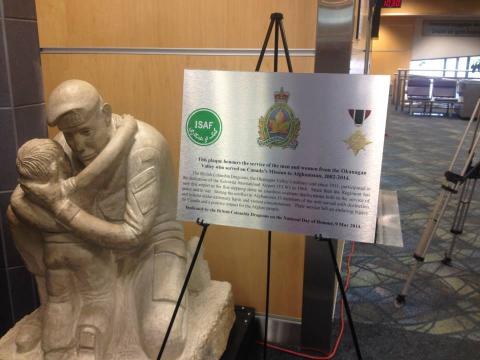
This plaque honours the service of the men and women from the Okanagan Valley who served on Canada's Mission to Afghanistan, 2002-2014.
The British Columbia Dragoons, the Okanagan Valley's military unit since 1911, participated in the dedication of the Kelowna International Airport (YLW) in 1968. Since then the Regiment has seen this airport as the first stepping stone on countless overseas deployments both in the service of peace and in war. During the conflict in Afghanistan 33 members of the unit served with distinction and honour under extremely harsh and violent circumstances. Their service left an enduring legacy for Canada and a positive impact for the Afghan people.
Dedicated by the British Columbia Dragoons on the National Day of Honour, 9 May 2014.
The National Day of Honour was recognized at Kelowna International Airport (YLW) on Friday May 9, 2014 at 10 am with a plaque presentation by the British Columbia Dragoons, the first and only Canadian Military Unit in the Okanagan. The British Columbia Dragoons is a Reserve Armoured Regiment based in Kelowna and Vernon. The Dragoons earned 12 battle honours in the Second World War and has also provided individual members and formed sub-units to the Regular Force for United Nations operations. The National Day of Honour was designated by Prime Minister Stephen Harper in recognition and commemoration of Canada’s military mission in Afghanistan. The plaque will be mounted in the airport arrivals area near the BC Dragoon stone sculpture ‘Coming Home’. The work was commissioned by the British Columbia Dragoons to commemorate its 100th anniversary in 2011. The work was donated by the Dragoons to the City of Kelowna.
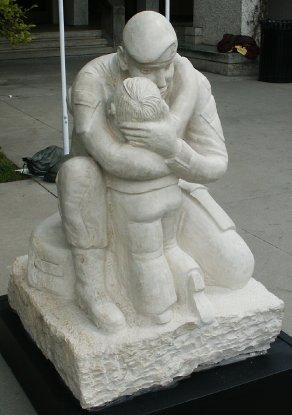
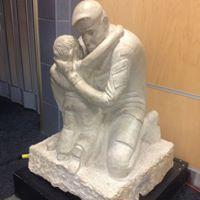
‘Coming Home’ was presented to the City of Kelowna on May 14, 2011 by the British Columbia Dragoons in honour of the regiment’s centennial celebrations. Kelowna International Airport was proudly chosen as the placement for display and Coming Home is listed as in the City’s Public Art collection. The theme of the artwork is a soldier returning home to the Okanagan from a tour overseas and his child running into his arms in an embrace.
While also a painter and portraitist Frances Brazeau’s’ principal medium is stone. Much of her sculpture is glyptic, i.e., directly carved to free the image inside. Often, rough stone remains. Other works are modeled to exploit natural tones and texture or to allow casting. Frances has exhibited and taught painting, drawing and sculpture across Canada. "The 'Coming Home' sculpture was inspired by the several sketches I did when my husband informed me that the British Columbia Dragoons were trying to think of something special to help celebrate their 100 anniversary. I chose one that I felt most depicted the feelings of both the Armed Forces and their families.....soldiers coming home being greeted by their loved ones. The Canadian Armed Forces has played a large role in my life. My father was in the first world war, my husband was in the Artillery and one of my grandsons is in the Reserves. I have always been proud of our Canadian Armed Forces."
Kelowna Memorial Arena
Okanagan Military Museum
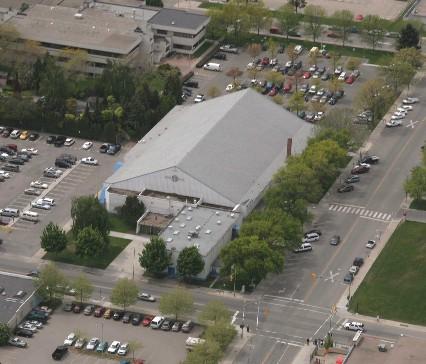
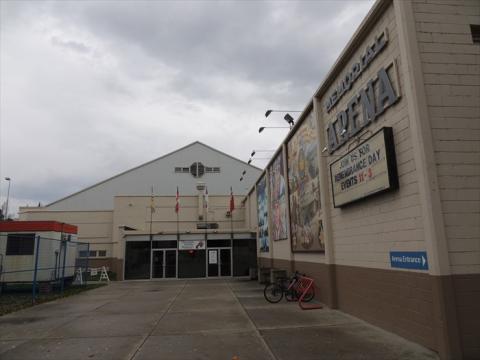
The Kelowna Memorial Arena is an ice hockey arena built in 1945. It was constructed by efforts of World War II veterans as a monument to fallen comrades. It was built with the memorial fund given to the city due to World War II. The Okanagan military museum is connected to the arena. It has a capacity of 2,600. The smaller ice surface of 180' X 80' is used for Kelowna Minor Hockey and the Okanagan College Hockey League. The Okanagan Military Museum is located in the Memorial Arena building in Kelowna at 1424 Ellis Street. The Okanagan Military Museum Society which oversees the museum is dedicated to the preservation of our military and naval history, within a local context, as a valuable contribution to our community. The museum has a significant collection of military artifacts such as military small arms, uniforms, insignia, badges and equipment. The collection includes relics and artifacts from the Boer War, World War I and II, the Korean War, the Cold War and contemporary military operations. The British Columbia Dragoons regiment is well represented as the Okanagan's military presence along with the RCMP.
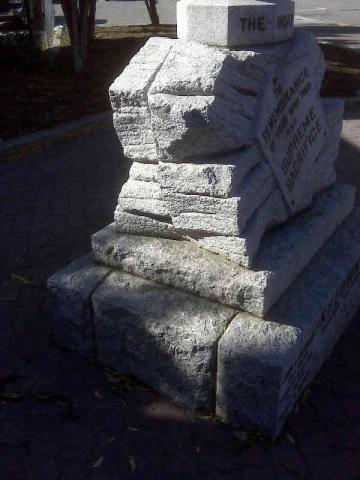
[front/avant]
1914-1918
The Great War
In Remembrance
of those who paid
the supreme sacrifice
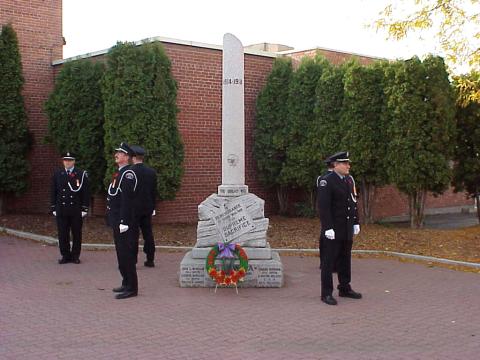
Kelowna Volunteer Fire Brigade
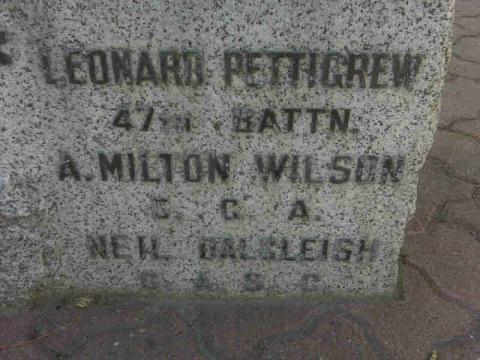
Jack L. McMillan Leonard Pettigrew
48th Battn 47th Battn
Leonard McMillan A. Milton Wilson
7th Bttn R.C.A.
Walter R. Raymer Neil Dalgleish
72nd Bttn
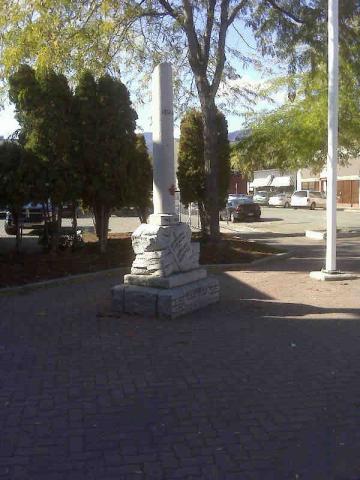
The memorial is a single granite spire set atop three separate granite bases.
[plaque/plaque]
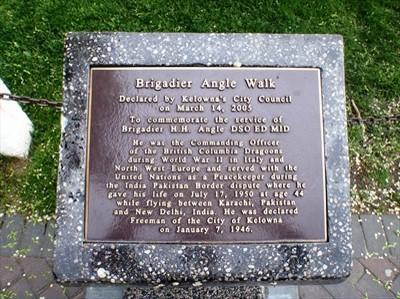
Brigadier Angle Walk
Declared by Kelowna’s City Council
on March 14, 2005
To commemorate the service of Brigadier H.H. Angle, DSO, ED, MID
He was the Commanding Officer of the British Columbia Dragoons during World War II in Italy and North West Europe and served with the United Nations as a Peacekeeper during the India-Pakistan border dispute where he gave his life on July 17, 1950 at age 44 while flying between Karachi, Pakistan and New Delhi, India. He was declared Freeman of the City of Kelowna on January 7, 1946.
The Brigadier Angle Walkway, from Bernard Avenue to William R. Bennet Bridge in City Park, was named in honour of Brigadier H.H. (Harry) Angle, DSO, MID, ED.
Brigadier H.H. Angle was born in England in 1906 and moved to Kelowna at the age of 16. In 1932, he joined the Okanagan Mounted Rifles Militia, the forerunner to the British Columbia Dragoons (BCD). He sailed for England with the BCD in November 1941 and spent much of the next two years training with the Regiment for the eventual invasion of the European continent. As Lieutenant-Colonel he commanded the British Columbia Dragoons from April 1943 to February 1944, and then again from September 1944 to January 1946, earning the DSO. Following the end of the Italian campaign, he led his troops into battle in North-West Europe and into the final battle of the Delfzijl Pocket, liberating the Netherlands from German occupation. The British Columbia Dragoons moved to the Veendam area after this final battle and were instrumental in the establishment of municipal affairs in the area, thus establishing a bond between Kelowna and Veendam that continues to be celebrated to this day. He returned to Kelowna with the Regiment in 1946 where he was honoured with the “Freedom of the City” in recognition of the honour he brought to Kelowna through his stellar military service. In 1947, he served as magistrate for Kelowna, but was called upon the following year to serve as a military observer in Pakistan and sent to India in 1949 as Chief Military Adviser to a United Nations mission dealing with a border dispute between India and Pakistan. Tragically, Brigadier Angle was killed in an airplane crash in India in July 1950.
[front/devant]
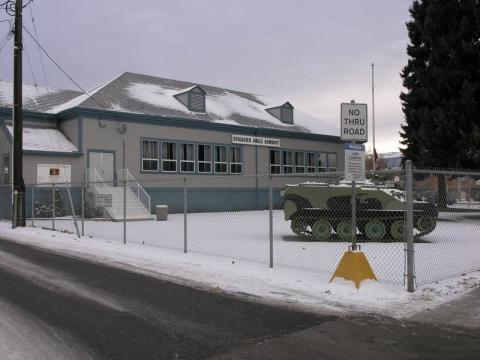
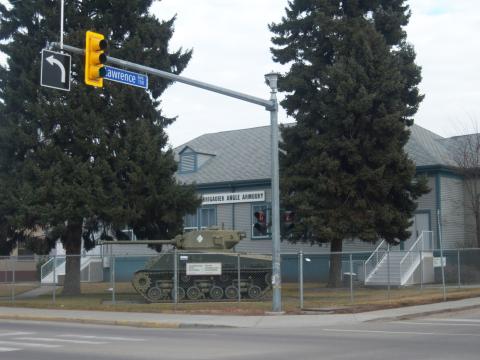
Brigadier Angle Armoury
The Brigadier Angle Armoury, of the British Columbia Dragoons, was named in honour of Brigadier H.H. (Harry) Angle, DSO, MID, ED.
Brigadier H.H. Angle was born in England in 1906 and moved to Kelowna at the age of 16. In 1932, he joined the Okanagan Mounted Rifles Militia, the forerunner to the British Columbia Dragoons (BCD). He sailed for England with the BCD in November 1941 and spent much of the next two years training with the Regiment for the eventual invasion of the European continent. As Lieutenant-Colonel he commanded the British Columbia Dragoons from April 1943 to February 1944, and then again from September 1944 to January 1946, earning the DSO. Following the end of the Italian campaign, he led his troops into battle in North-West Europe and into the final battle of the Delfzijl Pocket, liberating the Netherlands from German occupation. The British Columbia Dragoons moved to the Veendam area after this final battle and were instrumental in the establishment of municipal affairs in the area, thus establishing a bond between Kelowna and Veendam that continues to be celebrated to this day. He returned to Kelowna with the Regiment in 1946 where he was honoured with the “Freedom of the City” in recognition of the honour he brought to Kelowna through his stellar military service. In 1947, he served as magistrate for Kelowna, but was called upon the following year to serve as a military observer in Pakistan and sent to India in 1949 as Chief Military Adviser to a United Nations mission dealing with a border dispute between India and Pakistan. Tragically, Brigadier Angle was killed in an airplane crash in India in July 1950.