
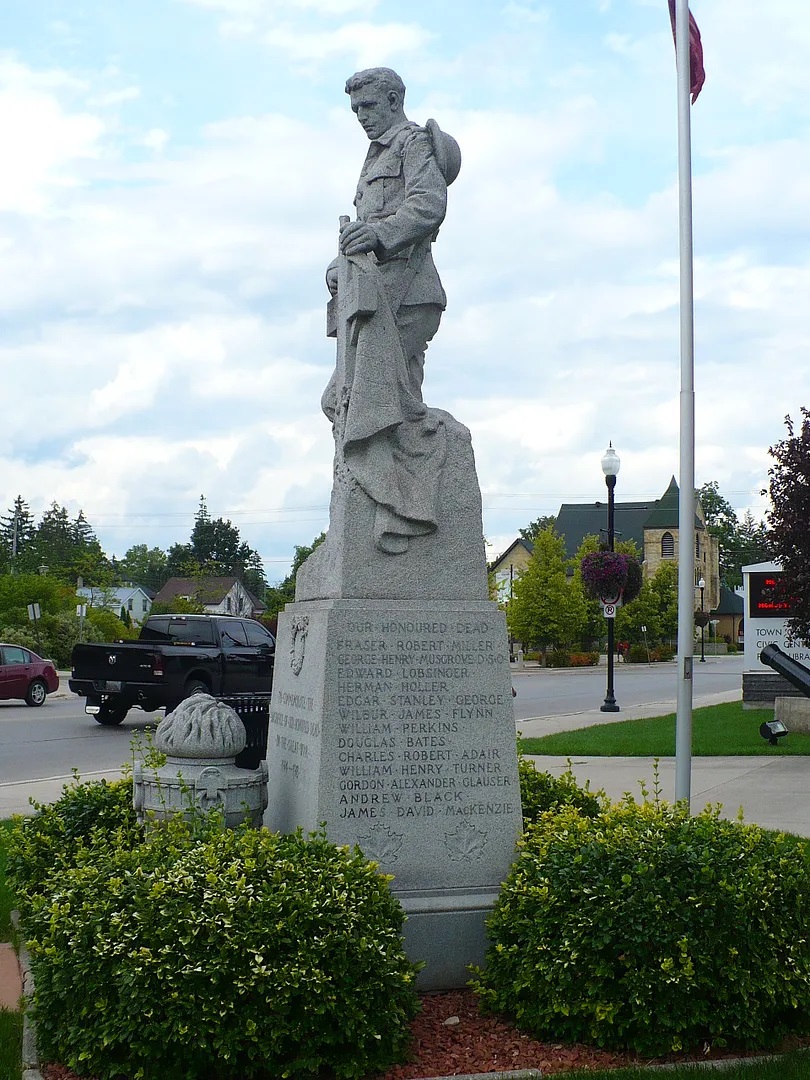

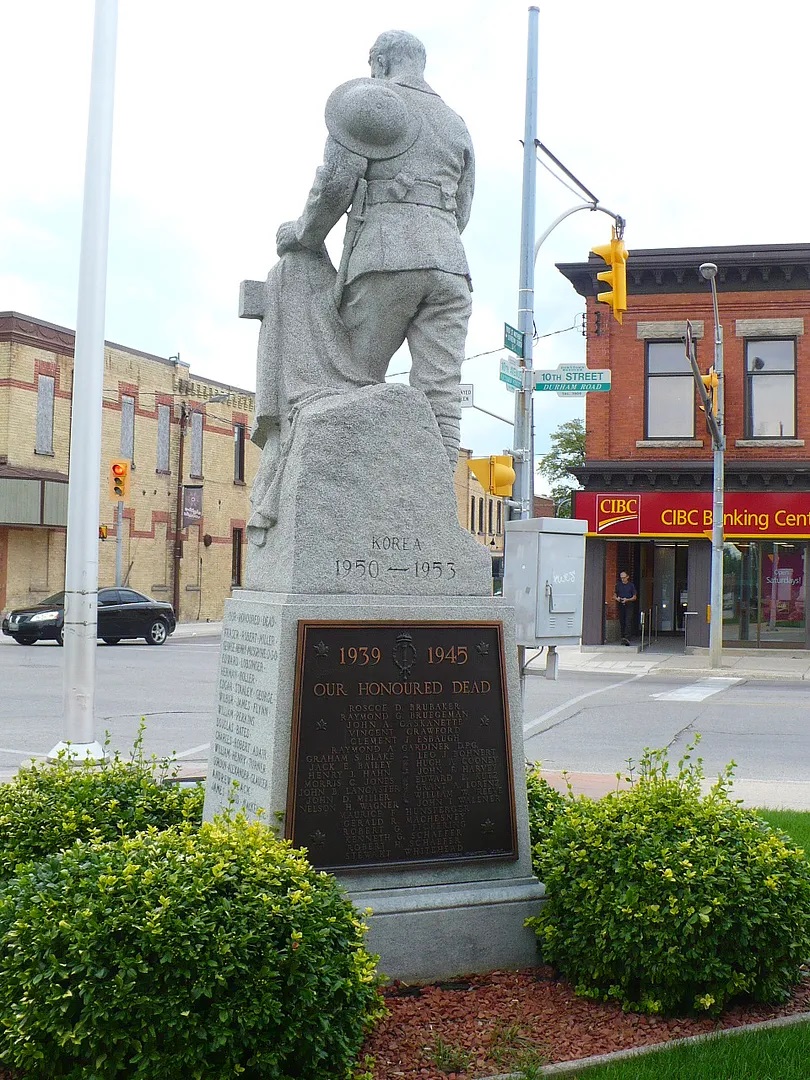


This memorial was constructed in 1922, and dedicated to those who died in the First World War. In December 1921, the Library Board met the International Order of the Daughters of the Empire for the purpose of erecting a war memorial on the library grounds. Town council had given the International Order of the Daughters of the Empire $500 toward the construction of a monument. In February 1922, a committee from the Library Board consisting of Miss A. Zinn, Rev. D.J. Lane, James A. Magee and Mayor Henry Peppler met with the International Order of the Daughters of the Empire to work out the details of erecting the monument. In March, the Library Board granted permission for the International Order of the Daughters of the Empire to place the monument in the northwest corner of the library lot. Another war memorial was suggested by the Hanover Women's Institute in March 1922. The Women's Institute met with the Library Board to place a service flag with the names of the Hanover enlists of the First World War. The flag was placed on the south wall of the men's reading room.
Emanuel Hahn moved to Toronto at the age of seven with his family of artists and musicians from Germany, in 1888. He studied commercial design and model-making at Toronto Technical School and Ontario College of Art and Industrial Design. At 25 years old Hahn began a nearly lifelong contract with Thomson Monument Company of Toronto. Two years later, he also started work as a studio assistant to sculptor Walter Seymour Allward. Part of his duties included assisting on Allward’s significant works such as the South African War Memorial in Toronto.
In 1912 Hahn began an association with the Thomson Monument Company of Toronto. It was there, along with several assistants, he made the many war memorials that are found across Canada: Fernie, British Columbia; Killarney and Russell, Manitoba; Alvinston, Bolton, Cornwall, Hanover, Lindsay, Malvern, Milton, Petrolia and Port Dalhousie, Ontario; Gaspe, Quebec; Moncton, New Brunswick; Springhill and Westville Nova Scotia; Summerside, Prince Edward Island.
Hahn is probably most famous as the designer of the Bluenose on the back of the Canadian dime and the Caribou on the back of the Canadian quarter. He was a victim of anti-German sentiment in the years following the Great War, when his design for the Winnipeg Cenotaph was rejected in 1925.