
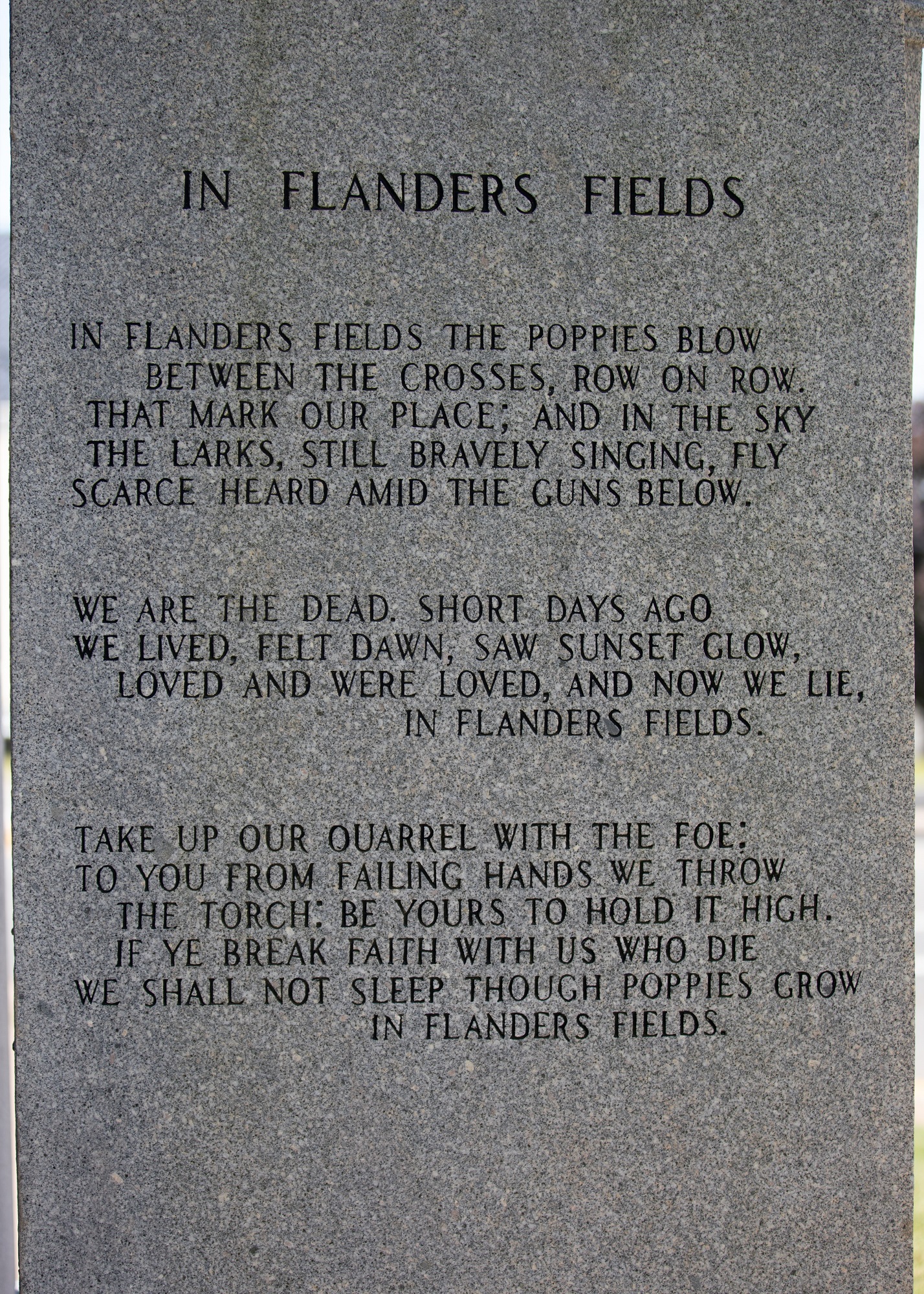
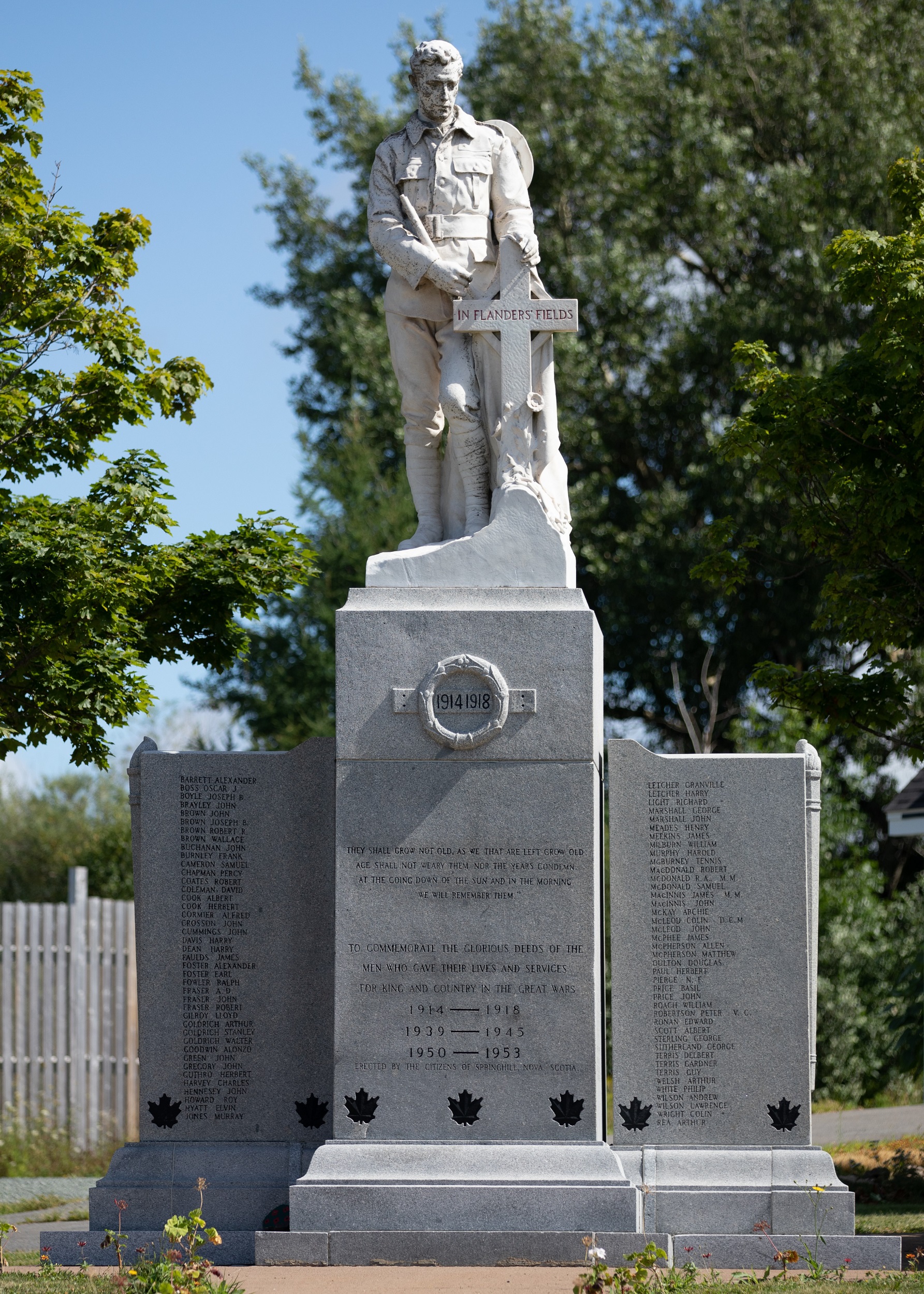

Erected by the citizens of Springhill after the First World War in honour of the local war dead, the beautiful Soldiers' Monument was officially unveiled on August 4, 1929. Mrs Annie Goldrich, who lost three sons in the war, unveiled the monument. The guard stood at the present and Bugler Young sounded the "Last Post".
The committee appointed to the Soldiers' Monument consisted of: Joseph Potter, Bruce Hyatt, Harry Moore, Oscar Goldrich, Harry Slater, Roach McKay, John Hannah, C.E. MacKenzie and William Cliffee. Giving much assistance and advice to this committee was Mr. R.B. Murray. The total cost for the monument was $4,953.69.
The total weight of the monument is 59 tons. Thirty-five tons of cement was put into the foundation, the first two stones weigh four tons, the main stone weighs eight tons and the next one three and one-half tons. The wings weigh three tons each and the statue about two and a half tons. Construction was handled by J.A. Tingley and Company of Amherst. The statue was made in Italy of Carrara marble.
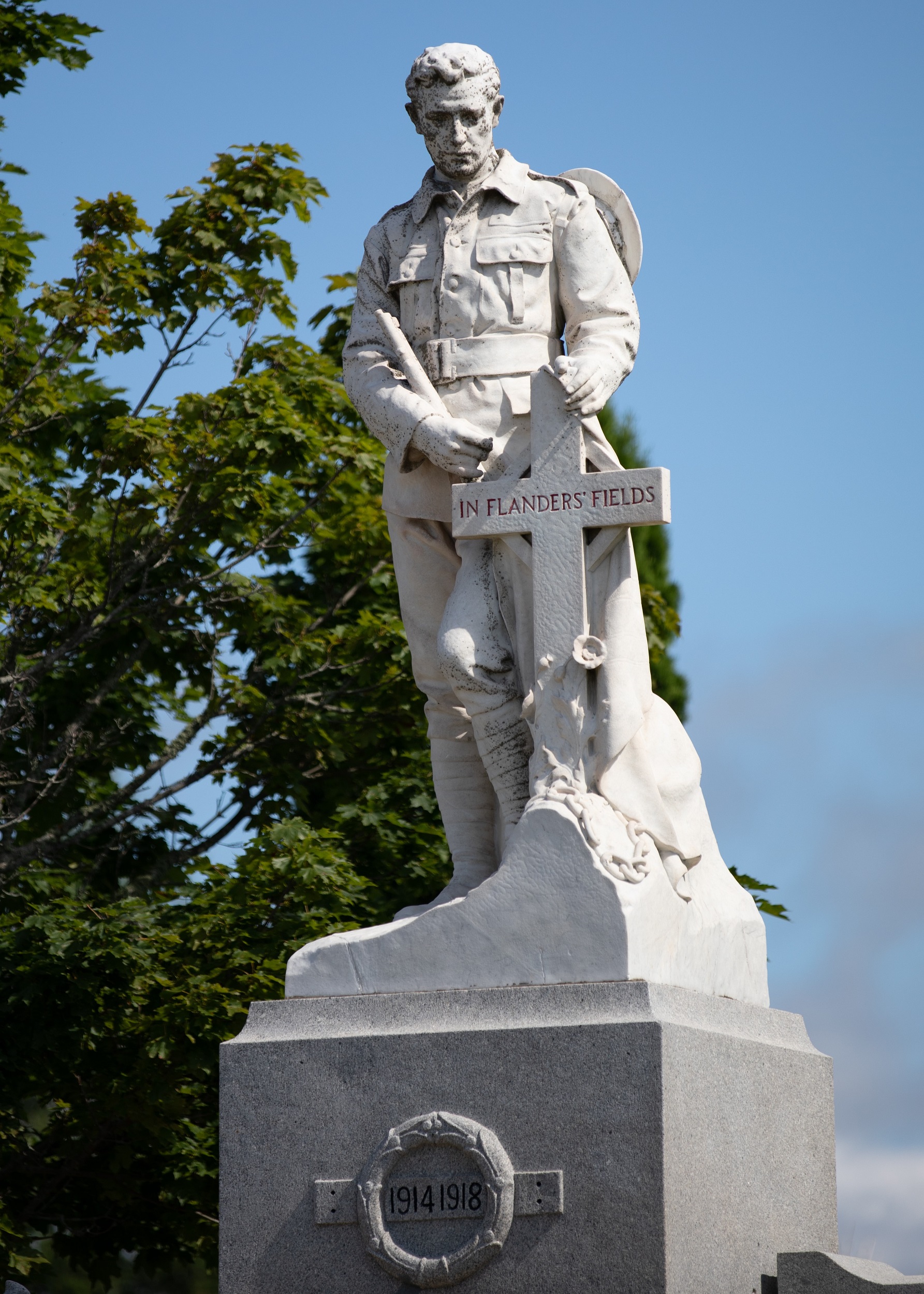
Emanuel Hahn's design represents the sorrows caused by war. The soldier atop the cenotaph looks down in sadness at the ground below him, as if he might find there, his fallen comrades, if not for the tragedy of war.
The statue depicts a young, grieving Canadian soldier in First World War army uniform. He is standing at a battlefield grave – a simple cross with poppies and a broken chain at the base and the flag draped behind it – the final resting place of a comrade killed in action. His left hand rests on the cross, while his right hand holds a reversed rifle. His helmet is slung over his shoulder.
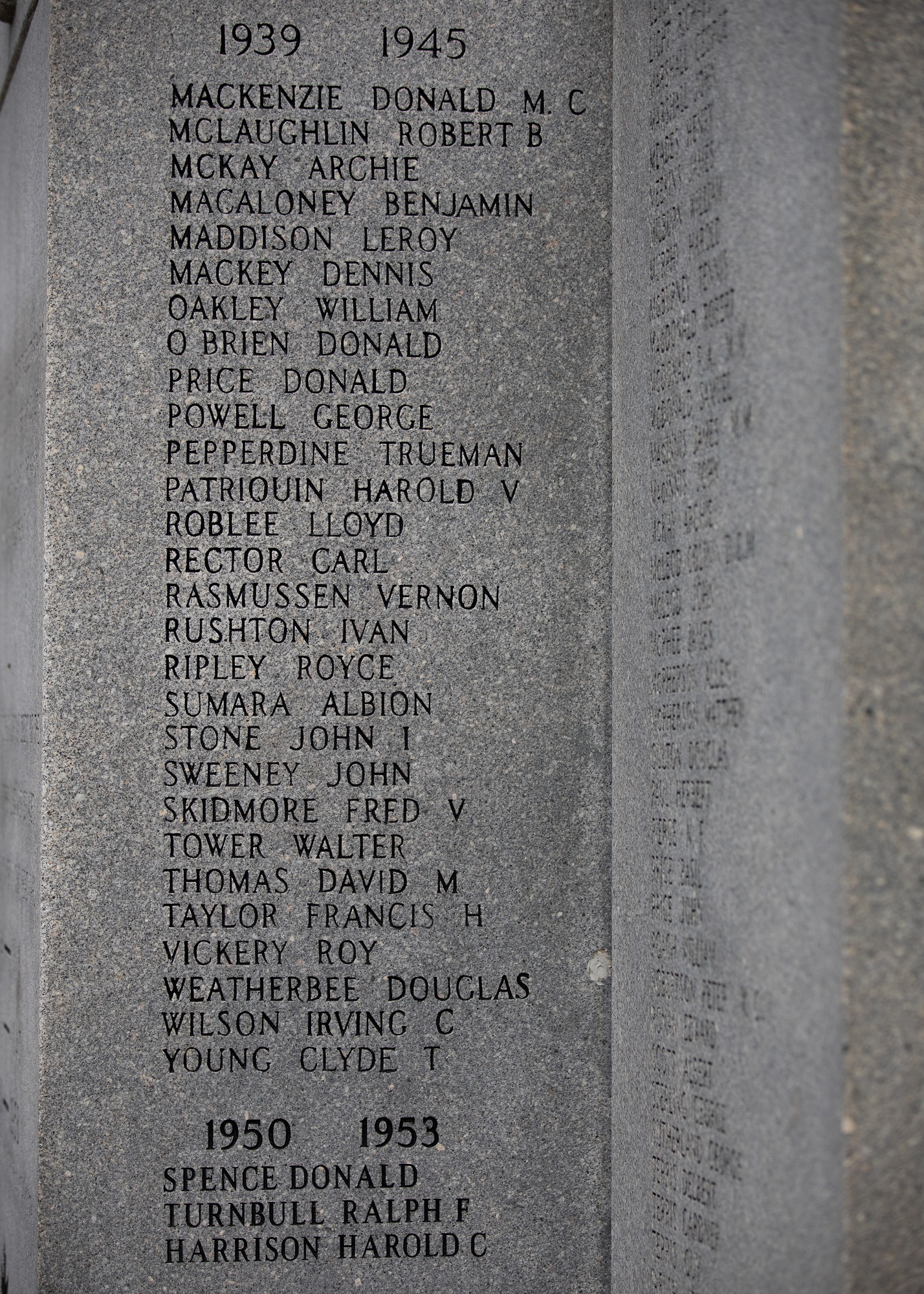
The Cenotaph was expanded after the Second World War to include a commemoration of the local war dead of that conflict and again after the Korean War. In 2013, the John Hopkins Committee raised money to restore the cenotaph. A new cement base was added and the wings were sent to the Annapolis Valley to be redone. At this time one name was added on the inscription - Private Harold C. Harrison.
Emanuel Hahn moved to Toronto at the age of seven with his family of artists and musicians from Germany, in 1888. He studied commercial design and model-making at Toronto Technical School and Ontario College of Art and Industrial Design. At 25 years old Hahn began a nearly lifelong contract with Thomson Monument Company of Toronto. Two years later, he also started work as a studio assistant to sculptor Walter Seymour Allward. Part of his duties included assisting on Allward’s significant works such as the South African War Memorial in Toronto.
In 1912 Hahn began an association with the Thomson Monument Company of Toronto. It was there, along with several assistants, he made the many war memorials that are found across Canada: Fernie, British Columbia; Killarney and Russell, Manitoba; Alvinston, Bolton, Cornwall, Hanover, Lindsay, Malvern, Milton, Petrolia and Port Dalhousie, Ontario; Gaspe, Quebec; Moncton, New Brunswick; Springhill and Westville Nova Scotia; Summerside, Prince Edward Island.
Hahn is probably most famous as the designer of the Bluenose on the back of the Canadian dime and the Caribou on the back of the Canadian quarter. He was a victim of anti-German sentiment in the years following the Great War, when his design for the Winnipeg Cenotaph was rejected in 1925.