

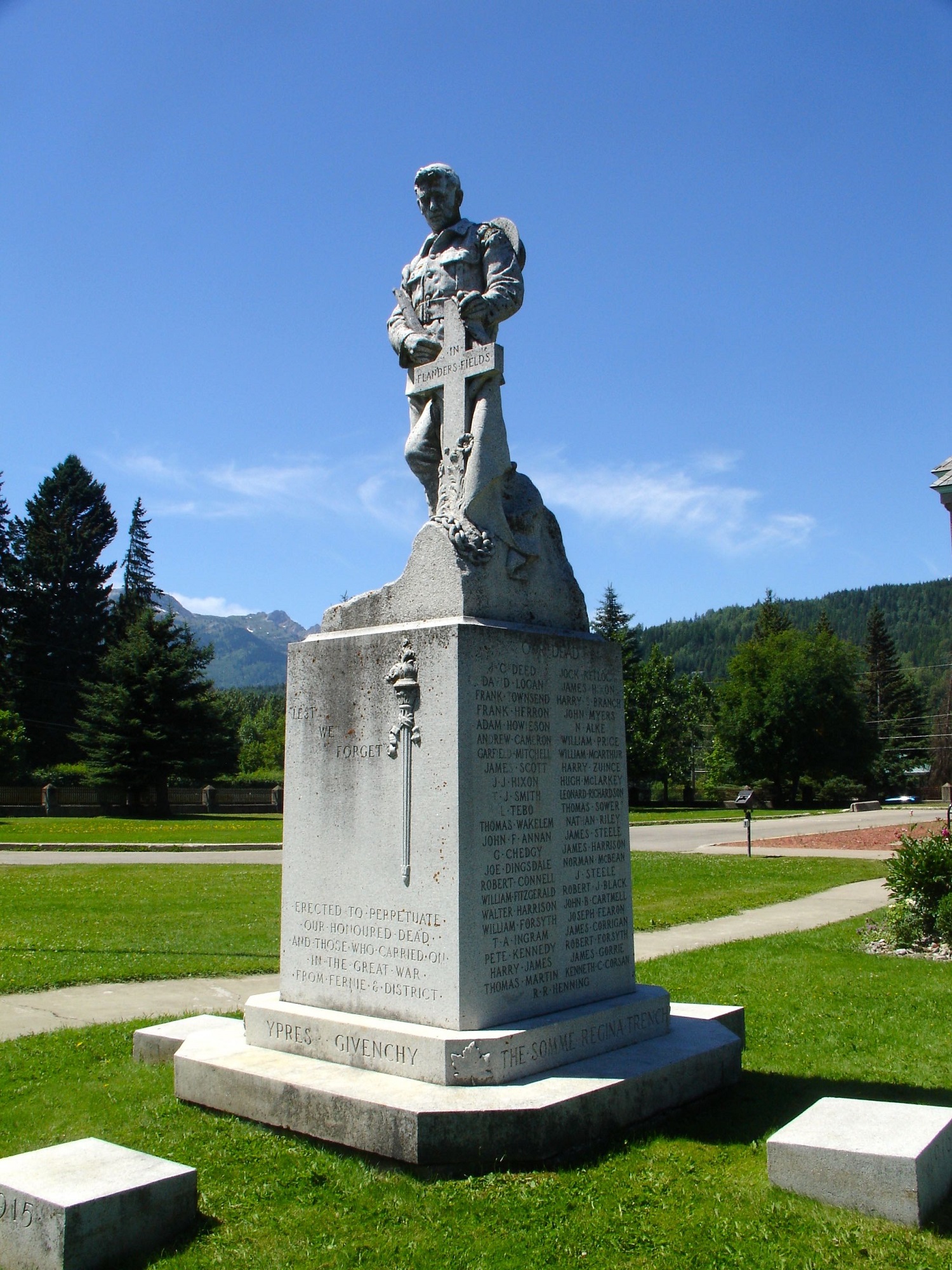

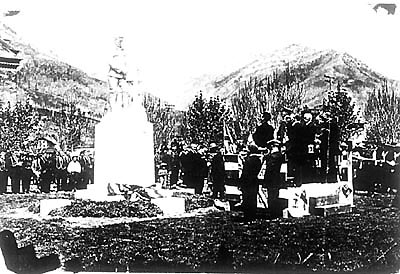

The Fernie Cenotaph was unveiled by Dr. Douglas Corsan on 24 May 1923. He lost two sons in the First World War. His oldest son Tom was among the first to leave Fernie for overseas. Tom was severely wounded twice and in each case went back to the fighting lines once recovered from his injuries. The cenotaph was dedicated to the memory of the local war dead and Veterans of the First World War. Names were later added of those who died in the Second World War and Korean War.
Hahn's design represents the sorrows caused by war. The soldier atop the cenotaph looks down in sadness at the ground below him, as if he might find there, his fallen comrades, if not for the tragedy of war.
The statue depicts a young, grieving Canadian soldier in First World War army uniform. With uncovered head, he is standing at a battlefield grave – a simple cross with poppies and a broken chain at the base and the flag draped behind it – the final resting place of a comrade killed in action. His left hand rests on the cross, while his right hand holds a reversed rifle. His helmet is slung over his shoulder.
Emanuel Hahn moved to Toronto at the age of seven with his family of artists and musicians from Germany, in 1888. He studied commercial design and model-making at Toronto Technical School and Ontario College of Art and Industrial Design. At 25 years old Hahn began a nearly lifelong contract with Thomson Monument Company of Toronto. Two years later, he also started work as a studio assistant to sculptor Walter Seymour Allward. Part of his duties included assisting on Allward’s significant works such as the South African War Memorial in Toronto.
In 1912 Hahn began an association with the Thomson Monument Company of Toronto. It was there, along with several assistants, he made the many war memorials that are found across Canada: Fernie, British Columbia; Killarney and Russell, Manitoba; Alvinston, Bolton, Cornwall, Hanover, Lindsay, Malvern, Milton, Petrolia and Port Dalhousie, Ontario; Gaspe, Quebec; Moncton, New Brunswick; Springhill and Westville Nova Scotia; Summerside, Prince Edward Island.
Hahn is probably most famous as the designer of the Bluenose on the back of the Canadian dime and the Caribou on the back of the Canadian quarter. He was a victim of anti-German sentiment in the years following the Great War, when his design for the Winnipeg Cenotaph was rejected in 1925.