
Copyright information
© His Majesty the King in Right of Canada, as represented by the Minister of Veterans Affairs, 2026.
Catalogue number: V1-9E-PDF
ISSN 2371-7033
Portions of this document were developed with the assistance of generative artificial intelligence tools for editing and creating summaries, in accordance with Government of Canada (GC) guidelines on responsible artificial intelligence use. All content has been reviewed for accuracy and compliance with applicable policies.
At a glance
This departmental plan details our priorities, plans, and associated costs for the upcoming three fiscal years.
These plans align with the priorities outlined in the Mandate Letter, as well as our Vision, mission, raison d’être and operating context and the Veterans Ombud’s mandate.
Key priorities
We identified the following key priorities for 2026–27:
Drive service excellence
Deliver exemplary and timely programs and services, including commemoration, that support the well-being of our Veterans and their families.
Enable modernized and digitized service delivery
Leverage advanced technologies and digital tools to enhance the efficiency and effectiveness of our service delivery, including our commemoration activities.
Provide equitable and accessible programs and services
Provide equitable, accessible, and transparent programs and services tailored to each Veteran’s unique needs, including acts of recognition.
Build an agile and resilient organization
Invest in our organization, ensuring clarity on values and strategic direction while fostering an agile, diverse, and highly skilled workforce and a culture of continuous improvement and innovation.
Comprehensive Expenditure Review
The government is committed to restraining the growth of day-to-day operational spending to make investments that will grow the economy and benefit Canadians.
As part of meeting this commitment, we are planning the following spending reductions:
- 2026–27: $88,000,000
- 2027–28: $101,000,000
- 2028–29: $110,000,000
We will achieve these reductions by doing the following:
- Reducing the rate of reimbursement for cannabis under the Cannabis for Medical Purposes benefit from $8.50 per gram to $6.00 per gram to align more closely with current market rates. This adjustment maintains existing entitlements to meet the needs of Veterans, while ensuring the government is paying a fair price to provide this support. Veterans will still have access to the same quantities and those who already purchase medical cannabis for $6.00 per gram or less will see no change.
The figures in this departmental plan reflect these reductions.
Our highlights for 2026–27
This year, we will strengthen the services Veterans rely on and commemorative initiatives that are important to all Canadians.
As part of our ongoing commitment to improving access to disability benefits, we will begin implementing a multi‑year modernization effort designed to speed up decision‑making and provide a more consistent experience for Veterans. This work will enhance capacity across the program and introduce updated technologies that reduce manual processes and support fair, timely outcomes.
We will further strengthen our focus on Veteran employment by advancing the National Veterans Employment Strategy and creating a new recognition initiative for Canadian companies and organizations that hire Veterans.
We will also move forward with an important national commemoration. Construction of the National Monument to Canada’s Mission in Afghanistan will begin in 2026–27, marking a significant milestone in honouring those who served and those who lost their lives during the mission. A groundbreaking ceremony is planned early in the fiscal year, underscoring our continued dedication to recognizing the sacrifices and contributions of Canadian Veterans and their families.
In 2026–27, our total planned spending (including internal services) is $8,171,287,460 and our total planned full-time equivalent staff (including internal services) is 3,241.1.
Summary of planned results
The following provides a summary of the results we plan to achieve in 2026–27 under our main areas of activity, called “core responsibilities.”
Core responsibility 1: Benefits, Services and Support
In 2026–27, we will focus on delivering faster and easier‑to‑access services for Veterans and their families. We will speed up disability benefit decisions, improve the tools we use to process applications, and strengthen mental health and rehabilitation supports. We will improve how we monitor Veteran health, track outcomes, and use evidence to guide our decisions. By simplifying processes, updating technology, and improving the way we communicate, we will make it easier for Veterans to understand and access benefits and services.
We will keep working directly with Veterans, their families and the organizations that support them to improve access and reduce barriers. We will reach Veterans in remote and Indigenous communities, expand peer‑support networks, and strengthen programs that better respond to the needs of women, Indigenous, 2SLGBTQI+, Black, and racialized Veterans. We will use feedback from surveys, engagement sessions, advisory groups, and partnerships to ensure our programs reflect the diverse needs and experiences of Veterans.
At the same time, we will improve digital platforms, update regulations, work with partners to strengthen housing supports, and build stronger connections with employers, local service providers, and federal partners. Through these efforts. we will deliver more consistent, accessible, and timely services and help Veterans meet their physical, mental, social, and financial needs throughout post‑service life.
- Planned spending in 2026–27: $8,001,906,519
- Planned human resources (full-time equivalents) in 2026–27: 2,318.4
More information about Benefits, Services and Support can be found in the full plan.
Core responsibility 2: Commemoration
We will honour Veterans and those who died in service through commemorative programming, major anniversaries, events, and storytelling that reflects Canada’s diversity. Our work will preserve memorials and grave markers and modernize key sites such as the Canadian National Vimy Memorial and the Beaumont-Hamel Newfoundland Memorial. We will work to enhance visitor experiences with renewed exhibits and interpretation. Construction of the National Monument to Canada’s Mission in Afghanistan will begin, supported by activities that help Canadians understand the importance of service and sacrifice. We will also work with communities to fund local projects that encourage Canadians to remember and honour all Veterans.
- Planned spending in 2026–27: $46,862,762
- Planned human resources (full-time equivalents) in 2026–27: 89.1
More information about Commemoration can be found in the full plan.
Core responsibility 3: Veterans Ombudsperson
In 2026–27, the Office of the Veterans Ombudsperson (OVO) will strengthen its ability to resolve complaints and ensure Veterans and their families are treated fairly. Building on recent improvements, the Office will refine tools and processes, enhance quality checks and reporting, and expand outreach through virtual and in-person engagement. It will review individual complaints, address systemic issues in VAC programs, and track recommendations to ensure action is taken. Clear communication, accessible content, and new initiatives will raise awareness of the Ombudsperson’s role and build trust in the Veteran community.
- Planned spending in 2026–27: $4,944,579
- Planned human resources (full-time equivalents) in 2026–27: 39
More information about Veterans Ombudsperson can be found in the full plan.
From the Minister

The Honourable Jill McKnight, P.C., M.P.
Minister of Veterans Affairs and Associate Minister of National Defence
Canada’s Veterans have served with honour and commitment. They are at the core of everything we do. These Canadians have made profound sacrifices for our peace and security. It is our responsibility—and our privilege—to ensure Veterans have the support, resources, and opportunities they need to live healthy and meaningful lives after service.
The 2026–27 Departmental Plan for Veterans Affairs Canada (VAC) describes how we will continue to support Veterans and their families. This year’s work will concentrate on initiatives that demonstrate our continued commitment to meeting their needs.
We are focused on delivering programs and services that are timely, high‑quality, and responsive to the needs of those we serve. This includes enhancing employment support by advancing the National Veterans Employment Strategy and developing a new initiative that recognizes Canadian employers who hire Veterans.
We are working to modernize service delivery with new technologies and tools. These improvements will make our services more efficient, accessible, and user-friendly.
We are building an agile and resilient organization by investing in our people and our culture. This means fostering a workforce that is diverse, highly skilled, and adaptable, guided by clear values and a strategic vision.
We will honour Veterans through inclusive events, major anniversaries such as the 35th anniversary of the conflict in the Persian Gulf, and stories that reflect Canada’s military diversity. This year, construction will begin on the National Monument to Canada’s Mission in Afghanistan, supported by education and engagement activities that help Canadians understand the meaning of service and sacrifice.
We will continue to work to ensure Canada’s women Veterans are heard and supported. We will use findings from the Community Health Needs Assessment to better understand their experiences during their transition from service to civilian life. We will partner with women Veterans, researchers, and engagement teams to advance research through the five-year Women Veteran Research Plan. Engagement and feedback from women Veterans will help shape recommendations to better respond to their unique needs across VAC programs and services.
Finally, Veterans’ experiences guide the work we do each day. Their courage, dedication, and sacrifices have shaped our country. As we look ahead, we will continue working with Veterans, their families, and communities across Canada to ensure all Veterans are honoured and supported.
Sincerely,
The Honourable Jill McKnight, P.C., M.P.
Minister of Veterans Affairs and
Associate Minister of National Defence
Plans to deliver on core responsibilities and internal services
Core responsibilities and internal services:
Core responsibility 1: Benefits, Services and Support
Description
Support the care and well-being of Veterans and their dependents or survivors through a range of benefits, services, research, partnerships, and advocacy.
Quality of life impacts
The work we do to fulfil this core responsibility has a positive impact on the following Quality of life (QoL) Framework domains and indicators:
- Health: Perceived mental health, Perceived health, Unmet needs for health care
- Prosperity: Employment, Core housing need, Homelessness, Postsecondary attainment, Making ends meet
- Society: Sense of belonging to local community, Satisfaction with personal relationships
- Sense of meaning and purpose
- Life satisfaction
Indicators, results, and targets
This section presents details on our indicators, the actual results from the three most recently reported fiscal years, the targets and target dates for Benefits, Services and Support. Details are presented by departmental result.
Table 1: Veterans are physically and mentally well
| Departmental result indicators | Actual results | 2026–27 target | Date to achieve target |
|---|---|---|---|
| % of Veterans who report that their health is very good or excellent |
2022–23: 40% 2023–24: 40%The result for 2023–24 (carried over from 2022–23) comes from the data collected during the 2022 Canadian Veteran Health Survey (CVHS). 2024–25: 41% |
Equal to or higher than the Canadian general populationEqual to or higher than the Canadian general population for those Veterans self-identifying with a disability and for those Veterans self-identifying as not having a disability (age- and gender-standardized). | March 2028 |
| % of Veterans who report that their mental health is very good or excellent |
2022–23: 49% 2023–24: 49%The result for 2023–24 (carried over from 2022–23) comes from the data collected during the 2022 Canadian Veteran Health Survey (CVHS). 2024–25: 49% |
Equal to or higher than the Canadian general populationEqual to or higher than the Canadian general population for those Veterans self-identifying with a disability and for those Veterans self-identifying as not having a disability (age- and gender-standardized). | March 2028 |
| % of Veterans receiving treatment in Operational Stress Injury Clinics reporting improved overall mental healthIn 2024–25, 54% of Veterans getting treatment in Operational Stress Injury clinics (OSICs) reported significantly improved mental health, exceeding the 35% improvement reported in scientific literature (Hansen, Lambert & Forman, 2002). This data comes from 27% of clients served who completed eight or more Outcome Questionnaire® (OQ®)-45.2 questionnaires in the Client-Reported Outcomes Monitoring Information System (CROMIS), almost triple the 10% sample size from 2020–21. |
2022–23: 50% 2023–24: 51% 2024–25: 54% |
50% | March 2027 |
| % of VAC Veteran clients who indicate that they have an unmet health need | n/aNo historical data is available because this question is new to the survey. | Lower than the Canadian general population | March 2027 |
Table 2: Veterans and their families are financially secure
| Departmental result indicators | Actual results | 2026–27 target | Date to achieve target |
|---|---|---|---|
| % of Veterans whose household income is below the Low Income Measure |
2022–23: 17% 2023–24: 17%The result for 2023–24 (carried over from 2022–23) comes from the data collected during the 2022 Canadian Veteran Health Survey (CVHS). 2024–25: n/aThe result is not available as the 2024 Low Income Measure (LIM) thresholds from Statistics Canada were not yet released at the time of writing. The LIM thresholds are required to calculate the % of Veterans whose household income falls below the LIM. |
Lower than the Canadian general population | March 2028 |
| % of VAC Veteran and survivor clients who are able to make ends meet | n/aNo historical data is available because this question is new to the survey. | Higher than the Canadian general population | March 2027 |
Table 3: Veterans have a sense of purpose
| Departmental result indicators | Actual results | 2026–27 target | Date to achieve target |
|---|---|---|---|
| % of Veterans who are satisfied with their job or main activity |
2022–23: 75% 2023–24: 75%The result for 2023–24 (carried over from 2022–23) comes from the data collected during the 2022 Canadian Veteran Health Survey (CVHS). 2024–25: 81% |
80% | March 2028 |
| % of Veterans who are employedThis survey question in the CVHS follows Statistics Canada’s standard approach in the Canadian Community Health Survey, where employment questions are asked only of those aged 75 and under, ensuring a fair comparison. |
2022–23: 56% 2023–24: 56%The result for 2023–24 (carried over from 2022–23) comes from the data collected during the 2022 Canadian Veteran Health Survey (CVHS). 2024–25: 54% |
60% | March 2028 |
| % of VAC Veteran clients who indicate that they have a purpose in lifeWhile this indicator is new to the Departmental Results Framework (DRF) in 2026–27, the associated survey question has been asked in the past and therefore historical results are available. |
2022–23: 62% 2023–24: 62%The result for 2023–24 (carried over from 2022–23) comes from the data collected during the 2022 VNCS. The VNCS is conducted every two years. 2024–25: 72% |
75% | March 2027 |
Table 4: Veterans are able to adapt, manage, and cope within post-service life
| Departmental result indicators | Actual results | 2026–27 target | Date to achieve target |
|---|---|---|---|
| % of Veterans who report an easy adjustment to post-service lifeThis indicator is derived from a CVHS question that was asked in the 2024 version of the survey but not the 2022 version. Therefore, results for 2022–23 and 2023–24 cannot be provided. In 2022–23 and 2023–24, a variation on this indicator was used, reporting on the VAC Veteran client population rather than the overall Veteran population. The previous indicator was sourced from the VNCS. |
2022–23: n/a 2023–24: n/a 2024–25: 63% |
65% | March 2028 |
| % of Veterans who have completed a post-secondary education |
2022–23: 64% 2023–24: 64%The result for 2023–24 (carried over from 2022–23) comes from the data collected during the 2022 Canadian Veteran Health Survey (CVHS). 2024–25: 67% |
65% | March 2028 |
| % of VAC Veteran clients who are satisfied with their life in generalWhile this indicator is new to the Departmental Results Framework (DRF) in 2026–27, the associated survey question has been asked in the past and therefore historical results are available. |
2022–23: 64% 2023–24: 64%The result for 2023–24 (carried over from 2022–23) comes from the data collected during the 2022 VNCS. The VNCS is conducted every two years. 2024–25: 69% |
70% | March 2027 |
Table 5: Veterans are living in safe and adequate housing
| Departmental result indicators | Actual results | 2026–27 target | Date to achieve target |
|---|---|---|---|
| % of Veterans who are in core housing need |
2022–23: 5%The results currently reported for 2022–23 are based on the 2021 Census and carried forward to 2023–24, as the Census is not conducted annually. We recently received the 2022 Canadian Housing Survey (CHS) data, and are now seeking age- and gender-standardized data to compare Veteran outcomes with the Canadian population. 2023–24: 5%The results currently reported for 2022–23 are based on the 2021 Census and carried forward to 2023–24, as the Census is not conducted annually. We recently received the 2022 Canadian Housing Survey (CHS) data, and are now seeking age- and gender-standardized data to compare Veteran outcomes with the Canadian population. 2024–25: n/aThe 2024 CHS results were not available at the time of writing. |
Lower than the Canadian general population | March 2027 |
| % of Veteran and survivor clients living in their own homes who are satisfied with their housingThis indicator previously appeared in the DRF as “% of Veteran clients of Veterans Affairs Canada 65 years and older living in their own homes who report satisfaction with their housing.” Because the associated survey question has been asked in the past, historical results for the new version of the indicator are also available and are provided in the table. |
2022–23: 86% 2023–24: 86%The result for 2023–24 (carried over from 2022–23) comes from the data collected during the 2022 VNCS. The VNCS is conducted every two years. 2024–25: 92% |
90% | March 2027 |
| % of VAC Veteran clients who are experiencing or at risk of homelessnessWhile this indicator is new to the DRF in 2026–27, a result is available for 2024–25. |
2022–23: n/a 2023–24: n/a 2024–25: 0.2% |
Less than 0.3% | March 2027 |
Table 6: Veterans are socially supported
| Departmental result indicators | Actual results | 2026–27 target | Date to achieve target |
|---|---|---|---|
| % of Veterans who have a strong sense of community belonging |
2022–23: 59% 2023–24: 59%The result for 2023–24 (carried over from 2022–23) comes from the data collected during the 2022 Canadian Veteran Health Survey (CVHS). 2024–25: 62% |
60% | March 2028 |
| % of VAC Veteran clients who are satisfied with their relationships with friends and/or familyThis indicator previously appeared in the DRF as “% of Veterans Affairs Canada clients who are satisfied with their relationships with friends or family.” Historical results for the new version of the indicator (specific to Veteran clients of VAC) are also available and are provided in the table. |
2022–23: 80% 2023–24: 88%The result for 2023–24 (carried over from 2022–23) comes from the data collected during the 2022 VNCS. The VNCS is conducted every two years. 2024–25: 86% |
85% | March 2027 |
Table 7: Veterans are satisfied with the services they receive
| Departmental result indicators | Actual results | 2026–27 target | Date to achieve target |
|---|---|---|---|
| % of clients who are satisfied with the quality of service delivery they receive from Veterans Affairs Canada |
2022–23: 78% 2023–24: 78%The result for 2023–24 (carried over from 2022–23) comes from the data collected during the 2022 VNCS. The VNCS is conducted every two years. 2024–25: 77% |
85% | March 2027 |
| % of clients who are satisfied with the quality of Veterans Affairs Canada’s programs and services offered |
2022–23: 76% 2023–24: 76%The result for 2023–24 (carried over from 2022–23) comes from the data collected during the 2022 VNCS. The VNCS is conducted every two years. 2024–25: 78% |
85% | March 2027 |
| % of clients who report the disability benefits they receive from VAC recognize their service-related disability While this indicator is new to the DRF in 2026–27, it was previously tracked as a program outcome indicator for Disability Benefits. Historical results are therefore available and are provided in the table. |
2022–23: 69% 2023–24: 69%The result for 2023–24 (carried over from 2022–23) comes from the data collected during the 2022 VNCS. The VNCS is conducted every two years. 2024–25: 79% |
75% | March 2027 |
Additional information on the detailed results and performance information for our program inventory is available on GC InfoBase.
Plans to achieve results
The following section describes the planned results for Benefits, Services and Support in 2026–27.
Departmental result: Veterans are physically and mentally well.
Our plan focuses on faster and more equitable delivery of disability benefits, better health monitoring and research, personalized rehabilitation. We are strengthening mental health services, making health care programs easier to navigate, and taking inclusive approaches that respect the diverse needs of all Veterans. Everything we do is aimed at improving well-being and ensuring Veterans get timely, consistent, and appropriate care.
Results we plan to achieve
Disability Benefits: Modernization and service standards
- In 2026–27, we will focus on making disability benefit decisions faster and improving the consistency of our turnaround times. Backed by a $184.9 million planned investment over four years (plus $40.1 million ongoing), we will stabilize disability benefits processing capacity, modernize information technology (IT) systems, and streamline operations. These modernizations will include automation and artificial intelligence (AI) enabled tools (with human oversight) to reduce manual work and support faster decision-making.
- Also in 2026–27 we expect to begin implementation of the revised Table of Disabilities. The updates will reflect the latest health research, apply a Veteran-centric approach using Gender-Based Analysis Plus (GBA Plus), and promote fair, transparent, and consistent disability benefits decisions. This will strengthen the decision-making process and ensure our approach remains evidence-based and Veteran-focused.
Health monitoring and research
- We will keep analyzing data from the Canadian Veteran Health Survey (CVHS) to understand how Veterans are doing and where we need to improve. Current results show mental health and overall health below targets—only 49% of Veterans rated their mental health as very good or excellent, and 41% rated their overall health the same. Updated data will come from the next CVHS cycle, and we will use those findings to guide future actions.
- We will evaluate programs that matter most to Veterans and caregivers to make sure they deliver real results. We will review the Caregiver Recognition Benefit and the Research and Innovation Program to find ways to strengthen practices and evidence-based policies that improve well-being and financial security. Both evaluations are underway, with reports expected later in the year.
Continuum of care and rehabilitation services
- We will make sure Veterans and their families get timely and personalized medical and psycho-social rehabilitation services that help them overcome barriers and adjust to life after service.
- We will work to make sure every Veteran gets the right level of support. We will provide targeted assistance such as referrals, program information, and help for Veterans and families with specific needs. Veterans with moderate needs will get guided support from a dedicated service agent who will follow up proactively. For those with complex needs, we will offer case management—a collaborative process to set goals and create plans that promote independence, health, and well-being.
- We will identify each Veteran’s level of risk through our screening tool and match them with the right services across the seven domains of well-being. Using this tool ensures service delivery consistency and helps us respond quickly when changes are needed.
- We will track results to measure service effectiveness, monitor outcomes, and identify resource needs.
Mental health supports and innovations
- We will create better tools for frontline employees to handle complex cases involving substance use disorders and in-patient care. These resources will give clear guidance to support informed and timely decisions.
- Since the addition of therapist-assisted, internet-based cognitive behavioural therapy to the benefit grid in 2025, we will work with Medavie to recruit qualified providers in 2026 so Veterans with mild to moderate anxiety and depression can benefit from this service.
- We will keep monitoring outcomes at Operational Stress Injury clinics to make sure Veterans are getting the help they need. Using the Client-Reported Outcomes Monitoring Information System and its next-generation tools, we will track improvements in mental health and share best practices across the network. Our national network team will work closely with local clinics, and we will have in-person and virtual meetings to improve consistency and processes at the local level.
Health care programs and treatment benefits
- We will keep Veterans’ health care continuous by supporting the implementation of the next Federal Health Claims Processing Services (FHCPS) contract in 2027. This will ensure continuous authorization and timely reimbursement for health care claims.
- We will strengthen the Treatment Benefits Program so that decisions are clear, consistent, and fair. Our focus will be on improving national guidance and making client letters easier to understand.
- We will advance work on the Cannabis for Medical Purposes audit recommendations. This includes introducing a new authorization form, improving program monitoring, and moving toward automated, real-time adjudication of claims.
- We will improve the Long Term Care Program by improving how results are measured so that they are reliable and meaningful. We will also develop clearer communication tools to make processes transparent and efficient.
- We will continue to improve how our health care providers are managed. This means continuing to implement our escalation tracking system, keeping advertising guidelines up to date, and moving toward annual recredentialling for providers. We will also set up attestation requirements to check provider criteria, make our deregistration processes better, and create internal procedures to help employees meet reporting duties and follow privacy rules.
- We will continue to respond to concerns raised in the Audit of Multi-Disciplinary and Interdisciplinary Clinics by using an evidence-based model. Our work will improve guidance for decision-making, accountability in authorization and billing, and audit processes.
Equity, diversity, and inclusion
- Through initiatives like Let’s Talk Veterans, advisory groups, and roundtables, we will continue our engagement with equity-deserving Veterans—women, Indigenous, Black, racialized, and 2SLGBTQI+—so their voices help shape our programs.
- We will work with Indigenous Services Canada and other partners to increase awareness of programs and improve access to culturally appropriate services for Indigenous Veterans. At the same time, we will continue to work directly with Indigenous communities to understand their needs. We will further build partnerships with national and regional organizations, such as the Assembly of First Nations Veteran Council. By tracking referrals and feedback, we will make sure services reflect cultural values and practices and respond to what Veterans tell us matters most.
Departmental result: Veterans and their families are financially secure.
Our focus is on improving services so Veterans and their families can count on timely financial support. We will modernize systems to speed up benefit delivery, strengthen programs that promote financial well-being, share practical tools to build financial literacy, and update policies to keep them clear and effective. These steps will help us reduce delays and improve understanding.
Results we plan to achieve
Strengthening financial security and program delivery
- In 2026–27, we will introduce new ways to measure how well the Income Replacement Benefit (IRB) and Canadian Forces Income Support programs work. These measures will help us assess timeliness and effectiveness in promoting financial security for Veterans and their families.
- We will continue analyzing CVHS data to track financial well-being. Recent results show 66% of Veterans were satisfied with their financial situation in 2024, up from 62% in 2022. Also in 2022, 17% of Veteran households fell below the Low-Income Measure. Updated data for 2024 are pending, as Statistics Canada has not yet released the thresholds.
- During our preparations for the transition to the new FHCPS contract in 2027, we will ensure Veterans continue to have uninterrupted access to treatment benefit reimbursements.
- We will act on recommendations from the Evaluation of the Income Replacement Benefit and Rehabilitation Services published in March 2025.
- We will work to address the recommendations from the Evaluation of the Pain and Suffering Compensation published in December 2025, to support faster decision‑making, make the program more effective, and improve Veterans’ overall satisfaction with services.
Financial literacy and education
- We will promote financial literacy by sharing practical tools and resources. For example, we’ll highlight Financial Literacy Month on social media and our website, feature resources from the Financial Consumer Agency of Canada, and provide clear explanations of how the IRB is calculated.
Financial benefit modernization
- As part of annual income verification for the IRB, we will work with other federal departments to find ways to appropriately share income data. This will help reduce the information Veterans need to provide, limit administrative burden, and ensure payments are calculated accurately and without delay.
- As a result of our Red Tape Review, we will streamline IRB calculations for Veterans released from the Reserve Force by amending the Veterans Well-being Regulations, therefore enhancing operational efficiency.
- We will review how Departmental Trust Funds are administered to ensure at-risk Veterans and families get support in line with the original intent of donations and bequests.
Departmental result: Veterans have a sense of purpose.
We want to help Veterans thrive after service by improving job opportunities, expanding access to education, and creating more ways to connect with their communities. We will support Veterans who want to start businesses, and work with employers and federal departments to hire Veterans. Through personalized support and engagement, we aim to make sure Veterans have the tools and connections they need to find meaningful work and to lead fulfilling lives and support their families.
Results we plan to achieve
Veteran employment and economic empowerment
- We will continue advancing the National Veterans Employment Strategy and work on an initiative that recognizes companies and organizations in Canada that hire Veterans.
- Support for the Veteran entrepreneur community will be advanced through expanded partnerships and resources that support self-employment and business success for Veteran-owned and operated companies.
Tracking outcomes and expanding opportunities
- We will monitor Veterans’ sense of purpose through employment and main activities. Current findings show 81% of Veterans are satisfied with their job or main activity—exceeding the 75% target. Employment rates remain below the 60% target, declining slightly from 56% in 2022 to 54% in 2024. We will use this information to guide future actions and will update our analysis when new data becomes available in 2028 following the next survey cycle.
- We will look at ways to increase access to the Education and Training Benefit, including expanding eligibility and extending time limits after release. These changes will help more Veterans pursue education, skills training, and other career‑building opportunities and join the workforce.
Personalized support and community engagement
- We will continue delivering tailored case management services by working with Veterans. Together, we will identify needs, set goals, and create personalized plans supported by comprehensive assessment, planning, and ongoing monitoring. Before services end, we will confirm there have been improvements and close cases only when the Veteran’s goals are achieved.
- We plan to strengthen community connections by hosting engagement sessions, storytelling initiatives, and mentorship programs. These efforts will help Veterans find meaningful roles and foster a sense of purpose within their communities.
Departmental result: Veterans are able to adapt, manage, and cope within post-service life.
We are taking action to help Veterans adapt and thrive after service. Our plans include analyzing new health survey data to guide decisions, implementing program evaluations to improve outcomes, and simplifying transition processes with tailored supports. We will strengthen health and well-being services, expand care planning, and advance gender-informed approaches through research and collaboration.
Results we plan to achieve
Data and evidence-based insights
- Early findings from the 2022 and 2024 surveys show the number of Veterans reporting a high level of life skills mastery increased slightly from 24% in 2022 to 27% in 2024. Education levels are strong, with 67% of Veterans completing post-secondary education in 2024, up from 64% in 2022 and exceeding our 65% target. We will continue to monitor and analyze these results to inform future planning.
Looking ahead, updated data for 2026–27 and beyond will not be available until the next survey cycle is complete. We will continue to plan for future analyses as new data becomes available.
Program evaluation and continuous improvement
- We published an evaluation of the Rehabilitation Services and Vocational Assistance Program and the IRB in March 2025. This evaluation provided clear recommendations to improve program outcomes and better support Veterans. We continue to work on the Management Response and Action Plan outlined in the evaluation summary to strengthen these programs.
Transition support and service integration
- We will continue supporting Canadian Armed Forces (CAF) members as they prepare for life after service. Transition interviews are an important first step and help members and their families identify needs early and access the information they need. These interviews also provide an opportunity to answer questions and connect Veterans with resources that support a smooth transition.
During each interview, we will continue to ensure Veterans and their families get comprehensive information on programs and services. This includes case management assessments, initiating referrals to VAC case management or CAF partners, guidance on applying for VAC programs, and connecting to community service providers when needed - We are working with CAF and Military Services to simplify and strengthen transition processes. Together, we are developing a model that aligns the Military to Civilian Transition process with Enhanced Transition Services (ETS) to better support all types of transitions. We are reviewing the ETS process for medically releasing CAF members and will pilot a revised model later this fiscal year. At the same time, we will keep improving Career Transition Services by creating and updating learning materials for Veterans. This will ensure they are supported when transitioning to the civilian workforce.
Health and well-being supports
- We will use findings from the Community Health Needs Assessment (CHNA) to better understand women Veterans’ experiences during their transition to civilian life. These insights will guide the modernization of the nursing assessment form and updates to Program of Choice (POC) 08 Nursing Services policies and procedures. This will help nurses create care plans that focus on the areas of well-being where support is most needed. CHNA findings will also inform nursing assessments, visits, and outreach activities with Veteran communities and stakeholders through 2026–27 and beyond.
- We will examine how to best support aging Veterans across the continuum of care. Our goal is to evolve and align VAC home care and long-term care services with the care provided by provinces and territories.
Gender-informed and inclusive approaches
- We will keep tracking progress on recommendations from the Invisible No More report by the Standing Committee on Veterans Affairs to improve programs and services. As part of this work, we will partner with women Veterans, researchers, and engagement teams to advance research through the five-year Women Veteran Research Plan. The Women Veterans Council will continue to share insights and recommendations to help us address the unique needs of women Veterans.
Departmental result: Veterans are living in safe and adequate housing.
We are committed to supporting Veterans’ access to safe, affordable, and suitable housing. Through targeted programs, research, and strong partnerships, we will continue to build solutions that help Veterans thrive in their communities.
Results we plan to achieve
Veteran homelessness program and research
- We will continue our partnership with Housing, Infrastructure and Communities Canada to deliver the Veteran Homelessness Program (VHP). This program funds third-party organizations to provide rent supplements and support services for Veterans who are experiencing, or at imminent risk of, homelessness.
In its first year, the program supported 1,460 Veterans. All 1,460 received comprehensive wrap around supports; 233 Veterans experiencing homelessness attained stable housing; and 1,053 Veterans at imminent risk of homelessness received prevention or shelter-diversion services. - The VHP also provides funding for research projects to build knowledge and improve our ability to prevent and reduce Veteran homelessness.
Housing data and measurement
- The 2022 Canadian Housing Survey shows that 10% of Veterans are in core housing need. When we get the 2024 Veteran‑specific results, we will use them to track our progress and to inform future work.
- Looking ahead to the next survey cycle in 2027, we will look for ways to access to real‑time housing data from Statistics Canada. Improved access could help us monitor changes more effectively.
Partnerships and outreach
- We will strengthen partnerships with community organizations to ensure Veterans have stable housing and access to the supports they need for a successful reintegration into civilian life. Our efforts will focus on improving identification and referral of Veterans who are at risk of or experiencing homelessness, even when they do not seek help directly.
- We will expand awareness among local organizations and stakeholders by providing tools and guidance that help them recognize Veterans experiencing homelessness and connect them to our Case Management or Guided Support services.
Departmental result: Veterans are socially supported.
Building social support for Veterans starts with understanding their needs and removing barriers to connection. We will use data to guide decisions, expand access to services, and deliver programs that foster inclusion and mental well-being. Through targeted outreach, peer-support networks, and partnerships, we will help Veterans and their families feel connected, supported, and informed.
Results we plan to achieve
Data and evidence-based insights
- We will continue leveraging insights from the 2024 CVHS to monitor key trends, including the increase in community belonging (62% in 2024, above our 60% target). Updated analysis will follow in 2028 when new data is released from the 2027 survey cycle.
Access, outreach and inclusion
- We will strengthen outreach and awareness so Veterans, CAF and Royal Canadian Mounted Police (RCMP) members, and Canadian Rangers in remote and Indigenous communities can access services. This includes eight in-person visits each year to Nunavut, the Northwest Territories, and Yukon, and proactive engagement with partners and Veterans’ organizations. These efforts aim to reduce barriers and improve access and awareness.
- We will expand peer-support networks and culturally appropriate programs for Indigenous, women, 2SLGBTQI+, Black, and racialized Veterans. We will also recommend establishing an annual Women Veterans’ Day and work with women Veterans to identify their needs and meaningfully recognize their contributions. This work will foster inclusion, strengthen community, and promote well-being.
Well-being and mental health supports
- We will strengthen case management so Veterans can build stronger connections with their communities and support networks. This includes assessing social integration, setting meaningful goals, and linking Veterans to resources that improve well-being.
- With long-term funding secured, we will continue to work with the Sexual Misconduct Support and Resource Centre to maintain the Peer Support Program for those affected by military sexual trauma.
- Our partnership with the Mental Health Commission of Canada will continue to deliver Mental Health First Aid training for the Veteran community. This training will improve mental health literacy and give Veterans and those who support them the confidence to recognize signs and respond effectively.
- Through the Operational Stress Injury Social Support Program, we will continue to provide peer support that reduces stigma, connects Veterans and families with others who share similar experiences, and normalizes seeking mental health care.
Departmental result: Veterans are satisfied with the services they receive.
We will focus on modernizing systems, streamlining processes, and aligning resources to meet Veterans’ evolving needs. Our efforts include improving digital platforms, enhancing accessibility, and fostering inclusive engagement. We will track progress through client feedback and performance indicators, and refine programs based on what Veterans tell us. By collaborating with partners, adopting best practices, and removing barriers, we will deliver timely, personalized, and satisfactory services.
Results we plan to achieve
Service standards and client satisfaction
- We will track progress through the VAC National Client Survey and performance indicators. The next survey will take place in summer 2026, and we will publish the final report in spring 2027.
- To keep up with Veterans’ evolving needs, we will align resources strategically. This means actively managing caseloads, applying a consistent, evidence-based approach, and optimizing service delivery so the right employees are in the right place to meet demand. Through ongoing monitoring and adjustments, we will provide timely, personalized support that promotes well-being and meets expectations.
- The Bureau of Pensions Advocates (BPA) will improve processing times and service standards by automating and modernizing its systems. At the same time, the Bureau will monitor client satisfaction questionnaires to ensure Veterans continue to receive courteous service and strong representation before the Veterans Review and Appeal Board.
Digital modernization and operational efficiency
- In line with the Prime Minister’s mandate to make government more productive by deploying AI at scale, we have launched an AI-enabled tool that scans Disability Benefits application documents, organizes evidence, and highlights key information so decision makers can focus on analysis. The tool aims to support quicker favourable decisions when the summary provides enough information. If the summary does not provide enough detail, the decision maker completes a full manual review before deciding. All decisions continue to be made by trained decision makers.
- We will enhance My VAC Account so Veterans have a smoother online experience. We will provide clear guidance throughout the disability benefit application process, make forms and benefit discovery navigation easier, and ensure the platform remains accessible, secure, and updated. We also plan to improve the delivery of payments and benefits through modernization. This will involve upgrading IT infrastructure and improving legacy systems to support reliable service.
Accessibility and inclusive service delivery
- We will work toward ensuring that our products and services meet Government of Canada accessibility standards and remove barriers so Veterans can access what they need without difficulty. Our goal is to create experiences that are inclusive and equitable for everyone. We will keep improving and refining our approach to deliver services that meet and exceed the expectations of the people who use them.
Inclusive engagement and collaboration
- We will publish the Strategic Direction for Women Veterans to advance inclusive, trauma-informed, Veteran-centered programming across VAC. This roadmap will guide progress in research, transition, health equity, engagement, and recognition.
- Building on the 2025 Women Veterans Forum and 2025 2SLGBTQI+ Veterans Forum, we will continue to provide safe, accessible, and inclusive engagement opportunities. These type of events, along with consultations through Let’s Talk Veterans, advisory groups, and roundtables, will help us celebrate the diversity and strength of modern Veterans, find gaps in services and policies, and improve programs for all equity-deserving Veterans and their families.
- We will advance reconciliation through our partnership with the Assembly of First Nations (AFN). Following the Letter of Understanding signed in February 2025, we will deliver on joint priorities for engagement, outreach, and commemoration. A joint workplan will guide concrete actions, including meaningful inclusion of First Nations culture in AFN and VAC-led ceremonies and events.
- We will continue engaging Veterans, Canadians, and community organizations through Let’s Talk Veterans, advisory groups, and roundtables. By sharing Veterans’ voices and insights, we will shape improvements in research, care, employment, transition services, and overall program delivery.
- We will implement a framework to engage with Black and racialized Veterans, creating culturally responsive, trauma-informed, and inclusive opportunities for dialogue. Through forums, consultations, and partnerships with community organizations, this framework will amplify Veterans’ voices, address service gaps, and ensure meaningful representation in VAC programs, ceremonies, and national narratives.
Occupational therapy modernization
- We will continue to explore ways to increase the use of virtual occupational therapy by encouraging more providers to offer it and more Veterans to choose it. This approach will make services more accessible and, as an added benefit, help reduce emissions.
- We will standardize tools and establish best practices for occupational therapy across Canada. This will ensure Veterans have equitable and timely access to benefits and services.
Gender-based Analysis Plus
This fiscal year we expect to begin implementation of the revised Table of Disabilities which will apply a Veteran-centric approach using GBA Plus, complete a GBA Plus review of the IRB, and explore ways to make the Education and Training Benefit more accessible, especially for women Veterans, as caregiving responsibilities are more likely to fall disproportionately to women. We will also modernize tools such as the nursing assessment form to better reflect gender identity and diverse health needs.
We will measure how our programs affect gender and diversity by applying GBA Plus and collecting disaggregated data across all core responsibilities. We will gather information through our programs, the CVHS, and engagement platforms like Let’s Talk Veterans. This will help us understand the experiences of women, Indigenous, 2SLGBTQI+, and other equity-deserving Veterans and use that insight to improve programs and policies.
To strengthen our data capacity, we will align with Government of Canada standards and work with Statistics Canada to link program data and close gaps in GBA Plus reporting. This includes analyzing intersections of gender, Indigenous identity, disability, employment, income, and housing needs. These efforts will create a baseline to measure impacts over time, including comparisons with the 2026 Census.
Through ongoing engagement—such as advisory groups, forums, and the Women’s Council—and collaboration on initiatives like the National Action Plan on Women, Peace, and Security, we will ensure Veterans’ voices guide improvements in fairness, equity, and inclusion across all programs and services.
Planned resources to achieve results
Table 8: Planned resources to achieve results for Benefits, Services and Support
Table 8 provides a summary of the planned spending and full-time equivalents required to achieve results.
| Resources | 2026–27 Planned |
|---|---|
| Spending (dollars) | 8,001,906,519 |
| Full-time equivalents | 2,318.4 |
Complete financial and human resources information for our program inventory is available on GC InfoBase.
Program inventory
Benefits, Services and Support is supported by the following programs:
- Caregiver Recognition Benefit
- Disability Benefits
- Health Care Benefits
- Income Replacement Benefit
- Canadian Forces Income Support
- Long Term Care
- Research and Innovation
- Transition Support
- Veterans Emergency Fund
- Veterans Independence Program
- War Veterans Allowance
Additional information related to our program inventory for Benefits, Services and Support is available on the results page on GC InfoBase.
Summary of changes to reporting framework since last year
As part of TBS’ 2026–27 Departmental Results Framework (DRF) amendment cycle, we made some changes to our departmental result indicators under this core responsibility to better align with the QoL Framework for Canada, and to introduce a greater balance between results for the overall Canadian Veteran population and results for Veteran clients of VAC.
- Departmental result: Veterans are physically and mentally well.
- The indicator “% of Veterans who report they need help with an activity of daily living” has been retired. While this indicator has been removed from our DRF, it is still monitored through the CVHS in support of the Veterans’ Well-Being Surveillance Framework.
- A new indicator “% of VAC Veteran clients who indicate that they have an unmet health need” has been added.
- Departmental result: Veterans and their families are financially secure.
- The indicator “% of Veterans who are satisfied with their financial situation” has been retired. While this indicator has been removed from our DRF, it is still monitored through the CVHS in support of the Veterans’ Well-Being Surveillance Framework.
- A new indicator “% of VAC Veteran and survivor clients who are able to make ends meet” has been added.
- Departmental result: Veterans have a sense of purpose.
- The indicator “% of VAC Veteran clients who indicate that they have a purpose in life” has been added.
- Departmental result: Veterans are able to adapt, manage, and cope within post-service life.
- We’ve changed the population for the indicator “% of Veteran clients of Veterans Affairs Canada who report an easy adjustment to post-service life” to capture all Veterans, not just those Veterans who are VAC clients.
- The indicator “% of Veterans who have high level of mastery of their life skills” has been retired.While this indicator has been removed from our DRF, it is still monitored through the CVHS in support of the Veterans’ Well-Being Surveillance Framework.
- A new indicator “% of VAC Veteran clients who are satisfied with their life in general” has been added.
- Departmental result: Veterans are living in safe and adequate housing.
- We have modified the target population for the indicator on satisfaction with housing. Instead of reporting on VAC Veteran clients aged 65 and older living in their own homes, we will be reporting on Veteran and survivor clients (without age parameters) living in their own homes going forward.
- A new indicator “% of VAC Veteran clients who are experiencing or at risk of homelessness” has been added.
- Departmental result: Veterans are socially supported.
- For the indicator “% of Veterans Affairs Canada clients who are satisfied with their relationships with friends or family,” we are changing our target population to focus specifically on Veteran clients of VAC as opposed to all clients.
- Departmental result: Veterans are satisfied with the services they receive.
- A new indicator “% of clients who report the disability benefits they receive from VAC recognize their service-related disability” has been added.
Full methodologies for our DRF are available on GC InfoBase.
Core responsibility 2: Commemoration
Description
Pay tribute to the sacrifices and achievements of those who served in Canada’s military efforts.
Quality of life impacts
The work we do to fulfil this core responsibility has a positive impact on the following QoL Framework domains and indicators.
- Society: Sense of pride in Canada; Sense of belonging to Canada; Participation in cultural or religious practices, recreation or sport; Sense of belonging to local community
- Sense of meaning and purpose
- Environment: Conserved areas
Indicators, results, and targets
This section presents details on our indicators, the actual results from the three most recently reported fiscal years, the targets and target dates for Commemoration. Details are presented by departmental result.
Table 9: Veterans and those who died in service are recognized and honoured
| Departmental result indicators | Actual results | 2026–27 target | Date to achieve target |
|---|---|---|---|
| % of clients who are satisfied with the way Veterans Affairs Canada’s commemorative initiatives honour Veterans and those who died in service |
2022–23: 70% 2023–24: 70%The result for 2023–24 (carried over from 2022–23) comes from the data collected during the 2022 VNCS. The VNCS is conducted every two years. 2024–25: 74% |
80% | March 2027 |
| % of Veteran clients who feel that VAC’s commemorative initiatives adequately recognize their experiences while serving | n/aNo historical information is available because this specific indicator was not previously measured. | To be determined as of March 2027 | To be determined as of March 2027 |
| # of page views of web content related to modern-day VeteransWhile this indicator is new to the DRF in 2026–27, a result is available for 2024–25. |
2022–23: n/a 2023–24: n/a 2024–25: 193,683 |
195,000 | March 2027 |
Table 10: Canadians are aware of, and value, the contributions of Veterans and those who died in service
| Departmental result indicators | Actual results | 2026–27 target | Date to achieve target |
|---|---|---|---|
| % of Canadians who indicate they make an effort to appreciate Veterans and those who died in service |
2022–23: 82% 2023–24: 82%This result was carried over as the Attitudes Towards Remembrance and Veterans’ Week Survey of Canadians is only conducted every two years. 2024–25: 80% In 2022, the survey was administered by telephone to approximately 1,000 Canadian residents aged 16 and over, whereas in 2024, it was conducted online with approximately 1,500 Canadian residents aged 18 and over. |
75% | March 2027 |
| # of Canadians who participated in community engagement activities financially supported by Veterans Affairs Canada |
2022–23: 1,073,690 2023–24: 993,617 2024–25: 2,127,559 |
900,000 | March 2027 |
| % of visitors to Vimy and Beaumont-Hamel overseas memorials who report they have a better understanding of the sacrifice and contribution of those who served |
2022–23: 98% 2023–24: 98% 2024–25: 98%This result was carried over as the visitor experience survey is only conducted every three years. |
95% | March 2029 |
Additional information on the detailed results and performance information for our program inventory is available on GC InfoBase.
Plans to achieve results
The following section describes the planned results for Commemoration in 2026–27.
Departmental result: Veterans and those who died in service are recognized and honoured.
We will honour all Veterans while emphasizing diversity and inclusion. Through ceremonies and events, storytelling, and consultations, we will recognize the contributions of women, Indigenous, Black, racialized, 2SLGBTQI+, and modern-day Veterans. At the same time, we will preserve memorials and grave markers and strengthen public awareness of Canada’s military history.
Results we plan to achieve
Major anniversaries and national tribute
- We will lead and/or support commemorative efforts for key anniversaries. In the coming year, we will mark the 35th anniversary of the end of the Gulf War and the 110th anniversary of the Battle of the Somme and of Beaumont Hamel.
- We will honour the memory of those who served and died in Afghanistan through the construction of the National Monument to Canada’s Mission in Afghanistan. The construction will begin in 2026–27, with a groundbreaking ceremony planned for the first quarter of the fiscal year.
Honouring Veterans and promoting diversity
- We will honour all Veterans and place emphasis on diversity, including modern‑day, women, Indigenous, Black, racialized, and 2SLGBTQI+ Veterans. We will launch initiatives that pay tribute to the many ways Canadian military personnel have served in the Middle East as part of the broader CAF Around the World approach.
- Our commemorative programming, ceremonies, and events will reflect the diversity of Canada’s Veteran community. By doing so, we will recognize their achievements and contributions and ensure that Veterans feels valued and respected.
- We gathered input at the Honouring Her Service: 2025 Women’s Forum and the 2025 2SLGBTQI+ Veterans Forum on how to better recognize equity-deserving Veterans. We will use this feedback to close gaps and improve how we honour Veterans.
Storytelling and public awareness
- We will highlight individual stories that show the service, professionalism, and bravery of Veterans who promoted peace as impartial military observers in Operation Proteus, Operation JADE, and Operation CALUMET. We will focus on first-hand storytelling about people and places connected to these operations.
- We will create learning materials and events that tell the stories of those who served and raise awareness of Canada’s military history. Digital, social media, video, web, and print materials will engage the public and students across Canada. We will help Canadians learn about diverse Veterans and fallen service members, Canadian efforts in the Middle East, and memorials and monuments in Canada and overseas. We will also encourage and create opportunities for Canadians to recognize and express their gratitude to Veterans.
- We will conduct consultations to find ways to enhance recognition of Persian Gulf and other modern-day Veterans. These consultations will guide programming and increase awareness among Canadians.
Preservation and maintenance
- We will continue maintaining over 250,000 Veteran grave markers across Canada. We will ensure these final resting places are preserved with dignity and respect through a 12-year inspection and repair cycle.
Departmental result: Canadians are aware of, and value, the contributions of Veterans and those who died in service.
We will work on key memorial sites, enhance visitor experiences through renewed exhibits and interpretation, and begin construction of the National Monument to Canada’s Mission in Afghanistan. Our efforts will also include engagement and education initiatives and support for community projects that honour all Veterans.
Results we plan to achieve
Maintenance, infrastructure, and visitor experience
- We will honour the memory of those who served by preserving and modernizing key memorial sites, including the Canadian National Vimy Memorial and the Beaumont-Hamel Newfoundland Memorial. This includes infrastructure upgrades, conservation work, and sustainable site management such as replanting wooded areas under the multi-year Forest Management Plan.
- We will improve visitor experiences by implementing our new Visitor Experience Strategy, advancing the renewal of the permanent exhibit at Beaumont-Hamel, and inspiring future generations through the memorial sites in France, as well as via passionate student guides who share the stories of Canadians.
- We will support community projects that honour all Veterans, including modern-day, women, Indigenous, Black, racialized, and 2SLGBTQI+ Veterans.
Canada’s mission in Afghanistan: Engagement and education
- We will honour those who served and died during Canada’s mission in Afghanistan by launching a multi-year engagement and outreach plan targeting families and friends of the fallen, CAF members, youth, and the Canadian public. Educational materials developed in support of the plan will connect the inspirational and symbolic elements of the Monument’s design with the meaning of service and the conflict in Afghanistan.
Community partnerships and local commemoration
- We will support community organizations through the Commemorative Partnership Program by providing funding for projects that engage Canadians and honour all Veterans.
Gender-based Analysis Plus
We apply a GBA Plus lens across commemorative initiatives to ensure they are respectful and inclusive of all who served. This includes designing programs and educational resources that reflect gender balance and diverse cultural, ethnic, and regional backgrounds, as well as ensuring intergenerational and cultural representation in ceremonies and events. We also provide meaningful and accessible visitor experiences at our National Historic Sites in France for those with accessibility barriers.
To measure impact, Canadians’ attitudes toward remembrance are assessed through the Attitudes Towards Remembrance and Veterans’ Week Survey, which is weighted to reflect the gender and age composition of the adult Canadian population based on census data.
We continue to apply GBA Plus when consulting with Canadians and Veterans to understand how identity factors influence preferences and to inform the development of learning resources, exhibits, programming, and events.
Planned resources to achieve results
Table 11: Planned resources to achieve results for Commemoration
Table 11 provides a summary of the planned spending and full-time equivalents required to achieve results.
| Resources | 2026–27 Planned |
|---|---|
| Spending (dollars) | 46,862,762 |
| Full-time equivalents | 89.1 |
Complete financial and human resources information for our program inventory is available on GC InfoBase.
Program inventory
Commemoration is supported by the following programs:
- Canada Remembers
- Funeral and Burial Program
Additional information related to our program inventory for Commemoration is available on the results page on GC InfoBase.
Summary of changes to reporting framework since last year
The wording of our two departmental results under this core responsibility has been revised to make clearer the distinction between them. Minor changes have been made to the suite of departmental results indicators to better reflect current priorities and programming.
- Departmental result: Veterans and those who died in service are recognized and honoured.
- This departmental result was formerly written as “Veterans and those who died in service are honoured.”
- The indicator “# of page views of the Canadian Virtual War Memorial” has been retired.
- A new indicator “# of page views of web content related to modern-day Veterans” has been added.
- A new indicator “% of Veteran clients who feel that VAC’s commemorative initiatives adequately recognize their experiences while serving” has been added.
- Departmental result: Canadians are aware of, and value, the contributions of Veterans and those who died in service.
- This departmental result was formerly written as “Canadians remember and appreciate Veterans and those who died in service.”
- The indicator “% of visitors to Vimy and Beaumont-Hamel overseas memorials who report they have a better understanding of the sacrifice and contribution of those who served” was previously under the departmental result “Veterans and those who died in service are honoured” (now “recognized and honoured”).
Full methodologies for our DRF are available on GC InfoBase.
Core responsibility 3: Veterans Ombudsperson
Description
Provide an independent and impartial review of complaints and issues related to programs and services delivered by the Veterans Affairs Portfolio and uphold the Veterans Bill of Rights.
Quality of life impacts
The work we do to fulfil this core responsibility has a positive impact on the following QoL Framework domains and indicators.
- Good governance: Discrimination and unfair treatment; Confidence in institutions
Indicators, results, and targets
This section presents details on indicators, the actual results from the three most recently reported fiscal years, the targets and target dates approved in 2026–27 for Veterans Ombudsperson. Details are presented by departmental result.
Table 12: Veterans and their families have access to a timely review of complaints about the programs, services and support delivered by the Veterans Affairs Portfolio
| Departmental result indicators | Actual results | 2026–27 target | Date to achieve target |
|---|---|---|---|
| % of complaints reviewed and closed within 12 weeks of receipt of the complaintThis indicator previously appeared in the DRF as “% of complaints reviewed within 60 working days.” Although the calculation for the new version of the indicator differs from the calculation for the previous version, a result for the new version of the indicator (using the updated calculation) is available starting in 2024–25. |
2022–23: n/a 2023–24: n/a 2024–25: 82% |
85% | March 2027 |
Table 13: Issues about the programs, services and support provided to Veterans and their families by the Veterans Affairs Portfolio identified by the Office of the Veterans Ombudsperson are addressed
| Departmental result indicators | Actual results | 2026–27 target | Date to achieve target |
|---|---|---|---|
| % of individual complaints reviewed and escalated by the Office of the Veterans Ombudsperson to the Veterans Affairs Portfolio that are addressedAlthough the wording of the performance indicator has not changed, the calculation methodology has been updated to more accurately capture all escalated complaints over time. This has resulted in a slight break in data continuity. Therefore, historical results are not available; however, a result based on the new calculation is available for 2024–25. |
2022–23: n/a 2023–24: n/a 2024–25: 93% |
80% | March 2027 |
| % of recommendations made by the Office of the Veterans Ombudsperson related to systemic issues addressed by the Veterans Affairs Portfolio |
2022–23: 70% 2023–24: 75% 2024–25: 74% |
75% | March 2027 |
Table 14: Veterans and their families are aware of the purpose and role of the Office of the Veterans Ombudsperson
| Departmental result indicators | Actual results | 2026–27 target | Date to achieve target |
|---|---|---|---|
| % of VAC clients who understand the purpose and role of the Office of the Veterans OmbudspersonAlthough this indicator is new to the DRF in 2026–27, a result is available for 2024–25. |
2022–23: n/a 2023–24: n/a 2024–25: 71% |
80% | March 2027 |
| # of outreach events targeting awareness of the Office of the Veterans Ombudsperson and its services undertaken each yearAlthough this indicator is new to the DRF in 2026–27, a result is available for 2024–25. |
2022–23: n/a 2023–24: n/a 2024–25: 23 |
25 | March 2027 |
Additional information on the detailed results and performance information for the program inventory is available on GC InfoBase.
Plans to achieve results
The following section describes the planned results for Veterans Ombudsperson in 2026–27.
Departmental result: Veterans and their families have access to a timely review of complaints about the programs, services and support delivered by the Veterans Affairs Portfolio.
Last fiscal year, the Office of the Veterans Ombud (OVO) strengthened its ability to resolve complaints faster by putting a new organizational structure in place, updating business processes, enhancing partnerships with VAC’s IT team, and improving tools. In 2026–27, the Office will build on these improvements by refining tools, adding new capabilities, and fostering a culture of continuous improvement.
Results we plan to achieve
Strengthening productivity and quality assurance monitoring
- The OVO will introduce new statistical reporting capabilities to deliver more detailed and accurate productivity measurements. This will help find where interventions are needed to ensure timely service for clients. The team will also continue improving the quality assurance system to reinforce high standards and support continuous learning.
Improving tools and processes
- The Office will review and refine decision-making tools and operating procedures to align with the new organizational structure. The team will also continue updating the case tracking system to boost efficiency.
Strengthening engagement and awareness
- The Office will strengthen engagement with Veterans and their families through virtual town halls, in-person events, social media initiatives, and other outreach channels. These efforts will raise awareness of the OVO and VAC services, help Veterans understand available programs and benefits, and reinforce the Office’s role in advocating for fairness.
Departmental result: Issues about the programs, services and support provided to Veterans and their families by the Veterans Affairs Portfolio identified by the Office of the Veterans Ombudsperson are addressed.
The Office will address complaints from Veterans and their families, review VAC programs to find broad issues, and track recommendations to make sure VAC takes action and to check whether those recommendations remain relevant.
Results we plan to achieve
Handling fairness complaints
- The OVO will review each complaint within its mandate to confirm whether it is valid by examining factors such as treatment, process, and outcomes to ensure fairness in VAC programs and services. When needed, the Office will send the complaint and its recommendations to the VAC Portfolio for resolution.
Addressing systemic issues
- The Office will assess systemic issues in VAC programs and services in addition to reviewing individual complaints. This analysis will find gaps and fairness concerns, and the Office will recommend ways to address these challenges. In 2026–27, employees will continue formal systemic reviews and explore informal approaches to address these issues with the Department.
Tracking recommendations
- Since 2017, the OVO has tracked recommendations on broad issues through the annual Spotlight publication (formerly the Report Card). In 2026–27, the Office will continue using this tool to press VAC to act on outstanding recommendations and to check whether those recommendations remain relevant.
Departmental result: Veterans and their families are aware of the purpose and role of the Office of the Veterans Ombudsperson.
For more than 18 years, the OVO has helped Veterans and their families understand its role and services. In the years ahead, the Office will build on this foundation by using clear communication, accessible content, and innovative outreach to strengthen awareness and trust.
Results we plan to achieve
Communicate clearly and transparently
- The Office will communicate its mandate and independence through clear, consistent messaging, publish the Annual Report each year to show progress and accountability, and share real-life advocacy examples to demonstrate how it supports Veterans.
Measure and improve awareness
- Employees will collect and analyze data on how well Veterans understand the OVO’s role and use those insights to refine outreach strategies and make changes that better reach Veterans and their families.
Expand outreach and engagement
- The Office will strengthen communication through multiple channels, including social media, virtual town halls, advertising, and partnerships with Veteran organizations. It will provide information in plain language and accessible formats so Veterans can understand and use the OVO’s support to improve their experiences with VAC.
- The OVO will introduce new ideas and innovative initiatives to broaden awareness and build trust across the Veteran community.
Gender-based Analysis Plus
In 2025–26, the Office ensured its GBA Plus approach was aligned with VAC’s data strategy and partnered with VAC to improve the accuracy of data analysis and reporting. In 2026–27, the Office will build on this foundation by exploring additional ways to strengthen data quality and ensure meaningful reporting on gender and diversity impacts. This will ensure that the Office will change their approach as needed to stay aligned with VAC.
Planned resources to achieve results
Table 15: Planned resources to achieve results for Veterans Ombudsperson
Table 15 provides a summary of the planned spending and full-time equivalents required to achieve results.
| Resources | 2026–27 Planned |
|---|---|
| Spending (dollars) | 4,944,579 |
| Full-time equivalents | 39.0 |
Complete financial and human resources information for the program inventory is available on GC InfoBase.
Program inventory
Veterans Ombudsperson is supported by the following programs:
- Veterans Ombudsperson
Additional information related to the program inventory for Veterans Ombudsperson is available on the results page of GC InfoBase.
Summary of changes to reporting framework since last year
In order to capture the outreach and awareness aspect of the OVO and its services, we have added a new departmental result with two departmental result indicators. We have also modified the calculation for two existing departmental result indicators in order to improve data accuracy.
- Departmental result: Veterans and their families have access to a timely review of complaints about the programs, services and support delivered by the Veterans Affairs Portfolio.
- The wording for the indicator “% of complaints reviewed within 60 working days” has been modified to “% of complaints reviewed and closed within 12 weeks of receipt of the complaint” (from reviewed within 60 working days to reviewed and closed within 12 weeks).
- Departmental result: Veterans and their families are aware of the purpose and role of the Office of the Veterans Ombudsperson.
- This is a new departmental result.
- A new indicator “% of VAC clients who understand the purpose and role of the Office of the Veterans Ombudsperson” has been added.
- A new indicator “# of outreach events targeting awareness of the Office of the Veterans Ombudsperson and its services undertaken each year” has been added.
Full methodologies for the DRF are available on GC InfoBase.
Internal services
Description
Internal services are the services that are provided within a department so that it can meet its corporate obligations and deliver its programs. There are 10 categories of internal services:
- acquisition management services
- communications services
- financial management services
- human resources management services
- information management services
- information technology services
- legal services
- material management services
- management and oversight services
- real property management services
Plans to achieve results
This section presents details on our plans to achieve results and meet targets for internal services.
Enhancing communications and outreach
- We will improve how Veterans, their families, and former RCMP members access information about our services and benefits. By digitizing service delivery and adopting innovative communication strategies, we will make our programs responsive to their needs and accessible in both official languages.
- Our focus is to refine the use of communication tools to support ongoing efforts to modernize service delivery.
- We will develop a clear strategy to prevent and address misinformation and disinformation.
- We will find new opportunities for targeted outreach and engagement with equity-deserving communities.
- Supporting our Minister as the primary spokesperson will remain a priority to raise awareness of Veterans’ needs, issues, and priorities.
- By using data-driven approaches, we will create communication products that not only respond to current needs but also anticipate the evolving expectations of Veterans and their families.
Real property and office space management
- We will advance our Real Property Strategy by putting in place a governance and reporting framework to support lifecycle planning and meet Treasury Board policies. This will give us better oversight and timely reporting on real property projects.
- We will enhance risk and compliance monitoring by standardizing how we calculate reinvestment rates for Treasury Board’s annual assessments.
- We will support the Office Portfolio Reduction Plan by working with Public Services and Procurement Canada to optimize leased office space as part of the government-wide plan to reduce the federal office footprint by 50% over the next 10 years.
Security and Information Management
- We will strengthen security governance and oversight by fully implementing our new Security Governance Framework. This will give us stronger assurance that our operations and information are protected and help us maintain trust and continuity of service for Veterans.
- We will strengthen resilience by improving cybersecurity and information management (IM). We will continuously monitor for online threats and follow Government of Canada security standards. To test our readiness and improve response, we will run a cybersecurity event management exercise. At the same time, we will integrate IM into our governance framework, publish a modernized IM strategy, and finish migrating from GCDocs to SharePoint. These steps will ensure information is managed securely, efficiently, and in line with departmental priorities.
Data and Technology Modernization
- We will build better data tools by completing development and implementing datasets and dashboards so data is easy to access and supports timely, accurate decisions across all programs.
- We will continue transitioning from legacy systems to modern accessible platforms to reduce risk, increase operational efficiency and enable responsible integration of automation and AI.
Accessibility and inclusion
- Our goal is to continue the transition to an accessibility-barrier-free department by finding, removing, and preventing barriers for clients and employees through the implementation of our Accessibility Action Plan 2025–2028.
- We will actively support and promote the Government of Canada Workplace Accessibility Passport through MyAccessibleWorkplace (myAW), ensuring its successful implementation and encouraging widespread use to create a more inclusive workplace.
- We will promote diversity and inclusion by sustaining our commitment to a workplace that empowers and supports employees. This includes implementing and monitoring our updated We All Belong Diversity and Inclusion Action Plan.
People and workplace culture
- We will implement our People and Culture Strategy by developing and delivering initiatives that strengthen our organization’s capacity. These initiatives will leverage technology and data to support decision-making, build coaching skills within the workforce, and instill a coaching culture. This work will help us provide an exceptional employee experience and create a positive workplace for all employees.
- Our focus is to promote workplace wellness by completing development and starting implementation of a departmental mental health strategy and action plan. This will help maintain a work culture that raises awareness of mental health and uses best practices to support well-being for all employees.
- We will reinforce values and ethics by continuing the implementation of our Values and Ethics Engagement Plan. This will strengthen our departmental framework and promote ethical right-doing.
- To progress staffing modernization, we will update our staffing services and processes to improve the overall experience and strengthen strategic advisory services. This includes creating and implementing tools and practices that are simplified, timely, inclusive, and accessible by design.
Planned resources to achieve results
Table 16: Planned resources to achieve results for Internal Services
Table 16 provides a summary of the planned spending and full-time equivalents required to achieve results.
| Resources | 2026–27 planned |
|---|---|
| Spending (dollars) | 117,573,600 |
| Full-time equivalents | 794.6 |
Complete financial and human resources information for our program inventory is available on GC InfoBase.
Planning for contracts awarded to Indigenous businesses
We have set targets for procurement with Indigenous businesses since 1996. We take a strategic approach to meet and exceed established targets.
In 2026–27, we plan to buy goods and services from Indigenous businesses in the following areas:
- License/maintenance fees for client software related to Distributed Computing Environment;
- Computer equipment related to production and operations environment, including all servers, storage, printers, and related parts and peripherals;
- Office furniture and furnishings, including parts;
- Cemetery maintenance;
- Simultaneous interpretation; and
- Language training
Table 17: Percentage of contracts planned and awarded to Indigenous businesses
Table 17 presents the current, actual results with forecasted and planned results for the total percentage of contracts the department awarded to Indigenous businesses.
| 5% reporting field | 2024–25 actual result | 2025–26 forecasted result | 2026–27 planned result |
|---|---|---|---|
| Total percentage of contracts with Indigenous businesses | 7.77% | 5.10% | 5.0% |
Department-wide considerations
In this section
Related government priorities
Artificial Intelligence
We will expand our use of practical, responsible AI to help us work more efficiently, improve services, and better support Veterans and their families. All AI‑enabled processes will continue to include strong human oversight to ensure decisions remain transparent, fair, and consistent with Government of Canada values. To advance our AI strategy, we will strengthen governance and carry out our roadmap through 2026–27. We will test, develop and implement tools that reduce manual work, promote consistency, and speed up decision making. We will also expand AI literacy training and provide clear guidance so employees can use AI safely and confidently. By adopting these tools thoughtfully, we will improve productivity, manage costs, enhance service delivery, and advance our mandate in ways that strengthen outcomes for Veterans and their families. Some of the following activities could apply to more than one category, but we have limited them to one to avoid repetition.
Increase productivity
- We will continue our pilot on generative AI to speed policy analysis and early-stage strategic research.
- We will look at building an AI-enabled assistant with Microsoft 365 (M365) Copilot Studio for Occupational Therapy Services to give employees faster access to internal resources and guidance, reduce response times, and ensure consistent information across the national network.
- We will explore AI tools to cut manual effort in data analysis, report generation, and monthly rollups to support program management. We will also assess how AI supported dashboards may help highlight performance trends faster and find opportunities to improve data quality.
- We will try using M365 Copilot to analyze funding recipient reports for the Veteran and Family Well Being Fund, improving productivity and data accuracy.
- We will explore AI tools to help security screening analysts by automatically checking files for missing forms, inconsistencies, or expired documentation. This will save time and reduce manual effort so analysts can focus on higher-value tasks.
- The OVO will apply AI to analyze anonymous data on systemic issues and streamline drafting of systemic reports by simplifying language without losing accuracy, and reducing review time.
- In 2026–27, we will complete the ongoing pilot that uses automated responses for common issues at the National IT Service Desk. This work will help us respond faster, improve accuracy, and give employees more time to focus on complex issues. After the pilot, we will review the results, apply what we learned, and decide on a future rollout.
Decrease government operating costs
- In preparation for the new FHCPS contract, we will be exploring opportunities to use Optical Character Recognition and targeted automation to streamline Cannabis for Medical Purposes pre-authorization requests for VAC reimbursement. For example, we will test targeted, rules based automation for processing pre authorization recommendations. Depending on the responses provided on the form, certain situations—such as those meeting all eligibility requirements—could automatically result in approval recommendations for VAC reimbursement. In these cases, it may be possible to expedite adjudication under the new contract.
Improve service delivery
- We will streamline Rehabilitation Program eligibility decisions by improving the application process and automating key steps to create a better experience for Veterans, their families, and our staff.
- We are advancing AI enabled tools that help employees review Disability Benefits applications more efficiently. The first version of the Claim Summary Tool is now in use and supports employees by organizing evidence and highlighting key information so they can focus more time on analysis and decision making. When the summary provides enough information for a favourable decision, the decision maker can proceed more quickly. If the summary does not provide enough detail, the decision maker completes a full manual review before deciding. Trained decision makers continue to make every decision. This work supports reduced backlogs, shorter wait times, and better outcomes for Veterans and their families.
- BPA will strengthen its service delivery by introducing AI-powered tools, including improved search capabilities and advancing automation and modernization efforts in collaboration with other VAC divisions. These initiatives include testing AI to support decision making and implementing advanced workload management tools to improve oversight, reporting, processing times, and overall operational efficiency, while continuing to rigorously protect solicitor-client privilege.
Deliver on our departmental mandate
- We will use AI-driven analytics to review engagement feedback and find emerging needs across Veteran communities, informing programs and outreach.
- The OVO will integrate AI to strengthen awareness and engagement with Veterans and families. The employees will analyze communication trends, anticipate issues, and refine outreach strategies for greater impact. The Office will also automate routine tasks such as content generation and accessibility formatting to deliver timely, inclusive communications that improve transparency and build trust.
- We will pilot AI-driven analytics tools to find trends in security incident reports, spot governance gaps, and detect compliance risks or emerging patterns. These insights will help us strengthen oversight and protect the integrity of our operations.
Key risks
We are committed to ensuring timely, high-quality services and benefits for Veterans and their families while managing risks that may impact our ability to deliver on our mandate. Complete information on our key risks and mitigation strategies can be found on our website.
Planned spending and human resources
This section provides an overview of our planned spending and human resources for the next three fiscal years and of planned spending for 2026–27 with actual spending from previous years.
Spending
This section presents an overview of our planned expenditures from 2023–24 to 2028–29.
Budgetary performance summary
Table 18: Three-year spending summary for core responsibilities and internal services (dollars)
Table 18 presents our spending over the past three years to carry out our core responsibilities and for internal services. Amounts for the 2025–26 fiscal year are forecasted based on spending to date.
| Core responsibilities and internal services | 2023–24 actual expenditures | 2024–25 actual expenditures | 2025–26 forecast spending |
|---|---|---|---|
| Benefits, Services and Support | 5,838,792,540 | 7,425,077,870 | 7,592,637,760 |
| Commemoration | 51,223,309 | 57,826,517 | 45,400,677 |
| Veterans Ombudsperson | 4,680,678 | 4,559,287 | 4,897,529 |
| Subtotal | 5,894,696,527 | 7,487,463,674 | 7,642,935,966 |
| Internal services | 158,369,676 | 142,579,511 | 134,819,275 |
| Total | 6,053,066,202 | 7,630,043,185 | 7,777,755,241 |
Analysis of the past three years of spending
As shown in the table, our expenditures amounted to approximately $6.1 billion in fiscal year 2023–24 and $7.6 billion in fiscal year 2024–25. Projections for fiscal year 2025–26 anticipate an additional rise in expenditures compared to the preceding two fiscal years, nearing $7.8 billion. This increasing trend in expenditures is driven by increasing client demand for many of our benefits and services, combined with increased production capacity to meet this increase in demand.
Over 90% of expenditures represent payments to Veterans, their families, and other program recipients.
More financial information from previous years is available on the finances section of GC InfoBase.
Table 19: Planned three-year spending on core responsibilities and internal services (dollars)
Table 19 presents our planned spending over the next three years by our core responsibilities and for internal services.
| Core responsibilities and internal services | 2026–27 planned spending | 2027–28 planned spending | 2028–29 planned spending |
|---|---|---|---|
| Benefits, Services and Support | 8,001,906,519 | 5,351,461,242 | 5,337,224,145 |
| Commemoration | 46,862,762 | 40,727,579 | 40,116,747 |
| Veterans Ombudsperson | 4,944,579 | 4,960,700 | 4,971,369 |
| Subtotal | 8,053,713,860 | 5,397,149,521 | 5,382,312,261 |
| Internal services | 117,573,600 | 113,929,720 | 112,556,238 |
| Total | 8,171,287,460 | 5,511,079,241 | 5,494,868,499 |
Analysis of the next three years of spending
In the coming fiscal years, planned spending shows a variable trend, with an increase in 2026–27 followed by decreases in the subsequent two years. This pattern reflects the scheduled conclusion of temporary investments that have supported our efforts to enhance case management services, and the completion of funding related to the Manuge class action settlement agreement. It also reflects the gradual reductions beginning in 2026–27 as part of the Budget 2025 Comprehensive Expenditure Review.
Although the table above indicates a decline in planned spending in the outer years, this is based on forecasts developed well in advance of the reporting period due to the nature of the budgeting process. More recent forecast models suggest an increase in demand for many programs and services in the coming years, consistent with past trends. Planned spending will be updated in future years to incorporate the latest demand projections and ensure resource levels remain aligned with program needs.
In addition, the figures presented do not include any new funding announced in Budget 2025. Planned spending is expected to increase once this funding is confirmed and incorporated into our budget.
More detailed financial information on our planned spending is available on the finances section of GC InfoBase.
Funding
This section provides an overview of our voted and statutory funding for our core responsibilities and for internal services. For further information on funding authorities, consult the Government of Canada budgets and expenditures.
Graph 1 summarizes our approved voted and statutory funding from 2023–24 to 2028–29.
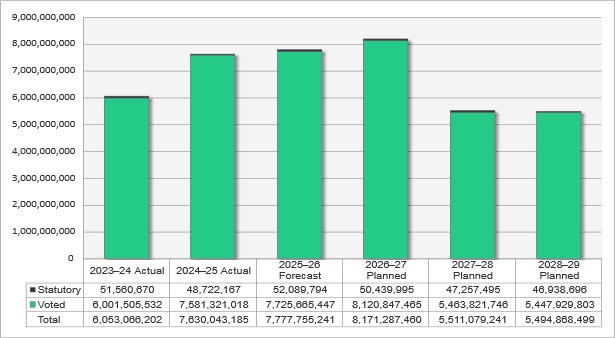
Text description of graph 1 (in dollars)
| Fiscal year | Total | Voted | Statutory |
|---|---|---|---|
| 2023–24 (actual) | 6,053,066,202 | 6,001,505,532 | 51,560,670 |
| 2024–25 (actual) | 7,630,043,185 | 7,581,321,018 | 48,722,167 |
| 2025–26 (forecast) | 7,777,755,241 | 7,725,665,447 | 52,089,794 |
| 2026–27 (planned) | 8,171,287,460 | 8,120,847,465 | 50,439,995 |
| 2027–28 (planned) | 5,511,079,241 | 5,463,821,746 | 47,257,495 |
| 2028–29 (planned) | 5,494,868,499 | 5,447,929,803 | 46,938,696 |
Analysis of statutory and voted funding over a six-year period
Our budget changes each year because of the demand-driven nature of our programs and services, which are based on the supports and services for which Veterans come forward. Annually, we update our client and expenditure forecasts to ensure that all Veterans who come forward receive the benefits and services to which they deserve.
While forecasting helps ensure enough funding is available, expenditures are only incurred for Veterans who in fact come forward to use the program or service. The design of the Government’s budget process accounts for these fluctuations, which is why there will be changes to both forecasted and actual spending from one year to the next. Fluctuations in spending are normal, given that initial forecasting is typically done many months in advance of the reporting period and adjusted throughout the year based on actual results.
For further information on our departmental appropriations, consult the 2026–27 Main Estimates.
Future-oriented condensed statement of operations
The future-oriented condensed statement of operations provides an overview of our operations for 2025–26 to 2026–27. The forecast and planned amounts in this statement of operations were prepared on an accrual basis. The forecast and planned amounts presented in other sections of the Departmental Plan were prepared on an expenditure basis. Amounts may therefore differ.
Table 20: Future-oriented condensed statement of operations for the year ended 31 March 2027 (dollars)
Table 20 summarizes the expenses and revenues which net to the cost of operations before government funding and transfers for 2025–26 to 2026–27.
| Financial information | 2025–26 forecast results | 2026–27 planned results |
Difference (planned results minus forecasted) |
|---|---|---|---|
| Total expenses | 7,671,571,776 | 8,160,233,544 | 488,661,768 |
| Total revenues | 0 | 0 | 0 |
| Net cost of operations before government funding and transfers | 7,671,571,776 | 8,160,233,544 | 488,661,768 |
Analysis of forecasted and planned results
The estimated net cost of operations for fiscal year 2026–27 is $8.2 billion. Over 90% of this planned spending is paid directly to, or on behalf of, the people VAC serves, in the form of compensation, financial support, health care and commemoration. This increasing trend in expenditures is driven by our continued efforts to improve disability benefits processing times and support case management as well as the continued growth in demand in many of our programs and services.
A more detailed Future-oriented statement of operations and associated notes for 2026–27, including a reconciliation of the net cost of operations with the requested authorities, is available on our website.
Human resources
This section presents an overview of our actual and planned human resources from 2023–24 to 2028–29.
Table 21: Actual human resources for core responsibilities and internal services
Table 21 shows a summary of human resources, in full-time equivalents (FTEs), for our core responsibilities and for internal services for the previous three fiscal years. Human resources for the 2025–26 fiscal year are forecasted based on year to date.
| Core responsibilities and internal services | 2023–24 actual FTEs | 2024–25 actual FTEs | 2025–26 forecasted FTEs |
|---|---|---|---|
| Benefits, Services and Support | 2,675.6 | 2,744.3 | 2,684.6 |
| Commemoration | 84.0 | 87.2 | 77.9 |
| Veterans Ombudsperson | 33.3 | 33.3 | 35.8 |
| Subtotal | 2,792.9 | 2,864.8 | 2,798.3 |
| Internal services | 880.8 | 906.0 | 858.5 |
| Total | 3,673.7 | 3,770.8 | 3,656.8 |
Analysis of human resources over the last three years
The Department’s human resource levels have increased steadily over the past three fiscal years, reflecting sustained workload pressures and targeted investments to improve service delivery. Actual FTE utilization increased from 3,673.7 in 2023–24 to 3,770.8 in 2024–25, and 3,656.8 FTEs are forecasted in 2025–26.
The year-over-year increases are primarily attributable to staffing implemented under the Service Excellence initiative, which was introduced to address backlogs in Disability Benefit applications and to strengthen Case Management Services. These additional resources also supported innovation and process improvements across the Department.
The larger increase observed in 2024–25 reflects the full-year impact of these staffing measures, while the more moderate increase forecasted for 2025–26 reflects a stabilization of staffing levels as backlog reduction efforts mature. Planned spending in 2025–26 is expected to sustain the Department’s current workforce and service capacity rather than drive significant further growth.
Table 22: Human resources planning summary for core responsibilities and internal services
Table 22 shows information on human resources, in full-time equivalents, for each of our core responsibilities and for internal services planned for the next three years.
| Core responsibilities and internal services | 2026–27 planned FTEs | 2027–28 planned FTEs | 2028–29 planned FTEs |
|---|---|---|---|
| Benefits, Services and Support | 2,318.4 | 2,105.4 | 2,085.2 |
| Commemoration | 89.1 | 88.1 | 88.1 |
| Veterans Ombudsperson | 39.0 | 39.0 | 39.0 |
| Subtotal | 2,446.5 | 2,232.5 | 2,212.3 |
| Internal services | 794.6 | 765.6 | 757.1 |
| Total | 3,241.1 | 2,998.1 | 2,969.4 |
Analysis of human resources for the next three years
Over the next three fiscal years, the Department's human resource levels are expected to decline, reflecting the planned conclusion of time-limited funding initiatives. Total FTE's are planned to decrease from 3,241.1 in 2026–27 to 2,998.1 in 2027–28, with levels remaining relatively consistent in 2028–29 at 2,969.4 FTEs. To note, the figures presented do not include any new funding announced in Budget 2025. The most significant variance occurs within the Disability Benefits program, where FTEs are forecasted to decrease by approximately 20% between 2026–27 and 2027–28. This reduction reflects the end of Case Management Renewal (CMR) funding, resulting in the reduction of approximately 209 temporary FTEs previously funded under this initiative.
Supplementary information tables
The following supplementary information tables are available online:
Information on our Departmental Sustainable Development Strategy can be found on our website.
Federal tax expenditures
Our Departmental Plan does not include information on tax expenditures.
The tax system can be used to achieve public policy objectives through the application of special measures such as low tax rates, exemptions, deductions, deferrals and credits. The Department of Finance Canada publishes cost estimates and projections for these measures each year in the Report on Federal Tax Expenditures.
This report also provides detailed background information on tax expenditures, including descriptions, objectives, historical information and references to related federal spending programs as well as evaluations and GBA Plus of tax expenditures.
Corporate information
Departmental profile
Appropriate minister:
The Honourable Jill McKnight, P.C., M.P
Institutional head:
Christine McDowell, A/Deputy Minister
Ministerial portfolio:
Veterans Affairs
Enabling instruments:
Department of Veterans Affairs Act; Veterans Well-being Act; Pension Act
For more information on these and other related acts and regulations, please refer to our Legislation page.
Year of incorporation / commencement:
1923
Departmental contact information
Veterans Affairs Canada
P.O. Box 7700
Charlottetown, PE
C1A 8M9
Telephone: 1-866-522-2122
TTY: 1-833-921-0071
Website: www.veterans.gc.ca
Veterans Ombud
P.O. Box 66
Charlottetown, PE
C1A 7K2
Telephone: 1-877-330-4343
TTY: 1-833-978-1639
Website: www.ombudsman-veterans.gc.ca
Definitions
List of terms
appropriation (crédit):
Any authority of Parliament to pay money out of the Consolidated Revenue Fund.
budgetary expenditures (dépenses budgétaires):
Operating and capital expenditures; transfer payments to other levels of government, departments or individuals; and payments to Crown corporations.
core responsibility (responsabilité essentielle):
An enduring function or role performed by a department. The intentions of the department with respect to a core responsibility are reflected in one or more related departmental results that the department seeks to contribute to or influence.
Departmental Plan (plan ministériel):
A report on the plans and expected performance of an appropriated department over a 3-year period. Departmental Plans are usually tabled in Parliament each spring.
departmental result (résultat ministériel):
A consequence or outcome that a department seeks to achieve. A departmental result is often outside departments’ immediate control, but it should be influenced by program-level outcomes.
departmental result indicator (indicateur de résultat ministériel):
A quantitative measure of progress on a departmental result.
departmental results framework (cadre ministériel des résultats):
A framework that connects the department’s core responsibilities to its departmental results and departmental result indicators.
Departmental Results Report (rapport sur les résultats ministériels):
A report on a department’s actual accomplishments against the plans, priorities and expected results set out in the corresponding Departmental Plan.
full time equivalent (équivalent temps plein):
A measure of the extent to which an employee represents a full person-year charge against a departmental budget. For a particular position, the full-time equivalent figure is the ratio of number of hours the person actually works divided by the standard number of hours set out in the person’s collective agreement.
gender-based analysis plus (GBA Plus) (analyse comparative entre les sexes plus [ACS Plus]):
Is an analytical tool used to support the development of responsive and inclusive policies, programs, and other initiatives. GBA Plus is a process for understanding who is impacted by the issue or opportunity being addressed by the initiative; identifying how the initiative could be tailored to meet diverse needs of the people most impacted; and anticipating and mitigating any barriers to accessing or benefitting from the initiative. GBA Plus is an intersectional analysis that goes beyond biological (sex) and socio-cultural (gender) differences to consider other factors, such as age, disability, education, ethnicity, economic status, geography (including rurality), language, race, religion, and sexual orientation.
Using GBA Plus involves taking a gender- and diversity-sensitive approach to our work. Considering all intersecting identity factors as part of GBA Plus, not only sex and gender, is a Government of Canada commitment.government priorities (priorités gouvernementales):
For the purpose of the 2026–27 Departmental Plan, government priorities are the high-level themes outlining the government’s agenda in the 2025 Speech from the Throne.
horizontal initiative (initiative horizontale):
An initiative where two or more federal departments are given funding to pursue a shared outcome, often linked to a government priority.
Indigenous business (entreprise autochtones):
Requirements for verifying Indigenous businesses for the purposes of the departmental result report are available through the Indigenous Services Canada Mandatory minimum 5% Indigenous procurement target website.
non-budgetary expenditures (dépenses non budgétaires):
Non-budgetary authorities that comprise assets and liabilities transactions for loans, investments and advances, or specified purpose accounts, that have been established under specific statutes or under non-statutory authorities in the Estimates and elsewhere. Non-budgetary transactions are those expenditures and receipts related to the government's financial claims on, and obligations to, outside parties. These consist of transactions in loans, investments and advances; in cash and accounts receivable; in public money received or collected for specified purposes; and in all other assets and liabilities. Other assets and liabilities, not specifically defined in G to P authority codes are to be recorded to an R authority code, which is the residual authority code for all other assets and liabilities.
performance (rendement):
What a department did with its resources to achieve its results, how well those results compare to what the department intended to achieve, and how well lessons learned have been identified.
performance indicator (indicateur de rendement):
A qualitative or quantitative means of measuring an output or outcome, with the intention of gauging the performance of a department, program, policy or initiative respecting expected results.
plan (plan):
The articulation of strategic choices, which provides information on how a department intends to achieve its priorities and associated results. Generally, a plan will explain the logic behind the strategies chosen and tend to focus on actions that lead to the expected result.
planned spending (dépenses prévues):
For Departmental Plans and Departmental Results Reports, planned spending refers to those amounts presented in Main Estimates.
A department is expected to be aware of the authorities that it has sought and received. The determination of planned spending is a departmental responsibility, and departments must be able to defend the expenditure and accrual numbers presented in their Departmental Plans and Departmental Results Reports.program (programme):
Individual or groups of services, activities or combinations thereof that are managed together within the department and focus on a specific set of outputs, outcomes or service levels.
program inventory (répertoire des programmes):
Identifies all the department’s programs and describes how resources are organized to contribute to the department’s core responsibilities and results.
result (résultat):
A consequence attributed, in part, to a department, policy, program or initiative. Results are not within the control of a single department, policy, program or initiative; instead they are within the area of the department’s influence.
statutory expenditures (dépenses législatives):
Expenditures that Parliament has approved through legislation other than appropriation acts. The legislation sets out the purpose of the expenditures and the terms and conditions under which they may be made.
target (cible):
A measurable performance or success level that a department, program or initiative plans to achieve within a specified time period. Targets can be either quantitative or qualitative.
voted expenditures (dépenses votées):
Expenditures that Parliament approves annually through an appropriation act. The vote wording becomes the governing conditions under which these expenditures may be made.