

Alexander Decoteau
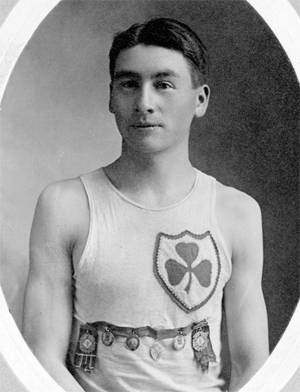
Alexander Decoteau was a Cree born on the Red Pheasant First Nation in Saskatchewan in 1887. He moved to Alberta as a young man and would become our country’s first Indigenous police officer when he joined the Edmonton force in 1909. Alex was a remarkable long-distance runner, he won most of the major races in western Canada during his athletic career. He was selected to compete in the 5,000 metre race at the 1912 Olympics in Stockholm, Sweden. He made it to the finals but unfortunately suffered leg cramps and finished out of the medals.
With the First World War raging, Decoteau enlisted in the Canadian Army in 1916. This did not keep him out of competitive running; he would win the five-mile race during a military sports day in England. King George V was watching that race and awarded him his personal gold pocket watch as a prize.
Tragically, Alex was killed in October 1917 during the Battle of Passchendaele. It is said that the German sniper who shot him took the special watch but Decoteau’s comrades later killed the sniper, recovering the treasured memento and sent it home to Decoteau’s mother.
Decoteau was inducted into the Edmonton Sports Hall of Fame in 1967.
James Duffy
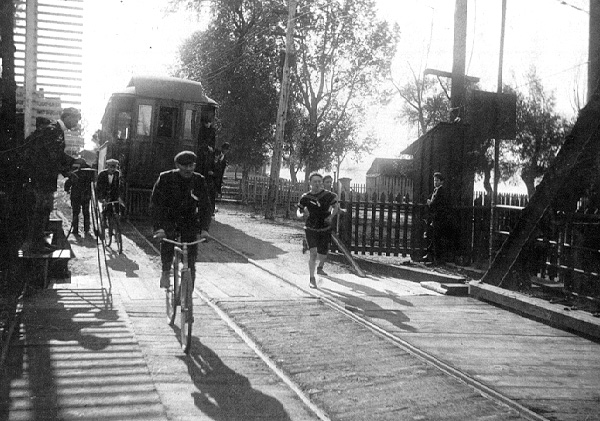
James Duffy was born in Ireland in 1890 and grew up in Edinburgh, Scotland before emigrating to Canada in 1911. An elite young runner back in Scotland, he started competing in long-distance races in Ontario soon after his arrival in the country. He represented Canada in the marathon at the 1912 Olympics in Stockholm where he finished fifth.
He continued to run after the Olympics, at one point winning an impressive string of seven straight marathons. In April 1914, he won the Boston marathon in a time of 2:25:14. Later that same year, the First World War erupted and Duffy quickly enlisted in the Canadian Expeditionary Force.
Private Duffy was among the first Canadian soldiers to see combat when his 16th Canadian Infantry Battalion (the Manitoba Regiment) took part in heavy fighting near Ypres, Belgium on 23 April 1915. This was part of a larger battle that saw the Canadians courageously hold the front line after the Germans used poison gas for the first time. Sadly, Duffy was killed by shrapnel during a night time counter-attack at Kitcheners’ Wood. He is buried at the Vlamertinghe Military Cemetery in Belgium.
John Armstrong “Army” Howard
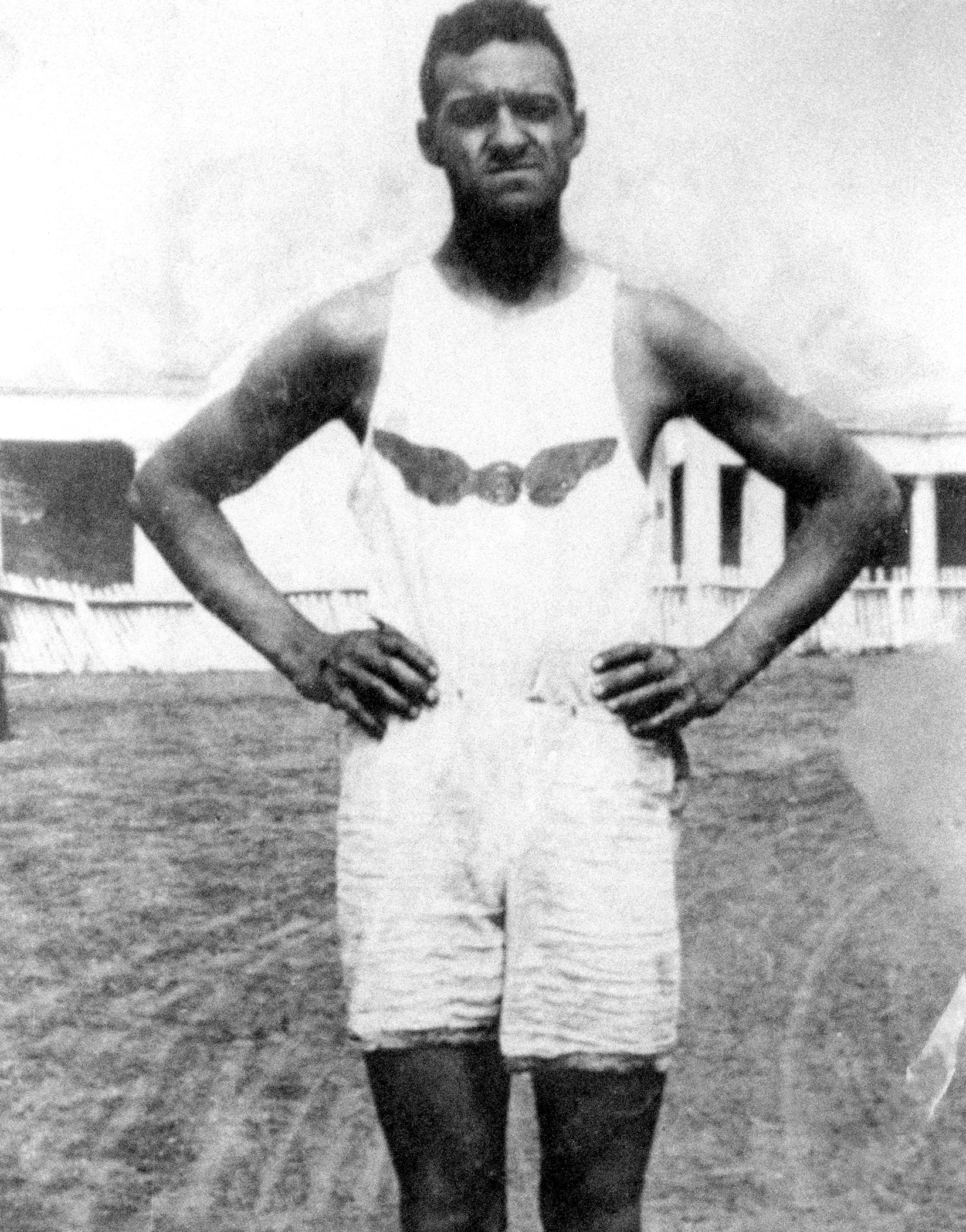
John Armstrong “Army” Howard was born in Winnipeg on 6 October 1888.
Howard took up track and field and dominated sprinting competitions in our country from 1912 to 1915. As a Black Canadian, he overcame the barriers of a less inclusive society then today and qualified for the 1912 Olympic Games in Stockholm. Unfortunately his medal hopes were dashed when he came down with a stomach ailment during the competition.
The First World War erupted in 1914 and Howard joined the Canadian Expeditionary Force. He began his military service as a private with 1st Depot Battalion of the Manitoba Regiment. He was soon serving in England with the Canadian Railway Troops, an army unit that constructed and repaired rail lines.
Howard was later transferred to the 11th and 18th Canadian Reserve Battalions, units that provided soldiers to reinforce infantry battalions that were fighting on the Western Front. He ended the war serving with the Canadian Army Medical Corps, most likely as a stretcher bearer helping move wounded soldiers.
Howard, who is thought to have been Canada’s first black Olympian, passed away in 1937 at the age of 48. He left an impressive legacy of athletic prowess. Two of his grandchildren—Valerie and and Harry Jerome—also competed in the Olympics as sprinters, with Harry winning a bronze medal in the 1964 games in Tokyo.
Tom Longboat
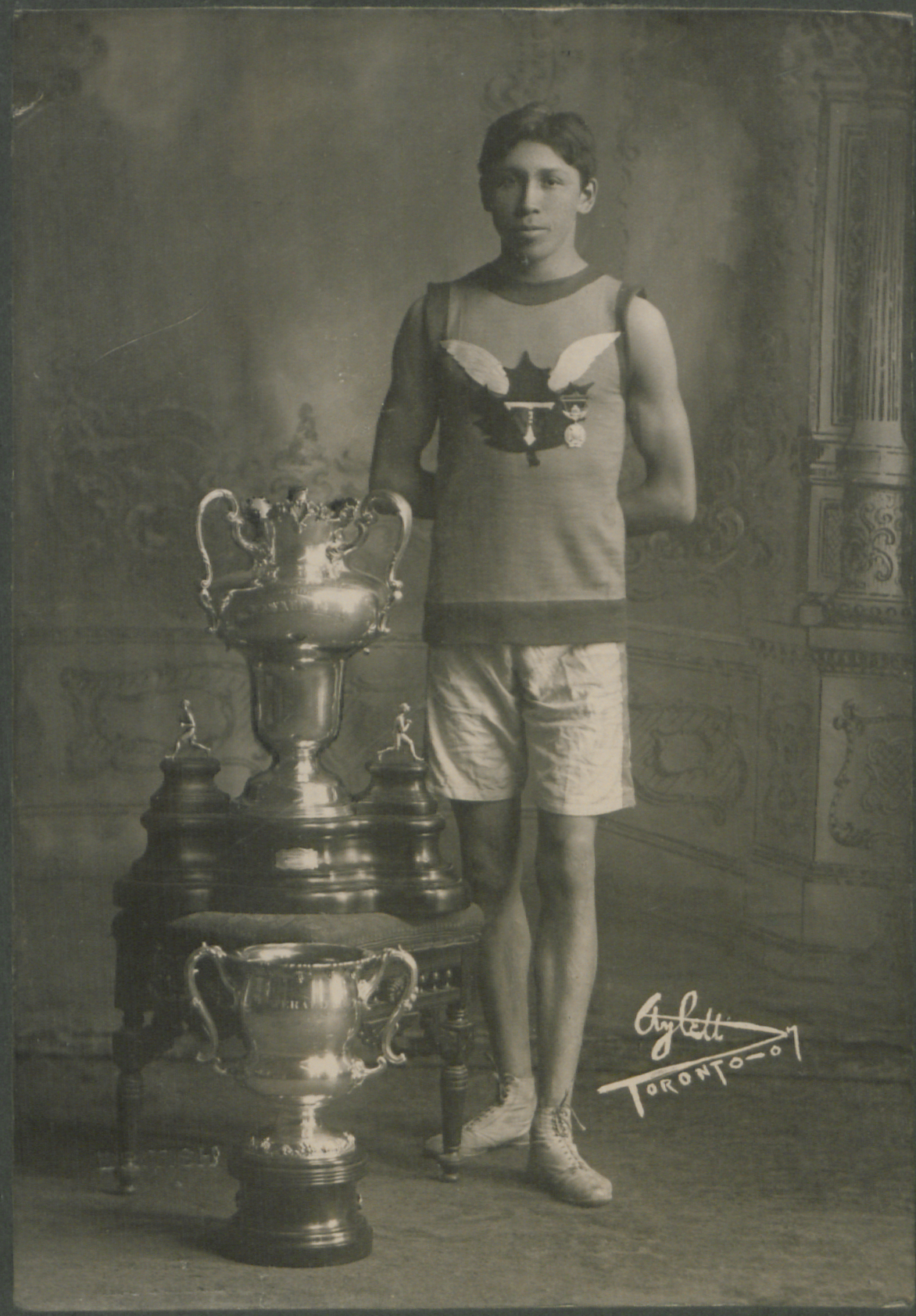
Tom Longboat was was from the Six Nations Grand River Reserve near Brantford, Ontario. Tom Longboat was one of the most famous athletes of the early 20th century. His name was known throughout North America and overseas. He helped establish marathon running as an international sport and won marathons in record-breaking times, beating competitors from all over the world. He won the Boston Marathon in 1907 and was considered a favourite in the marathon at the 1908 Olympic Games in London, England, but he collapsed at the 19-mile mark and did not finish the race.
In February 1916, he put aside his impressive racing career to serve during the First World War. Private Longboat was a dispatch carrier with the 107th Pioneer Battalion of the Canadian Expeditionary Force. In a time before wide-spread radio communications, he used his running skills to deliver messages between units on the front lines in France. It was a dangerous task - he was wounded twice and was even once officially declared dead - but did not let serving in the Canadian Army stop him from competing. During the war, he would race in events like the Canadian Corps Dominion Day competitions in 1918.
Longboat returned to Canada in 1919 and was inducted as part of the inaugural class of Canada’s Sports Hall of Fame in 1955.
Heritage Minutes- Tom Longboat
Percival Molson
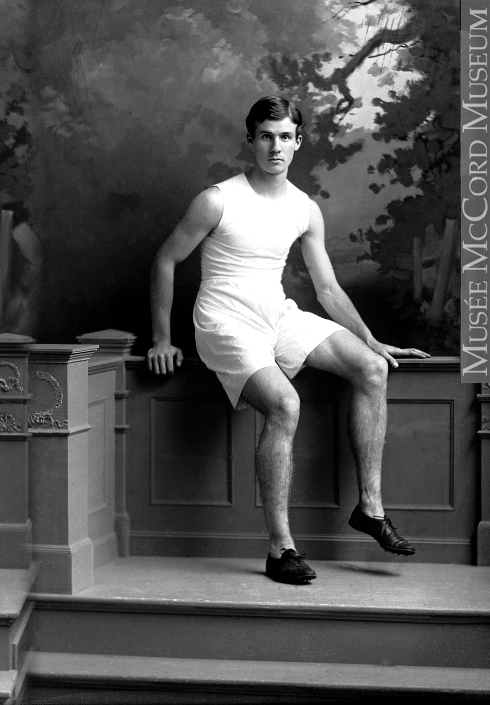
Born in 1880, Percival Molson, was a member of the prominent Montréal family and an exceptional all-round athlete. He played on the hockey team that won the Stanley Cup in 1896 and was a track and field star at McGill University.
In 1904, the Olympic Games were held in St. Louis, Missouri and Molson competed in the 400-metre race. While considered a possible medalist in the months leading up to the event, he did not make it to the winners’ podium.
Molson would go on to answer the call to serve in the First World War and enlisted in the Canadian Army. In June 1916, he was badly wounded during the Battle of Mount Sorrel at Sanctuary Wood in Belgium, earning a Military Cross for his valour. After recovering from his wounds, Captain Molson returned to the front lines with the Princess Patricia’s Canadian Light Infantry. He was killed in action on the outskirts of Avion, near Vimy Ridge on 5 July 1917.
Molson left $75,000 to McGill University in his will to help cover the costs of a new athletic field. The Percival Molson Memorial Stadium was officially opened in October 1919, named in honour of this fallen hometown sports and military hero.
The Winnipeg Falcons
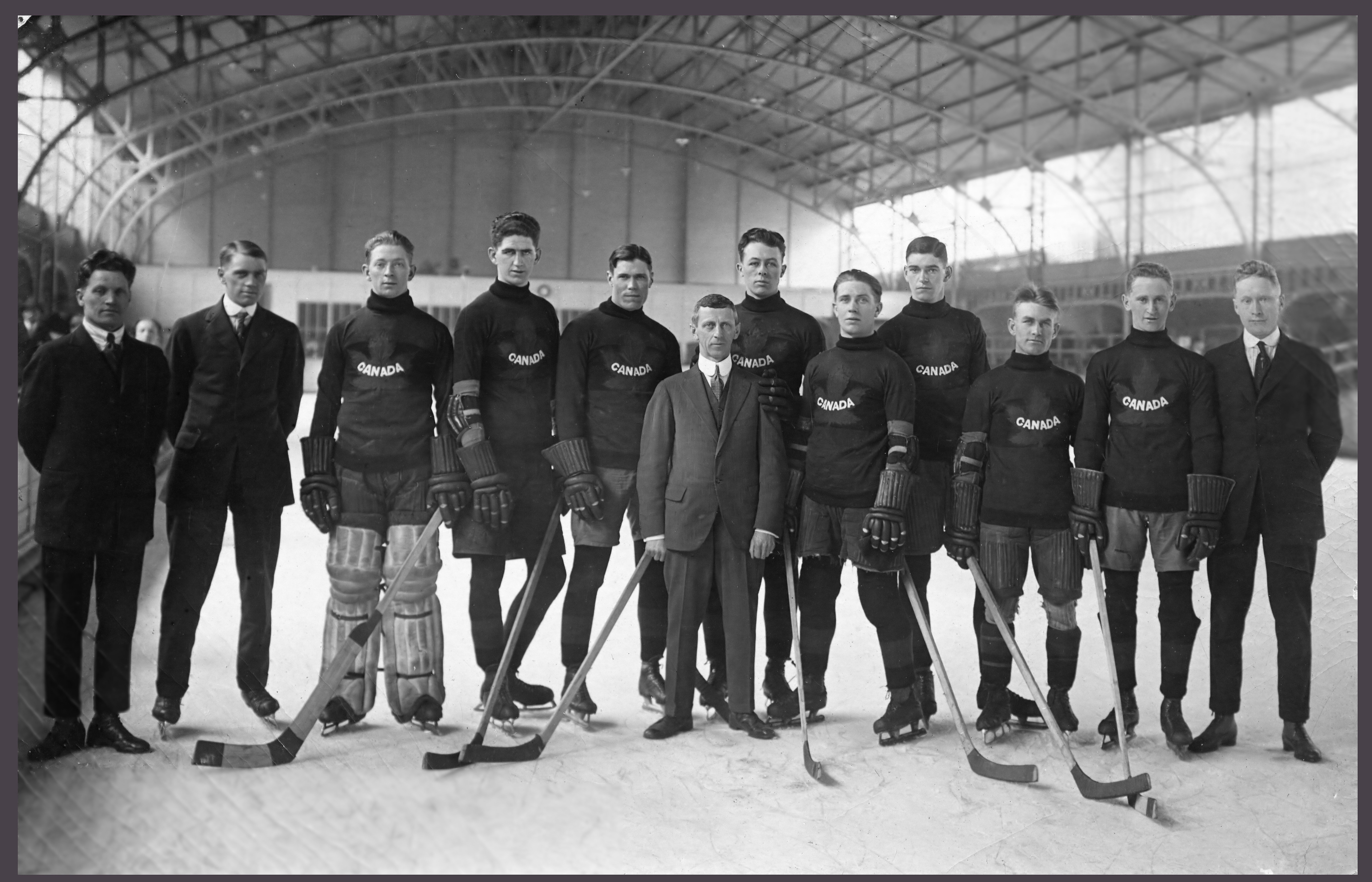
Ice hockey was an Olympic sport for the first time in 1920. Canada was represented by the Winnipeg Falcons, who had won the Allan Cup that year as the country’s top senior men's amateur hockey team.
The Falcons would defeat their opponents handily (capped with a 12-1 victory over Sweden in the final) and won the very first gold medal in hockey.
Conn Smythe
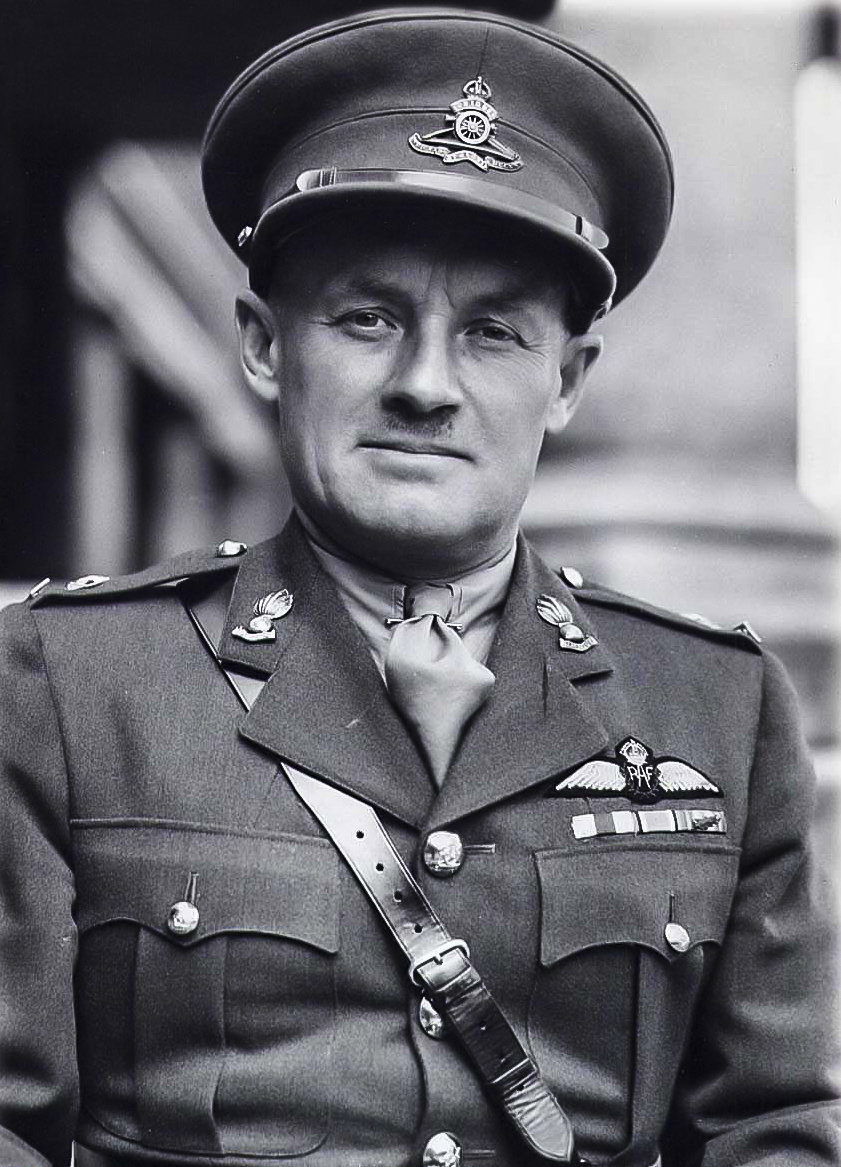
Conn Smythe of Toronto played on the University of Toronto hockey team until the First World War interrupted his studies. A week after winning the Ontario Hockey Association championship in 1915, he and eight teammates enlisted. Smythe served in the Canadian Artillery where he earned the Military Cross. He transferred to the Royal Flying Corps in 1917 and was an airborne observer until being shot down and captured. Despite two escape attempts, he spent more than a year in a German prisoner of war camp.
Smythe returned to his hockey roots after the war and helped found the Toronto Maple Leafs. He also coached the Varsity Grads team that would go on to win at the 1928 Winter Olympic Games in St. Moritz, Switzerland. Smythe did not travel to Europe with his team in protest of a controversy over the eligibility of some of his players, but he still received a gold medal.
Remarkably, Smythe enlisted again at age 45 during the Second World War. He was commanding an artillery battery in France when he was wounded in an enemy bombing attack on an ammunition depot. Major Smythe survived, but suffered injuries that would affect him for the rest of his life.
The NHL’s Conn Smythe trophy, named in his honour, is given to the most valuable player in the playoffs.
Jack Varaleau
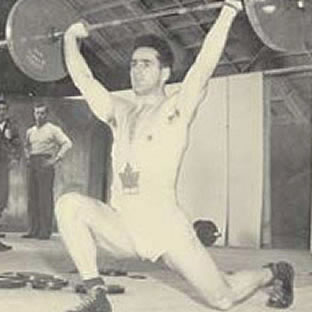
James (Jack) Varaleau was born in Vanier, Ontario and joined the military during the Second World War and served with the Royal Canadian Air Force throughout the war and for almost 30 years before retiring in the late 1960s.
He was one of Canada’s elite weightlifters. Varaleau came first at the 1950 British Empire Games in his weight class. He represented our country in the light-heavyweight division in the 1948 Summer Olympic Games in London, England and in the 1952 Summer Olympic Games in Helsinki, Finland. He even broke the Olympics bench press record at one point during the 1948 games (although he would go on to finish in sixth place).
Soon after his retirement from the military, he was inducted into the Canadian Armed Forces Sports Hall of Fame. After his retirement from the military he worked with the City of Vancouver and also helped develop fitness programs for seniors. Today, the Jack Varaleau Fitness Centre can be found in the west end of Vancouver, named in honour of this notable Canadian Veteran and athlete.
The RCAF Flyers
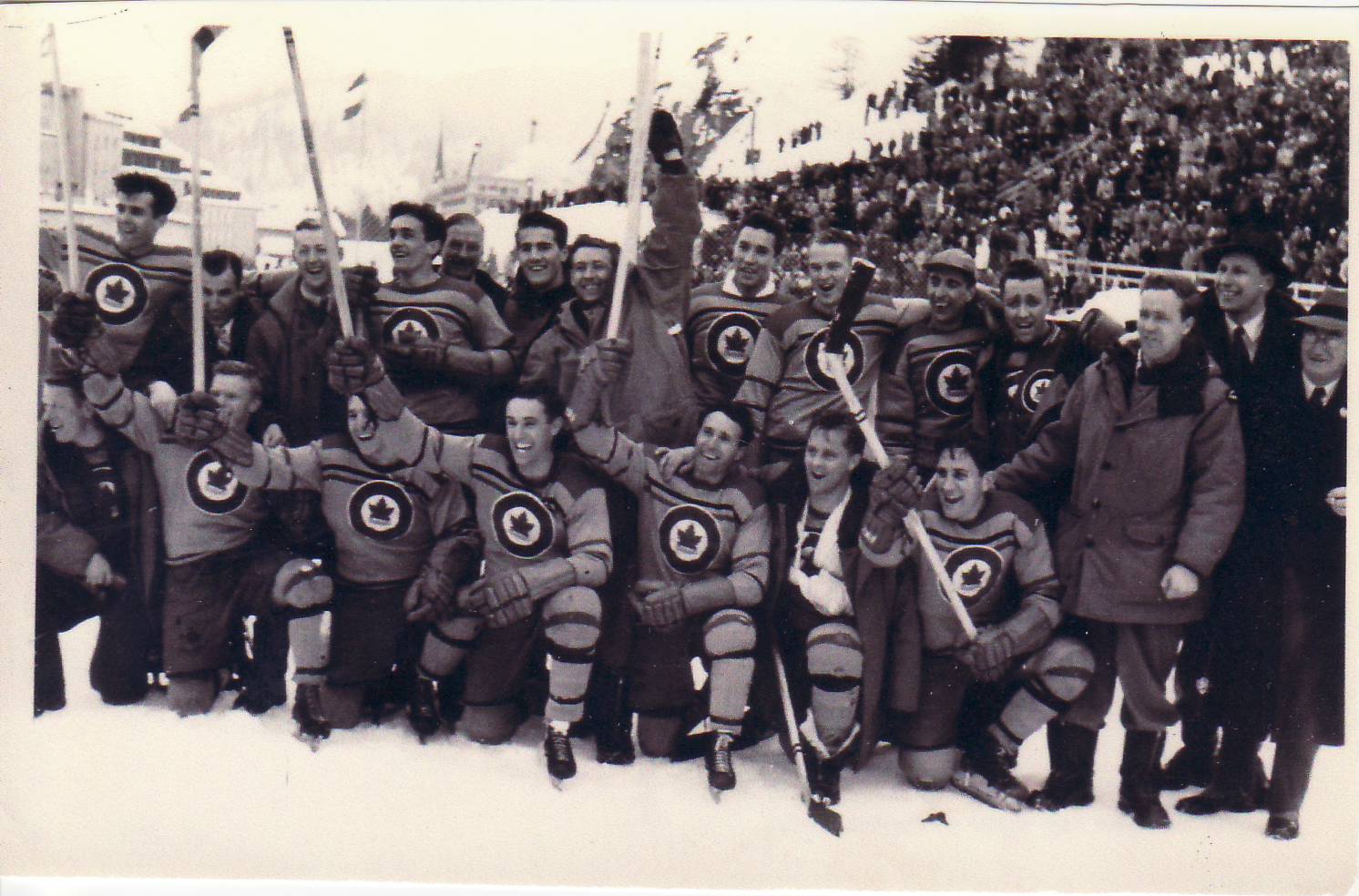
Less than three years after the end of the Second World War, the Winter Olympic Games were held in St. Moritz, Switzerland. Many of the players on the Royal Canadian Air Force Flyers hockey team that competed at the Games were Veterans of the war.
The 1948 RCAF Flyers’ Olympic gold medal win was selected as the greatest moment in Canadian Armed Forces sports history.
Gérald Ouellette
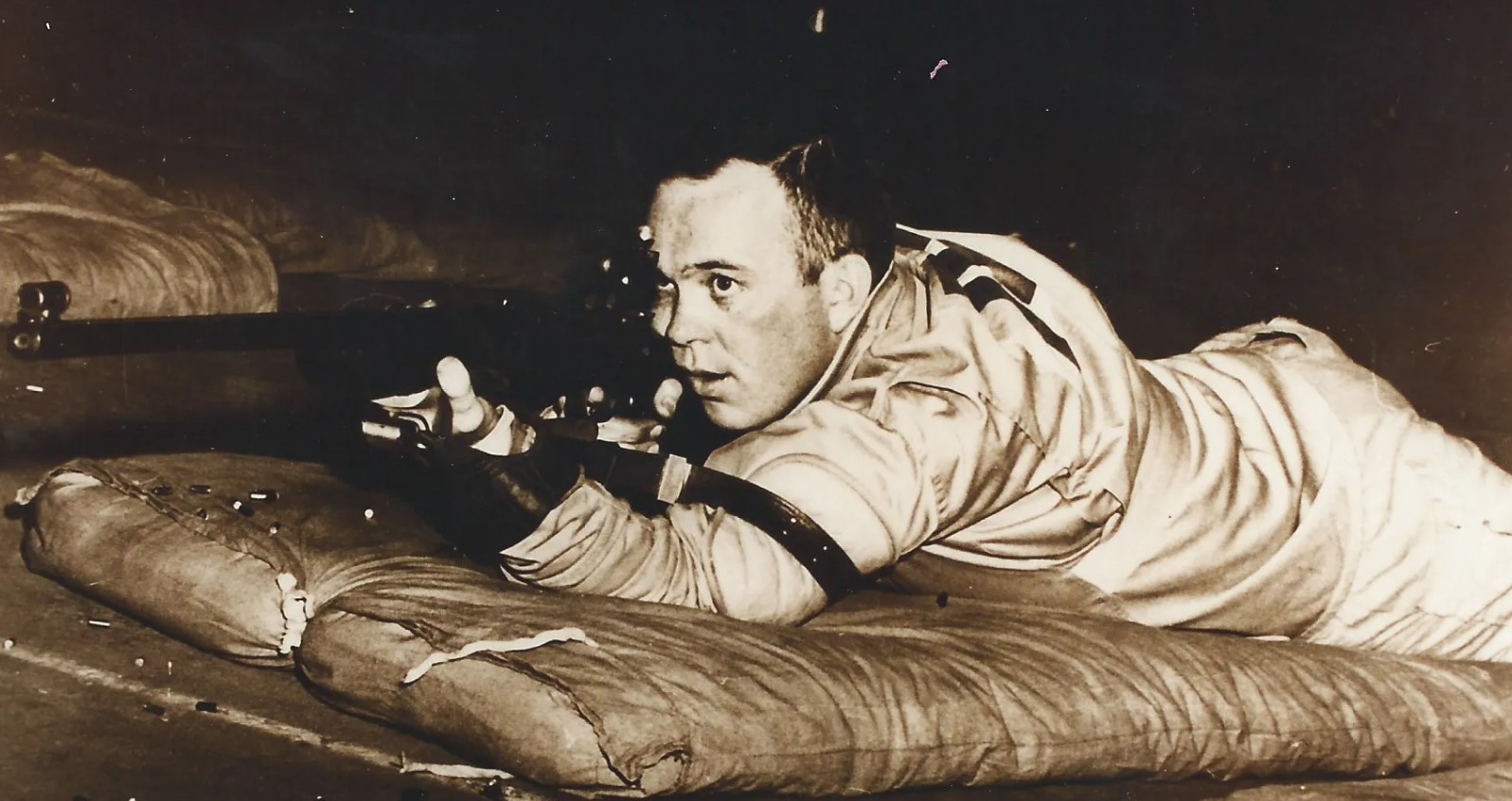
Gérald ‘Gerry’ Ouellette was born in Windsor, Ontario and joined the Canadian Armed Forces in 1955, serving in the military for 20 years.
Ouellette began his shooting success while still a teenager, winning Cadet shooting titles. He competed in the 1956 Summer Olympics in Melbourne, Australia (his first big international competition). Facing fierce competition, Ouellette brought home the gold medal in small bore rifle shooting in the prone position after hitting 60 consecutive bulls-eyes to earn a perfect score of 600. He also achieved great success in service shooting competitions, winning the 1957 Service Pistol Title. In 1959, Ouellette won the Canadian sporting rifle championship, as well as a gold medal and two silver medals at the Pan-American Games. He competed at a high level for years, bringing home a silver medal from the 1967 Pan-American Games.
Captain Ouellette died at age 40 when the private plane which he was piloting crashed. He is a member of both the Canadian Armed Forces Sports Hall of Fame and Canada’s Sports Hall of Fame.
Kenneth Money
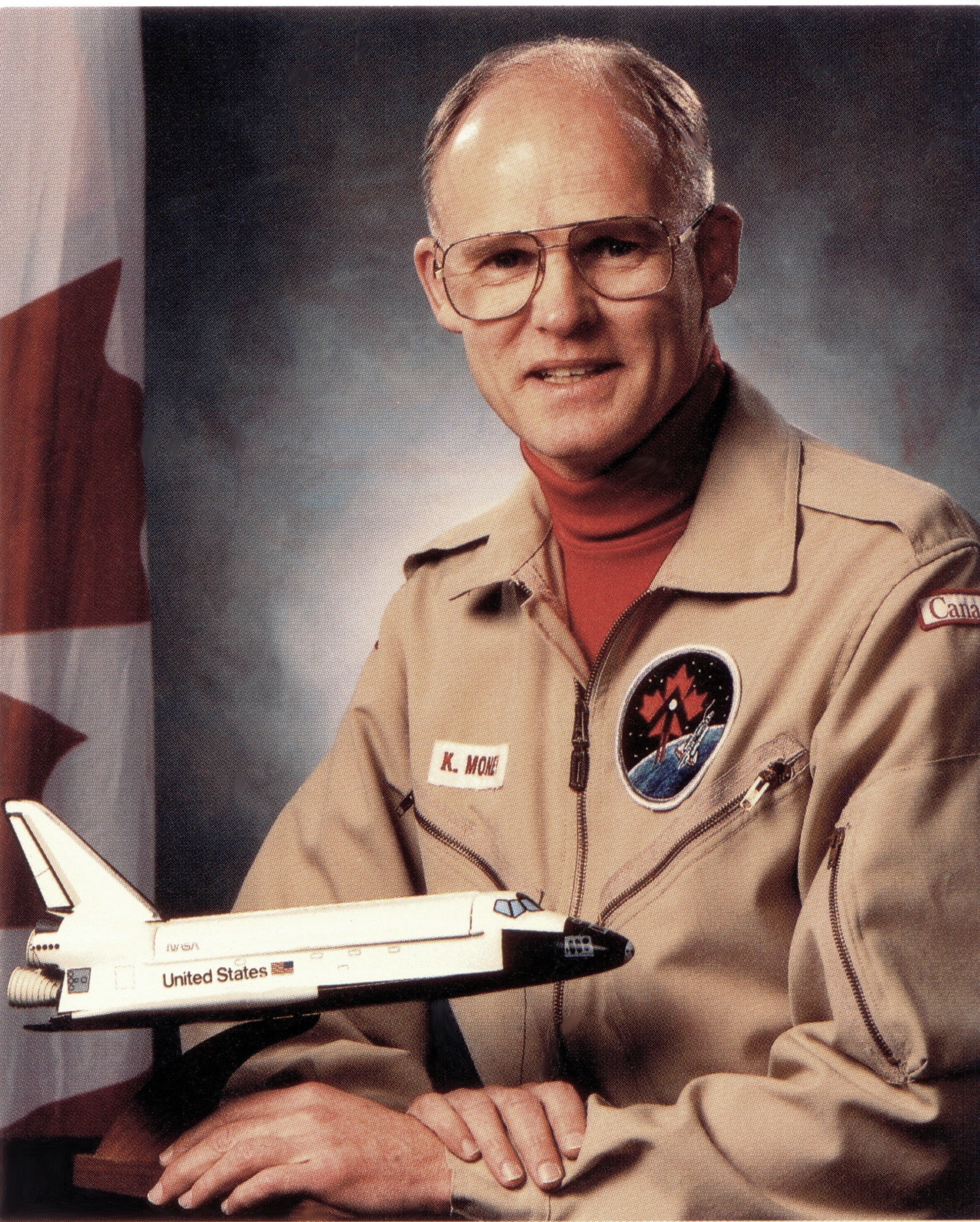
One of the Canadians who wore both military and Olympic uniforms also went on to wear an astronaut’s uniform. Kenneth Money was born in Toronto and joined the Canadian military in 1953. He set records in the high jump as a student at the University of Toronto and represented Canada in the event at the 1956 Summer Olympic Games in Melbourne, Australia, finishing in fifth place.
Money went on to become a jet pilot, earned advanced degrees in physiology and published widely in scientific journals. He contributed new knowledge to the study of motion sickness and the biological effects of space flight.
In the 1980s, Major Money was selected to be part of the Canadian astronaut program, working as one of the team members on the 1992 Spacelab mission that saw Roberta Bondar (Canada’s first female astronaut) go into space. Money was a backup astronaut for the mission, contributed to experiments with the International Microgravity Laboratory, and was a Spacelab operations radio communicator.
In 1994, Money was awarded the Meritorious Service Cross for his many contributions to science and technology.
Denis Whitaker
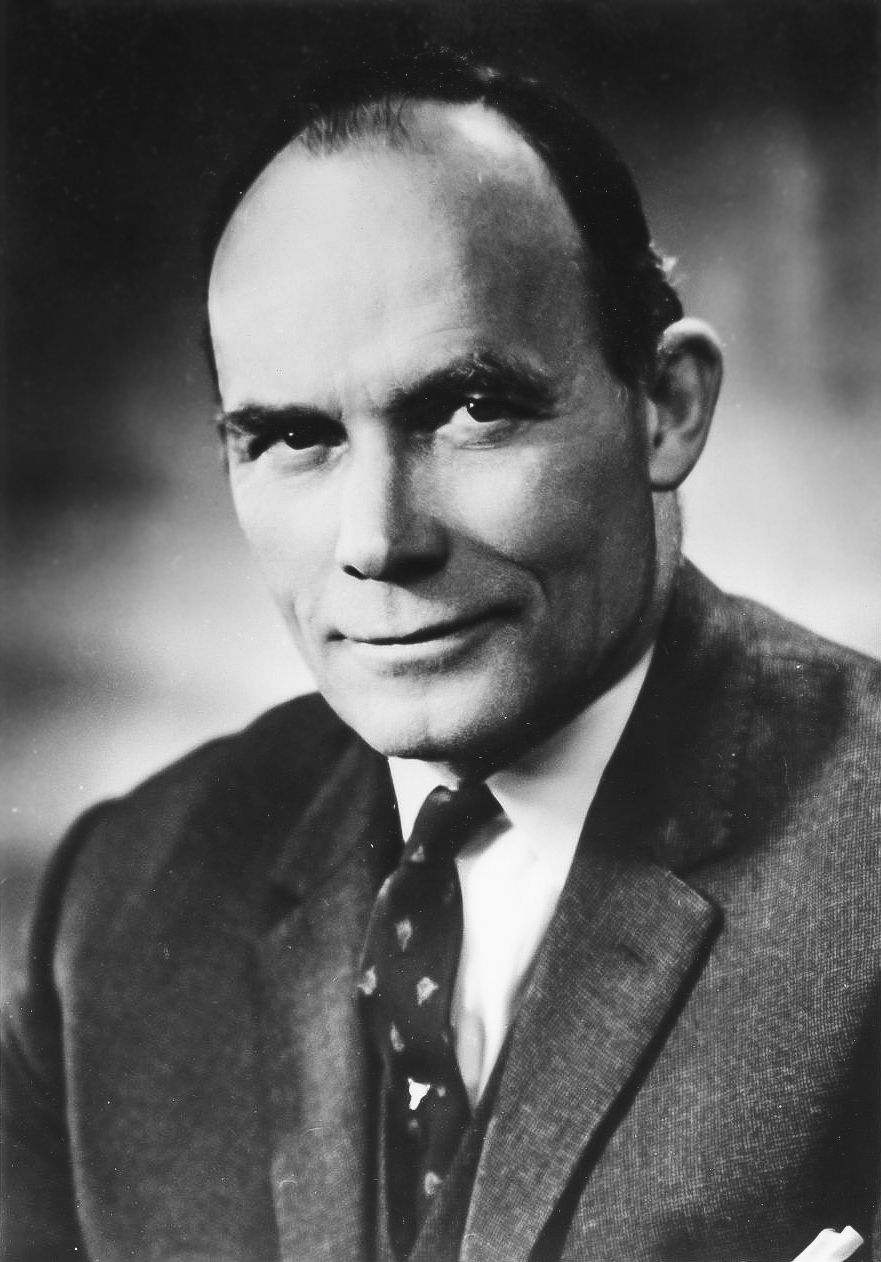
Denis Whitaker was born in Calgary in 1915 and grew up in Toronto. He attended the Royal Military College (RMC) in Kingston, Ontario, where he captained the school’s hockey and football teams. After graduation, Whitaker played quarterback for the Hamilton Tigers football team (which would later become the Hamilton Tigercats).
Whitaker joined the Royal Hamilton Light Infantry after the outbreak of the Second World War. His leadership and courage in battle would see him rise rapidly through the ranks and earn two Distinguished Service Orders for his actions during the Dieppe Raid in August 1942 and the Battle of the Rhineland in February 1945. Twice wounded, he would also be named an Officer of the Legion of Honour (France) and a Commander, Order of the Crown (Belgium).
After leaving military service as a brigadier-general in 1951, Whitaker entered the business world. He also continued his life-long connection with sports, both as a participant in sports like squash and water skiing, and as an administrator.
He was chairman of the Canadian Equestrian Team that won two Olympic gold medals and become Director of the Canadian Olympic Association in the 1970s. Whitaker was the Chef de Mission for the Canadian team at both the 1972 and 1976 Olympic Games and lead the team that boycotted the Moscow Games in 1980. He was also Governor of the Olympic Trust of Canada.
Whitaker added being a successful author to his long list of accomplishments when he wrote a number of popular books about the Second World War.
At RMC, the Whitaker Cup is awarded each year to the top team captain of one of the RMC varsity teams, in honour of his contributions to Canada in both sport and military endeavours. In 1990, he was named to the Order of Canada and was also inducted into Canada’s Sports Hall of Fame. Whitaker died in 2001.
Steve Cyr
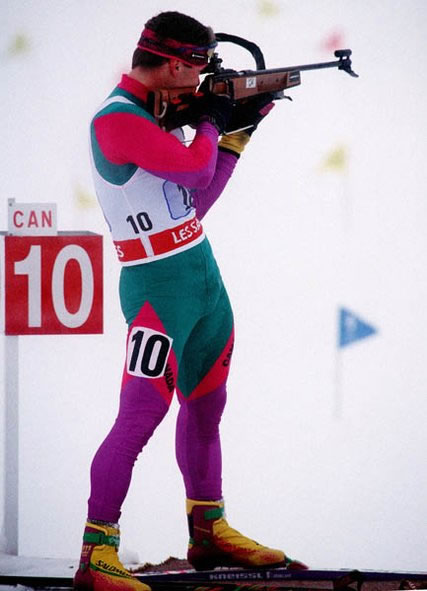
Steve Cyr was born in West Germany, where his father was serving in the Canadian Armed Forces. After returning to Canada and settling in Québec, Cyr became interested in biathlon when he saw soldiers stationed at nearby CFB Valcartier training for the event. He began competing at age 19 and quickly proved to be an elite-level biathlete. Cyr enlisted in the military in 1988, becoming a member of the Royal 22nd Regiment (commonly known as the 'Van Doos').
Corporal Cyr has the distinction of competing in three different Winter Olympics: Albertville, France in 1992, Lillehammer, Norway in 1994 and Nagano, Japan in 1998. He placed as high as eighth in his Olympic biathlon competition career, which included 10 kilometre, 20 kilometre and team relay events. In addition to competing internationally, Cyr won Canadian biathlon titles in 1992, 2000 and 2002. He took great pride in also representing his regiment at many military biathlon competitions, both in Canada and beyond, taking home titles for the Van Doos on numerous occasions. Cyr was inducted into the Canadian Armed Forces Sports Hall of Fame in 2002.
Mark Graham
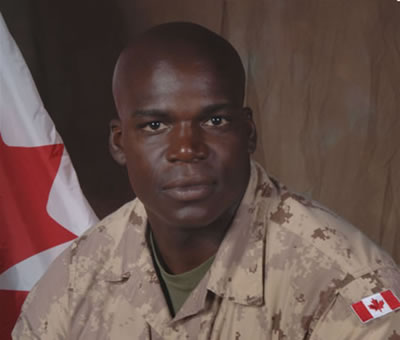
Born in Gordon Town, Jamaica, Mark Graham moved to Hamilton, Ontario with his family as a child. An exceptional athlete, he was a member of the Canadian 4 x 400 metre relay team in the 1992 Summer Olympic Games in Barcelona, Spain. While his team did not reach the finals, Graham’s skills in track-and-field would go on to earn him an athletic scholarship from the University of Nebraska and later at Kent State University in Ohio.
In 2004, he answered the call to serve in the cause of peace and freedom and enlisted in the Canadian Armed Forces. Private Graham served in Afghanistan with the Royal Canadian Regiment.
Sadly, Mark was killed in a ‘friendly fire’ incident on 4 September 2006 when his platoon was mistakenly attacked by an American warplane during an operation to capture a Taliban stronghold west of Kandahar.
Graham is buried at the National Military Cemetery in Ottawa.
Sharon Donnelly
Sharon Donnelly was born in Toronto, Ontario. An elite-level competitive swimmer as a teenager, she enlisted with the Canadian Armed Forces and entered the Royal Military College at age 17.
While at RMC, Donnelly began to compete at a recreational level in triathlons and soon realized she had a natural talent for the sport. Donnelly enjoyed great success, and was named Canadian Armed Forces Female Athlete of the Year in 1995, becoming a three-time Canadian champion, winning a silver medal at the World Military Games in 1997 and winning gold at the 1999 Pan-American Games in Winnipeg. In recognition of her achievements, Captain Donnelly was inducted into the Canadian Armed Forces Sports Hall of Fame in 1999.
s officer with the regular forces (although she remained in the army reserves) in order to train full-time and qualify for the Canadian Olympic team. At the games she crashed during the cycling leg of the triathlon which unfortunately took her out of the running for a medal. The bruised and bloodied Donnelly persevered, however, and finished the race. She remained active in the sport, participating again at the Olympics, this time as an assistant coach for the 2008 US Olympic team.
Related information
The Paralympic Games and the military
The origins of the Paralympic Games have their roots in the Second World War.
The Invictus Games and the military
The Invictus Games are an international sporting event for military members or Veterans who are ill or injured.
Hockey and the Canadian military
The relationship between hockey and our country’s military dates back more than a century.