
Note: We used our generative artificial intelligence (AI) tool (Copilot) to support the development of content in this report. A human has reviewed and validated all AI-generated content.
At a glance
This departmental results report details our actual accomplishments against the plans, priorities and expected results outlined in our 2025–26 Departmental Plan (DP).
These results align with the priorities outlined in the Prime Minister’s 21 May 2025 mandate letter, as well as with:
Key priorities
We identified the following key priorities for 2025–26:
- Drive service excellence
Deliver exemplary and timely programs and services, including commemoration, that support the well-being of our Veterans and their families. - Enable modernized and digitized service delivery
Leverage advanced technologies and digital tools to enhance the efficiency and effectiveness of our service delivery, including our commemoration activities. - Provide equitable and accessible programs and services
Provide equitable, accessible, and transparent programs and services tailored to each Veteran’s unique needs, including acts of recognition. - Build an agile and resilient organization
Invest in our organization, ensuring clarity on values and strategic direction while fostering an agile, diverse, and highly skilled workforce and a culture of continuous improvement and innovation.
Highlights
During 2025–26, we advanced several key initiatives to improve service delivery, strengthen support for Veterans, and honour Canada’s military service.
We advanced our service modernization agenda by establishing the Chief Digital Service Transformation Office to provide enterprise leadership and coordination for transformation efforts, implementing governance and oversight mechanisms to support investment prioritization and accountability, and developing a departmental Service Modernization Strategy and Phase 1 two-year roadmap to guide modernization activities across the organization. Together, these efforts established a coordinated enterprise approach to leading and advancing digital and service transformation across Veterans Affairs Canada.
Supported by Budget 2025 investments of $184.9 million over four years beginning in 2026–27 and $40.1 million ongoing, these efforts focus on improving processing capacity, modernizing Information Technology (IT) systems, simplifying workflows, and leveraging automation and AI to better meet the needs of Veterans and respond to growing demand, while safeguarding the privacy and security of client information.
As an early outcome of the department's broader service modernization efforts, we improved how services are delivered through the phased launch of the Claim Summary Tool (CST) in February 2026. This AI-enabled tool helps employees review disability benefit applications more quickly and consistently while maintaining human oversight and decision-making. By streamlining the review of medical and service records, the CST supports more timely disability benefit decisions for Veterans.
We continued to improve employment opportunities for Veterans through the National Veterans Employment Strategy. As of 31 March 2026, more than 300 employers had committed to hiring Veterans. Regular career webcasts were held to connect Veterans with employment resources, and the “Hire a Veteran” LinkedIn community has grown to nearly 7,000 participants. Since the National Veterans Employment Strategy launched in 2024, we have made significant progress in implementing planned actions and advancing key roadmap initiatives to improve employment opportunities for Veterans. We also continued to support Veterans in finding meaningful employment in their chosen fields.
During the year, we made significant progress toward construction of the National Monument to Canada’s Mission in Afghanistan, securing final monument design approval, advancing key planning and procurement activities, selecting a construction contractor, and holding a groundbreaking ceremony in May 2026, marking the project’s transition into the construction phase. This marked an important milestone in honouring the service and sacrifice of the Canadians who participated in the mission.
- Total actual spending (including internal services): $7,908,045,146
- Total full-time equivalent staff (including internal services): 3,647.3
For detailed information on our total spending and human resources, read the Spending and human resources section of this report.
Summary of results
The following provides a summary of the results we achieved in 2025–26 under our “core responsibilities” (our main areas of activity).
Core responsibility 1: Benefits, Services and Support
Actual spending: $7,719,401,084
Actual human resources: 2,663.5
In 2025–26, we made significant progress in improving the well-being of Veterans and their families by working to increase access to health care, mental health services, financial supports, housing, employment programs, and social connections.
We expanded mental health options, including a new therapist-assisted online cognitive behavioural therapy service and continued delivery of the VAC Assistance Service, which provided support to more than 2,000 individuals. Veterans benefited from faster access to rehabilitation services, expanded virtual care through the Veterans Family Telemedicine Service, stronger oversight of health care providers, and improvements to treatment benefits. We also strengthened support for equity-deserving Veterans by improving access to culturally safe services for Indigenous Veterans, investing $17 million through the Veteran and Family Well-being Fund (VFWF), and supporting research focused on women Veterans and Two-Spirit, Lesbian, Gay, Bisexual, Transgender, Queer (or Questioning), Intersex, plus (2SLGBTQI+) communities. Additional efforts helped Veterans find employment, pursue education and training, transition successfully from military service, access safe housing, prevent and address homelessness, and build social connections through peer support and community-based programs.
We also focused on improving service delivery, financial security, and client experience. The Veterans Emergency Fund approved more than 1,000 applications, while improvements to the Income Replacement Benefit (IRB) and other income support programs increased transparency, made it easier for Veterans to view and update their income information, strengthened program oversight and performance measurement, and supported more efficient program delivery. To address rising demand for disability benefits, we expanded automation and artificial intelligence tools, streamlined workflows, and strengthened decision-maker supports. We also secured long-term funding to improve processing capacity and increase the number of applications completed each month. Modernization efforts enhanced My VAC Account, updated systems to better reflect Veterans’ identities, and improved online services.
We continued to use research, evaluation, and client feedback to guide improvements, including studies on financial well-being, health outcomes, cancer risks, suicide risk, and service satisfaction. Strong partnerships with community organizations, provincial and territorial governments, the Canadian Armed Forces (CAF), and other stakeholders supported a more coordinated continuum of care. Together, these efforts helped Veterans access services more quickly, improve their health and financial well-being, strengthen their sense of purpose and community connection, and better adapt to life after service.
For more information on our activities related to Benefits, Services and Support, read the “Results: What we achieved” section of this report.
Core responsibility 2: Commemoration
Actual spending: $44,828,203
Actual human resources: 79.9
In 2025–26, we honoured Veterans and those who died in service through commemorative events, learning activities, and public outreach in Canada and abroad. We delivered more than 120 commemorative events, including the 80th anniversary of the Liberation of the Netherlands and the end of the Second World War, and the 35th anniversary of the end of the Persian Gulf conflict, and helped Canadians learn about and remember military service. During Veterans’ Week, we supported events in communities across the country and expanded educational resources for schools and the public. These efforts increased awareness of CAF service, encouraged remembrance, and supported the well-being of Veterans through recognition and connection.
We also worked to ensure that commemoration reflects the diversity of Canada’s Veteran community. We highlighted the experiences and contributions of Indigenous, Black, racialized, women, and 2SLGBTQI+ Veterans through events, exhibits, learning materials, and public outreach. We improved memorial sites and digital tools, advanced new commemorative projects, and supported community-led initiatives across Canada. Through these efforts, we helped Canadians better understand military service and provided meaningful opportunities to recognize and remember those who served.
For more information on our activities related to Commemoration, read the “Results: What we achieved” section of this report.
Core responsibility 3 : Veterans Ombudsperson
Actual spending: $4,821,028
Actual human resources: 35.8
In 2025–26, the Office of the Veterans Ombud (OVO) improved how it supports Veterans and their families by resolving complaints more quickly and consistently. As complaints and information requests reached their highest level since the Office opened, the OVO strengthened its capacity, improved business processes, enhanced employee training, and introduced new quality assurance measures. These changes helped the Office provide more timely and consistent service while maintaining a focus on fairness and accessibility for Veterans seeking assistance.
The OVO also expanded outreach and engagement with Veterans, serving members, families, and stakeholders across Canada. Through town halls, outreach events, stakeholder meetings, and other activities, the Office gathered feedback and gained further insight into Veterans' experiences. It identified systemic issues affecting Veterans, published recommendations to improve programs and services, and continued to monitor progress on past recommendations. Together, these efforts promoted fairness, informed recommendations to address barriers facing Veterans, and increased awareness of the Office's role and services.
For more information on our activities related to Veterans Ombudsperson, read the “Results: What we achieved” section of this report.
From the Minister

The Honourable Jill McKnight, P.C., M.P.
Minister of Veterans Affairs and Associate Minister of National Defence
Canadians ask much of those who serve our country. In return, we have a responsibility to ensure Veterans and their families receive the support, recognition, and care they are eligible for. This report highlights the progress Veterans Affairs Canada (VAC) made in 2025–26 to uphold that commitment.
Supporting Veterans remains our highest priority. In 2025–26, more than 90 percent of departmental spending went directly to Veterans, their families, and other program recipients. We invested in programs, services, and initiatives that help Veterans navigate the transition to life after service, access the benefits and supports they need, and receive the recognition they deserve.
Veterans and their families should be able to access timely and responsive support. In 2025–26, we continued to strengthen and modernize the Department to improve service delivery, reduce barriers, and strengthen our capacity to respond to increasing demand.
Guided by our priorities of improving service delivery, supporting successful transition to post-service life, and ensuring Veterans’ service and sacrifices continue to be recognized and remembered, VAC achieved several important results in 2025–26:
- processed more disability benefits claims than any previous year in VAC’s history by modernizing disability benefits processing with new digital tools designed to support more timely and consistent service for Veterans;
- connected more than 2 million Canadians with Veterans' stories through commemorative events and initiatives, helping ensure their service and sacrifice continue to be remembered by future generations, while advancing landmark projects such as the National Monument to Canada's Mission in Afghanistan;
- established the foundations for a more modern VAC, strengthening the Department's ability to meet the evolving needs of Veterans and their families with services that are easier to access, more responsive, and centred on the Veteran experience; and
- strengthened the National Veterans Employment Strategy, bringing more employers to the table and laying the foundation for even greater employment opportunities for Veterans in the years ahead.
These achievements represent meaningful progress toward a more responsive, accessible, and efficient department for Veterans and their families. They also reflect our ongoing commitment to improve the programs and services Veterans rely upon.
Through initiatives like the National Veterans Employment Strategy, we are helping Veterans thrive beyond their military service. As Canada works to strengthen its economy, bolster its competitiveness, and increase investment in the defense sector, Veterans represent a highly skilled and experienced workforce whose contributions strengthen communities and workplaces across the country.
At the same time, through commemorative initiatives and partnerships across the country and internationally, we remained committed to preserving and sharing the stories of Veterans. By honouring their service, we help ensure future generations understand the courage, sacrifice and achievements that have shaped our nation.
The results presented in this report reflect the dedication of VAC employees and the strong partnerships that support our work. While we are proud of the progress made this year, we know there is more work ahead. As the needs of Canada’s Veterans evolve, so too must the services we provide.
Our efforts are focused on ensuring Veterans and their families receive the support, care, and recognition to which they are eligible through their service to Canada. By honouring their contributions and investing in their success, we reaffirm the covenant Canada has made with Veterans: that those who answered the call to serve will continue to be recognized, supported and valued long after their military service concludes.
It is a privilege to serve Canada's Veteran community.
With gratitude to all who have served, and to the families and loved ones who support them.
The Honourable Jill McKnight, P.C., M.P.
Minister of Veterans Affairs and
Associate Minister of National Defence
Results – what we achieved
Core responsibilities and internal services:
Core responsibility 1: Benefits, Services and Support
Description
Support the care and well-being of Veterans and their dependents or survivors through a range of benefits, services, research, partnerships, and advocacy.
Quality of Life Impacts
The work we did to fulfill this core responsibility had a positive impact on the following Quality of life Framework domains and indicators:
- Health: Self-rated mental health, Self-rated health
- Prosperity: Financial well-being, Employment, Housing needs
- Society: Sense of belonging to local community
- Life satisfaction
Progress on results
This section details our performance against our targets for each departmental result under Core responsibility 1: Benefits, Services and Support.
Table 1 shows the target, the date to achieve the target and the actual result for each indicator under “Veterans are physically and mentally well” in the last three fiscal years.
| Departmental result indicator | Target | Date to achieve target | Actual result |
|---|---|---|---|
| % of Veterans who report that their health is very good or excellent | 50%We carried over these targets from an old data source that has been phased out. Since the new data source represents a different survey population, we reviewed our targets to better align with the new survey methodology and the overall Canadian population. New targets for the updated data source have been established effective 2026–27. | March 2027 |
2023–24: 40%The result for 2023–24 (carried over from 2022–23) comes from the data collected during the 2022 Canadian Veteran Health Survey (CVHS). 2024–25: 41% 2025–26: 41%The result for 2025–26 (carried over from 2024–25) comes from the data collected during the 2024 CVHS. |
| % of Veterans who report that their mental health is very good or excellent | 60%We carried over these targets from an old data source that has been phased out. Since the new data source represents a different survey population, we reviewed our targets to better align with the new survey methodology and the overall Canadian population. New targets for the updated data source have been established effective 2026–27. | March 2027 |
2023–24: 49%The result for 2023–24 (carried over from 2022–23) comes from the data collected during the 2022 Canadian Veteran Health Survey (CVHS). 2024–25: 49% 2025–26: 49%The result for 2025–26 (carried over from 2024–25) comes from the data collected during the 2024 CVHS. |
| % of Veterans receiving treatment in Operational Stress Injury Clinics reporting improved overall mental health | 50% | March 2026 |
2023–24: 51% 2024–25: 54% 2025–26: 54% |
| % of Veterans who report they need help with an activity of daily living | 20%We carried over these targets from an old data source that has been phased out. Since the new data source represents a different survey population, we reviewed our targets to better align with the new survey methodology and the overall Canadian population. New targets for the updated data source have been established effective 2026–27. | March 2027 |
2023–24: n/aQuestions on activities of daily living were not included in the 2022 CVHS. 2024–25: 18% 2025–26: 18%The result for 2025–26 (carried over from 2024–25) comes from the data collected during the 2024 CVHS. |
Table 2 shows the target, the date to achieve the target and the actual result for each indicator under “Veterans and their families are financially secure” in the last three fiscal years.
| Departmental result indicator | Target | Date to achieve target | Actual result |
|---|---|---|---|
| % of Veterans whose household income is below the Low Income Measure | Lower than the Canadian general population (19%)At the time of publication of the 2025–26 DP, the age- and gender-standardized comparison to the Veteran population was 19.4% based on the 2021 Census. The figure is rounded in the table for easier comparability to the historical results. While updated comparator data may become available over time, the reference target reported in Departmental Results Reports remains consistent with the target established in the corresponding Departmental Plan. Any updates to the reference target will therefore be incorporated in future DPs. | March 2027 |
2023–24: 17%The result for 2023–24 (carried over from 2022–23) comes from the data collected during the 2022 Canadian Veteran Health Survey (CVHS). 2024–25: 20% 2025–26: 20%The result for 2025–26 (carried over from 2024–25) comes from the data collected during the 2024 CVHS. |
| % of Veterans who are satisfied with their financial situation | 75%We carried over these targets from an old data source that has been phased out. Since the new data source represents a different survey population, we reviewed our targets to better align with the new survey methodology and the overall Canadian population. New targets for the updated data source have been established effective 2026–27. | March 2027 |
2023–24: 62%The result for 2023–24 (carried over from 2022–23) comes from the data collected during the 2022 Canadian Veteran Health Survey (CVHS). 2024–25: 66% 2025–26: 66%The result for 2025–26 (carried over from 2024–25) comes from the data collected during the 2024 CVHS. |
Table 3 shows the target, the date to achieve the target and the actual result for each indicator under “Veterans have a sense of purpose” in the last three fiscal years.
| Departmental result indicator | Target | Date to achieve target | Actual result |
|---|---|---|---|
| % of Veterans who are satisfied with their job or main activity | 75%We carried over these targets from an old data source that has been phased out. Since the new data source represents a different survey population, we reviewed our targets to better align with the new survey methodology and the overall Canadian population. New targets for the updated data source have been established effective 2026–27. | March 2027 |
2023–24: 75%The result for 2023–24 (carried over from 2022–23) comes from the data collected during the 2022 Canadian Veteran Health Survey (CVHS). 2024–25: 81% 2025–26: 81%The result for 2025–26 (carried over from 2024–25) comes from the data collected during the 2024 CVHS. |
| % of Veterans who are employedThis survey question in the CVHS follows Statistics Canada’s standard approach in the Canadian Community Health Survey, where employment questions are asked only of those aged 75 and under, ensuring a fair comparison. | 70%We carried over these targets from an old data source that has been phased out. Since the new data source represents a different survey population, we reviewed our targets to better align with the new survey methodology and the overall Canadian population. New targets for the updated data source have been established effective 2026–27. | March 2027 |
2023–24: 56%The result for 2023–24 (carried over from 2022–23) comes from the data collected during the 2022 Canadian Veteran Health Survey (CVHS). 2024–25: 54% 2025–26: 54%The result for 2025–26 (carried over from 2024–25) comes from the data collected during the 2024 CVHS. |
Table 4 shows the target, the date to achieve the target and the actual result for each indicator under “Veterans are able to adapt, manage, and cope within post-service life” in the last three fiscal years.
| Departmental result indicator | Target | Date to achieve target | Actual result |
|---|---|---|---|
| % of Veteran clients of Veterans Affairs Canada who report an easy adjustment to post-service life | 70% | March 2027 |
2023–24: 59%The result for 2023–24 (carried over from 2022–23) comes from the data collected during the 2022 VAC National Client Survey (VNCS). The VNCS is conducted every two years. 2024–25: 49%The 2024 result (49%) is not directly comparable to the 2022 result (59%) due to a change in the survey population. In 2022, the question was asked of all Veteran respondents, while in 2024 it was asked only of Veterans who released in 2014 or later. 2025–26: 49%The result for 2025–26 (carried over from 2024–25) comes from the data collected during the 2024 VNCS. The VNCS is conducted every two years. |
| % of Veterans who have completed a post-secondary education | 55%We carried over these targets from an old data source that has been phased out. Since the new data source represents a different survey population, we reviewed our targets to better align with the new survey methodology and the overall Canadian population. New targets for the updated data source have been established effective 2026–27. | March 2027 |
2023–24: 64%The result for 2023–24 (carried over from 2022–23) comes from the data collected during the 2022 Canadian Veteran Health Survey (CVHS). 2024–25: 67% 2025–26: 67%The result for 2025–26 (carried over from 2024–25) comes from the data collected during the 2024 CVHS. |
| % of Veterans who have high level of mastery of their life skills | 40%We carried over these targets from an old data source that has been phased out. Since the new data source represents a different survey population, we reviewed our targets to better align with the new survey methodology and the overall Canadian population. New targets for the updated data source have been established effective 2026–27. | March 2027 |
2023–24: 24%The result for 2023–24 (carried over from 2022–23) comes from the data collected during the 2022 Canadian Veteran Health Survey (CVHS). 2024–25: 27% 2025–26: 27%The result for 2025–26 (carried over from 2024–25) comes from the data collected during the 2024 CVHS. |
Table 5 shows the target, the date to achieve the target and the actual result for each indicator under “Veterans are living in safe and adequate housing” in the last three fiscal years.
| Departmental result indicator | Target | Date to achieve target | Actual result |
|---|---|---|---|
| % of Veterans who are in core housing need | Lower than the Canadian general population (7%)At the time of writing the 2025–26 DP, the Canadian general population result was 7.2% based on 2021 Canadian Housing Survey (CHS) data. The figure is rounded in the table for easier comparability to historical results. While updated comparator data may become available over time, the reference target reported in Departmental Results Reports remains consistent with the target established in the corresponding Departmental Plan. Any updates to the reference target will therefore be incorporated in future DPs. | March 2027 |
2023–24: 5%At the time of writing the 2025–26 DP, the 2023–24 result was based on the 2021 Census, as the Census is not conducted annually. More recent data from the 2022 CHS was not available in time for inclusion in the DP. To maintain consistency between reports, the historical result is presented as originally reported in the corresponding DP. 2024–25: n/aThe 2024 CHS data was not yet released by Statistics Canada at the time of writing of this report, therefore the 2024–25 result is not yet available. 2025–26: n/aResults for 2025–26 will be carried forward from 2024–25, pending the release of data from the 2024 CHS, which is conducted every two years. |
| % of Veteran clients of Veterans Affairs Canada 65 years and older living in their own homes who report satisfaction with their housingThe results used for this indicator are derived from a secondary analysis of disaggregated data that is not broken down in the final VNCS report. | 97% | March 2027 |
2023–24: 90%The result for 2023–24 (carried over from 2022–23) comes from the data collected during the 2022 VAC National Client Survey (VNCS). The VNCS is conducted every two years. 2024–25: 95% 2025–26: 95%The result for 2025–26 (carried over from 2024–25) comes from the data collected during the 2024 VNCS. The VNCS is conducted every two years. |
Table 6 shows the target, the date to achieve the target and the actual result for each indicator under “Veterans are socially supported” in the last three fiscal years.
| Departmental result indicator | Target | Date to achieve target | Actual result |
|---|---|---|---|
| % of Veterans who have a strong sense of community belonging | 60%We carried over these targets from an old data source that has been phased out. Since the new data source represents a different survey population, we reviewed our targets to better align with the new survey methodology and the overall Canadian population. New targets for the updated data source have been established effective 2026–27. | March 2027 |
2023–24: 59%The result for 2023–24 (carried over from 2022–23) comes from the data collected during the 2022 Canadian Veteran Health Survey (CVHS). 2024–25: 62% 2025–26: 62%The result for 2025–26 (carried over from 2024–25) comes from the data collected during the 2024 CVHS. |
| % of Veterans Affairs Canada clients who are satisfied with their relationships with friends or familyThe results used for this indicator are derived from a secondary analysis of disaggregated data that is not broken down in the final VNCS report. | 85% | March 2027 |
2023–24: 88%The result for 2023–24 (carried over from 2022–23) comes from the data collected during the 2022 VAC National Client Survey (VNCS). The VNCS is conducted every two years. 2024–25: 88% 2025–26: 88%The result for 2025–26 (carried over from 2024–25) comes from the data collected during the 2024 VNCS. The VNCS is conducted every two years. |
Table 7 shows the target, the date to achieve the target and the actual result for each indicator under “Veterans are satisfied with the services they receive” in the last three fiscal years.
| Departmental result indicator | Target | Date to achieve target | Actual result |
|---|---|---|---|
| % of Veterans Affairs Canada clients who are satisfied with the quality of service delivery they receive from Veterans Affairs Canada | 85% | March 2027 |
2023–24: 78%The result for 2023–24 (carried over from 2022–23) comes from the data collected during the 2022 VAC National Client Survey (VNCS). The VNCS is conducted every two years. 2024–25: 77% 2025–26: 77%The result for 2025–26 (carried over from 2024–25) comes from the data collected during the 2024 VNCS. The VNCS is conducted every two years. |
| % of Veterans Affairs Canada clients who are satisfied with the quality of Veterans Affairs Canada’s programs and services offered | 85% | March 2027 |
2023–24: 76%The result for 2023–24 (carried over from 2022–23) comes from the data collected during the 2022 VAC National Client Survey (VNCS). The VNCS is conducted every two years. 2024–25: 78% 2025–26: 78%The result for 2025–26 (carried over from 2024–25) comes from the data collected during the 2024 VNCS. The VNCS is conducted every two years. |
The Results section of our Infographic on Government of Canada’s InfoBase (GC InfoBase) provides additional information on results and performance related to our program inventory.
Details on results
The following section describes the results for Benefits, Services and Support in 2025–26 compared with the planned results set out in our departmental plan for the year.
Veterans are physically and mentally well
Results achieved
We made progress in supporting Veterans’ physical and mental well-being by making it easier to access services. We improved access to timely, evidence-based care, expanded virtual health services, strengthened oversight of programs and health care providers and advanced supports for equity-deserving Veterans.
Mental health services
- We continued to partner with Health Canada to provide psychological support to Veterans, former Royal Canadian Mounted Police (RCMP) members, and their families through the VAC Assistance Service. This free service is available 24 hours a day, 7 days a week and is available whether or not individuals are VAC clients. In 2025–26, the service provided psychological support to 2,056 people and responded to an additional 835 calls for immediate assistance.
- We added a new therapist-assisted online therapy option in fall 2025 to improve access to mental health services. This option, called Therapist-Assisted Internet-Based Cognitive Behavioural Therapy (TA-iCBT), supports Veterans with mild to moderate depression and anxiety disorders, including phobias. It uses an evidence-based approach that helps reduce barriers such as distance and stigma. As part of our continuum of mental health services, TA-iCBT helps us provide support at the right level to meet Veterans’ needs more quickly and easily. While coverage for TA-iCBT was added to the benefit grid in fall 2025, provider evaluations are underway, and the service launched in June 2026.
- In August 2025, we updated the Android version of Post-Traumatic Stress Disorder (PTSD) Coach Canada to ensure it remained available on the Google Play Store. During 2025–26, the app had an average of 503 monthly active users.
- During 2025–26, consultations with VAC health professionals, treatment benefits employees, and frontline employees helped us identify and address opportunities to better meet the needs of our clients. We made progress on developing tools for interdisciplinary and multidisciplinary clinics, including an inpatient Residential Treatment Recommendation Form. These tools will help Veterans access appropriate treatments.
- As of 31 March 2026, 42.27% of clients receiving case management said that their mental health improved at the end of services. This result suggests that case management helped Veterans address mental health needs by setting goals together and connecting them to the right supports and resources. While many clients made meaningful progress, we have an opportunity to further strengthen mental health supports to improve outcomes for Veterans receiving case management.
Comprehensive supports
- Through the Veteran and Family Well-being Fund, we funded organizations that improve the physical and mental well-being of Veterans and their families. All funded projects submit final reports, which we review and publish on the program’s external website. We are also scheduling site visits with funded organizations to assess project implementation, outcomes, and lessons learned.
- We continued work to strengthen the delivery of rehabilitation services for Veterans and their families. We introduced earlier assessments of rehabilitation needs, with the aim of connecting Veterans with appropriate services sooner. We also expanded an evidence-based interdisciplinary mental health model intended to provide more coordinated support for Veterans with complex needs participating in the Rehabilitation Program. This work forms part of ongoing efforts to address challenges and improve rehabilitation service delivery.
- We continued to monitor mental health outcomes for clients at Operational Stress Injury clinics using the Client-Reported Outcome Monitoring Information System (CROMIS). In 2025–2026, 54% of clients receiving treatment at the clinics reported a significant improvement in their mental health, compared to the 35% improvement rate reported in the scientific literature (Hansen, Lambert and Forman, 2002). We also promoted and supported the use of CROMIS for outcome monitoring. During the reporting period, the number of completed outcome questionnaires across the OSI clinic network increased by 14%, supported by a coordinated approach involving VAC and OSI clinics.
- We published the Occupational Therapy (OT) Services business process for treatment involving family members in March 2025. We also completed a review of OT services and started updating the process to align with practices across other health professions. This update includes introducing a distinct benefit code to streamline services for Veterans and their families.
- We strengthened occupational therapy services through professional development, mentorship for fee-for-service occupational therapists new to working with Veterans, and the development of a checklist and review process to support consistent service delivery. These efforts help strengthen provider capacity and support consistent, quality care for Veterans.
- In February 2026, we expanded the Veteran Family Telemedicine Service to give all releasing CAF members and their families access to a contracted virtual health care provider for two years after their release, with eligibility backdated to 1 April 2025. This temporary pilot service does not replace provincial health care but supports Veterans and their families while they wait for a family health care provider. The program will accept participants until 31 March 2027 and will end on 31 March 2029.
Equity-deserving Veterans
- We worked to maintain the progress made in reducing processing time gaps for disability benefits applications across sex and official language groups. In 2025–26, average processing times for first applications were 23.0 weeks for women and 22.2 weeks for men, and 22.4 weeks for applicants who requested service in either English or French. We will continue to monitor these results, recognizing that they may fluctuate, and take action as needed.
- We worked with Indigenous Services Canada to improve awareness of and access to culturally safe mental wellness services for Indigenous Veterans and their families. We developed a referral process, began tracking and monitoring referrals, and began collecting feedback.
- We continued to engage respectfully with Indigenous Veterans to better understand their needs and gather feedback on culturally appropriate services. We worked with the Assembly of First Nations Veterans Council to create a joint workplan and met regularly with the National Métis Veterans Council to explore partnerships and support a national gathering. We also held engagements across six provinces and territories to increase awareness of VAC programs and gather feedback.
- We worked with partners to increase awareness of available programs and provide targeted training to employees and service providers, including trauma-informed approaches and tools to better understand the needs of Indigenous Veterans. We also improved how we track access to services to support more culturally appropriate, responsive, and equitable service delivery.
- We awarded $17 million through the VFWF to organizations that provide comprehensive supports to Veterans and their families. The funded initiatives focused on mental health, housing, employment, and research to improve well-being. Many initiatives also focused on supporting equity-deserving Veterans, including women, Indigenous, and 2SLGBTQI+ Veterans.
- We partnered with Department of National Defence (DND)/CAF in funding 24 new research projects through the Joint Federal Research Funding Program, focusing on women’s health, the health needs of the 2SLGBTQ+ community, menstrual health, oral health needs, health communication strategies, and the impacts of obesity and PTSD treatments.
Benefit gaps
- We continued to address gaps in the Health Care Benefits Program to better align with comparable health plans and support equitable access to care for Veterans. We reviewed benefit rates to reflect provincial and territorial costs and updated parameters for several health-related service providers, including Massage Therapists, Chiropractors, Physiotherapists, Occupational Therapists, Dietitians, Kinesiologists, and Osteopaths. We also updated Benefit Grid parameters under these Programs of Choice (POC): POC 1 (Aids for Daily Living), POC 7 (Medical Supplies), POC 11 (Prosthetics and Orthotics), and POC 13 (Special Equipment) to remove barriers such as prescriber and recommender requirements, which supported access to appropriate, up-to-date health benefits.
Health care providers
- We improved the oversight of health care providers by setting out clear requirements for tracking provider related issues and by starting a phased recredentialing process. Early recredentialing focused on high-volume providers, including mental health professionals, to help ensure Veterans received care from providers who met program requirements.
- We updated guidelines for how providers communicate about their services. The guidelines reflect modern practices, including the use of digital and social media platforms, and clearly outline providers’ responsibilities under federal requirements.
- Working with the RCMP and the CAF, we improved how providers understand and follow program requirements. We updated the Federal Health Claims Processing Services (FHCPS) Registered Provider Guide and strengthened education efforts to reduce repeat issues, support compliance, and make processes easier for providers.
Health research insights
- We conducted analyses to better understand how demographic, socio-emotional, and service-related factors were associated with physical and mental health outcomes among Veterans, including incident cancer (new cancer diagnoses identified during the study period) and suicide risk.
Veterans and their families are financially secure
Results achieved
We supported Veterans’ and their families’ financial security by providing timely emergency assistance, improving financial benefits delivery and management, and advancing work to strengthen income support programs. We also increased our understanding of Veterans’ financial well-being through research, evaluation, and analysis.
Timely emergency assistance for Veterans
- The Veterans Emergency Fund continued to provide timely, necessary emergency funding to Veterans and their families facing unexpected situations. In 2025–26, we approved 1,076 applications. We met the two-day turnaround target for payments 84% of the time.
Improving financial support
- We published the Evaluation of the Income Replacement Benefit and Rehabilitation Services and Vocational Assistance Program in March 2025. The evaluation provided clear recommendations to better support Veterans. We published a Management Response and Action Plan and completed significant policy analysis during 2025–26.
- We improved the accuracy and transparency of Income Replacement Benefit payments by adding a new dashboard in My VAC Account. Veterans can now easily view and update their income through a guided process. We are continuing to explore automation options for income verification to reduce administrative burden and improve efficiency.
- We continued to improve our understanding of the financial well-being for Canadian Veterans. We began working with research experts to define financial well-being and to identify the factors that affect it, such as financial literacy. This work will help inform future policy and program design decisions.
- In 2025–26, we decided to separate the Income Support Program into two standalone programs in our official program inventory: the Income Replacement Benefit and Canadian Forces Income Support. This aims to better measure each program’s outcomes and further strengthen support for Veterans. While the change only takes effect as of 1 April 2026, we completed work in 2025–26 to develop new performance indicators to measure the future success of both programs.
Gender-based Analysis Plus review
- We reviewed several Financial Benefits policies through a Gender-based Analysis (GBA) Plus lens to ensure they aligned with VAC’s GBA Plus Strategy and Framework.
- We studied how Veterans’ income changes as they move from military to civilian life. Most Veterans saw little change in income after release, and few experienced low income. The study showed that younger Veterans, female Veterans, and medically released Veterans may need more attention in future research and policy work. We expect to publish a report speaking to this in 2026–27.
Veterans have a sense of purpose
Results achieved
We supported Veterans by assessing their needs, connecting them to the right supports, and providing personalized case management to help them reach their goals. We improved access to rehabilitation, mental health, education, and employment supports, and strengthened key programs and partnerships. These efforts helped Veterans build skills, find jobs, and stay connected to their communities.
Empowering Veterans through support
- Over the past fiscal year, we assessed Veterans’ needs and connected them to the right level of support. Through tailored case management and personalized follow-up, we helped Veterans address challenges, build on their strengths, and make progress toward employment. This improved well-being and contributed to meaningful participation in their communities.
- The VFWF received additional funding to support initiatives for Veterans and their families. This funding supported new and existing projects focused on volunteerism, employment, and education, helping Veterans build skills and stay connected to their communities.
Enhancing supports and services
- We worked with the CAF to review the Education and Training Benefit (ETB) through the CAF-VAC Joint Steering Committee. A joint task force reviewed how each organization delivered educational programming and identified areas for improvement. In December 2025, the Committee endorsed the recommendations to strengthen the ETB and improve data collection and coordination with the CAF.
- Since launching the National Veterans Employment Strategy, we have connected with over 300 employers committed to hiring Veterans and hosted three multi-day online career webcasts with an average of 378 participants and 35 employer organizations annually. As of 31 March 2026, the “Hire a Veteran” LinkedIn group has grown to nearly 7,000 active participants.
Veterans are able to adapt, manage, and cope within post-service life
Results achieved
We worked to improve access to care, employment supports, and transition services through stronger partnerships, program modernization, and simplified service delivery. We supported organizations that help Veterans and their families adapt to post service life and advanced initiatives to better understand and respond to the needs of women and equity-deserving Veterans. These efforts helped strengthen a more coordinated and responsive continuum of support as Veterans adjust to life after service.
Continuum of care
- We engaged with provincial and territorial governments, including through federal-provincial-territorial Home and Community Care Network meetings, to gather information on home care and long-term care programs and share VAC priorities. We used this information to inform discussions with stakeholders, other federal departments and provincial and territorial partners on policy considerations related to home and community care.
- We continued to modernize our health care programming. As this work progressed, we used research and expert advice to inform policy development and program improvements, including insights from the National Institute on Ageing’s report on the evolving needs of Canada’s Veterans.
Enhancing supports and services
- Since the National Veterans Employment Strategy launched in 2024, we have made significant progress in implementing planned actions and advancing key roadmap initiatives to improve employment opportunities for Veterans. We also continued to support Veterans in finding meaningful employment in their chosen fields. We also continued to help Veterans find employment in their chosen field.
- The Enhanced Transition Services Renewal Working Group continued to meet, bringing together joint care teams from VAC, the CAF, and Military Family Services. We published new training materials and procedures for frontline employees to ensure that medically releasing CAF members and their families continue to receive support under the existing model. We continue to develop the new service delivery model, which has delayed the pilot until late 2026.
- We improved access to the Rehabilitation Services and Vocational Assistance Program by simplifying processes, enhancing system tools, and strengthening communication. Updated forms, clearer guidance, and ongoing training reduced the administrative burden, improved accuracy, and supported more consistent service delivery, contributing to an improved experience for Veterans.
- We continued to support Veterans and their families through programs and partnerships. Through the VFWF, we provided financial support organizations that helped Veterans and their families adapt to post-service life. These initiatives focused on strengthening mental health supports, improving employment and retraining opportunities, and advancing research. We focused particularly on Veterans who may face extra barriers.
Supporting women Veterans
- We continued to act on the findings of the Standing Committee on Veterans Affairs report “Invisible No More: The Experiences of Canadian Women Veterans.” We published new and updated disability benefit entitlement eligibility guidelines and consulted with women Veterans to develop a Women Veterans Research Plan. The CAF-VAC Joint Working Group on Women Well-being and the Women Veterans Council continued to deliver on key priorities and advance measurable outcomes.
- We used findings from the Community Health Needs Assessment (CHNA) to identify gender-based gaps and priorities, including the need to modernize the VAC 1415 Nursing Assessment Tool. In 2025–26, we updated the tool through consultations with our National Nursing Service’s National Committee of Diversity, Equity, and Inclusion in Nursing (NCDEIN) and by incorporating findings from the CHNA. These updates strengthened gender- and sex-sensitive nursing practice and supported care that is trauma informed, respects Veterans’ choices, and responds to the social factors that affect health. The updated tool helps us better identify and respond to the needs of women Veterans, including timely connections to appropriate supports during their transition.
Veterans are living in safe and adequate housing
Results achieved
We strengthened support to help prevent and reduce Veteran homelessness by working with partners and community networks and investing in housing initiatives. These efforts helped improve housing stability, reduce barriers to support, and improve access to safe and stable housing for Veterans. We also tested new approaches to support safe and appropriate home adaptations.
Ending Veteran homelessness
- We continued to support Housing, Infrastructure and Communities Canada (HICC) in administering the Veteran Homelessness Program. We worked with organizations to verify that CAF and RCMP service of 581 people made them eligible for the program. We also worked closely with HICC to adjust program directives, including how we consider VAC benefits when we calculate income for rent supplements.
- Veterans who were at risk of or experiencing homelessness benefited from stronger supports and improved housing stability because we strengthened coordination and regional partnerships with community organizations and service providers. As of March 2026, we were providing direct support to 243 Veteran clients experiencing or at risk of homelessness. Early identification, timely intervention, targeted outreach, and improved file review processes contributed to improved housing outcomes for some Veterans and more accurate maintenance of client records.
- We used the VFWF to support multiple new initiatives and provided added funding to existing ones to strengthen and expand housing-related supports. These efforts improved services, expanded crisis supports, and reduced barriers that prevent Veterans at risk of or experiencing homelessness from accessing safe and adequate housing.
Improving home adaptations
- We completed the final phases of the Home Adaptation Pilot Project within Occupational OT Services. The pilot helped ensure that home adaptations were appropriate and safe for Veterans. The project provided specialized Accessibility Construction Expert (ACE) support to Veterans, occupational therapists, and our employees. In the final phase, we tested a second service delivery model using our internal Accessibility Construction Experts (iACEs) to compare approaches and assess their impact on the home adaptation process. By the end of the reporting period, we were preparing recommendations on the future use of ACE services based what we learned from the pilot.
Veterans are socially supported
Results achieved
We improved social connections and well-being by launching tools that help Veterans connect with community resources and by expanding peer support programs. These efforts strengthened social networks, helped reduce isolation, and increased access to support for Veterans and their families, including underserved groups.
Social prescribing
- We launched an interactive Veterans Resource Directory map to support the adoption of social prescribing as a best practice approach. The tool enables nurses to connect Veterans with community-based resources that promote well-being. Implementation was supported through demonstrations, guidance, and training for health professionals to encourage consistent use of social prescribing across operations. The Directory is maintained as a living resource, with new entries added regularly to ensure it remains relevant and responsive to Veteran needs.
Building peer support
- We continued to deliver peer support to Veterans and their families through the Operational Stress Injury Social Support (OSISS) program. OSISS connects individuals with shared experiences, provides valuable resources, reduces stigma, and supports mental health and well being. The program also offers peer support with groups specifically for women, separated spouses, adult children, and Indigenous Veterans. During the reporting period, OSISS supported 3,355 unique peers, with an average of 2,021 peers accessing program supports each month, helping Veterans and their families build and maintain social connections.
- We continued to collaborate with the Defence Community Support and Resource Centre (DCSRC)Formerly known as the Sexual Misconduct Support and Resource Centre (SMSRC)., by working on shared priorities, promoting each other’s programs, and delivering a Peer Support Program for members of the defence community affected by sexual misconduct. In 2025–2026, we recorded 159 registrations (including 79 new participants) across various groups and peer support activities, supported the training of eight mental health workers over 21 sessions, and secured permanent funding for the program.
- Through the VFWF, we funded projects that bring Veterans together and connect them to their communities, especially underserved groups. These initiatives helped to reduce social isolation and to build strong support networks. For example, the VFWF supported the Veterans Wives Support Group, operated by Royal Canadian Legion Branch 110 since 2021. The group brings together a now close-knit group of Veteran spouses—most in their 70s and 80s—twice a month to discuss topics related to aging, caregiving, and well-being. Over the past four years, participants have built a strong peer-support network and helped one another through illness, caregiving challenges, and bereavement. Beyond the facilitated sessions, the women continue to meet socially and participate in community activities. The program played a role in reducing isolation and strengthening participants' well-being, resilience, and sense of connection.
Veterans are satisfied with the services they receive
Results achieved
We worked to improve disability benefit processing times by simplifying workflows, expanding automation and AI tools, strengthening decision maker supports, and updating systems and service channels. We also used research, evaluation, client feedback, and stakeholders to inform improvements and help us respond to growing demand more efficiently and consistently.
Processing times
- Reducing processing times for disability benefits remained a top priority as applications increased by 90% over the last ten years. Despite this growth, the average number of applications completed per month increased from approximately 4,900 in 2024–25 to approximately 5,800 in 2025–26, an increase of about 18%. We also reduced the number of applications exceeding the service standard by 17% compared to the previous fiscal year. Together, these results demonstrate meaningful progress. Over the last four years, we have improved processing times by 44% and continue to make further improvements to the process.
- Budget 2025, approved on 4 November 2025, included funding of $184.9 million over four years, starting in 2026–27, and $40.1 million ongoing, to help us keep pace with demand. This funding will help our efforts to stabilize processing capacity, update IT systems, improve work processes, reduce manual effort through automation, and leverage AI to support decision-makers. These investments are expected to support more efficient and consistent processing and help us respond to growing demand.
- We strengthened our processes by adding a review step so that only the most complex cases are referred for a medical consult. We trained decision-makers on 10 medical conditions that previously required a consult and met regularly to track processing times and address issues early. This allows decision-makers to make more decisions themselves, reduces backlogs, and helps Veterans receive decisions faster.
- We are following the Prime Minister’s direction to make our government more productive by using AI at scale. We launched the CST, an AI-enabled tool that scans disability benefit applications, organizes evidence, and highlights key details so we can focus on analysis. Our trained decision-makers review the summary to decide if it has enough information to make a decision based on evidence. When it does, they can make quicker favourable decisions. When it does not, they complete a full manual review of the file to gather what they need before deciding.
- We expanded automation to reduce manual work, by improving the rules used to automatically request service health records and creating automated routing for entire categories of work. These changes eliminated the need for employees to manually route thousands of items, saving hundreds of hours and improving how applications move through the system.
- Under Service Modernization, we advanced the department's transformation agenda by establishing the Chief Digital Service Transformation Office to provide enterprise leadership and coordination, implementing governance and oversight mechanisms to support investment prioritization and accountability, and developing a Service Modernization Strategy and two-year roadmap following Budget 2025. Together, these actions established the leadership, governance and strategic direction required to advance modernization efforts across the department, including the responsible use of automation to improve services, beginning with disability benefit processing.
- We strengthened the guidance used to support disability benefit decisions by updating 22 Entitlement Eligibility Guidelines for high-volume and complex medical conditions, developing and releasing 11 new guidelines using GBA Plus, and completing a GBA Plus review of the remaining lower-volume guidelines as part of an ongoing maintenance plan. We also completed a full review of the Table of Disabilities, with implementation planning beginning in 2026–27 to reflect current medical evidence and a Veteran-centred approach informed by GBA Plus.
- We began analyzing processing times for cancer-related disability benefits by sex and medical condition, with results to be reported in 2026–27. We also established a working group with representatives from policy and service delivery areas to share findings from the Canadian Forces Cancer and Mortality Study with VAC health professionals and policy decision-makers to inform and use those findings to inform policy and process improvements.
- Through the Joint Federal Research Funding Program, we supported research on cancer risks for Veterans by awarding $70,000 to external academic researchers to review links between military occupational exposures and cancers in women Veterans. We also contributed $95,000 toward a $165,000 project with partners at the International Agency for Research on Cancer to support a scientific workshop on occupational and environmental cancer hazards.
- We showed progress by routinely using current, peer reviewed medical and scientific evidence to inform disability decisions. To support this, Medical Advisors regularly reviewed new research on conditions such as cancers and hazardous or occupational exposures, assessed the quality and limits of the evidence, and explained how it applied under VAC legislation and policy. This helped adjudicators understand complex medical information and supported consistent, well-informed decisions.
System enhancements and modernization
- Systems were updated to better reflect Veterans’ identities, including the introduction of fields for chosen name and pronouns.
- We improved the Benefit and Health Services Online (BHSOL) system by simplifying navigation, making forms easier to complete, and speeding up how the system responds, so users can find what they need faster and finish their tasks with less effort.
- We began working with Medavie, the next FHCPS contractor, to prepare for the August 2027 launch by upgrading portals and creating a mobile app. This work is expected to simplify authorizations, increase electronic and automated claims, improve access to data and reporting, and update our systems so the contractor can securely access the data it needs while protecting privacy.
- We enhanced My VAC Account (MVA) to make it more accessible, user-friendly, and informative. We completed a user experience review and developed prototypes to guide future improvements including making it easier for Veterans to track the status of their requests. We made it easier to filter and manage inbox messages, added income offset information to the current benefits page, and introduced options for clients to include chosen names and pronouns. In addition, we launched new guided web forms, digitized the virtual medical reassessment process, created a “What’s New in MVA” page, and continued to improve accessibility, including better support for screen readers
Learning, evaluating, analyzing
- We completed additional analysis of the 2024 VAC National Client Survey (VNCS) results during the 2025–26 fiscal year. We used these findings, along with the published survey results, to share clear program- and service-level insights with program areas, departmental partners, and policy and research teams.
- We began planning the 2026 VNCS to continue measuring client satisfaction with our services. We selected a Canadian survey firm through an existing standing offer and worked with our procurement partners to finalize the contract for the 2026–27 survey. We also improved the survey questions based on past results and input from our teams, which helps keep the survey useful, reliable, and focused on our service priorities.
- To improve how Rehabilitation Services and Vocational Assistance Program participants share feedback, we launched a new Participant Survey that is shorter, easier to complete, and fully anonymous. The updated survey added an overall satisfaction question, reduced the number of questions from up to 31 to a maximum of 20, and focused on the most relevant information. These changes improved the feedback experience, increased response rates, and strengthened our ability to assess and improve the program.
- We began preparing for the evaluation of the Long Term Care Program and the Intermediate Care component of the Veterans Independence Program in the fourth quarter of the fiscal year. This early work set the purpose, scope, and focus of the evaluation so it could move forward in a clear and well-defined way.
- We continued the evaluation of the Caregiver Recognition Benefit and expect to complete it in 2026–27.
- We completed the evaluation of Research and Innovation in the 2025–26 fiscal year and published it in June 2026. The results will inform future decisions and support ongoing improvements to this program.
Working with partners and stakeholders
- We held the 2025 2SLGBTQI+ Veterans Forum in Ottawa on 26–27 November 2025, in partnership with Rainbow Veterans of Canada and the Lesbian, Gay, Bisexual, and Transgender (LGBT) Purge Fund. Veterans and community leaders from across the country took part, with 62 people attending in person and 57 joining online. Participants included presenters, currently serving members of the CAF and the RCMP, and VAC employees. Discussions focused on understanding the wide range of Veteran identities and lived experiences and identifying gaps and unmet needs among equity-deserving Veterans.
- We gathered feedback from employees, Veterans, and their families through surveys and one-on-one conversations to better understand how people access and experience the Rehabilitation Program and find areas of improvement.
Resources required to achieve results
Table 8 provides a summary of the planned and actual spending and full-time equivalents required to achieve results.
| Resource | Planned | Actual |
|---|---|---|
| Spending (dollars) | 7,646,250,664 | 7,719,401,084 |
| Full-time equivalents | 2,788.9 | 2,663.5 |
The Finances section of our Infographic on GC InfoBase and the People section of our Infographic on GC InfoBase provide complete financial and human resources information related to our program inventory.
Related government priorities
This section highlights government priorities that are being addressed through this core responsibility.
Gender-based Analysis Plus
To learn more about our GBA Plus-related efforts, please refer to our GBA Plus Supplementary Information Table.
United Nations (UN) 2030 Agenda for Sustainable Development and the UN Sustainable Development Goals
More information on our contributions to Canada’s Federal Implementation Plan on the 2030 Agenda and the Federal Sustainable Development Strategy can be found in our Departmental Sustainable Development Strategy and reports on progress.
Innovation
- We advanced Service Modernization by establishing the Chief Digital Service Transformation Office, implementing governance and oversight mechanisms, and developing a Service Modernization Strategy and two-year roadmap to accelerate system-wide execution. Together, these initiatives established an enterprise-wide approach to leading, coordinating and advancing modernization activities across the department, including automation-enabled improvements beginning with disability benefit processing.
- Our Bureau of Pensions Advocates (BPA) improved service delivery by expanding the innovative Early Resolution Sessions in partnership with the Veterans Review and Appeal Board (VRAB). This approach focused on simpler claims through earlier review and shorter, issue-focused submissions. Based on positive results, we implemented the model nationally, reduced decision timelines, and increased system capacity while maintaining positive outcomes for Veterans. In 2025–26, 88% of 1,487 claims were successfully resolved through Early Resolution Sessions. Building on this success, we will expand this simplified approach to include more types of claims, helping more Veterans benefit from faster decisions and continued improvements in service delivery, efficiency, and access to benefits.
- We developed demographic profiles using linked 2021 Census and program data to better understand who is accessing our programs and services. We found that men Veterans were more likely to receive a service or benefit than their share of the population (89% compared to 82.9%), while women Veterans were less likely (11% compared to 17.2%). Indigenous Veterans received services at about the same rate as their population share (5%), while visible minority Veterans were underrepresented (2% compared to 5%). We also found differences across programs: women Veterans were less likely to receive Pain and Suffering Compensation (10.7%) and Treatment Benefits (10.7%), but more likely to take part in Rehabilitation services (19.1%). These insights help us identify gaps and improve access to programs and services for Veterans.
Program inventory
Benefits, Services and Support is supported by the following programs:
- Caregiver Recognition Benefit
- Disability Benefits
- Health Care Benefits
- Income Support
- Long Term Care
- Research and Innovation
- Transition Services
- Veterans Emergency Fund
- Veterans Independence Program
- War Veterans Allowance
Additional information related to our program inventory for Benefits, Services and Support is available on our Results page on GC InfoBase.
Core responsibility 2: Commemoration
Description
Pay tribute to the sacrifices and achievements of those who served in Canada’s military efforts.
Quality of life impacts
The work we did to fulfill this core responsibility had a positive impact on the following Quality of life Framework domains and indicators:
- Society: Sense of pride/belonging to Canada; Participation in cultural or religious practices, recreation or sport; Sense of belonging to local community
- Sense of meaning and purpose
- Environment: Conserved areas
Progress on results
This section details our performance against our targets for each departmental result under Core responsibility 2: Commemoration.
Table 9 shows the target, the date to achieve the target and the actual result for each indicator under “Veterans and those who died in service are honoured” in the last three fiscal years.
| Departmental result indicator | Target | Date to achieve target | Actual result |
|---|---|---|---|
| % of Veterans Affairs Canada clients who are satisfied with the way Veterans Affairs Canada’s commemorative initiatives honour Veterans and those who died in service | 80% | March 2027 |
2023–24: 70%The result for 2023–24 (carried over from 2022–23) comes from the data collected during the 2022 VAC National Client Survey (VNCS). The VNCS is conducted every two years. 2024–25: 74% 2025–26: 74%The result for 2025–26 (carried over from 2024–25) comes from the data collected during the 2024 VNCS. The VNCS is conducted every two years. |
| # of page views of the Canadian Virtual War Memorial | 2,000,000 | March 2026 |
2023–24: 2,246,391 2024–25: 2,511,842 2025–26: 2,298,607 |
| % of visitors to Vimy and Beaumont-Hamel overseas memorials who report they have a better understanding of the sacrifice and contribution of those who served | 95% | March 2026 |
2023–24: 98%This result was carried over from the 2022 visitor experience survey, as the survey is only conducted every three years. 2024–25: 98%This result was carried over from the 2022 visitor experience survey, as the survey is only conducted every three years. 2025–26: 96% |
Table 10 shows the target, the date to achieve the target and the actual result for each indicator under “Canadians remember and appreciate Veterans and those who died in service” in the last three fiscal years.
| Departmental result indicator | Target | Date to achieve target | Actual result |
|---|---|---|---|
| % of Canadians who indicate they make an effort to appreciate Veterans and those who died in service | 75% | March 2027 |
2023–24: 82%This result was carried over from the 2022 Attitudes Towards Remembrance and Veterans’ Week Survey of Canadians. This survey is only conducted every two years. 2024–25: 80%In 2022, the survey was administered by telephone to approximately 1,000 Canadian residents aged 16 and over, whereas in 2024, it was conducted online with approximately 1,500 Canadian residents aged 18 and over. 2025–26: 80%This result was carried over from the 2024 Attitudes Towards Remembrance and Veterans’ Week Survey of Canadians. This survey is only conducted every two years. |
| # of Canadians who participated in community engagement activities financially supported by Veterans Affairs Canada | 200,000 | March 2026 |
2023–24: 993,617 2024–25: 2,127,559 2025–26: 2,011,396 |
Details on results
The following section describes the results for Commemoration in 2025–26 compared with the planned results set out in our departmental plan for the year.
Veterans and those who died in service are honoured
Results achieved
We delivered commemorative activities in Canada and internationally. We led major ceremonies and anniversaries, recognized the contributions of diverse Veteran communities, and increased public engagement, particularly during Veterans’ Week. We expanded learning and outreach activities to help Canadians better understand and remember military service. Through these efforts, we raised awareness of CAF service, encouraged remembrance among Canadians, and recognized the important role commemoration can play in supporting Veteran well-being.
Leadership in commemorative efforts
- We led or supported over 120 commemorative ceremonies and events in Canada and internationally (not including Veterans’ Week), focusing on major anniversaries that increased public awareness and participation in remembrance.
- We marked the 80th anniversary of the Liberation of the Netherlands and the end of the Second World War (Victory in Europe Day and Victory in Japan Day) through events in Canada and abroad, learning activities, and large public engagements. Our international employees and student guides helped run the Canada House exhibit in Apeldoorn, and we created learning resources and on-site elements like Veteran recognition cards, an animated video on remembrance symbols, a peace tree, and a Quick Response (QR) code wall featuring 80 fallen Canadians.
- We marked the 35th anniversary of the conflict in the Persian Gulf with a multi-day series in Halifax and Ottawa that included ceremonies, delegations, learning events, and key activities.
- We supported other key anniversaries—Vimy Ridge, D-Day, Battle of the Atlantic, Peacekeepers’ Day, Battle of Britain, Korean War commemorations, and Indigenous Veterans Day—mainly by providing employees and operational support, and we attended 8 of 15 Indigenous Veterans Day ceremonies across Canada
- During Veterans’ Week 2025, we helped deliver 220 events across 124 cities, including 11 events we led, bringing communities together through ceremonies and remembrance activities.
- We held a ceremony on 25 May 2025, at Cabaret Rouge Cemetery to mark the 25th anniversary of the Unknown Soldier’s repatriation from France to Canada.
- In June 2025, we presented a temporary exhibit at the Beaumont-Hamel Newfoundland Memorial Visitor Centre to mark the 100th anniversary of the Caribou monument, supporting Budget 2022 commitments to highlight key milestones.
- We also hosted 100 students from Newfoundland and Labrador at Beaumont-Hamel for ceremonies marking the Battles of the Somme and Beaumont-Hamel, including a time capsule placement at the historic site.
Honouring the diversity of Veterans
- We invited Veterans from diverse groups to lead key parts of ceremonies, such as serving as emcee, leading prayers, offering a land acknowledgement, and reading the Acts of Remembrance in both official languages and, where appropriate, in a local Indigenous language. We also worked with these groups to nominate representatives for official delegations and events marking major military anniversaries, including the 80th anniversary of Victory in Europe Day in Toronto and the 35th anniversary of the end of the conflict in the Persian Gulf in Halifax.
- We delivered commemorative and learning activities that recognized the experiences and contributions of Veterans from underrepresented communities. Language-focused initiatives included poetry activities such as One Poem, Many Voices; translated ceremonial content to support more inclusive participation; and showcasing the Canadian Rangers, more than 60% of whom are Indigenous and who speak over 25 languages across more than 200 communities. New learning products, including the My Grandpa Joe video and lesson plan, helped students explore service and remembrance through diverse family and cultural perspectives.
- We commemorated modern Veterans at the Vimy Memorial Visitor Education Centre through a wreath-laying station that marked the anniversaries of key military operations, wars, and missions involving the CAF since Confederation. Through ceremonies led by Student Guides and a rotating digital display of major anniversaries, visitors could pay their respects, learn about Canada’s military history, and reflect throughout the year.
- We highlighted women, Indigenous, and racialized Veterans of the Second World War in the D-Day and Liberation of the Netherlands temporary exhibit at Vimy and Beaumont Hamel to mark the 80th anniversary. We also shared their stories during Veterans’ Week activities, along with resources like a dog tag lesson plan honouring fallen Black Canadians and a Women and War research lesson plan on women Veterans’ experiences.
- We included a panel in a temporary exhibit marking the centennial of the Caribou monument that highlights the important role women played in raising funds for the Newfoundland and Labrador memorial.
- We worked with communities affected by Canada’s military actions to create respectful and meaningful ways to remember and recognize their experiences, including organizing the Kites for Peace event for Victory in Japan Day alongside a traditional wreath laying ceremony hosted by the Chinese community in Vancouver.
- We showcased the diversity of military service in our Veterans’ Week materials by featuring profiles and stories of Veterans from 2SLGBTQI+, First Nations, Black Canadian, Asian Canadian, and women Veteran communities. This included articles recognizing Japanese Canadians who served in the First World War and a student led story on visiting the grave of Private Buckam Singh.
- In April 2025, students and Elders from the Piikani Nation (Alberta) participated in the Vimy Ridge Day ceremony at the Vimy Memorial in France, where participants laid a wreath, recited the Act of Remembrance and Commitment to Remember, and offered greetings, prayers, and blessings honouring First World War Indigenous soldiers. We provided logistical support to a Piikani Nation-led ceremony at Roye British Cemetery honouring Corporal Pete Provost, a fallen soldier from their community.
- In November, we held Indigenous-style poppy beading demonstrations at the two visitor centres at our national historic sites in France. We supported these sessions with historical content and instruction posters created by an Indigenous Student Guide from the Northwest Territories, helping visitors learn about Indigenous Veterans and make their own poppies at home. Two student guides also shared stories on the Student Guide Memorial Camera Canada Instagram account highlighting Indigenous Veterans of the First World War.
- On 30 September 2025, the National Day for Truth and Reconciliation, our student guides at both national historic sites in France wore orange pins to support an Indigenous-led movement in Canada. We used this day to honour residential school survivors, remember those who did not return, raise awareness of lasting impacts, and show our commitment to reconciliation.
- We held a commemorative tree planting ceremony to recognize the CAF’s work during Operation LENTUS in response to the Prince Albert wildfires in Saskatchewan. We began with a smudge ceremony, then we blessed the land where we planted the tree.
- We encouraged partners and third-party groups to use inclusive practices when planning Remembrance Day and Veterans’ Week events. In Winnipeg, we saw the Eagle Staff of Indigenous Veterans Manitoba displayed alongside other Veterans’ organization flags for the first time, showing greater recognition of Indigenous Veterans.
- We distributed more than one million Veteran Recognition Cards featuring Indigenous languages. We also released a special edition with the Métis National Council and another featuring a painting of First Nations Veteran, Chief Joseph Dreaver.
- We marked the 110th anniversary of In Flanders Fields through the One Poem, Many Voices initiative, highlighting Canada’s diversity in remembrance. We translated the poem into more than 25 languages, including 16 Indigenous languages, and distributed over 600,000 themed Veteran Recognition Cards to schools and communities. We also produced four videos—one featuring readings of the poem in over a dozen languages—which reached more than 305,000 people on social media and extended the impact across Canada and beyond.
- We encouraged communities to invite representatives from Rainbow Veterans of Canada to take part in Remembrance Day ceremonies, including laying wreaths, to better reflect the diversity of Canada’s Veteran community.
- At both National Historic Sites, we shared the Canadian pamphlet Queering the Western Front: A Guided Queer History Tour of the First World War to help visitors learn about 2SLGBTQI+ people who served, and we made it available in the Vimy Education Centre research kiosks.
- We flew the Pride flag for the third year in a row at both Vimy and Beaumont-Hamel during Public Service Pride Week to celebrate the contributions of 2SLGBTQI+ public servants, including Veterans.
Celebrating Canadian military service globally
- We held events to recognize CAF service in the Americas, including school activities in Charlottetown and Whitehorse and a tree planting in Prince Albert, Saskatchewan to mark the 10th anniversary of the Operation LENTUS firefighting relief.
- We hosted a virtual learning event on CAF Search and Rescue technicians, reaching more than 800 employees from VAC, VRAB, and OVO.
- We commemorated CAF service in the Middle East by marking the 35th anniversary of the conflict in the Persian Gulf with events in Halifax and Ottawa. We organized wreath-laying ceremonies, documentary screenings, panel discussions, and an open mic event that gave Veterans and their family members an opportunity to share their experiences in an informal setting. These efforts brought together Veterans, their families, invited guests, and youth participants in a welcoming space to learn, reflect and commemorate their service.
- At our international visitor centres, we highlighted Canadian military service in the Americas through exhibit banners and educational materials developed by our Learning team for Veterans’ Week.
- Throughout the year, we welcomed serving and retired military members from Canada and abroad to National Historic Sites and other Government of Canada memorial sites in Europe. We provided guided tours, supported private ceremonies, and included service members in official commemorative activities, including Remembrance Day events in 2025.
- We expanded learning activities by developing new educational products, including lesson plans, videos, posters, recognition cards, and printed historical materials. These resources included a lesson plan and video on the Tomb of the Unknown Soldier, Persian Gulf recognition cards made by Canadian students, and the Being a Good Neighbour animated video with accompanying classroom materials.
- Through these activities, we honoured Veterans and those who died in service. We increased awareness of CAF operations and missions, expanded educational outreach, and engaged the public, youth, and serving members in remembrance and reflection.
Implementing the strategic plan for Commemoration
- As part of our continued Strategic Plan implementation, we increased awareness of how recognition supports Veteran well-being. We delivered recognition-focused activities, including Veterans Open Mic and Afternoon of Gratitude and Recognition events, with OSISS mental health support available. Veterans told us they felt honoured, appreciated, and supported in their healing.
- We delivered commemorative activities that honoured Veterans and those who died in service. We also connected Veterans and their families with VAC benefits and services at events and brought together Veterans and currently serving CAF members to recognize service across generations.
Broadening public participation
- In fall 2025, we delivered a national Veterans’ Week learning program that helped Canadians learn about Veterans and their service. We distributed over 3.6 million learning materials and translated content into more than 25 languages, including Indigenous languages. Strong engagement included more than 14,000 material orders, 650,000 social media impressions, 318,000 web page views, and 65,000 educational video views. We also shared more than 20,000 Valentines for Vets, provided translated ceremonial readings, and added lesson plans on Canadian Rangers to support learning in schools and communities.
Canadians remember and appreciate Veterans and those who died in service
Results achieved
We preserved and improved our memorial sites by advancing infrastructure projects, strengthening conservation efforts, and enhancing exhibits, digital tools, and visitor experiences. We also advanced commemorative initiatives, including the National Monument to Canada’s Mission in Afghanistan, and supported community-led projects across Canada, helping ensure meaningful and accessible opportunities for remembrance.
Preservation and improvement of memorial sites
- We advanced infrastructure projects at our international memorial sites to support safe operations, protect heritage assets, and maintain visitor access. At the Canadian National Vimy Memorial, we moved forward with the parking lot redevelopment, completed design planning in early 2026, and expect the project to improve safety, accessibility, and traffic flow by March 2027.
- We set up the Heritage Advisory Committee to provide expert advice on maintaining, restoring, and conserving Canada’s overseas memorial sites. The Committee gives advice to help protect the commemorative integrity and heritage value of the Canadian National Vimy Memorial, the Beaumont-Hamel Newfoundland Memorial, and the St. Julien Canadian Memorial, which are part of the United Nations Educational, Scientific and Cultural Organization (UNESCO) Funerary and Memory Sites of the First World War.
- We had a bronze conservator assess the condition of the caribou sculpture at the Beaumont-Hamel Newfoundland Memorial. The assessment will help inform future maintenance and conservation work.
- We enhanced visitor experiences at the Canadian National Vimy Memorial and the Beaumont-Hamel Newfoundland Memorial through temporary exhibits and inclusive programming. These activities highlighted key events including the Liberation of the Netherlands, the 100th anniversary of the Caribou monument, and Veterans’ Week to give visitors timely and meaningful information.
- We expanded digital learning by updating on-site research kiosks and adding new content, including a link to the Queering the Western Front website. Our Student Guides also shared inclusive stories on Instagram, including stories about Indigenous service members for Indigenous Veterans’ Day.
- Our Student Guides led tours, delivered learning activities, and took part in ceremonies with youth and Veterans. We also hosted international commemorative events. Together with exhibit updates and conservation work, these activities helped us provide high-quality, accessible, and engaging experiences at our memorial sites.
- We launched a Request for Proposal to design, build, and install a new permanent exhibit at Beaumont-Hamel. The contract was awarded early in 2026–27.
- In fall 2025, we recruited Student Guides of Indigenous descent who shared their languages, stories and cultural knowledge with visitors and fellow guides. One guide also taught fellow guides how to bead, created a how-to guide, and showed visitors how to make beaded poppy pins while explaining their cultural meaning and terms from her community. We now have a collection of beaded poppy pins that all Student Guides can wear during Veterans’ Week and on Indigenous Veterans’ Day.
- We made steady progress on the Forestry Management Plan by planting trees at both Beaumont-Hamel and Vimy. This work supports our commitment to sustainable site management.
Development of new commemorative initiatives
- We made strong progress on the National Monument to Canada’s Mission in Afghanistan through several key milestones, including securing and formalizing CAF funding, obtaining final monument design approval from the National Capital Commission, and advancing the planning and procurement activities needed to move the project toward construction.
Modernization of commemorative tools
- We updated the Canadian Virtual War Memorial to make it easier to use, more engaging, and more reliable. The site includes information on more than 120,000 Canadians who died in military service, along with photos and research contributed by the public. We improved how user-contributed content is displayed and shared, and the site received more than 400,000 page views in fall 2025 alone.
Community engagement and support
- Through the Commemorative Partnership Program, we provided $2.37 million to support 254 commemorative projects across Canada in 2025–26. This included $607,418 for 16 projects that honoured No. 2 Construction Battalion, and $1.49 million for 114 projects that recognized modern, women, Indigenous, racialized, and 2SLGBTQI+ Veterans. These projects supported opportunities for Canadians to learn about, remember and honour Veterans and those who died in service.
Resources required to achieve results
Table 11 provides a summary of the planned and actual spending and full-time equivalents required to achieve results.
| Resource | Planned | Actual |
|---|---|---|
| Spending (dollars) | 46,876,121 | 44,828,203 |
| Full-time equivalents | 89.1 | 79.9 |
The Finances section of our Infographic on GC InfoBase and the People section of our Infographic on GC InfoBase provide complete financial and human resources information related to our program inventory.
Related government priorities
This section highlights government priorities that are being addressed through this core responsibility.
Gender-based Analysis Plus
To learn more about our GBA Plus-related efforts, please refer to our GBA Plus Supplementary Information Table.
United Nations (UN) 2030 Agenda for Sustainable Development and the UN Sustainable Development Goals
More information on our contributions to Canada’s Federal Implementation Plan on the 2030 Agenda and the Federal Sustainable Development Strategy can be found in our Departmental Sustainable Development Strategy and reports on progress.
Program inventory
Commemoration is supported by the following programs:
- Canada Remembers
- Funeral and Burial Program
Additional information related to our program inventory for Commemoration is available on our Results page on GC InfoBase.
Core responsibility 3: Veterans Ombudsperson
Description
Provide an independent and impartial review of complaints and issues related to programs and services delivered by the Veterans Affairs Portfolio and uphold the Veterans Bill of Rights.
Quality of life impacts
The work completed to fulfill this core responsibility had a positive impact on the following Quality of life domains and indicators:
- Good governance: Discrimination and unfair treatment; Confidence in institutions
Progress on results
This section details the performance against the targets for each departmental result under Core responsibility 3: Veterans Ombudsperson.
Table 12 shows the target, the date to achieve the target and the actual result for the indicator under “Veterans and their families have access to a timely review of complaints about the programs, services and support delivered by the Veterans Affairs Portfolio” in the last three fiscal years.
| Departmental result indicator | Target | Date to achieve target | Actual result |
|---|---|---|---|
| % of complaints reviewed within 60 working days | 85% | March 2026 |
2023–24: 93% 2024–25: 93% 2025–26: 81% |
Table 13 shows the target, the date to achieve the target and the actual result for each indicator under “Issues about the programs, services and support provided to Veterans and their families by the Veterans Affairs Portfolio identified by the Office of the Veterans Ombudsperson are addressed” in the last three fiscal years.
| Departmental result indicator | Target | Date to achieve target | Actual result |
|---|---|---|---|
| % of individual complaints reviewed and escalated by the Office of the Veterans Ombudsperson to the Veterans Affairs Portfolio that are addressed | 80% | March 2026 |
2023–24: 88% 2024–25: 92% 2025–26: 90% |
| % of recommendations made by the Office of the Veterans Ombudsperson related to systemic issues addressed by the Veterans Affairs Portfolio | 75% | March 2026 |
2023–24: 75% 2024–25: 74% 2025–26: 72% |
Details on results
The following section describes the results for Veterans Ombudsperson in 2025–26 compared with the planned results set out in the departmental plan for the year.
Veterans and their families have access to a timely review of complaints about the programs, services and support delivered by the Veterans Affairs Portfolio
Results achieved
The OVO focused on resolving complaints more quickly and consistently while improving how it works and connects with Veterans. The Office strengthened its capacity to handle a growing number of complaints, improved internal processes and quality assurance, and expanded outreach and communications. These efforts helped the OVO provide more timely support, improve service delivery, and increase awareness of its role among Veterans and stakeholders.
Commitment to fair and prompt resolution
- In 2025–26, the OVO received 2,257 complaints and requests for information. This is 409 more than the year before and the highest number since the Office opened in 2007.
- To support timely and effective complaint reviews, the OVO updated its organizational structure and added Senior Investigator positions to lead complex cases and provide guidance to employees.
Improving internal processes
- The OVO improved its internal processes by updating business procedures, improving training for new and existing employees, and streamlining workload management. The Office also worked with VAC-IT to improve the Ombudsman File Tracking System, which reduced administrative work and helped employees process files more efficiently. The Office introduced dashboards and reporting tools to improve the accuracy of statistics and turnaround time information. Together, these changes improved efficiency and allowed employees to spend more time directly supporting clients.
Strengthening quality assurance
- The OVO fully implemented a new quality assurance framework to support consistent file reviews and provide timely feedback to employees. They also established productivity targets and minimum quality assurance standards to strengthen accountability and support continuous improvement.
Outreach and accessibility innovation
- Through events and outreach, the OVO reached CAF and RCMP Veterans and serving members, their families, and partners across Canada. The OVO held in-person town halls in five regions—Nova Scotia, Alberta, Yukon, British Columbia, and Newfoundland and Labrador—and hosted a national virtual town hall focused on Rainbow Veterans.
- The Office met with key stakeholders and took part in conferences and community events, including VAC’s 2025 2SLGBTQI+ Forum, Atlas’ Veteran Family Summit 2026, the First Nations Veterans Summit, and the 2025 Canadian Institute for Military and Veteran Health Research (CIMVHR) Forum. The Office also delivered virtual briefings to the Saskatchewan First Nations Veterans Association and the Winnipeg Operational Stress Injury Clinic, held in-person briefings in Kingston with a Veterans group, and delivered a keynote address at the Respect Forum. These activities helped the OVO share information and stay informed about emerging and changing issues affecting the Veteran community.
- The OVO hosted an online Reintegration Summit with mental health clinicians who have experience treating Veterans with mental health conditions. The discussion focused on Veterans who had disengaged from VAC but needed to reconnect to access the support and services they require because of their condition.
- Communications, recognition, and media activities also helped the OVO reach a wider audience. The Office delivered a virtual Veterans Ombud Commendation Ceremony and promoted it through social media, its website, and YouTube. It also improved its social media approach and shared reports, educational content, and opinion pieces, helping more people understand available supports.
- Parliamentary engagement and advertising efforts expanded the OVO’s visibility and impact. The Veterans Ombud and Deputy Veterans Ombud appeared before three parliamentary committees. The Office also updated its advertising approach by adding digital ads, which helped it reach more people despite a reduced advertising budget in the fiscal year and ensured key issues affecting Veterans were heard.
Issues about the programs, services and support provided to Veterans and their families by the Veterans Affairs Portfolio identified by the Office of the Veterans Ombudsperson are addressed
Results achieved
This year, the OVO took steps to improve how it handles complaints and identifies broader issues that affect Veterans. The Office strengthened fairness reviews, advanced systemic work to address root causes, and continued to track outstanding recommendations and ensure they remain valid. Together, these efforts support more consistent decisions, clearer information for Veterans, and more effective improvements to VAC programs.
Handling fairness complaints
- To strengthen consistency, the OVO introduced Senior Investigator roles to lead complex files and provide hands-on mentorship to employees, supported by clear procedures and a quality assurance framework for fairness assessments. These tools ensure employees review treatment, process, and outcomes in a consistent way, and support raising issues with the Department and recommending solutions when unfairness is identified.
Commitment to systemic reviews and program evaluation
- The Office identified systemic issues in VAC programs and published a report on VAC’s Internal Review Process, making three recommendations to improve reasons in review decision letters, strengthen first-level reviews, and support regulatory changes. The OVO also created two plain-language resources to help Veterans better understand services and how the Income Replacement Benefit is calculated.
Tracking and enhancing recommendations
- The OVO continued to track outstanding systemic recommendations through its annual Spotlight report. During the reporting period, the Office consulted with VAC to clarify the intent of certain recommendations and reviewed their ongoing relevance, including removing one recommendation based on this review.
Resources required to achieve results
Table 14 provides a summary of the planned and actual spending and full-time equivalents required to achieve results.
| Resource | Planned | Actual |
|---|---|---|
| Spending (dollars) | 4,863,548 | 4,821,028 |
| Full-time equivalents | 39.0 | 35.8 |
The Finances section of the Infographic on GC InfoBase and the People section of the Infographic on GC InfoBase provide complete financial and human resources information related to the program inventory.
Related government priorities
This section highlights government priorities that are being addressed through this core responsibility.
Gender-based Analysis Plus
To learn more about the GBA Plus-related efforts, please refer to the GBA Plus Supplementary Information Table.
United Nations (UN) 2030 Agenda for Sustainable Development and the UN Sustainable Development Goals
More information on the Department’s contributions to Canada’s Federal Implementation Plan on the 2030 Agenda and the Federal Sustainable Development Strategy can be found in VAC’s Departmental Sustainable Development Strategy and reports on progress.
Program inventory
Veterans Ombudsperson is supported by the following programs:
- Veterans Ombudsperson
Additional information related to the program inventory for Veterans Ombudsperson is available on the Results page on GC InfoBase.
Internal services
Description
Internal services are the activities and resources that supports us in meeting our corporate obligations and delivering our programs. The 10 categories of internal services are:
- acquisition management services
- communications services
- financial management services
- human resources management services
- information management services
- information technology services
- legal services
- material management services
- management and oversight services
- real property management services
Progress on results
This section presents details on how we performed to achieve results and meet targets for internal services.
In 2025–26, we focused on delivering results by improving services, managing resources effectively, and advancing key priorities. We supported Veterans and their families while fostering a workplace that is inclusive, productive, and sustainable.
Improving technology and tools
- We delivered on our 2025–26 commitment to use AI responsibly while improving our operations and services. We launched a central AI Hub to support employees, introduced the CST to assist disability benefit decision-making, and launched an AI-powered IT Service Desk chatbot to improve access to support and reduce wait times. We also began testing AI tools for software development to improve efficiency and reduce technical debt, with pilots continuing into 2026–27.
- We strengthened digital tools and improved efficiency across the Department. We completed the rollout of Access to Information and Privacy (ATIP) Xpress, improving digital case management and ensuring accessibility standards are met for employees and ATIP clients. The system includes limited AI assisted functionality to support intake processes; however, AI assisted redaction and reporting features have important limitations and are not fully used yet at VAC. We also modernized key systems by moving programs such as Pension for Life and the ETB to newer platforms, improving automation, accessibility, and data use, while reducing risks linked to aging technology.
Strengthening processes and operations
- We have developed a new Information Governance Framework which will be implemented in 2026. The framework sets out roles, responsibilities, and how oversight will be carried out. It helps ensure consistent information practices across the Department and also supports better decision-making and reduces duplication.
- We enhanced how we manage materiel by developing a Materiel Management Framework. It clarifies roles and responsibilities, strengthens decision-making, and sets a consistent approach to managing materiel needs. It also improves how these needs are considered in departmental planning and investment discussions.
Focusing on sustainability and security
- We strengthened departmental security by updating our screening processes and developing the 2026–2029 Departmental Security Plan. We aligned our screening processes with the new Directive on Security Screening and maintained a risk-based approach that supports fairness and accessibility while protecting the integrity of the screening process. We also enhanced our approach to managing security risks, compliance and security controls.
- We continued to include sustainability in our planning, decision-making, and daily work. We made progress on key priorities and met or exceeded several targets. We improved accountability and coordination across VAC to track results. We also reinforced transparency by tabling our 2024–25 Departmental Sustainable Development Strategy Report in November 2025. Our work supports:
- Sustainable Development Goal (SDG) 10 – Reduced Inequalities: We used targeted efforts to recruit Indigenous employees.
- SDG 12 – Responsible Consumption and Production: We improved how we manage real property by setting up stronger governance, tracking assets in one system, adding commemorative assets to the real property portfolio, and using a clear method to plan and report on investments.
- SDG 13 – Climate Action: We considered environmental impacts in our decisions, explored electric vehicle options for international operations, and started work to make our operations more resilient to climate risks.
Strengthening our people and workplace culture
- We improved staffing and recruitment processes to make hiring simpler and more user-friendly. We used clear and welcoming language to make job advertisements and communications easier to understand for candidates. We also shared pools and used joint hiring processes to increase efficiency and reduce the effort needed to apply for multiple jobs. In addition, we developed training for assessment boards to support fair and inclusive hiring practices and strengthen the experience for candidates and managers.
- We enhanced organizational design and classification by strengthening governance, oversight, and monitoring. We also provided training and guidance to managers and Human Resources (HR) teams to support consistent job classification decisions and meet central agency requirements. In addition, we improved how vacant positions are managed, prepared for new HR systems, and enhanced workforce oversight.
- We developed a Recruitment and Retention Strategy for Veterans to strengthen our ability to attract and hire them. We simplified the job application process and reviewed workforce data to better understand how Veterans are represented at VAC and across the federal public service. We also created a Veterans and RCMP employee network to support connection, inclusion, and retention.
Employee experience and development
- We made progress on our People and Culture Strategy by supporting leadership development and building a coaching culture. We also worked with academic partners to better understand how leadership development benefits our workforce. We developed the Leadership Excellence and Achievement Program, which will launch in 2026.
- We strengthened our HR analytics by improving workforce data and building analytical skills across teams. We developed standard dashboards and regular reports to make workforce information easier to access, monitor trends, and identify risks. These changes helped us make better decisions, plan employee development, and build a strong, sustainable workforce.
Values and ethics
- We enhanced our values and ethics culture by strengthening leadership accountability and helping employees better understand their responsibilities. We implemented a Values and Ethics Engagement Plan, updated our Code of Conduct, and used employee input to create practical guidance. We also required executives to disclose conflicts of interest and take part in learning sessions focused on ethical leadership. Together, these efforts, along with training, reporting on wrongdoing, and ongoing engagement, increased awareness of values and ethics across our organisation.
Tools, processes, and staffing modernization
- We modernized our HR tools and processes by improving HR reporting and workforce data. We reduced manual and duplicate work by developing standard reports based on validated data and making workforce information easier to access. These changes increased efficiency, improved transparency for managers, and supported more timely and consistent staffing and people management decisions.
Diversity, inclusion, accessibility, and well-being
- We advanced diversity and inclusion by creating a Diversity and Inclusion Scorecard to help branches track progress on mandatory training and workforce representation. We also developed a learning module for new employees, launched a Diversity and Inclusion Community of Practice, and delivered a self-identification campaign to promote its importance.
- We strengthened accessibility by introducing the myAccessibleWorkplace application, which allows employees to carry their Workplace Accessibility Passport across roles, managers, and departments. We published the Accessibility Action Plan 2025–2028 to support an accessible and inclusive workplace and guide ongoing efforts to remove barriers.
Strengthening communications and key initiatives
- We provided clear and timely information to help Veterans, their families, and survivors understand available services and benefits. We used social media, My VAC Account alerts, information in Service Canada offices, updated web content, advertising campaigns, and Veteran profiles in both Salute! and videos to reach Canadians. We also continued to use plain language and communicate in both official languages to improve accessibility and understanding.
- We provided regular, evidence-based updates on disability benefits and service improvements. We used data and stakeholder feedback to guide our communication strategies and adjusted how we use social media to respond to changing trends and direct people to trusted sources, including our website.
- We delivered national advertising campaigns on Remembrance and Recognition (Oct 29 – Nov 11) and Services for Veterans (December 16 to March 31), as well as communications products for diverse audiences. We promoted remembrance and recognition and raised awareness of services for Veterans through search engine marketing, social media, and other digital channels. We also developed inclusive communications that reflected the experiences of diverse Veteran communities, including women Veterans and Indigenous Veterans, and supported public events and Parliamentary activities with timely communications. Throughout, we continued to provide high-quality communications products and services in support of the Minister of Veterans Affairs at public events and Parliamentary appearances.
Community engagement and stakeholder collaboration
- We strengthened relationships with Indigenous Veterans and their representative organizations through ongoing collaboration and partnerships. During the year, we finalized a joint work plan with the Assembly of First Nations Veteran Council, met with the National Métis Veteran Council to explore partnership opportunities, supported a national gathering, and held engagement activities across six provinces and territories. These activities helped support ongoing dialogue and collaboration between us and Indigenous Veteran communities.
- We continued to engage with Ministerial Advisory Groups representing diverse Veteran communities. We held 16 meetings across six groups to discuss issues such as Veteran health, transition, recognition, and support, which helped inform advice to the Minister. We also worked with the Service Excellence and Transition Advisory Group to identify barriers that equity-deserving groups face when accessing our programs and services and to explore ways to improve access.
- We engaged women Veterans through the Women Veterans Council and public consultations. We held five council meetings where members shared their lived experiences and perspectives with the Minister.
Women, peace, and security collaboration
- We continued to report on our progress under the Women, Peace and Security Implementation Plan through updates to Global Affairs Canada. In September 2025, we shared quantitative and qualitative results, including how we used intersectional indicators and examples of progress in supporting women and diverse Veterans. This included work to strengthen responses to gender-based violence, updates to the Table of Disabilities and Entitlement Eligibility Guidelines, engagement activities, and improvements to data collection. Our results were included in the Government of Canada’s 2023–24 and 2024–25 progress updates.
Annual forums for equity-deserving communities
- We held the 2025 2SLGBTQI+ Veterans Forum in Ottawa in partnership with Rainbow Veterans of Canada and the LGBT Purge Fund. The forum brought together 119 participants including, Veterans, community leaders, serving CAF and RCMP members, and our employees, to discuss diverse Veteran identities and lived experiences and identify gaps and needs among equity-deserving Veterans.
Resources required to achieve results
Table 15 provides a summary of the planned and actual spending and full-time equivalents required to achieve results.
| Resource | Planned | Actual |
|---|---|---|
| Spending (dollars) | 132,745,068 | 138,994,831 |
| Full-time equivalents | 870.1 | 868.1 |
The Finances section of our Infographic on GC InfoBase and the People section of our Infographic on GC InfoBase provide complete financial and human resources information related to our program inventory.
Risk and compliance process
The Risk and Compliance Process (RCP) is a self-assessment designed to help deputy heads verify that they have controls and practices in place to meet their accountabilities under legislation and Treasury Board policy, and to effectively manage risks in their organizations.
In 2025–26, VAC completed the RCP self-assessment. The results show how we demonstrated appropriate practices and controls in most areas and identified opportunities to improve our management practices in others. In response, we will:
- strengthen performance management by increasing monitoring, clarifying accountabilities, and providing guidance to managers;
- implement a Real Property Portfolio Strategy to improve how we plan and manage our assets over the long term;
- improve security governance by formalizing roles and responsibilities, documenting decisions, and introducing regular reporting; and
- strengthen security compliance by establishing centralized tracking of non-compliance, improving contractor oversight, and tracking debriefings for employee departures.
Contracts awarded to Indigenous businesses
Government of Canada departments are required to award at least 5% of the total value of contracts to Indigenous businesses every year.
As shown in Table 16, we awarded 34% of the total value of all contracts to Indigenous businesses for the fiscal year.
| Contracting performance indicators | 2025–26 result |
|---|---|
| Total value of contracts awarded to Indigenous businesses (A) (dollars) | 8,002,407.83 |
| Total value of contracts awarded to Indigenous and non-Indigenous businesses (B) (dollars) | 123,804,045.30 |
| Value of exceptions approved by deputy head (C) (dollars) | 100,433,211.72Approximately $80 million of the Deputy Head exceptions relate to amendments to existing contracts that were originally awarded to non-Indigenous suppliers. The remaining $20 million relates to a contract we awarded through a mandatory supply arrangement of pre-qualified suppliers, as Indigenous suppliers did not have the capacity to deliver the full scope of the required work. |
| Proportion of contracts awarded to Indigenous businesses [A / (B−C) × 100] | 34% |
VAC exceeded its Indigenous procurement target again in 2025–26 with 34% of contracts awarded going to Indigenous businesses demonstrating continued progress in supporting Indigenous economic participation and advancing the Government of Canada's commitment to reconciliation through federal procurement.
This achievement was the result of a coordinated departmental approach that prioritized engagement with Indigenous businesses across procurement activities. For lower-value procurements, VAC adopted a strategy of approaching Indigenous suppliers first in areas where Indigenous business capacity existed, increasing opportunities for Indigenous firms to compete for and secure departmental contracts. For higher-value requirements, VAC leveraged procurement set-asides and other procurement strategies designed to favour Indigenous businesses, helping to increase Indigenous participation in more significant contracting opportunities.
To further strengthen its supplier base, the VAC Procurement Unit actively participated in reverse trade shows and supplier engagement events focused on Indigenous businesses. These activities enabled the department to identify and establish relationships with new Indigenous suppliers offering goods and services commonly procured by VAC, thereby expanding procurement options and supporting continued growth in Indigenous contracting opportunities.
Through these efforts, VAC not only surpassed its departmental target but also strengthened relationships with Indigenous businesses, contributing to economic growth and capacity development within Indigenous communities while ensuring departmental procurement requirements were met effectively and responsibly.
Artificial intelligence
While an AI section was not included in the 2025–26 DP, this report includes a new section to highlight our significant progress and how it supports service delivery and operations. Some of the following activities could apply to more than one category, but we have limited them to one to avoid repetition.
Increasing productivity
- Across VAC and the OVO, we used Microsoft 365 Copilot to help with document drafting, analysis, and administrative tasks. We used the tool for tasks such as summarizing information, preparing briefing notes and training materials, improving written communication, and supporting research. We used human review to ensure AI-generated content met quality standards and followed Government of Canada policies and requirements.
- We launched the CST in phases starting February 2026, a major step forward in using AI to help process disability benefits. It scans applications, sorts evidence, and highlights key information so decision-makers can focus on their analysis. It made reviews of medical and service records more consistent and faster, which helped us make decisions sooner for Veterans. We kept human review at the centre of the process, with employees still doing full reviews when needed and making all final decisions.
- We used generative AI across teams to support analysis, tool development, and content management. We used these tools to analyze information, develop and improve HR tools, speed up how we build and test tools in PowerApps by quickly creating and trying new features, and organize presentations and other content. This improved efficiency and helped support departmental operations.
Decreasing government operating costs
- We worked with program areas to identify and prioritize where we can use automation and AI in high-volume, labour-intensive processes. We also aligned efforts across teams to strengthen planning, coordination and the implementation of future digital transformation initiatives.
- We used robotic process automation to improve HR to Pay processing. By automating routine data entry for acting appointments, we reduced manual work and improved the accuracy, consistency, and timeliness of transactions.
- We continued to use automation to reduce manual processing steps. We improved auto-ordering rules for service health records to reduce delays in moving applications to a decision. We also created automated routing for entire classes of work items, so employees no longer had to manually route them. This saved hundreds of hours and made application processing more efficient.
Improving service delivery
- We focused on planning and coordination to improve services using automation and AI, especially for disability benefits processing. We developed a Service Modernization Strategy, a two-year roadmap, and an oversight framework to guide delivery in the coming years.
- We improved internal services by launching VAC’s IT Assistant (VITA), our AI enabled Service Desk chatbot, and expanding automation. VITA gives employees quick, self-service help for common IT issues, which improves access to support and allows Service Desk employees to focus on more complex requests.
- We used automation and improved HR-to-Pay performance and timeliness to reduce demand for Pay Centre support. This helped reduce employee pay issues and improve service outcomes.
- We used AI to strengthen communications, digital content management, and performance monitoring. AI tools helped us identify and track online misinformation and disinformation, improve the consistency of social media analysis, and enhance data quality for trend analysis and year over year reporting. We also used it to review website content, support learning after system changes, and improve how we organize and manage information, so employees could focus more on creating clear, engaging content for Veterans and their families.
Delivering on our departmental mandate
- We established the Chief Digital Service Transformation Office to advance our use of automation and AI across the Department. The Office works with program areas to identify priority needs, support implementation, and strengthen governance and coordination for future digital initiatives.
- At the BPA, we built capacity to use AI responsibly in legal work and service delivery. We hosted forums with experts on how AI is changing legal work, including its ethical impacts. We explored how to use tools with generative AI in our daily work and researched legal considerations to guide future use. These efforts helped us prepare to use AI responsibly, maintain professional standards, and continue to provide effective service to Veterans.
- We used AI to support statistical analysis and policy work. We used AI assisted coding tools for statistical work and reviewed all outputs before use. We tested Microsoft 365 Copilot to support policy work and found it worked well for tasks like summarizing, rewording, and providing technical help with formulas, searches, and formatting. This helped save time. It was less effective for complex tasks like interpreting legislation, doing historical research, and nuanced policy analysis, especially when we could not use protected information. However, in 2026–27, Copilot was approved for Protected B information, which will better support policy work and allow us to test it again for complex situations.
- We piloted agentic AI coding tools to support software development and system modernization. We assessed how they could simplify development and maintenance and improve productivity using user feedback, adoption data (i.e. who is using the tool and how much they are using it), and indicators such as time savings. Once our analysis is complete, we will use the results to guide future decisions on AI enabled development tools.
Spending and human resources
In this section
Spending
This section presents an overview of our actual and planned expenditures from 2023–24 to 2028–29.
Budgetary performance summary
Table 17 shows the money that we spent in each of the past three years on our core responsibilities and on our internal services.
| Core responsibilities and internal services | 2025–26 Main Estimates | 2025–26 total authorities available for use | Actual spending over three years (authorities used) |
|---|---|---|---|
| Benefits, Services and Support | 7,646,250,664 | 7,962,871,515 |
|
| Commemoration | 46,876,121 | 46,458,777 |
|
| Veterans Ombudsperson | 4,863,548 | 4,977,148 |
|
| Subtotal | 7,697,990,333 | 8,014,307,440 |
|
| Internal services | 132,745,068 | 139,006,291 |
|
| Total | 7,830,735,401 | 8,153,313,731 |
|
Analysis of the past three years of spending
We build our annual budget to respond to Veterans in need of benefits and services. A key part of this process is forecasting, which helps ensure there is enough funding for all eligible Veterans who are likely to need help in a given year. Our annual budget fluctuates each year due to the demand-driven nature of our programs, which are based on Veterans’ needs and entitlements. In other words, a Veteran who is entitled to a benefit or service receives it.
While forecasting helps ensure enough funding is available, expenditures are only incurred for Veterans who come forward to use the program or service. The Government's budget process is designed to account for these fluctuations. As a result, both forecasted and actual spending may vary from one year to the next. Fluctuations in spending are normal, given that initial forecasting is typically done many months in advance of the reporting period and is adjusted throughout the year based on actual results. In addition, due to timing, new spending announced in recent Federal Budgets is not included in the planned spending figures.
As shown in the tables, we spent $7.9B in 2025–26, of which over 90% represented payments to Veterans, their families, and other program recipients. Total spending was $278M higher than in 2024–25. When comparing actual spending to planned spending for 2025–26, actual spending was approximately $77M higher than planned. This increase in spending reflects growing demand for many of our benefits and services, as well as our increased capacity to process applications and deliver services.
The Finances section of our Infographic on GC InfoBase provides more financial information from previous years.
Planned spending for next three years
Table 18 shows our planned spending for each of the next three years on our core responsibilities and on our internal services.
| Core responsibilities and internal services | 2026–27 planned spending | 2027–28 planned spending | 2028–29 planned spending |
|---|---|---|---|
| Benefits, Services and Support | 8,001,906,519 | 5,351,461,242 | 5,337,224,145 |
| Commemoration | 46,862,762 | 40,727,579 | 40,116,747 |
| Veterans Ombudsperson | 4,944,579 | 4,960,700 | 4,971,369 |
| Subtotal | 8,053,713,860 | 5,397,149,521 | 5,382,312,261 |
| Internal services | 117,573,600 | 113,929,720 | 112,556,238 |
| Total | 8,171,287,460 | 5,511,079,241 | 5,494,868,499 |
Analysis of the next three years of planned spending
The table above shows planned spending increasing in 2026–27 and then decreasing over the following two years. The decrease shown in 2027–28 is not a cut to benefits or services for Veterans. It reflects the timing of the government's budgeting process. Funding for demand-driven programs is reviewed and updated regularly based on the latest forecasts, and future funding levels will be adjusted as needed to ensure Veterans continue to receive the benefits and services they are eligible for.
More recent forecasts show that demand for many programs and services is expected to continue growing, consistent with past trends. Future spending plans will be updated to reflect the latest demand forecasts and program requirements.
The figures also do not include new funding announced in Budget 2025. Planned spending is expected to increase once this funding is confirmed and reflected in future budgets.
The Finances section of our Infographic on GC InfoBase provides more financial information from previous years.
Funding
This section provides an overview of our voted and statutory funding for our core responsibilities and for our internal services.
Graph 1 summarizes our approved voted and statutory funding from 2023–24 to 2028–29.
Graph 1: Approved funding (statutory and voted) over a six-year period (dollars)
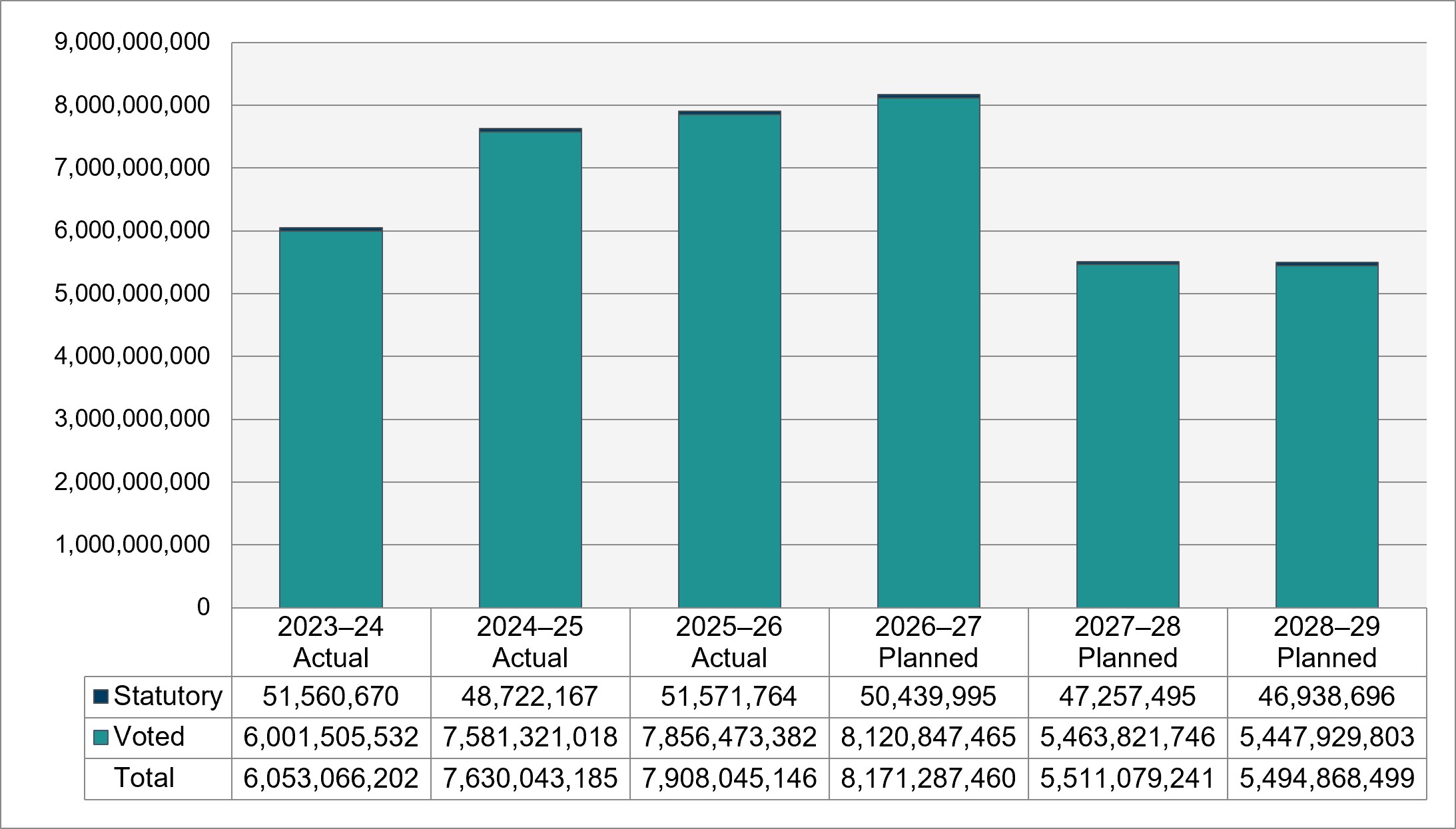
Text version of Graph 1 (dollars)
| Fiscal year | Statutory | Voted | Total |
|---|---|---|---|
| 2023–24 Actual | 51,560,670 | 6,001,505,532 | 6,053,066,202 |
| 2024–25 Actual | 48,722,167 | 7,581,321,018 | 7,630,043,185 |
| 2025–26 Actual | 51,571,764 | 7,856,473,382 | 7,908,045,146 |
| 2026–27 Planned | 50,439,995 | 8,120,847,465 | 8,171,287,460 |
| 2027–28 Planned | 47,257,495 | 5,463,821,746 | 5,511,079,241 |
| 2028–29 Planned | 46,938,696 | 5,447,929,803 | 5,494,868,499 |
Consult the Public Accounts of Canada for further information on our departmental voted and statutory expenditures.
Financial statement highlights
This section presents our Financial statements (Unaudited) for the year ended 31 March 2026
Table 19 summarizes the expenses and revenues for 2025–26, which net to the cost of operations before government funding and transfers.
| Financial information | 2025–26 actual results | 2025–26 planned results | Difference (actual results minus planned) |
|---|---|---|---|
| Total expenses | 7,708,047,418 | 7,559,236,499 | 148,810,919 |
| Total revenues | 38,732 | 0 | 38,732 |
| Net cost of operations before government funding and transfers | 7,708,008,686 | 7,559,236,499 | 148,772,187 |
Analysis of expenses and revenues for 2025–26
In 2025–26, we spent about $149 million more than planned, as demand for our programs and services was higher than expected. Because these programs respond to the needs of Veterans and their families, spending increases when more people turn to us for support.
The 2025–26 planned results information is provided in our Future-Oriented Statement of Operations and Notes 2025–26.
Table 20 summarizes actual expenses and revenues and shows the net cost of operations before government funding and transfers.
| Financial information | 2025–26 actual results | 2024–25 actual results | Difference (2025–26 minus 2024–25) |
|---|---|---|---|
| Total expenses | 7,708,047,418 | 7,208,774,294 | 499,273,124 |
| Total revenues | 38,732 | 60,574 | (21,842) |
| Net cost of operations before government funding and transfers | 7,708,008,686 | 7,208,713,720 | 499,294,966 |
Analysis of differences in expenses and revenues between 2024–25 and 2025–26
Compared to the previous year, our total departmental expenses increased by about $499 million. This rise reflects continued growth in demand for benefits and services throughout the year, with more Veterans and their families accessing support.
Table 21 provides a brief snapshot of the amounts we owe or must spend (liabilities) and our available resources (assets), which helps to indicate our ability to carry out programs and services.
| Financial information | Actual fiscal year (2025–26) | Previous fiscal year (2024–25) | Difference (2025–26 minus 2024–25) |
|---|---|---|---|
| Total net liabilities | 506,018,554 | 682,748,811 | (176,730,257) |
| Total net financial assets | 158,002,882 | 214,475,011 | (56,472,129) |
| Departmental net debt | 348,015,672 | 468,273,800 | (120,258,128) |
| Total non-financial assets | 16,530,822 | 13,634,712 | 2,896,110 |
| Departmental net financial position | (331,484,850) | (454,639,088) | 123,154,238 |
Analysis of our liabilities and assets since last fiscal year
We reduced total net liabilities by $177 million in 2025–26 compared to 2024–25, as we paid the liability set aside to settle a litigation claim. We also saw a $56 million decrease in total net financial assets, due to a lower amount due from the Consolidated Revenue Fund. As a result, our departmental net debt decreased by $120 million. At the same time, we increased total non-financial assets by $3 million, mainly due to the construction of tangible capital assets.
Human resources
This section presents an overview of our actual and planned human resources from 2023–24 to 2028–29.
Table 22 shows a summary in full-time equivalents of human resources for our core responsibilities and for our internal services for the previous three fiscal years.
| Core responsibilities and internal services | 2023–24 actual full-time equivalents | 2024–25 actual full-time equivalents | 2025–26 actual full-time equivalents |
|---|---|---|---|
| Benefits, Services and Support | 2,675.6 | 2,744.3 | 2,663.5 |
| Commemoration | 84.0 | 87.2 | 79.9 |
| Veterans Ombudsperson | 33.3 | 33.3 | 35.8 |
| Subtotal | 2,792.9 | 2,864.8 | 2,779.2 |
| Internal services | 880.8 | 906.0 | 868.1 |
| Total | 3,673.7 | 3,770.8 | 3,647.3 |
Analysis of human resources over the last three years
In 2025–26, we continued to prioritize Service Excellence initiatives and worked to reduce processing times for disability applications, enhancing services for Veterans and their families. Additionally, VAC focused on sustaining frontline staffing levels, including maintaining the Case Manager-to-Veteran ratio.
Between 2024–25 and 2025–26, our workforce decreased by 123 full-time equivalents (FTE). Much of this decrease was due to the decrease and completion of work related to major litigation files, including the Manuge and Logan cases, and the end of associated temporary salary funding.
We also reduced staffing through normal employee departures as part of government-wide spending reduction measures. Together, these factors contributed to the year-over-year decrease in FTEs.
Table 23 shows the planned full-time equivalents for each of our core responsibilities and for our internal services for the next three years. Human resources for the current fiscal year are forecast based on year to date.
| Core responsibilities and internal services | 2026–27 planned full-time equivalents | 2027–28 planned full-time equivalents | 2028–29 planned full-time equivalents |
|---|---|---|---|
| Benefits, Services and Support | 2,318.4 | 2,105.4 | 2,085.2 |
| Commemoration | 89.1 | 88.1 | 88.1 |
| Veterans Ombudsperson | 39.0 | 39.0 | 39.0 |
| Subtotal | 2,446.5 | 2,232.5 | 2,212.3 |
| Internal services | 794.6 | 765.6 | 757.1 |
| Total | 3,241.1 | 2,998.1 | 2,969.4 |
Analysis of human resources over the next three years
In 2026–27, we will continue to support our priorities using permanent Service Modernization funding announced in Budget 2025 to sustain the on-going employment of trained and experienced personnel across the organization. This funding helps us maintain service delivery and workforce capacity.
Temporary Case Management Renewal funding is scheduled to end in 2026–27 and is the main reason for the projected decrease in our Department's resources.
Before this funding ends, we will continue to review our long-term staffing and resource needs to support ongoing improvements in services for Veterans and their families.
Supplementary information tables
The following supplementary information tables are available on our website:
Federal tax expenditures
The tax system can be used to achieve public policy objectives through the application of special measures such as low tax rates, exemptions, deductions, deferrals and credits. The Department of Finance Canada publishes cost estimates and projections for these measures each year in the Report on Federal Tax Expenditures. This report also provides detailed background information on tax expenditures, including descriptions, objectives, historical information and references to related federal spending programs as well as evaluations and GBA Plus of tax expenditures.
Corporate information
Departmental profile
Appropriate minister:
The Honourable Jill McKnight, PC, MP
Institutional head:
Nancy Gardiner, Deputy Minister
Ministerial portfolio:
Veterans Affairs
Enabling instruments:
Department of Veterans Affairs Act; Veterans Well-being Act; Pension Act
For more information on these and other related acts and regulations, please refer to our Legislation page.
Year of incorporation or commencement:
1923
Departmental contact information
Veterans Affairs Canada
P.O. Box 7700
Charlottetown, PE
C1A 8M9
Telephone:
1-866-522-2122
TTY:
1-833-921-0071
Email:
information@veterans.gc.caPlease do not e-mail personal or confidential information.
Website:
Veterans Ombud
P.O. Box 66
Charlottetown, PE
C1A 7K2
Telephone:
1-877-330-4343
TTY:
1-833-978-1639
Email:
info@ombudsman-veterans.gc.caFor the purposes of the minimum 5% target, Indigenous Services Canada defines “Indigenous businesses” as: businesses owned and operated by Elders, band and tribal councils; businesses registered in the Government of Canada’s Indigenous Business Directory; or, registered on a modern treaty beneficiary business list.
Website:
Definitions
List of terms
appropriation (crédit)
Any authority of Parliament to pay money out of the Consolidated Revenue Fund.
budgetary expenditures (dépenses budgétaires)
Operating and capital expenditures; transfer payments to other levels of government, departments or individuals; and payments to Crown corporations.
core responsibility (responsabilité essentielle)
An enduring function or role of a department. The departmental results listed for a core responsibility reflect the outcomes that the department seeks to influence or achieve.
Departmental Plan (plan ministériel)
A report that outlines the anticipated activities and expected performance of an appropriated department over a three-year period. Departmental Plans are usually tabled in Parliament in spring.
departmental priority (priorité)
A plan, project or activity that a department focuses and reports on during a specific planning period. Priorities represent the most important things to be done or those to be addressed first to help achieve the desired departmental results.
departmental result (résultat ministériel)
A high-level outcome related to the core responsibilities of a department.
departmental result indicator (indicateur de résultat ministériel)
A quantitative or qualitative measure that assesses progress toward a departmental result.
departmental results framework (cadre ministériel des résultats)
A framework that connects the department’s core responsibilities to its departmental results and departmental result indicators.
Departmental Results Report (rapport sur les résultats ministériels)
A report outlining a department’s accomplishments against the plans, priorities and expected results set out in the corresponding Departmental Plan.
Full‑time equivalent (équivalent temps plein)
Measures the person years in a departmental budget. An employee’s scheduled hours per week divided by the employer’s hours for a full-time workweek calculates a full-time equivalent. For example, an employee who works 20 hours in a 40-hour standard workweek represents a 0.5 full-time equivalent.
Gender-based Analysis Plus (GBA Plus) (analyse comparative entre les sexes plus [ACS Plus])
An analytical tool that helps to understand the ways diverse individuals experience policies, programs and other initiatives. Applying GBA Plus to policies, programs and other initiatives helps to identify the different needs of the people affected, the ways to be more responsive and inclusive, and the methods to anticipate and mitigate potential barriers to accessing or benefitting from the initiative. GBA Plus goes beyond biological (sex) and socio-cultural (gender) differences to consider other factors, such as age, disability, education, ethnicity, economic status, geography (including rurality), language, race, religion, and sexual orientation.
government priorities (priorités pangouvernementales)
For the purpose of the 2025–26 Departmental Results Report, government priorities are the high-level themes outlining the government’s agenda as announced in the 2025 Speech from the Throne.
horizontal initiative (initiative horizontale)
A program, project or other initiative where two or more federal departments receive funding to work collaboratively on a shared outcome usually linked to a government priority, and where the ministers involved agree to designate it as horizontal. Specific reporting requirements apply, including that the lead department must report on combined expenditures and results.
Indigenous business (entreprise autochtones)
Requirements for verifying Indigenous businesses for the purposes of the departmental result report are available through the Indigenous Services Canada Mandatory minimum 5% Indigenous procurement target website.
non‑budgetary expenditures (dépenses non budgétaires)
Net outlays and receipts related to loans, investments and advances, which change the composition of the financial assets of the Government of Canada.
performance (rendement)
What a department did with its resources to achieve its results, how well those results compare to what the department intended to achieve, and how well lessons learned have been identified.
performance indicator (indicateur de rendement)
A qualitative or quantitative measure that assesses progress toward a departmental-level or program-level result, or the expected outputs or outcomes of a program, policy or initiative.
plan (plan)
The articulation of strategic choices, which provides information on how a department intends to achieve its priorities and associated results. Generally, a plan will explain the logic behind the strategies chosen and tend to focus on actions that lead to the expected result.
planned spending (dépenses prévues)
For Departmental Plans and Departmental Results Reports, planned spending refers to the amounts presented in Main Estimates. Departments must determine their planned spending and be able to defend the financial numbers presented in their Departmental Plans and Departmental Results Reports.
program (programme)
An Individual, group, or combination of services and activities managed together within a department and focused on a specific set of outputs, outcomes or service levels.
program inventory (répertoire des programmes)
A listing that identifies all the department’s programs and the resources that contribute to delivering on the department’s core responsibilities and achieving its results.
result (résultat)
An outcome or output related to the activities of a department, policy, program or initiative.
statutory expenditures (dépenses législatives)
Spending approved through legislation passed in Parliament, other than appropriation acts. The legislation sets out the purpose and the terms and conditions of the expenditures.
target (cible)
A quantitative or qualitative, measurable goal that a department, program or initiative plans to achieve within a specified time period.
voted expenditures (dépenses votées)
Spending approved annually through an appropriation act passed in Parliament. The vote also outlines the conditions that govern the spending.